

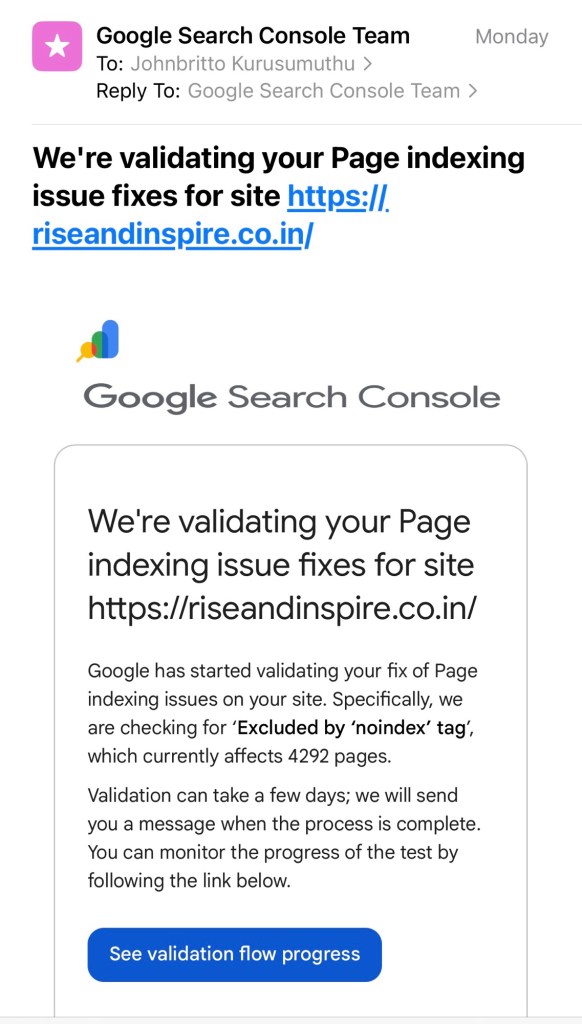
Last month, I watched my blog traffic drop 30% in a matter of days. No warning. No explanation. Just numbers falling off a cliff while I desperately searched for answers. Then I saw the notification from Google Search Console: “We’re validating your Page indexing issue fixes”—and 4,292 pages were in the queue. What followed was a masterclass in patience, SEO reality, and using setbacks strategically. If you’ve ever seen your traffic drop during a Google validation or wondered what really happens when Search Console says they’re “validating your fixes,” this is everything I wish someone had told me on day one.
My Google Search Console Validation Journey: What I Learned When Traffic Dropped
The Day Everything Changed
I still remember the morning I opened my Site Kit dashboard and felt my heart sink. The numbers that had been steadily climbing for months were suddenly… falling. Not a little dip—a real, noticeable drop in traffic. My first thought? Panic. My second thought? What did I do wrong?
Then I saw it: a notification from Google Search Console that stopped me mid-worry.
“We’re validating your Page indexing issue fixes for the site https://riseandinspire.co.in/”
And just like that, I found myself in the middle of what I now call “The Great Validation Journey”—a experience that taught me more about SEO, patience, and website management than months of reading articles ever could.
The Moment of Truth: Understanding What Was Happening
As a blogger, seeing your traffic drop feels personal. Each visitor represents someone who found value in your words, and watching those numbers decline felt like watching readers walk away. But here’s what I didn’t understand at first: “this wasn’t about my content failing. This was about Google doing its job.”
Let me explain what I learned.
When Google Search Console tells you they’re “validating your indexing issue fixes,” they’re essentially putting your website under a microscope. Imagine a quality inspector at a factory who needs to recheck every item after a manufacturing issue was fixed. They can’t just glance at things—they need to thoroughly examine each piece to ensure the problem is truly resolved.
That’s exactly what Google was doing with my 4,000 pages.
The Reality Check: 4,000 Pages and Counting
Four thousand pages. When I saw that number, I did the math blogger-style: “If Google checks 100 pages a day, that’s 40 days. If they check 50 pages a day, that’s 80 days. If they check…”
You get the picture. I was looking at anywhere from three weeks to two and a half months of validation time.
Two months felt like forever when I was watching my traffic metrics every single day.
Why Traffic Drops During Validation (And Why It’s Normal)
Here’s what I wish someone had told me on day one: “a traffic drop during Google’s validation process is not only normal—it’s expected.”
Think about it this way. When Google validates your fixes, they’re:
Re-crawling your pages with fresh eyes.They’re not just glancing at your site; they’re examining every page thoroughly to verify that the issues you fixed are actually fixed and staying fixed.
“Temporarily adjusting your visibility”. During this assessment period, Google may show your pages less frequently in search results. It’s like they’re saying, “Hold on, we need to make sure this is all good before we put you back in the spotlight.”
“Re-evaluating your rankings.”Some pages might temporarily drop in rankings or even be removed from the index while Google reassesses their quality and relevance. It’s not permanent—it’s procedural.
“Processing everything methodically.” Google doesn’t rush this process. They take their time because they want to get it right.
I learned to see this traffic drop not as a failure, but as a sign that Google was taking my site seriously enough to do a thorough job.

My Biggest Mistake (And How I Fixed It)
In my panic during those first few days of declining traffic, I almost made a crucial mistake: I nearly started making drastic changes to my site.
I wanted to redesign everything, change my permalink structure, delete underperforming posts, and basically overhaul my entire website. Thank goodness I paused and did more research first.
Here’s what I learned: “making major changes during validation can reset the entire process.” It’s like interrupting that quality inspector mid-examination and handing them a completely different product to check. You’ll just have to start over.
Instead, I adopted a “steady as she goes” approach and focused on meaningful, gradual improvements.
The Silver Lining: Using Validation Time Wisely
Once I accepted that the validation would take time, I asked myself an important question: “What can I do during this period that will actually help my site in the long run?”
That’s when I discovered the power of thoughtful, strategic updates.
My Content Audit Journey
I started looking through my old posts with fresh eyes, and I was honestly embarrassed by what I found. So many posts were missing basic SEO elements that I simply didn’t know about when I started blogging.
The Meta Description Mystery
I had published dozens of posts without meta descriptions. Back then, I didn’t even know what a meta description was, let alone why it mattered. Now I understand: meta descriptions are like movie trailers for your blog posts. They’re those short snippets that appear under your link in search results, and they can make the difference between someone clicking your link or scrolling past it.
I began adding compelling meta descriptions to my old posts—keeping them between 150-160 characters, including my target keywords naturally, and making each one unique and enticing.
The Tag Trouble
Some of my posts had no tags at all. Others had way too many. I learned that tags should be like signposts helping readers find related content—not a chaotic mess of every keyword you can think of.
I settled on a strategy: 3-7 relevant, specific tags per post. No more, no less.
The Category Confusion
This was perhaps my biggest organizational mistake. I had posts scattered across categories that didn’t make sense. Some posts were in multiple unrelated categories. Others weren’t categorized at all.
I spent time creating a logical category structure and assigning each post to 1-2 appropriate categories. It was tedious work, but I could immediately see how much cleaner and more navigable my site became.
My Update Strategy: Slow and Steady
Here’s the approach I developed for updating my old posts during the validation period:
I updated 5-10 posts per day. No more, no less. This pace looked natural to Google, gave me time to do quality work on each post, and made the task feel manageable rather than overwhelming.
“I focused on meaningful improvements.”I didn’t just add meta descriptions for the sake of it. I crafted descriptions that would genuinely make people want to click. I didn’t add tags randomly. I chose tags that would genuinely help readers find related content.
“I avoided URL changes.”Even though some of my old permalinks weren’t perfect, I left them alone. Changing URLs during validation would create new indexing issues—exactly what I was trying to avoid.
“I tracked everything.” With Site Kit enabled, I could monitor how my updates were affecting impressions, clicks, and any new indexing issues in real-time.
What I Learned About Google’s Validation Speed
Google typically validates between 50-200 pages per day, but this varies wildly based on several factors:
“Your site’s crawl budget” matters more than you’d think. Google assigns each website a certain amount of crawling resources based on factors like domain authority, site speed, and update frequency. Sites with higher authority get crawled more frequently and thoroughly.
“Server response times” play a crucial role. If your hosting is slow, Google’s crawlers will take longer to validate your pages. This was a wake-up call for me to optimize my site speed.
“Fresh content helps.” I noticed that on days when I published new posts, Google seemed to crawl my site more actively. Regular publishing kept the validation moving forward.
The Waiting Game: Managing Expectations
I’m now several weeks into this validation journey, and here’s what I’ve observed:
The validation doesn’t happen all at once. It’s gradual. Some days I’ll see 150 pages validated. Other days, only 50. There’s no predictable pattern, and that’s okay.
“Traffic doesn’t wait for validation to complete before recovering.” This was a huge relief to discover. As pages get validated and re-indexed, they start performing better. You don’t have to wait until all 4,000 pages are done to see improvement.
I’ve started seeing small upticks in traffic even though thousands of pages are still being validated. It’s encouraging and reminds me that progress is happening even when I can’t see the full picture yet.
What I’d Do Differently
Looking back at the beginning of this journey, here’s what I wish I’d known:
“I would have fixed my indexing issues sooner.”The validation wouldn’t be so overwhelming if I’d maintained better SEO hygiene from the start.
“I would have stayed calm.” Those first few days of panic were wasted energy. The traffic drop was temporary and expected.
“I would have used the time more strategically from day one.” Instead of worrying, I could have immediately started on those content improvements.
“I would have trusted the process.” Google’s validation system exists for a reason, and it works. Fighting it or trying to rush it only creates more problems.
Advice for Fellow Bloggers Facing Validation
If you’re reading this because you’re going through your own validation journey, here’s what I want you to know:
‘Breathe’. The traffic drop is normal. It’s temporary. It’s not a reflection of your content’s quality.
‘Be patient’. With thousands of pages to validate, expect 1-2 months for the full process. Use this time wisely.
‘Keep creating’. Don’t stop publishing new content. Regular updates actually help Google crawl your site more frequently.
‘Make thoughtful improvements’. This is the perfect time to add those missing meta descriptions, fix categories, and optimize tags—but do it gradually and carefully.
‘’Avoid drastic changes’. Don’t change URLs, don’t delete posts in bulk, and don’t completely overhaul your site structure during validation.
‘Monitor progress weekly, not daily’. Checking Search Console every day will drive you crazy. Once a week is plenty to track your validation progress.
‘Submit your sitemap.’ Make sure your XML sitemap is up to date and submitted in Search Console. This helps Google crawl your site more efficiently.
‘Trust the timeline.’Your traffic will recover. In many cases, it will come back stronger than before because you’ll have fixed the underlying issues.
The Bigger Picture: What This Experience Taught Me
This validation journey has been humbling and educational in equal measure.
It taught me that ‘SEO isn’t a one-time task’—it’s ongoing maintenance. Those meta descriptions, tags, and categories I neglected? They matter. They always mattered. I just didn’t know it yet.
It showed me the importance of ‘doing things right from the start’. If I’d learned proper SEO practices before launching my blog, I wouldn’t be fixing thousands of pages now.
It reminded me that ‘patience is a crucial blogging skill’. We live in an instant-gratification world, but SEO works on Google’s timeline, not ours.
Most importantly, it reinforced that ‘setbacks are often setups for comebacks’. This traffic drop forced me to improve my site in ways I’d been putting off. When the validation completes and traffic recovers, my site will be stronger, better optimized, and more valuable to readers than it was before.
Where I Am Now
As I write this, I’m still in the middle of validation. Thousands of pages remain to be checked. My traffic is still below where it was, though I’m seeing encouraging signs of recovery.
Explore more at the Rise & Inspire archive | Personal Development
But here’s the thing: I’m not panicking anymore. I’m not checking my analytics obsessively. I’m not making desperate changes hoping for quick fixes.
Instead, I’m doing the work. I’m updating those old posts thoughtfully. I’m publishing new content consistently. I’m improving my site’s foundation piece by piece.
And I’m trusting that when Google finishes its validation—whether that’s in three weeks or three months—my site will emerge better than before.

A Message to You
If you’re a fellow blogger going through this same validation process, know that you’re not alone. That traffic drop you’re seeing? I’m seeing it too. Those weeks of waiting? I’m waiting too.
But we’re not just waiting passively. We’re using this time to become better bloggers, to understand SEO more deeply, and to build stronger foundations for our sites.
The validation will end. The traffic will recover. And we’ll be better prepared for whatever comes next.
Keep writing. Keep improving. Keep believing in your content.
The validation journey isn’t easy, but it’s taking us exactly where we need to go.
Have you experienced a Google Search Console validation? I’d love to hear your story in the comments below. Let’s learn from each other’s experiences and support one another through this journey.
Archives: Astrology & Numerology | Daily Prompts | Law | Motivational Blogs | Motivational Quotes | Personal Development | Tech Insights | Wake-Up Calls
Visit Rise&Inspire to explore more on faith, law, technology, and the pursuit of purposeful living.
© 2025 Rise & Inspire. Follow our journey of reflection, renewal, and relevance.
Website: Home | Blog | About Us | Contact| Resources
Word Count:2232
Discover more from Rise & Inspire
Subscribe to get the latest posts sent to your email.

Hi, I have the same issue. So I have often edited tags and old blogs.
What I want to fix now is the format for ads. Sometimes auto ads cover my content.
To avoid it, I have posted short blogs and photos. I am not an engineer. I don’t know how to fix it…
Anyway, 4000 is a lot of pages! I have to post more!😅
Thank you so much for sharing your experience! It’s comforting to know I’m not alone in this validation journey.
I completely understand your frustration with auto ads covering content—that’s such a common struggle for non-technical bloggers like us! Here are a few things that have helped me with ad placement without needing coding skills:
“For Auto Ads”: In your AdSense dashboard, try adjusting the ad load settings (reduce it slightly) and turn off specific ad formats that tend to be intrusive, like anchor ads or vignette ads if they’re disrupting the reading experience.
“Quick fixes you can try:”
– Use spacing/padding between paragraphs to give ads natural placement spots
– Add more subheadings—ads often anchor to these and create better visual breaks
– Consider switching some auto ads to manual ad placements in strategic spots where they won’t cover text
You mentioned posting short blogs with photos to work around the ad issue—that’s creative thinking! But don’t let ads dictate your content length. Your readers came for your valuable insights, not shorter posts. Quality content will always win in the long run.
And yes, 4,000 pages still amazes me too! But honestly, it’s not about the quantity—it’s about consistent, meaningful content. Your focus on improving your existing posts while adding new ones is exactly the right approach.
How long has your validation been running? I’m curious to hear how your traffic is holding up during the process!
Keep going—we’ve got this! 💪
Thank you for your advice.🙏 I will work on my website this weekend.
I created my website in July of 2023. I applied for Google Ads in October and was approved in December. Before I started blogging, I was a freelance content writer (as a side job). I wrote many articles for other websites (mostly for Japanese travel websites). So writing is no problem, but I don’t have technical skills. I want to learn coding and programming skills.😅
I received the report for September (monthly reports). 719 pages were indexed, but still many pages are not indexed. The traffic has not changed much, but I need to fix some.
I plan to blog for 10 years. Like you said, consistently writing is important. I hope to improve my technical skills while blogging.😊
That’s wonderful to hear — I love your long-term vision and dedication to learning! 😊 It’s amazing that you already have a solid writing background from your freelance work; that skill gives you such a strong foundation as a blogger. Technical skills can always be learned gradually, and you’re already doing the right thing by being curious and proactive.
I completely understand what you mean about ads. Though I have enabled Site Kit, which combines Google Search Console, Google Analytics, and PageSpeed Insights, I haven’t enabled AdSense yet. When I initially tried WordPress Ads, several readers mentioned issues with unsolicited or poorly placed ads interrupting the reading flow — especially since one of my main categories is “Wake-Up Calls,” where I share daily reflections on Bible verses. I wanted to keep those posts free from distractions and preserve a calm, meaningful reading experience.
It sounds like your site is progressing beautifully — 719 indexed pages is great progress! Don’t worry about the rest; indexing often takes time, especially for newer sites. The consistency you’re showing now will absolutely pay off over the next 10 years.
Keep writing, keep experimenting, and keep learning bit by bit — you’re building something lasting and purposeful. 🌱
I’m excited to see how your blogging and technical journey unfolds!