

The world has a way of dismissing quiet faithfulness. It applauds the loud and rewards the visible. But the God of Wisdom keeps a different ledger. Every hidden act of integrity, every prayer offered in exhaustion, every service rendered without fanfare — all of it is recorded. And Wisdom 5:1 is the receipt.
Oppression does not always arrive with a raised fist. Sometimes it comes with a shrug. A smirk. A voice that says your labour means nothing and your faith is a private eccentricity. Wisdom 5:1 knows that particular wound intimately. And it speaks directly into it with a word that does not flinch.
You may not be able to silence the critics. You may not be able to make the indifferent care or compel the contemptuous to reconsider. But you do not have to. Wisdom 5:1 reveals that God has reserved for Himself the right to be your advocate — and His timing is not delayed. It is exact.
Reflection on Wisdom 5:1
Rise & Inspire
Wake-Up Calls 2026 | Reflection #91 of 2026 | 2nd April 2026
They Shall Stand With Confidence
A Wake-Up Call for Those Who Have Endured in Silence
Verse for Today — Watch the Daily Verse (Video)
(Shared by His Excellency, Rt. Rev. Dr. Selvister Ponnumuthan)
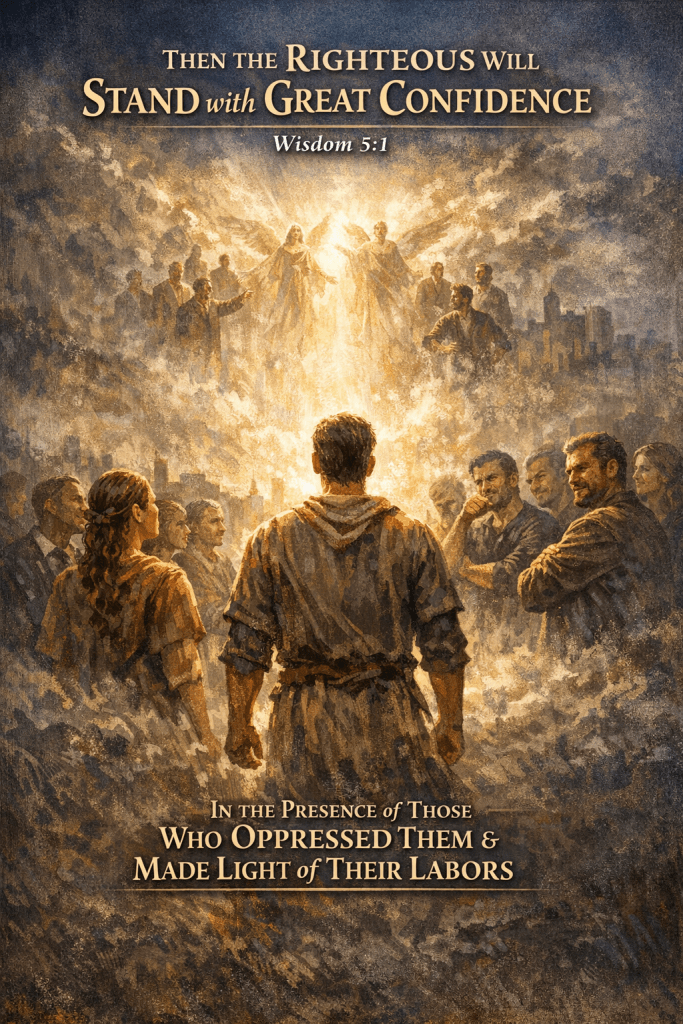
“Then the righteous will stand with great confidence in the presence of those who have oppressed them and those who make light of their labors.”
— Wisdom 5:1
1. The Silence That Preceded the Standing
Before the righteous stand in glory, the Book of Wisdom tells us, they were mocked. They were dismissed. Their labours were treated as foolishness. In Wisdom 4:18–19, the ungodly looked upon the righteous man’s end and sneered, seeing nothing but defeat. But chapter five opens with a dramatic reversal. The tables are not merely turned — they are overturned by the hand of God Himself.
This is not a scene from human imagination. It is a scene from eternity. And if you are someone who has laboured faithfully, prayed persistently, and served quietly — only to be ignored, belittled, or overlooked — this verse is written for you.
2. What It Means to “Stand With Great Confidence”
The Greek text of Wisdom uses the word parresia — a bold, open, unhesitating confidence. This is not arrogance. It is the confidence of a clear conscience before God. It is the quiet dignity of someone whose life, though hard and misunderstood, was lived in faithfulness.
Notice the precision of the verse: they stand not merely in the presence of God, but in the presence of those who oppressed them. This is deeply pastoral. God does not remove His faithful ones to some distant corner of heaven to spare them the discomfort of memory. Instead, He vindicates them openly. The very people who dismissed your labour, who questioned your integrity, who mocked your devotion — they will see.
This is not vengeance. This is truth. When all pretence is stripped away and God’s justice shines in full, every hidden act of faithfulness becomes visible. Every tear offered in prayer is accounted for. Every act of service rendered without applause is honoured in full.
3. The Two Faces of Opposition
The verse identifies two types of adversaries: those who oppressed and those who made light of their labours. This is a remarkably accurate portrait of human experience.
Some people in your life have actively worked against you — creating obstacles, spreading doubt, undermining your work, or treating your convictions as a nuisance. These are the oppressors.
Others have been subtler. They did not oppose you directly. They simply dismissed you with a shrug or a smirk. They made light of what you poured your soul into — your prayer life, your integrity, your faithful service, your quiet witness. Their weapon was not hostility but contempt.
Both are named here. And God’s vindication addresses both. The righteous shall stand before them all.
4. A Word to the Weary
If you are reading this today in a state of exhaustion — tired of doing what is right when it seems to bring no visible reward, discouraged by indifference, or quietly wounded by dismissal — hear the word of Wisdom 5:1 as God’s personal word to you.
Your labour is not invisible. Your faithfulness is not forgotten. The One who sees in secret rewards openly (Matthew 6:4), and the day of standing is coming.
Saint Paul carried this same assurance when he wrote from prison: “I have fought the good fight, I have finished the race, I have kept the faith. Now there is in store for me the crown of righteousness” (2 Timothy 4:7–8). He did not write those words from a place of comfort. He wrote them from the same place you may be standing right now — overlooked, confined, and yet undefeated.
5. The Cross Makes This Promise Credible
No one has stood more fully in the pattern of Wisdom 5:1 than Jesus Christ. He was mocked, dismissed, stripped of every earthly dignity, and nailed to a cross while those around Him made light of His claims and His labours. Yet on the third day, He rose. He stands now at the right hand of the Father in perfect parresia — in eternal, unshakeable confidence.
The Resurrection is the prototype of every vindication promised to the righteous. Easter, which we now approach in this Holy Week season, is not merely a historical event. It is the charter of hope for every person who has suffered faithfully. If God raised the crucified Christ, He can and will vindicate you.
6. Live in the Light of That Standing
Let this verse reshape how you carry yourself today. You do not need the validation of those who have dismissed you. You do not need to defend yourself to every critic or justify yourself before every sceptic. God is your vindicator, and His timing is perfect.
This does not mean passivity. It means faithfulness — continuing to do what is right, to love what is good, and to trust the One who sees all. Stand tall in your calling. Serve with generosity. Pray without ceasing. The moment of great confidence is coming, and it will not be borrowed from anyone else. It will be the fruit of a life lived before God.
A Prayer for This Day
Gracious God, there are days when faithfulness feels unrewarded and when the labour of doing good seems to disappear into silence. On those days, let the promise of Wisdom 5:1 rise within us like a flame. Remind us that You see every hidden act of love, every sacrifice made in Your name, and every labour performed in integrity. Give us the courage to stand — not in pride, but in the quiet confidence of those who have kept faith with You. May we live today in the light of eternity. Amen.
Questions for Personal Reflection
1. Where in your life have you been faithful in ways that have gone unnoticed or dismissed?
Bring that specific area before God today and ask Him to renew your sense of purpose in it.
2. Is there someone whose contempt or dismissal has silently discouraged you?
Consider whether you have been seeking their vindication more than God’s. Surrender that need to Him.
3. How does the Resurrection of Christ speak to you personally this Holy Week?
Let it be more than doctrine — let it be the ground of your confidence today.
Rise and Inspire — because the righteous shall stand.
For those who wish to go deeper today:
If the morning reflection on Wisdom 5:1 stirred something in you — that quiet promise of vindication for unnoticed faithfulness — this Scholarly Companion explores the single Greek word at its heart: parrēsia (παρρησία).
Tracing its roots in classical Athenian democracy, its rich theology across the New Testament, and its practical power in prayer and witness, this companion shows how the same bold confidence the righteous will one day display before their oppressors is already available to us now through Christ and the Holy Spirit.
Read the reflection first for the heart. Then linger here for the roots and the road ahead. May both strengthen your steps in this Holy Week season.

Scholarly Companion | Wake-Up Call #91
2nd April 2026
Parresia
παρρησία — parrēsia
Bold Confidence Before God and People
Companion to the Pastoral Reflection on Wisdom 5:1
“Then the righteous will stand with great confidence in the presence of those who have oppressed them”
Connecting Bridge: From the Morning Reflection to This Study
This morning’s Wake-Up Call rested its entire pastoral weight on a single Greek word. When the Book of Wisdom promises that the righteous will stand with great confidence before their oppressors, the word behind that promise is parresia — and it is not a word the sacred author borrowed casually. It is a word with a long, rich, and layered history: first in the democratic assemblies of classical Athens, then across thirty-one carefully placed occurrences in the New Testament, and finally here in Wisdom 5:1 as the defining posture of the vindicated faithful on the last day.
Understanding parresia does more than enrich a Bible study. It changes how you pray, how you witness, how you endure dismissal, and how you carry yourself on the days when faithfulness feels invisible. This companion study traces the word from its Greek roots through its New Testament theology and into its living application in the prayer life and the evangelising mission of the Christian today.
It is offered in the spirit of the reflection itself: not as an academic exercise, but as an act of service to those who want to go deeper — and who believe that the deeper you go into the Word, the more solid the ground beneath your feet becomes.
Part I — Etymology and Core Meaning
Parresia (παρρησία) appears exactly 31 times as a noun in the New Testament (Strong’s G3954). The word is built from two Greek roots: πᾶς (pas — “all”) and a form of ῥέω (rheō — “to speak / to flow”). Taken literally, the compound means “all-out-spokenness” — a complete, unfiltered, unreserved release of speech.
In classical Greek usage the word carried two interlocking senses that the New Testament inherits and deepens: frank, open, unambiguous speech without concealment or euphemism, and fearless courage in the act of that speaking — cheerful, unhesitating assurance before authority, whether human or divine.
Thayer’s Greek Lexicon defines it as: “freedom in speaking, unreservedness in speech … free and fearless confidence, cheerful courage, boldness, assurance.” This double sense—transparency of speech and courage of bearing—runs through every NT occurrence and culminates in Wisdom 5:1’s image of the righteous standing in open, unashamed vindication.
Part II — Parresia in Classical Athenian Democracy
Before parresia entered the vocabulary of faith, it was the heartbeat of Athenian democracy. In the 5th and 4th centuries BCE, it named a practice and an ethic that defined what it meant to be a free citizen: the courageous duty to say everything that needed saying, for truth and the common good, even when dangerous.
A. Etymology and Earliest Appearances
The word surfaces first in the tragedies of Euripides (c. 484–407 BCE)—in plays such as Hippolytus, Andromache, and Suppliants. In these works characters contrast the freedom of frank speech in Athens with the enforced silence of exile or tyranny. One celebrated line captures the contrast with stark clarity: “What chiefly galls an exile’s heart? The worst is this: right of free speech does not exist. That’s a slave’s life — to be forbidden to speak one’s mind.”¹ Parresia, in other words, was a marker of freedom versus slavery — not merely a political right but a lived practice that defined the free person.
B. Parresia in the Democratic Constitution
In classical Athens, parresia formed one pillar of the democratic constitution alongside demokratia (rule by the people), isegoria (equality of speech — the formal right of every male citizen to address the Assembly), and isonomia (equality before the law). The philosopher Michel Foucault, in his landmark lectures at the Collège de France and at Berkeley (1982–84), described how these elements together enabled Athenian citizens to speak openly in the Ecclesia on the Pnyx hill. Diverse, uncomfortable, even critical views were celebrated as essential to good decision-making: hearing everything strengthened the polis.
It was not, however, a formal constitutional right in the modern sense. It was more precisely a cultural expectation and democratic ethos — the mutual agreement of citizens to grant one another space for frank speech. The sovereign demos could still punish speech it disliked. Excessive abuse could shade into kakegoria (bad speech) or into the territory of insolence. The tension between frankness and civility was negotiated constantly.
C. Parresia versus Isegoria: A Critical Distinction
Athenians actually operated with two concepts that modern translations loosely render as “free speech”, and the distinction matters for understanding the NT usage.
• Isegoria: the institutionalised right to participate equally in formal assemblies. It was procedural and tied to democratic institutions.
• Parresia: the licence and courage to say anything frankly, holding nothing back, often in informal or risky contexts. It emphasised boldness, sincerity, and truth-telling over polished rhetoric or majority-pleasing flattery.
Parresia was riskier and more personal. It required courage — and courage was considered proof of sincerity. It thrived especially in theatre (the Old Comedy of Aristophanes regularly targeted leaders and social norms), in private philosophical conversation, and in the teaching relationships of Socrates and the Cynics.
D. Socrates: The Embodiment of Parresia
Socrates embodied parresia through his relentless questioning and plain speech, even when it led to his trial and death. He understood it as a moral duty — not a rhetorical device. Later, in Hellenistic and Roman periods, the concept shifted from a primarily political-institutional value toward a personal ethical attitude, particularly in Stoic and Cynic philosophy. In both periods, it remained tied to the open life of the free person: no fear of speaking one’s mind, in contrast to life under tyranny, exile, or shame.
E. Positive and Negative Faces
Parresia carried both a celebrated and a cautionary dimension in ancient literature.
• Positive: Truth-telling for the good of the city; a levelling force that rejected hierarchy; a sign of healthy democracy and personal virtue (Aristotle’s “great-souled man” is a frank speaker).
• Critical: Some writers, notably Isocrates in the 4th century BCE, lamented that democracy had degenerated into licence, where parresia became shameless flattery of the mob or unrestrained speech by the unworthy. Plato worried it could fuel demagoguery.
This tension between courage and recklessness, between truth-telling and insolence, is precisely the tension the New Testament resolves by grounding parresia not in democratic virtue but in the finished work of Christ and the gift of the Holy Spirit.
Part III — Parresia in the New Testament: A Threefold Taxonomy
The 31 NT occurrences of parresia cluster into three clear and theologically progressive categories. Each builds upon the last, and together they form a complete account of what boldness before God and people looks like for the follower of Christ.
Category 1: Jesus Speaks Openly and Plainly (Gospels — 10 occurrences)
In the Gospels, parresia frequently contrasts with speaking in secret or in parables and figures of speech. Jesus models the word at the level of transparent, courageous communication.
• Mark 8:32: Jesus plainly predicts His suffering for the first time after Peter’s confession — no softening, no symbolic language, full clarity.
• John 7:4, 13, 26; 10:24; 11:14, 54; 16:25, 29; 18:20: Jesus’ brothers urge Him to act “openly” before the world; the crowd notes He speaks “boldly”; the Jews demand He tell them “plainly” if He is the Christ; He tells the disciples “plainly” that Lazarus is dead; He promises a time of plain speech about the Father instead of figures; He declares before Pilate, “I have spoken openly to the world.”
Theological point: Jesus models parresia as the courageous willingness to say what must be said without concealment, even when it costs everything. His open speech is simultaneously a proclamation and a form of love — the love that does not protect itself by hiding the truth.
Category 2: Apostolic Boldness in Proclamation (Acts and Paul’s Letters — 13 occurrences)
This is the most dramatic and historically vivid use of parresia: the Holy Spirit-empowered courage to preach the gospel openly before hostile authorities, under threat, and even in chains.
• Acts 2:29: Peter addresses the crowd on Pentecost with frank freedom: “Let me speak freely to you about David.”
• Acts 4:13: The Sanhedrin — the highest legal authority in Judaism — marvels at the boldness of uneducated fishermen.
• Acts 4:29, 31: The early church prays specifically for boldness and is immediately filled with the Holy Spirit. They speak the word of God with boldness. The direct chain — prayer for parresia leading to empowered proclamation — is explicit.
• Acts 28:31: Paul, under house arrest in Rome, proclaims the kingdom “with all confidence, unhindered” — the final word of the book of Acts.
• Ephesians 6:19: Paul asks the Ephesians to pray for him so that he may open his mouth boldly to proclaim the mystery of the gospel.
• 2 Corinthians 3:12; 7:4; Philippians 1:20: Paul writes of his great plainness of speech, his boldness toward the Corinthians, and his confidence that Christ will be magnified with full parresia whether by life or death.
Theological point: Parresia in proclamation is not human bravado. It is a gift of the Holy Spirit that enables fearless witness precisely where it is most costly. It is the diametric opposite of fear and shame. It is also, critically, something the early church prayed for — treating it as a grace to be sought, not a personality trait to be admired.
Category 3: Confident Access to God (Ephesians, Hebrews, 1 John — 8 occurrences)
Here parresia makes its most profound shift: from speech addressed to people to a posture assumed before God. This is the same word used in Wisdom 5:1, and the connection is theologically exact.
• Ephesians 3:12: We have boldness and access with confidence by the faith of Christ — the two words boldness and access together describe an open, unhindered entry into the presence of God.
• Hebrews 3:6: We are God’s house if we hold fast the confidence firm to the end.
• Hebrews 4:16: We may come boldly to the throne of grace to receive mercy and find timely help.
• Hebrews 10:19: We have boldness to enter the holiest place by the blood of Jesus.
• Hebrews 10:35: We must not cast away our confidence, which has great reward.
• 1 John 2:28; 3:21; 4:17; 5:14: We may have confidence at Christ’s appearing, toward God in daily life, in the day of judgment, and in prayer.
Theological point: Because of Christ’s blood and our union with Him, we already possess — now, in this life — the same parresia that the righteous will display on the Day of Judgment in Wisdom 5:1. The bold standing before oppressors in eternity is a future realisation of the bold standing before God in prayer that is our present inheritance. The two moments are the same posture, in different dimensions of time.
Part IV — Summary Reference Table
The following table is designed as a quick reference for readers, preachers, and those engaged in personal study. It distils the three NT streams of parresia into their essential coordinates.
| Theme | Books | Key Idea | Example Verses |
| Open / Plain Speech | Mark, John | Clarity instead of concealment | Mk 8:32; Jn 10:24; 16:25 |
| Bold Proclamation | Acts, Paul | Fearless gospel witness | Acts 4:13, 29, 31; Eph 6:19 |
| Confident Access | Ephesians, Hebrews, 1 Jn | Bold approach to throne and judgment | Heb 4:16; 10:19; 1 Jn 4:17 |
Part V — Parresia in the Prayer Life
Parresia in prayer does not mean presumption. It means the confidence of a beloved child who knows they are heard — the humble boldness of someone who comes to God’s throne not because they deserve access but because the blood of Jesus has opened the way and the Spirit of adoption cries within them, “Abba, Father” (Galatians 4:6).
The Key Passages
Hebrews 4:16 is the magna carta of parresia in prayer: “Let us therefore come boldly (meta parresias)unto the throne of grace, that we may obtain mercy and find grace to help in time of need.” Because Jesus is our sympathetic High Priest who has been tested in every point as we are, we do not crawl into God’s presence in fear or hide behind formulas. We come openly, honestly, and urgently — speaking our real needs, struggles, doubts, and desires without concealment or flattery.
Hebrews 10:19–22 extends the image: we have boldness to enter the Most Holy Place by the blood of Jesus. The veil is torn. Access is not negotiated — it is given. This invites transparent prayer in all its registers: confession, petition, intercession, lament, and even the honest complaint of the Psalms — all of it rooted in Christ’s once-for-all sacrifice.
The Catechism of the Catholic Church draws this connection with particular beauty when it notes that parresia is the power of the Spirit that enables the believer to “dare to say” Our Father. The Lord’s Prayer is itself an act of parresia — addressing the Creator of the universe as “our Father” with the open familiarity of a child.
Practical Applications for the Prayer Life
✓ Pray honestly, not performatively. Bring your exhaustion, your wounds from dismissal, your doubts, and even your anger to God. He welcomes the unfiltered heart more than the polished petition.
✓ Pray with expectation. Come not as a distant servant but as a child whose Father is both capable and glad to help.
✓ Pray persistently and corporately. The early church prayed together for boldness and received it immediately. Parresia is often amplified in community.
✓ In moments of weariness or opposition, let parresia be a deliberate act of will: “Lord, I come boldly because of Jesus — hear me, help me, hold me.”
✓ Connect the two movements: the same confidence with which you approach God’s throne prepares you to stand before any human authority with the same uncollapsing steadiness.
Parresia in prayer is not presumption; it is relational trust. It is the purification of the soul through honest self-examination and the deepening of intimacy with God that comes from refusing to hide.
Part VI — Parresia in Evangelism and Witness
In evangelism and public witness, parresia is the Spirit-empowered courage to speak the truth plainly — without shame, without ambiguity, and without compromise — even when it risks rejection, opposition, or personal cost. It is, in the precise sense of its etymology, saying everything about Christ with frankness and love.
The Apostolic Pattern
The book of Acts provides the most dramatic and historically verifiable demonstrations of evangelistic parresia. Three moments deserve particular attention.
• Acts 4:13: The Sanhedrin — composed of the most educated legal and religious authorities in Judaism — could not account for the confidence of uneducated fishermen. Parresia, in other words, was not a function of education, social standing, or rhetorical training. It was a function of the Holy Spirit.
• Acts 4:29–31: After facing explicit threats from the Sanhedrin, the church gathered and prayed not for safety but for all boldness to continue speaking. God answered immediately: the place was shaken, they were filled with the Holy Spirit, and they spoke the word of God with boldness. The chain is explicit and instructive: prayer for parresia leads directly to empowered proclamation.
• Acts 28:31: The book of Acts ends with Paul proclaiming the kingdom in Rome with all confidence, unhindered. In a city that claimed to rule the world, the gospel was announced with parresia. It is the note on which Luke chooses to close his account.
What Parresia in Witness Is Not
✗ Aggressive rudeness or cultural insensitivity — parresia is truth spoken in love (Ephesians 4:15), not truth weaponised.
✗ Self-reliant bravado — it is explicitly a gift of the Spirit, sought in prayer, not manufactured by personality or willpower.
✗ A permanent personality trait of the naturally outgoing — even Paul, the most articulate theologian in the early church, asked others to pray for his parresia (Ephesians 6:19).
What Parresia in Witness Is
✓ Truth spoken in love, even when it hazards rejection — prophetic witness that chooses truth over safety, as the apostles did.
✓ Often accompanied by signs and reliance on God to confirm the message, not on the speaker’s skill or persuasiveness.
✓ Rooted in the resurrection: the confidence that the one being proclaimed is not dead but alive changes everything about how the witness speaks.
Practical Applications for Witness
✓ Speak openly and plainly about Jesus — His death, resurrection, lordship, and call to repentance — without diluting the gospel to make it more palatable.
✓ In contexts of indifference or subtle contempt — precisely the context described in Wisdom 5:1 — parresia frees you from needing human validation. Your confidence rests in God’s vindication, not in the audience’s approval.
✓ Pray specifically for parresia before conversations, meetings, or opportunities, as the early church did. Boldness frequently comes in answer to prayer rather than as a stable personality characteristic.
✓ Count the cost realistically but remain unsurprised by pushback. True parresia chooses truth over safety and does so with equanimity, not with performance.
✓ Live the integrity that makes the words credible. Quiet faithfulness — the kind celebrated in Wisdom 5:1 — is itself a form of witness, and it amplifies the impact of every spoken word.
Part VII — One Parresia, Two Directions
The most important structural insight of this study is that parresia before God in prayer and parresia before people in witness are not two separate things. They are a single spiritual posture expressed in two directions.
As one early Christian writer observes, “We exercise parresia in prayer and in evangelisation. Not two parresias, but one. Because we know how generous and trustworthy God is, we have the courage to speak His truth to others.” The link is seamless: boldness before God in the throne room fuels boldness before people in the public square. One flows from the other. You cannot sustain one without the other.
This is why the early church in Acts 4 did not separate their prayer meeting from their proclamation. When they prayed for parresia, the Holy Spirit filled them for witness. When they witnessed, they returned to prayer. The rhythm was not strategic — it was organic. It was the natural motion of a life lived in bold intimacy with God.
| The righteous who were mocked and dismissed in Wisdom 4 stand with great confidence in Wisdom 5:1 — not because they have finally found their voice in an earthly sense, but because their voice was formed in prayer, tested in witness, and vindicated by God. The parresia of eternity is the parresia of the prayer room and the marketplace, finally brought to full flower. |
Part VIII — Connecting Back to Wisdom 5:1 and Daily Faithfulness
The reflection you read this morning was built on a single promise: that the righteous will stand with great confidence before those who oppressed them and made light of their labours. We can now see the full theological depth of that promise.
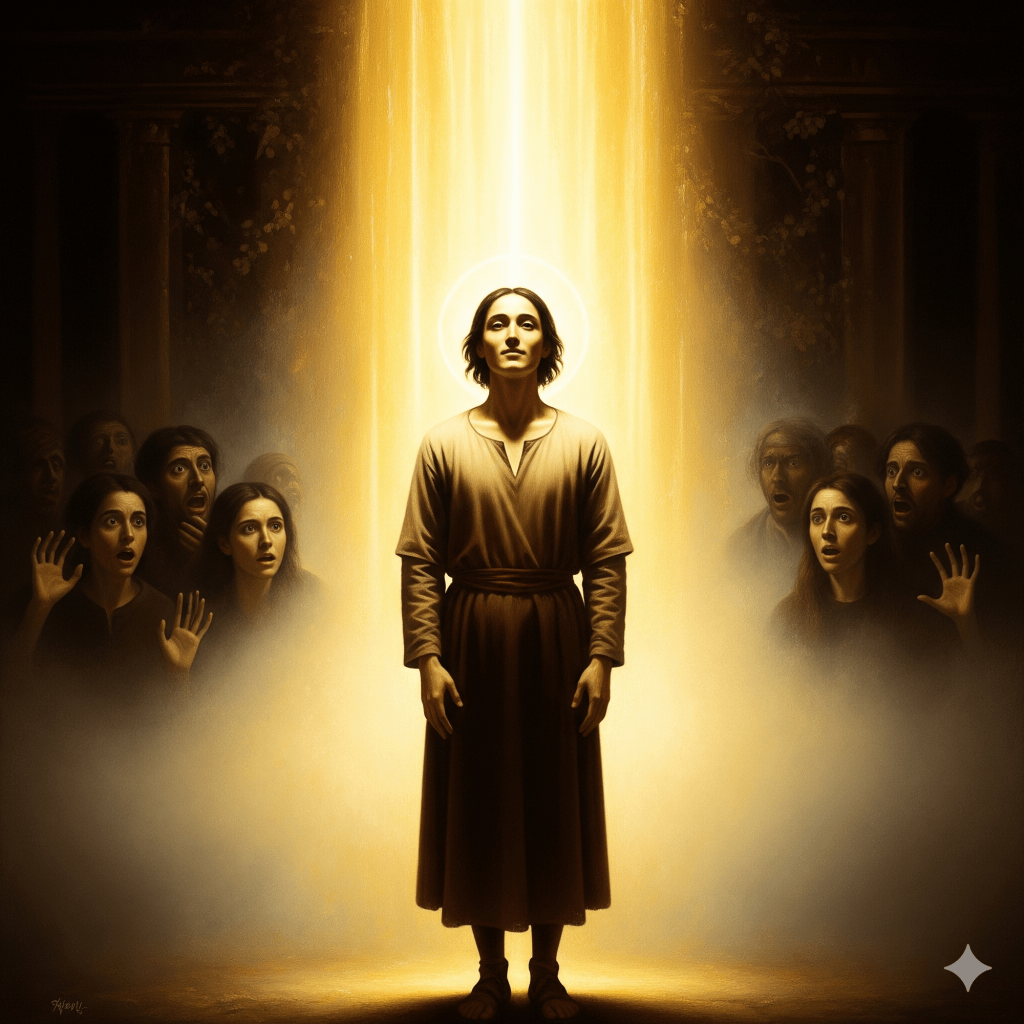
The great confidence of Wisdom 5:1 is parresia. It is the same posture with which Jesus spoke openly before Pilate, the same boldness with which Peter addressed the Sanhedrin, the same confidence with which the believer approaches the throne of grace, and the same assurance with which the righteous soul will stand on the last day. It is one word, one posture, one Spirit-given gift — present now in prayer, active now in witness, and destined for glorious completion in the final vindication.
Your hidden labours are not in vain. Your quiet integrity is not invisible. The same Spirit who empowers parresia sustains you through every season of dismissal and every day of unnoticed faithfulness. The standing of Wisdom 5:1 is not a distant compensation for a wasted life. It is the public culmination of a life lived in the parresia of prayer and witness — a life that was bold before God in the secret place and faithful before people in the open day.
That is the life you are called to live. Not someday. Today.
A Prayer to Cultivate Parresia
| Gracious Father, by the blood of Jesus and the power of Your Spirit, grant me parresia — bold confidence in prayer and fearless openness in speaking Your truth. Let me come to Your throne with the unhesitating trust of a beloved child, and let me go into the world with the apostolic courage of one who knows that vindication belongs to You. On the days when my labour feels invisible and my faithfulness unrewarded, let the promise of Wisdom 5:1 rise within me like a steady flame. I do not need to defend myself. I do not need the approval of those who dismiss me. I need only to stand — before You now in prayer, and before all in the day You have appointed. For Christ’s sake. Amen. |
Notes and Sources
The following sources inform this study. All biblical citations follow the King James Version unless otherwise indicated. Greek lexical references follow standard scholarly authorities.
1. Euripides, Phoenician Women and related tragedies, c. 5th century BCE. Quoted in classical parrhesia studies.
2. Michel Foucault, Fearless Speech, ed. Joseph Pearson (Semiotext(e), 2001). Transcripts of Foucault’s Berkeley lectures on parresia, 1983.
3. Joseph Henry Thayer, A Greek-English Lexicon of the New Testament (Harper, 1889), s.v. παρρησία, G3954.
4. Walter Bauer, Frederick W. Danker et al., A Greek-English Lexicon of the New Testament and Other Early Christian Literature, 3rd ed. (University of Chicago Press, 2000), s.v. παρρησία.
5. Mogens Herman Hansen, The Athenian Democracy in the Age of Demosthenes (Blackwell, 1991). On isegoria, parresia, and demokratia as constitutional pillars.
6. Catechism of the Catholic Church, 2nd ed. (Libreria Editrice Vaticana, 1997), §2777: on parresia and the Lord’s Prayer.
7. James Swanson, Dictionary of Biblical Languages with Semantic Domains: Greek (New Testament) (Logos Bible Software, 1997), GGK4244.
Category: Wake-Up Calls 2026 — Reflection #91 of 2026 | 1 April 2026
Rise & Inspire | Scholarly Companion Series | Wake-Up Call #91 | Wisdom 5:1 | 2 April 2026
Wake Up. Reflect. Inspire.
Copyright © 2026 Rise&Inspire
Website: Home | Blog | About Us | Contact| Resources
Word Count:5060
Discover more from Rise & Inspire
Subscribe to get the latest posts sent to your email.

This is deep and powerful … God sees every quiet act of faithfulness, every prayer whispered in exhaustion, and every service done without applause. Even when the world dismisses or mocks you, Wisdom 5:1 promises that your faithfulness is accounted for, and vindication will come.
🙇🤲👏🙏🎉