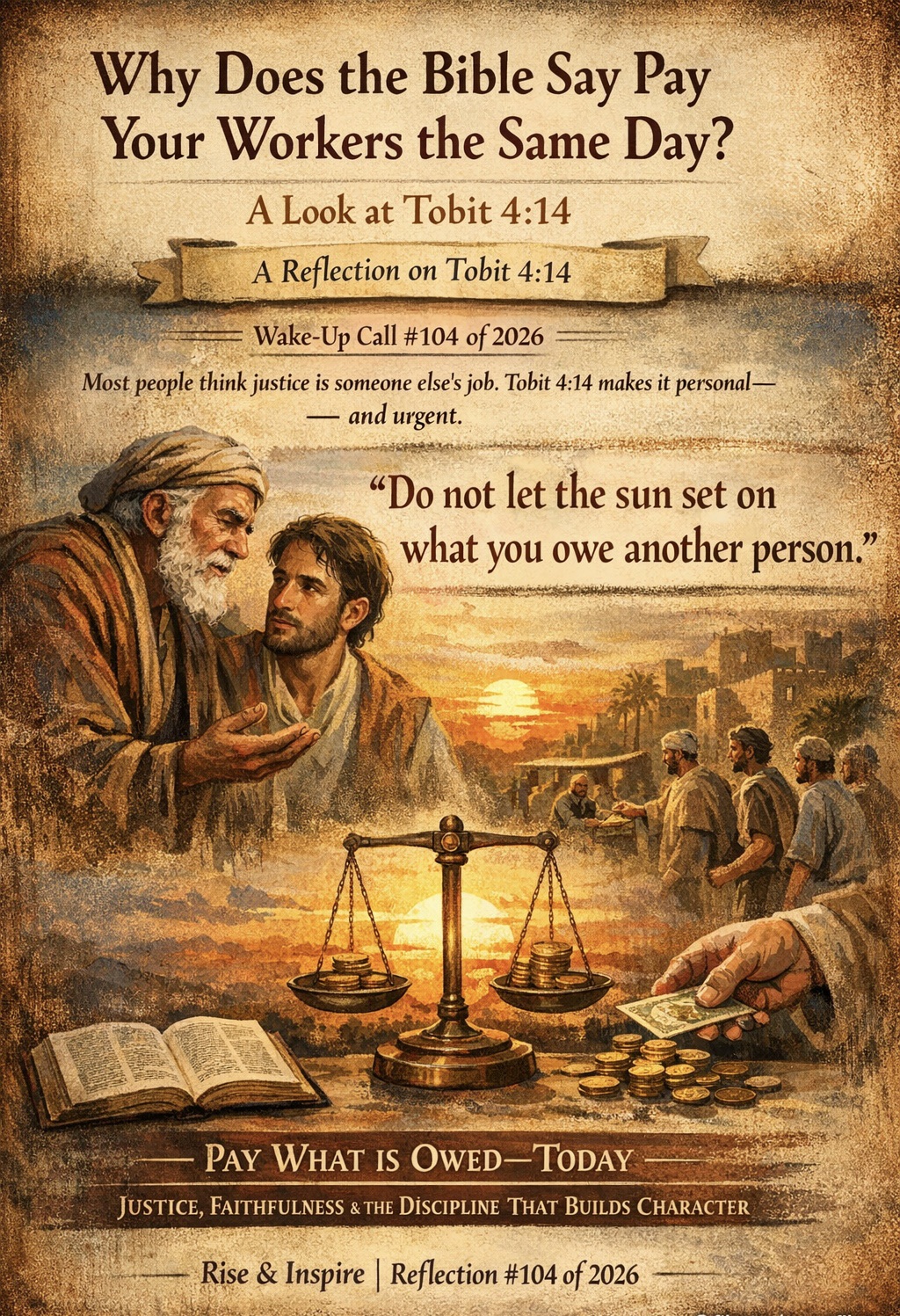
Why Does the Bible Say Pay Your Workers the Same Day? A Look at Tobit 4:14

A Reflection on Tobit 4:14 

Wake-Up Call #104 of 2026. 

Most people think justice is someone else’s job. Tobit 4:14 makes it personal — and urgent. A dying father’s final counsel to his son is not about grand theology but about one plain, daily act: do not let the sun set on what you owe another person. This reflection explores why that instruction is still the most radical thing you can do today.

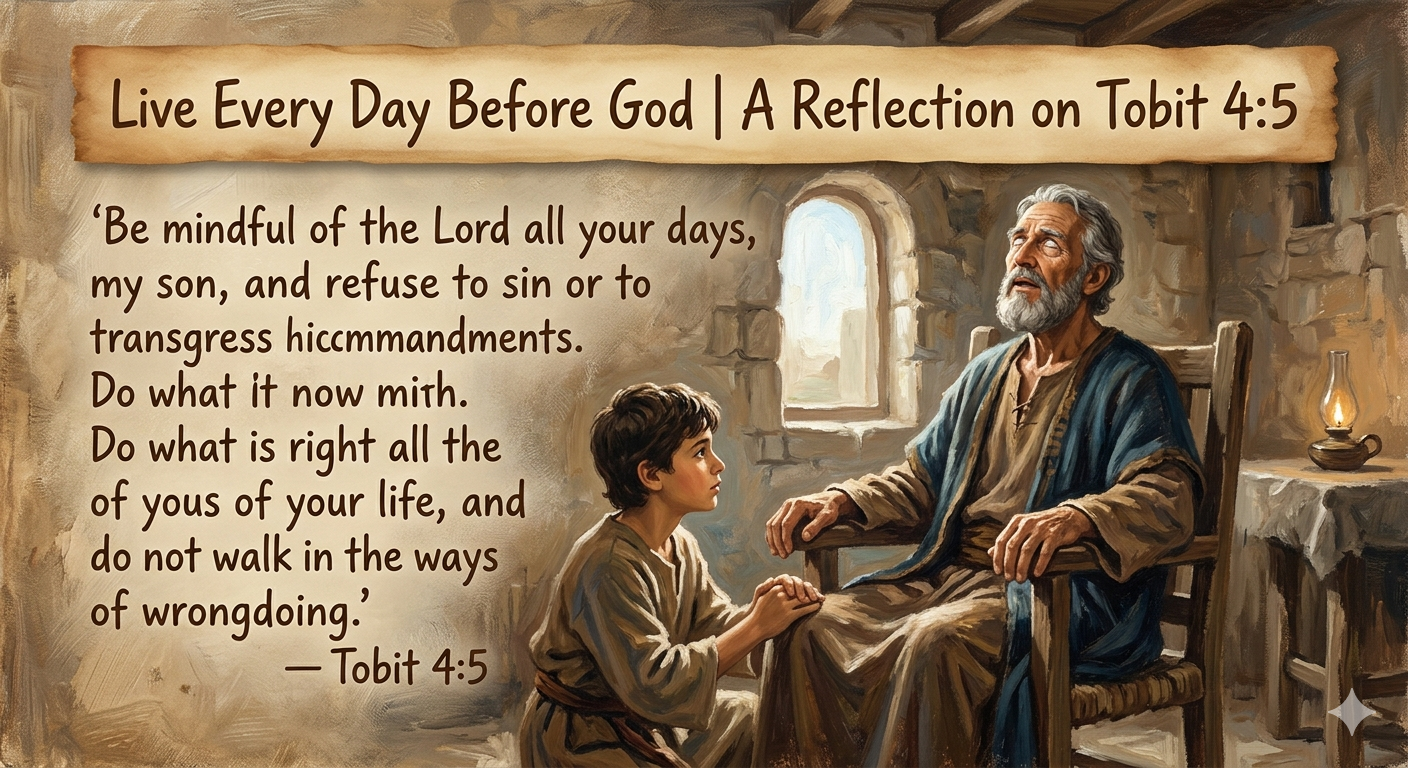
You can pray every morning, attend every service, and still be in debt to the person who worked for you yesterday. Tobit 4:14 names that contradiction without apology — and then shows you the way out. What Tobit tells his son in his final hours is not piety; it is precision. And it applies to far more than wages.

The Bible does not treat delayed payment as a paperwork problem. It treats it as a sin that cries out to God. In Tobit 4:14, a father about to die refuses to waste his final words on comfort alone — he speaks about money, fairness, and watching yourself. Find out why this verse is more urgent today than it has ever been.

What the blog post covers:

Title: Pay What Is Owed — Today: Justice, Faithfulness, and the Discipline That Builds Character

Structure (seven sections):

1. A Father’s Practical Wisdom — setting Tobit’s deathbed context and the weight of his counsel

2. Justice Is Not Optional — grounding the command in Leviticus, Deuteronomy, and James; the covenant principle behind fair wages

3. The Promise Hidden in the Command — unpacking “Your pay will not be kept over if you serve God faithfully” and God’s character as one who keeps no overdue accounts

4. Watch Yourself, My Son — the interior vigilance and purposeful self-discipline Tobit calls for

5. A Mirror for Our Modern World — connecting to the gig economy and broadening to owed apologies, gratitude, forgiveness, and presence

6. Rise and Act — the call to act today, not defer; grace as heightened responsibility, not excuse

7. A closing prayer + YouTube URL and a Study in Biblical Ethics, Deuterocanonical Wisdom, and Patristic Reception as Scholarly Companion to Reflection on Tobit 4:14 

Rise & Inspire  |  Wake-Up Calls  |  Reflection #104 of 2026

15 April 2026

Pay What Is Owed—Today

Justice, Faithfulness, and the Discipline That Builds Character

“Do not keep over until the next day the wages of those who work for you, but pay them their wages the same day, and let not the pay of those among you be delayed overnight. Your pay will not be kept over if you serve God faithfully. Watch yourself, my son, in everything you do, and discipline yourself in all your conduct.”— Tobit 4:14

Inspired by the Verse for Today shared by His Excellency, Rt. Rev. Dr. Selvister Ponnumuthan, Bishop of the Diocese of Punalur

A Father’s Practical Wisdom

Tobit is dying. He knows it. And so, in the tender hours that remain to him, he calls his son Tobiah close and speaks the things that matter most. Not grand theological arguments. Not elaborate rituals. But plain, urgent, life-shaping wisdom.

Among his final counsels, this one stands with uncommon force: Pay the worker on time. Do not let the sun set on withheld wages. Do not let a labourer go home empty-handed when the day’s work is done.

It is the kind of instruction we might expect from an experienced employer, or a seasoned judge, or a man who has himself known the sting of injustice. But here it comes from a father to a son, embedded in a spiritual testament, surrounded by commands to love God, give alms, honour the poor, and live with integrity. That placement is itself a sermon.

Justice Is Not Optional

The withholding of wages is not merely a social failing in the ancient world. Scripture treats it as a sin of the first order. Leviticus 19:13 commands, “Do not defraud your neighbour or rob him. Do not hold back the wages of a hired worker overnight.” Deuteronomy 24:15 reinforces it: the poor worker “is counting on it,” and if you delay, “he may cry to the Lord against you, and you will be guilty of sin.”

James 5:4 strikes perhaps the sharpest note of all: “The wages you failed to pay the workers who mowed your fields are crying out against you. The cries of the harvesters have reached the ears of the Lord Almighty.”

Tobit is not inventing something new. He is transmitting an ancient covenant principle: that between any person who gives their labour and any person who receives it, there exists an obligation that is holy. The worker has trusted you with their time, their strength, and their family’s welfare. To delay repayment is not administration. It is a breach of covenant.

Justice delayed is justice denied—not only in the courtroom, but in the household, in the workshop, in the field, in the office.

The Promise Hidden in the Command

Tobit does not leave his son only with an obligation. He adds a promise: “Your pay will not be kept over if you serve God faithfully.”

This is the reciprocal logic of covenant life. Those who deal honestly with others will themselves be dealt with honestly—by God. Those who release what is owed will find that what is owed to them is never held back. The faithful servant does not wait forever for reward. God keeps no overdue accounts.

This is not a guarantee of material prosperity or exemption from hardship. Tobit himself spent years in poverty and blindness. But it is a declaration about God’s character: He is not a defaulter. He is not a bureaucrat who loses your file. When you have served faithfully, when you have given your best, when you have laboured in love and integrity, God does not forget.

What belongs to you—in grace, in dignity, in eternal reward—will reach you. Not one day late by His reckoning.

Watch Yourself, My Son

The second half of this verse widens the lens: “Watch yourself, my son, in everything you do, and discipline yourself in all your conduct.”

Here Tobit moves from the particular to the universal. Yes, pay your workers on time. But more than that: watch yourself. In everything. Not just in your financial dealings. Not just in the obvious moral arenas. In everything.

The word “watch” here carries the sense of vigilance, of interior alertness. It is the antidote to spiritual drowsiness, to moral drift, to the slow erosion of character that happens not in a single catastrophic fall but in a thousand small compromises. The man who watches himself does not wait for his habits to betray him. He examines them before they form.

And discipline: not the grim, joyless self-punishment the word sometimes evokes, but the purposeful ordering of oneself toward a worthy end. The athlete trains. The musician practises. The person of God structures their inner life. Discipline is not the enemy of freedom—it is the road to it.

A Mirror for Our Modern World

We live in a world in which obligations are routinely deferred. Payments are delayed. Acknowledgements are withheld. Credit is claimed by those who did not earn it; debt is borne by those who do not deserve it. The gig economy has made Tobit’s concern acutely contemporary: millions of workers across the globe wait, often without recourse, for wages that are slow in coming or never arrive at all.

But Tobit’s challenge is not only for employers and institutions. It speaks to every relationship in which something is owed.

Have you withheld an apology that was due? Have you delayed a word of gratitude that would have meant the world to someone? Have you kept back forgiveness that another person has been waiting for, perhaps for years?

We owe more to one another than money. We owe honesty, recognition, presence, and compassion. Do not let the sun set on what you owe.

Rise and Act

Tobit’s wisdom is not passive. It does not say “intend well.” It says: act today. Pay today. Do today what justice and love require, and do not defer to tomorrow what you can render now.

This is the posture of a disciple who has understood that grace is not an excuse for negligence, but a call to heightened responsibility. Because we have received so much—freely, abundantly, without deserving it—we are equipped and obliged to give fully and promptly in return.

Watch yourself. Not with the anxious eye of fear, but with the clear eye of love—love for God, love for your neighbour, love for the person you are becoming in God’s hands.

Discipline yourself. Not because grace is insufficient, but because grace, taken seriously, reshapes the will, reorders the priorities, and makes us people who do the right thing not only when it is easy, but when no one is watching.

A Prayer for Today

Lord, You are a God who keeps every promise and delays no grace. Make me someone who reflects Your faithfulness in every obligation I carry. Help me to give what I owe—today, in full, without hesitation. Where I have held back what belongs to another, give me the courage to release it now. Teach me to watch myself with honesty and discipline myself with love, so that my conduct brings honour to Your name. Amen.

From Reflection to Study

A Bridge Between the Pastoral Post and the Scholarly Companion

You have just read a reflection on Tobit 4:14. It was written for the heart — to move you, to name something you may have been carrying quietly, to set a direction for the hours ahead. Its purpose was not to explain Tobit 4:14 exhaustively but to let the verse speak at the level where most of life is actually lived: in the unspoken debt, the deferred apology, the wages paid late or the gratitude withheld too long.

If that is where you need to stay today, stay there. The pastoral reflection has done its work if it has left you with a single honest question about your own conduct.

But some of you will want more. You will want to know where this command comes from in the longer arc of Scripture, how it sits within the legal codes of Leviticus and Deuteronomy, what the Greek of the Septuagint actually says, how the Fathers of the Church heard it, and what the Church’s social teaching has made of it across a century and a half. You will want the verse held up to a stronger light — not because devotion is insufficient, but because deeper knowledge, honestly pursued, deepens devotion rather than displacing it.

That is what the Scholarly Companion is for.

The reflection asked what you owe. The Companion asks why the tradition insists so fiercely that you pay it.

The two documents are written for different registers of the same reader. The pastoral post speaks to you at six in the morning, before the day has made its demands. The Scholarly Companion speaks to you at the desk, in the study, in the margin of an afternoon — when you have the patience to follow an argument through its sources and discover that what felt like a simple moral instruction is in fact one of the most consistently defended principles in the entire biblical and ecclesial tradition.

From Tobit’s Aramaic original, through the Septuagint translators, through the legal codes Moses received at Sinai, through the prophets who made unpaid wages a mark of covenant betrayal, through the apostolic warning in James that cries out to the Lord of hosts, through Chrysostom’s homilies and Ambrose’s De Officiis, through Aquinas’s natural law analysis and Leo XIII’s Rerum Novarum, through to John Paul II’s theology of labour and Francis’s ecological encyclicals — a single thread runs without break. The person who gives their labour has a right, grounded not in contract but in their dignity as a human being made in God’s image, to receive what is owed without delay.

Tobit 4:14 is not a footnote to that tradition. It is one of its clearest early voices — and one of the most personal, because it comes not from a lawgiver at a mountain but from a father at the edge of death, passing on the things that still matter when everything else has been stripped away.

Read what follows slowly. The Scholarly Companion is not a test. It is an invitation — to see how wide and deep the ground beneath this single verse really is, and to return to your daily life with the kind of knowledge that makes faithfulness not just an impulse but a conviction.

Scholarly Companion

Tobit 4:14 — Wages, Watchfulness, and the Discipline of the Faithful Life

A Study in Biblical Ethics, Deuterocanonical Wisdom, and Patristic Reception

I. The Source Text: Tobit 4:14

1.1  The Book of Tobit: Canonical Status

The Book of Tobit occupies a distinctive position in the Christian biblical canon. It is received as deuterocanonical (protocanonical second class) by the Roman Catholic Church and the Eastern Orthodox Churches, and included in the Septuagint (LXX). Protestant traditions following the Hebrew canon generally classify it as apocryphal, though Luther included it in his German Bible with a commendatory preface, acknowledging its spiritual utility. The Council of Trent (1546) formally defined Tobit as canonical Scripture for Catholics, a position reaffirmed by Vatican I (1870) and consistently maintained in magisterial teaching.

The text survives in multiple ancient recensions: the shorter Greek recension (GI, used in the Vulgate and most early translations) and the longer Aramaic/Hebrew-based recension (GII, represented in the Qumran fragments — 4Q196–200 — and the Sinaiticus Codex). Most modern critical editions and Catholic lectionaries follow the Sinaiticus recension.

1.2  Genre and Literary Context

Tobit belongs to the genre of Jewish wisdom narrative or didactic romance, sharing characteristics with the Joseph cycle (Genesis 37–50), the Book of Ruth, and Hellenistic Jewish novellas. Scholars such as Carey Moore characterise it as a Diaspora narrative with a strong wisdom (sapiential) core,¹ structured around themes of piety, trial, prayer, divine intervention, and restoration.

Chapter 4 constitutes the ethical and spiritual testament of Tobit to his son Tobiah — a literary form (the deathbed instruction) well attested in ancient Near Eastern and Second Temple Jewish literature, including the Testaments of the Twelve Patriarchs and analogous Egyptian wisdom texts. The chapter’s movement is from almsgiving (vv. 5–11) through honourable marriage (vv. 12–13) to economic justice (v. 14) and beyond. Verse 14 stands at the ethical heart of Tobit’s economic teaching.

II. Exegesis of Tobit 4:14

2.1  “Do not keep over until the next day the wages”

The Greek verb used in the Sinaiticus recension for “keep over” is ὑπομένω (hypomenō),³ which conveys active retention, not mere forgetfulness. The prohibition targets not the accident of oversight but the deliberate or negligent withholding of remuneration owed. This linguistic choice aligns Tobit with the harder-edged legal prohibitions of the Mosaic Torah, where the same principle is articulated with urgency:

You shall not oppress a hired worker who is poor and needy… You shall give him his wages on the same day, before the sun sets… lest he cry against you to the Lord, and you be guilty of sin. (Deuteronomy 24:14–15)

The wages of a hired servant shall not remain with you all night until the morning. (Leviticus 19:13)

The Torah’s concern is covenantal as well as humanitarian: the cry of the defrauded worker ascends to God as a juridical complaint. The worker who cannot wait is one who has no economic cushion—a day’s wages is a day’s sustenance. Delay is therefore not an inconvenience; it is an act of structural violence against the most economically precarious.

2.2  “Your pay will not be kept over if you serve God faithfully”

This clause introduces the covenant principle of reciprocity: fidelity to God expressed through justice toward others generates divine faithfulness in return. The logic is not crudely transactional but covenantally integrative. In the Hebrew covenantal worldview, ethical conduct and divine blessing are inseparable dimensions of a single relational framework. Tobit does not promise wealth; he promises that the faithful servant will not be left waiting for what God owes.

The same principle governs Proverbs 19:17 (“Whoever is generous to the poor lends to the Lord, and he will repay him for his deed”) and finds its New Testament fulfilment in Luke 6:38 (“Give, and it will be given to you”) and Matthew 25:34–40, where service to the neighbour in need is equated with service to Christ himself.

2.3  “Watch yourself… and discipline yourself in all your conduct”

The dual injunction — watch and discipline — moves from the particular (wages) to the universal (all conduct). The Greek for “watch” (proseche seautō, or similar) is a standard Greek philosophical and Jewish wisdom formula for self-examination. It appears in Sirach 18:27 (“A sensible person will not overlook a thoughtful suggestion”) and echoes the Delphic maxim gnōthi seauton (know thyself), though in Tobit the frame is theocentric rather than anthropocentric: one watches oneself before God and for God.

The word for “discipline” (paideia in the LXX tradition) carries the full freight of Hebrew musar: moral instruction received through both teaching and suffering, formation through corrective encounter. It is the dominant concept in Proverbs (appearing over thirty times) and is used by the author of Hebrews (12:5–11) to reframe suffering as divine pedagogy. For Tobit, self-discipline is not stoic self-mastery; it is the active cooperation of the human will with divine formation.

III. The Pentateuchal and Prophetic Background

3.1  The Torah on Prompt Payment

The commandment against withholding wages is among the most socially specific in the entire Torah, appearing in both the Holiness Code (Leviticus 17–26) and the Deuteronomic Code. Its specificity signals the seriousness with which Israel’s legislators viewed economic exploitation. The hired labourer (sakir) was the most economically vulnerable person in the Israelite social system — not a slave (who at least had guaranteed shelter and food), not a landowner, but a free person with no economic security beyond each day’s earnings.

Modern scholars such as John Sietze Bergsma and Jacob Milgrom have noted that the Holiness Code’s economic provisions constitute a systemic effort to prevent the concentration of wealth and the permanent degradation of the labouring poor — a concern expressed also in the Jubilee legislation (Leviticus 25) and the sabbatical year (Exodus 23:10–11).

3.2  The Prophetic Tradition

The prophets amplify the Torah’s concern into a central criterion of covenant faithfulness. Jeremiah condemns King Jehoiakim precisely for building his palace with unpaid labour: “Woe to him who builds his house by unrighteousness, and his upper rooms by injustice, who makes his neighbour serve him for nothing and does not give him his wages” (Jeremiah 22:13). Malachi places withholding wages among the gravest covenant violations: “I will be a swift witness against… those who oppress the hired worker in his wages” (Malachi 3:5).

James 5:4 — one of the New Testament’s most direct economic judgments — echoes this prophetic tradition: “The wages of the labourers who mowed your fields, which you kept back by fraud, are crying out against you, and the cries of the harvesters have reached the ears of the Lord of hosts.” The continuity from Leviticus through Tobit to James is direct and unbroken.

IV. Comparative Biblical Parallels

Parallel TextThematic Link to Tobit 4:14
Leviticus 19:13Explicit prohibition of withholding wages overnight; same legal frame as Tobit 4:14
Deuteronomy 24:14–15Wages due on the same day; the worker’s cry reaches God; sin of delay
Proverbs 3:27–28Do not withhold good from those to whom it is due when it is in your power to do it
Sirach 7:20Do not ill-treat a servant who works faithfully; honour a hired labourer
Jeremiah 22:13Prophetic condemnation of those who use unpaid labour to build wealth
Malachi 3:5God as swift witness against those who withhold wages
Matthew 20:1–8Parable of the Vineyard Workers: wages paid promptly at day’s end
James 5:4Withheld wages cry out to the Lord of hosts; New Testament apex of this tradition
Sirach 18:27–29Watch yourself; the wise man is attentive and disciplines conduct
Proverbs 4:23Guard your heart with all diligence — the interior watchfulness Tobit counsels

V. Patristic and Theological Reception

5.1  The Greek Fathers

St. John Chrysostom, in his Homilies on the Gospel of Matthew and Homilies on 2 Corinthians, repeatedly invokes the principle that economic justice is a spiritual obligation inseparable from liturgical practice. His teaching — that the poor constitute a living altar of Christ more awe-inspiring than the Eucharistic altar of the Church⁴ — reflects the same covenantal logic Tobit articulates: that worship of God and just treatment of the neighbour are not parallel tracks but a single moral act.

Origen, in his Commentary on Romans, treats the principle of paying what is owed (Romans 13:7–8) as a comprehensive moral framework encompassing not only financial debts but all obligations of love. He argues that the only debt that can never be fully discharged is the debt of love itself — a reading that places Tobit’s practical counsel within an eschatological horizon.

5.2  The Latin Fathers

St. Ambrose of Milan, in De Officiis (On the Duties of the Clergy), devotes sustained attention to the obligations of justice in economic life, drawing on both Stoic natural law categories and biblical texts including the wisdom tradition. He understands prompt payment of wages as part of the broader virtue of iustitia — rendering to each what is their due — which for Ambrose is the foundational virtue of social life.

St. Augustine, in De Doctrina Christiana and his Sermons, consistently insists that the love of God must express itself in concrete acts of justice toward neighbours, and that failure to do so represents not merely a social deficiency but a theological contradiction: one cannot claim to love God while defrauding or neglecting those made in God’s image.

5.3  Medieval Synthesis

St. Thomas Aquinas, in the Summa Theologica (II-II, Q. 77–78), treats the withholding of just wages under the heading of injustice in buying and selling, arguing from natural law that the labourer has a right (ius) to their wages that precedes any contractual arrangement because it is grounded in the nature of the relationship itself. This represents the scholastic systematisation of the biblical and patristic tradition that Tobit represents.

The medieval canonists, building on this foundation, developed the doctrine of laesio enormis (unjust enrichment through disproportionate exchange) which eventually contributed to the development of labour law in the Western legal tradition.

VI. Catholic Social Teaching and Magisterial Continuity

6.1  Rerum Novarum to Laudato Si’

Pope Leo XIII’s encyclical Rerum Novarum (1891), the founding document of modern Catholic Social Teaching, places the prompt and fair payment of wages at the centre of its social programme. Leo XIII articulates the principle of the just wage — a wage sufficient for the worker to live with dignity — as a moral obligation grounded in natural law, not merely a matter of contractual agreement between consenting parties.

This tradition was developed by Pius XI in Quadragesimo Anno (1931), which introduced the principle of subsidiarity and extended the analysis of wage justice to structural economic arrangements. John XXIII’s Mater et Magistra (1961) and Paul VI’s Populorum Progressio (1967) further universalised the application, extending the principle from individual employer-employee relations to international economic structures.

John Paul II’s Laborem Exercens (1981) offers the most theologically dense treatment, arguing that human labour participates in the creative act of God and therefore possesses an irreducible dignity that no economic arrangement may override. The withholding of just wages is thus not merely unjust but sacrilegious — a violation of the image of God in the worker.

Pope Francis, in Laudato Si’ (2015) and Laudate Deum (2023), extends this concern to ecological and global dimensions, noting that economic systems that exploit both the earth and its workers share a common anthropological root: the treating of persons and creation as instruments rather than ends.

6.2  The Compendium of the Social Doctrine of the Church

The Compendium (2004, Pontifical Council for Justice and Peace) consolidates this tradition in paragraph 302: “Paying a just wage is a concrete means of verifying the justice of the whole socioeconomic system and, in any case, of checking that it is functioning justly.” The Compendium further identifies prompt payment as a requirement of commutative justice (the justice of exchanges) as distinct from, but inseparable from, distributive justice.

VII. Contemporary Hermeneutical Significance

7.1  Wage Theft in the Modern Economy

Wage theft — the withholding of earned wages through delayed payment, illegal deductions, misclassification, or outright non-payment — has been identified by labour economists as among the most pervasive forms of economic crime in contemporary societies. Studies in the United States (Economic Policy Institute), the United Kingdom (Low Pay Commission), and across the Global South indicate that low-wage workers, migrant workers, and informal sector workers are disproportionately affected.

The biblical tradition represented by Tobit 4:14 provides both a moral vocabulary and a theological grounding for advocacy in this area that predates and supersedes the categories of secular labour law.

7.2  The Virtue of Self-Discipline in a Distracted Age

Tobit’s counsel to “watch yourself” and “discipline yourself in all your conduct” resonates with contemporary discussions in moral psychology, virtue ethics (Alasdair MacIntyre, After Virtue), and Christian spiritual formation (Dallas Willard, The Spirit of the Disciplines; James K.A. Smith, You Are What You Love). The convergence of ancient wisdom with contemporary scholarship on habit, attention, and character formation suggests that Tobit’s counsel is not culturally conditioned moralising but perennial anthropological wisdom.

The patristic concept of nepsis (watchfulness, sobriety of spirit), developed extensively in the Philokalia and the hesychast tradition, offers a contemplative dimension to Tobit’s practical injunction. To watch oneself is not merely to audit one’s behaviour; it is to maintain the interior alertness that makes virtuous action possible, to prevent the “spiritual sleepiness” (akedia) that leads to moral drift.

VIII. Homiletical and Catechetical Notes

8.1  Key Themes for Preaching

1. Economic justice as spiritual practice: the inseparability of worship and fair dealing in the biblical tradition.

2. The covenant of trust: what the employer-employee or service-recipient relationship means theologically.

3. God’s faithfulness as the paradigm for human faithfulness: He keeps no overdue accounts.

4. Self-discipline (paideia/musar) as the necessary interior condition for consistent moral conduct across all spheres of life.

5. The widening application: from wages to apologies, from debts of money to debts of recognition, gratitude, and forgiveness.

8.2  Discussion Questions

6. In what ways do you “delay payment” in relationships — withholding gratitude, apology, or recognition that is already owed?

7. How does the biblical principle of the just wage speak to the economic arrangements of your workplace, industry, or country?

8. What practices of “watching yourself” (self-examination, spiritual direction, accountability) do you currently have? What might you add?

9. How does Tobit’s promise — “Your pay will not be kept over if you serve God faithfully” — speak to experiences of waiting for delayed justice in your own life?

IX. Select Bibliography

Moore, Carey A. Tobit: A New Translation with Introduction and Commentary. Anchor Bible, Vol. 40A. New York: Doubleday, 1996.

Fitzmyer, Joseph A. Tobit. Commentaries on Early Jewish Literature. Berlin: De Gruyter, 2003.

Milgrom, Jacob. Leviticus 17–22. Anchor Bible, Vol. 3A. New York: Doubleday, 2000.

Chrysostom, John. Homilies on Matthew (NPNF Series I, Vol. 10). Various editions.

Ambrose of Milan. De Officiis (On the Duties of the Clergy). Trans. Ivor Davidson. Oxford: Oxford University Press, 2001.

Thomas Aquinas. Summa Theologica II-II, QQ. 57–79 (Justice and Injustice). Trans. Fathers of the English Dominican Province.

Leo XIII. Rerum Novarum (1891). Vatican City: Libreria Editrice Vaticana.

John Paul II. Laborem Exercens (1981). Vatican City: Libreria Editrice Vaticana.

Pontifical Council for Justice and Peace. Compendium of the Social Doctrine of the Church. Vatican City: Libreria Editrice Vaticana, 2004.

MacIntyre, Alasdair. After Virtue: A Study in Moral Theory. 3rd ed. Notre Dame: University of Notre Dame Press, 2007.

Willard, Dallas. The Spirit of the Disciplines. San Francisco: HarperOne, 1988.

Smith, James K.A. You Are What You Love: The Spiritual Power of Habit. Grand Rapids: Brazos Press, 2016.

Bergsma, John Sietze. The Jubilee from Leviticus to Qumran. Leiden: Brill, 2007.

Notes on Sources and Accuracy

¹ Carey A. Moore, Tobit (Anchor Bible 40A; New York: Doubleday, 1996). The characterisation of Tobit as a Diaspora narrative with a sapiential core is a close scholarly summary of Moore’s analysis rather than a verbatim quotation from his commentary.

² The English rendering of Tobit 4:14 used throughout this document follows the longer Sinaiticus recension as found in the New Revised Standard Version Updated Edition (NRSVUE) and Catholic editions based on it. The NABRE reads: “Do not keep with you overnight the wages of those who have worked for you, but pay them at once.” The underlying principle is identical across all standard Catholic translations.

³ The correct Greek form in the Sinaiticus recension is ὑπομένω (hypomenō).

⁴ St. John Chrysostom, Homilies on the Gospel of Matthew 50.3–4 and Homilies on 2 Corinthians 20. The phrasing used here accurately captures his teaching, though Chrysostom’s exact language describes the poor as the “living altar” of Christ and characterises that altar as more “awful” (awe-inspiring) than the church’s Eucharistic altar.

⁵ Thomas Aquinas, Summa Theologica II-II, qq. 77–78, especially q. 77, a. 1 on commutative justice in exchange.

⁶ Leo XIII, Rerum Novarum (1891), nos. 34–38, 45; John Paul II, Laborem Exercens (1981), nos. 7–9, 18–19; Pontifical Council for Justice and Peace, Compendium of the Social Doctrine of the Church (2004), §302.

⁷ Economic Policy Institute (U.S.), Low Pay Commission (U.K.), and ILO reports on wage theft in informal and gig economies (data current to 2023–2025).

In what area of your life have you been holding back what you owe — whether money, an apology, recognition, or forgiveness — and what would it look like to release it today?

If this reflection stirred something in you, the Rise and Inspire Wake-Up Calls arrive every morning with the same depth and care. Subscribe at riseandinspire.co.in and start your day grounded in Scripture.

Watch Today’s Verse — Video Reflection

Scholarly Companion and Reflection on Tobit 4:14 Written by Johnbritto Kurusumuthu

Rise & Inspire  |  riseandinspire.co.in

  Wake-Up Calls |  Reflection #104 of 2026  |  Tobit 4:14  | 15 April 2026

© 2026 Rise&Inspire. All rights reserved.

Website: Home | Blog | About Us | Contact| Resources

Word Count:5125
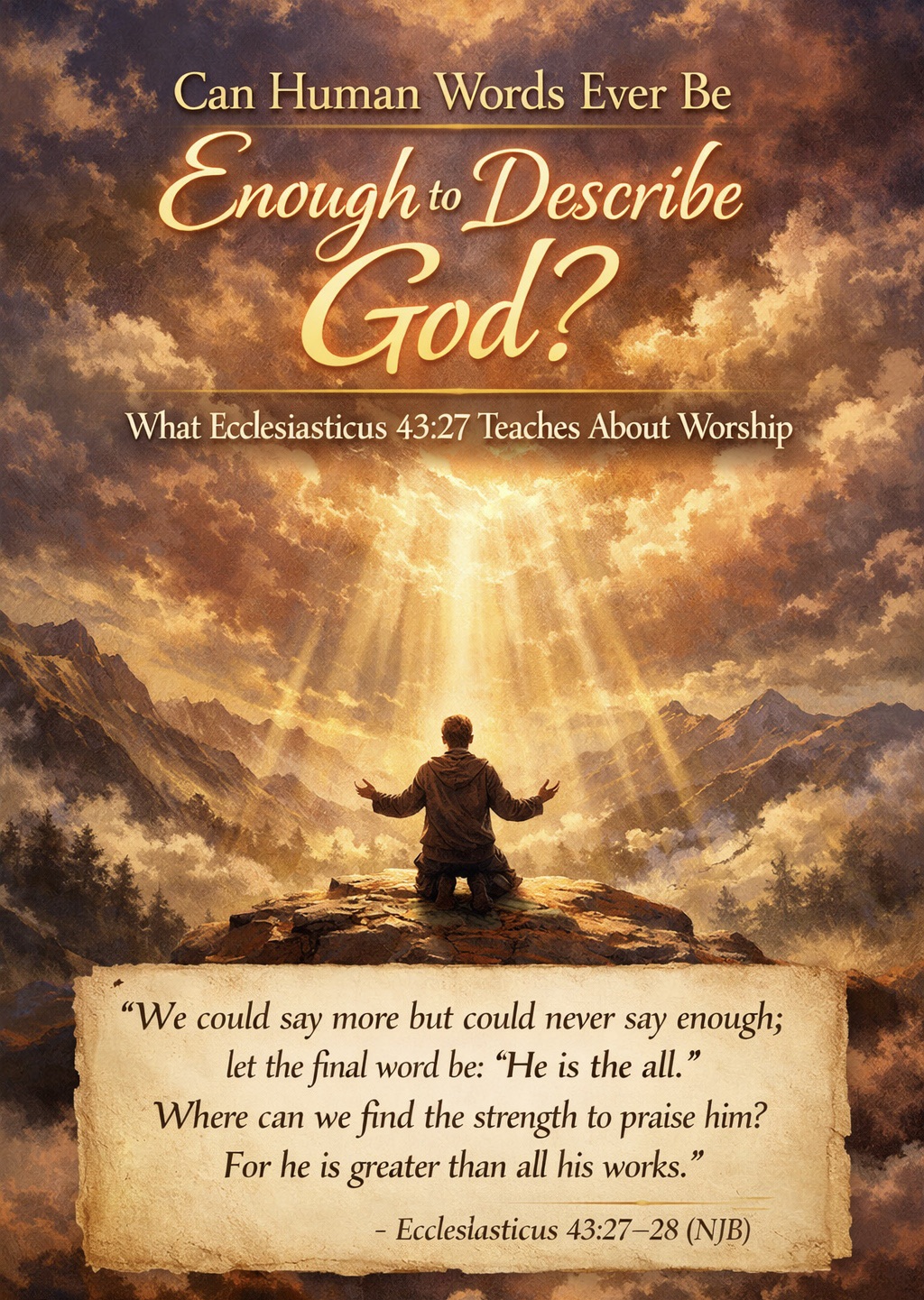
Can Human Words Ever Be Enough to Describe God?

What Ecclesiasticus 43:27 Teaches About Worship

A reflection on Ecclesiasticus 43:27–28

Wake-Up Call No. 103 of 2026  |  Tuesday, 14 April 2026

You have probably been told that better prayers are longer prayers. More words, more detail, more fervour. Ecclesiasticus 43:27 suggests something quietly radical: the best prayer you will ever offer may be the one where your words run completely out. Today’s reflection tells you why that moment is not a crisis of faith but its fullest expression.

There is a phrase in the book of Ecclesiasticus that most Bible readers have never encountered, and it may be the most theologically precise thing ever written about God in these words: He is the all. Not he is great. Not he is mighty. He is the all. Today’s reflection unpacks what that phrase means, what it does not mean, and why it matters for the way you pray this morning.

He Is the All: When Language Runs Out and Praise Begins

“We could say more but could never say enough; let the final word be: ‘He is the all.’ Where can we find the strength to praise him? For he is greater than all his works.”

Ecclesiasticus 43:27–28  (NJB)

Companion Video — Listen & Be Lifted:

The Day Words Give Out

There is a moment every honest person of faith eventually reaches. It is the moment when the vocabulary runs dry, when the most carefully chosen words feel thin against the weight of who God is, when even the most eloquent prayer trails off into silence — not from inattention, but from awe.

Ben Sira knew that moment. He had just spent forty-three chapters of Ecclesiasticus cataloguing the wonders of creation: the sun blazing across the sky like a furnace, the moon marking seasons, the stars obeying their courses, hail and lightning, snow and frost, the depths of the sea, the mystery of the human heart. He had tried to put it all into words. And then, at the summit of that great hymn to creation, he stops. He concedes. He offers the most honest sentence a theologian has ever written: We could say more, but could never say enough.

That is not defeat. That is the beginning of real worship.

The Admission That Unlocks Everything

Most of us have been trained to think that more words mean more worship. Longer prayers, fuller sermons, more elaborate liturgies. And there is nothing wrong with any of that. Language is one of the highest gifts we bring to God. But Ecclesiasticus 43:27 makes a different and deeper point: the quality of our praise is not measured by its completeness. It is measured by its honesty about its own incompleteness.

We could say more but could never say enough. This is not a counsel of despair. It is a liberation. The moment you stop trying to fully capture God in your words is the moment your words begin to point beyond themselves — which is precisely what praise is supposed to do. Praise is not a report. It is a gesture toward something inexhaustible.

The great mystics understood this. The apophatic tradition — the theology of the via negativa — insists that everything we affirm about God must be held lightly, because God always exceeds our categories. God is not merely large. He is not merely powerful. He is not merely wise. He is the all. That single phrase — He is the all — is not a lazy summary. It is the most precise thing Ben Sira could say. It is the word that contains all the other words and admits that none of them are sufficient.

He Is the All: What That Actually Means

The phrase He is the all is not pantheism — the idea that God and creation are identical. Ben Sira is deeply Jewish in his theology. Creation is not God; it is the work of God’s hands, and the chapter that precedes this verse is an extended meditation on creation’s splendour precisely because creation points beyond itself to the Creator.

What He is the all means is that God is the source, the sustainer, the meaning, the destination, and the fullness of everything that exists. Every beautiful thing you have ever seen is a fragment of his beauty. Every true thing you have ever known is a refraction of his truth. Every act of genuine love is a trace of his love. Nothing is, except in him. Everything that is, is because he holds it in being.

Paul is saying the same thing when he writes to the Colossians: “In him all things hold together” (Colossians 1:17). And again in Acts: “In him we live and move and have our being” (Acts 17:28). And John begins his Gospel not with the birth of Jesus but with the Word through whom all things were made, without whom nothing was made that has been made (John 1:3). The New Testament writers are all circling the same truth that Ben Sira reached from the Jewish wisdom tradition: God is not one item in the list of existing things. He is the ground of the list itself.

Where Can We Find the Strength to Praise Him?

Verse 28 asks one of the most searching questions in all of Scripture: Where can we find the strength to praise him? Notice what is being asked. Not where can we find the right words. Not how should we structure our worship. But where do we find the strength?

This is the question of a man who has tried to praise adequately and discovered that he cannot. Not for lack of desire, but for lack of capacity. The creature stands before the Creator and realises that even the act of praise is a gift from the one being praised. We cannot lift our voices to God by our own power. We need grace even to worship.

This is why the great Christian tradition has always insisted that prayer is not primarily our speech to God — it is God’s Spirit praying through us. Paul writes in Romans 8:26 that we do not know how to pray as we ought, but the Spirit himself intercedes for us with groanings too deep for words. The Spirit gives us the strength that Ben Sira is looking for. The praise we offer is not self-generated. It is drawn out of us by the God who is, himself, the ground of all worship.

And so the question becomes not a dead end but an opening. Where can we find the strength? In him. In the One who is greater than all his works and who gives us, as sheer gift, both the desire and the capacity to praise.

Greater Than All His Works: The Distance Between the Creator and the Creature

For he is greater than all his works. This is a simple sentence that contains a staggering claim. Consider what his works include: the Milky Way, which contains approximately 200 billion stars. The blue whale. The human brain, which processes roughly 11 million bits of information per second. Beethoven’s Ninth Symphony. The double helix. The aurora borealis. The moment a child is born. The quiet in a room after a great grief has passed.

God is greater than all of that. Not as a quantity is greater than a smaller quantity. Greater in the way that an author is greater than the story — not by being a larger version of the characters in the book, but by being of an entirely different order of being. The gap between the creation and the Creator is not a gap you close by adding more creation. It is a categorical difference.

And yet — this is the miracle at the heart of Christian faith — this God who is of an entirely different order of being chose, in Jesus Christ, to enter the story. The one who is greater than all his works became one of his works. The Word became flesh. The author became a character. Not because he had to, but because love is that extravagant.

When Ben Sira says God is greater than all his works, he is not driving God away from creation into distant transcendence. He is setting the stage for the most astonishing act of condescension in all of history: that this God, greater than all, came close enough to be held.

The Wisdom to Stop Explaining and Simply Adore

There is a spiritual maturity that looks like silence. Not the silence of those who have nothing to say, but the silence of those who have encountered something so much larger than themselves that words temporarily stop functioning. Moses at the burning bush took off his sandals. Isaiah, in the year King Uzziah died, cried “Woe is me!” before the seraphim. Peter, on the shore after the resurrection, could only say “Lord, you know everything” (John 21:17). Mary kept all these things and pondered them in her heart.

Each of these is a version of We could say more but could never say enough. Each is a person at the edge of what human language can hold, standing before the One who is greater than all his works, finding that the most faithful response is not more speech but deeper surrender.

This is not anti-intellectual. Ben Sira is one of the most learned writers in the deuterocanonical tradition. He celebrates wisdom, learning, and the skilled use of language throughout his book. But he knows that all learning and all language are in the service of something they can point to but never contain. The map is not the territory. The theology is not the God.

Your Wake-Up Call: Let the Final Word Be Wonder

Today’s invitation is not to say less about God. It is to say what you say with the full knowledge that it is never enough — and to let that knowledge produce wonder rather than paralysis.

When you sit with your morning coffee and the light comes through the window, you are in the presence of one of his works. When the person you love laughs, you are hearing an echo of the One who invented laughter. When a piece of music does something to your chest that you cannot explain, you are being touched by the fingerprint of the One who is greater than all his works and whose beauty leaks through every beautiful thing.

Let the final word not be a definition. Let it be a doxology. Let it be the word that Ben Sira reached at the end of his long, brilliant, exhaustive attempt to describe the universe and its Maker: He is the all.

That is enough. That is more than enough. That is everything.

  A Prayer for Today  

Lord, I come to you at the edge of my own language. I have run out of adequate words, and I have discovered that the silence on the other side of all my words is not emptiness but you. You are the all — and I am one small, astonished creature, grateful beyond expression to be held in the hands of the One who is greater than all his works. Take my insufficient praise and complete it, as only you can. Amen.

 For the Reader Who Wants to Go Deeper

The reflection you have just read rested on a single admission: we could say more, but we could never say enough. That admission is the devotional heart of Ecclesiasticus 43:27–28. But it also has a long intellectual history.

The Scholarly Companion that follows traces that history. It begins with a question most readers of Ecclesiasticus do not think to ask — which Bible does this book belong to, and why does it depend on who you ask? It then unpacks the Greek phrase at the centre of verse 27 (ho panta, “he is the all”), which turns out to be more precisely chosen, and more carefully guarded against misreading, than any English translation suggests. From there it moves into the tradition of apophatic theology — the ancient, rigorous discipline of approaching God by acknowledging what cannot be said — and finally into the New Testament passages where Paul takes Ben Sira’s intuition and transforms it into a christological and eschatological claim.

The goal is not to complicate what Ben Sira kept simple. He is the all. That stands. The goal is to show how much weight those few words have carried, and how faithfully the tradition has tried to honour the silence they open.

Scholarly Companion to Wake-Up Call No. 103

“He Is the All”: Apophasis, Divine Transcendence,

and the Limits of Praise in Ecclesiasticus 43:27–28

I. Introduction: A Book, a Canon, and a Climax

Ecclesiasticus 43:27–28 stands at the summit of Ben Sira’s extended hymn to creation (chapters 42–43), which is itself the culmination of a longer section praising the works of God and the great figures of Israel’s history (chapters 44–50). These two verses are not an afterthought. They are Ben Sira’s deliberately chosen stopping point — the place where the most learned sage in the deuterocanonical tradition lays down his pen and admits that the subject exceeds him.

The scholarly study of these verses requires engagement with four distinct but overlapping domains: the textual and canonical status of Ecclesiasticus in Jewish and Christian tradition; the Greek and Hebrew lexical texture of the key phrases; the place of these verses within the broader tradition of Jewish wisdom theology; and the reception of their theological content in patristic and medieval thought, particularly the apophatic tradition. This companion addresses each in turn.

II. The Book of Ecclesiasticus: Text, Canon, and Authority

Title, Attribution, and Date

The book known in Catholic and Orthodox tradition as Ecclesiasticus or Sirach was composed in Hebrew by Joshua ben Sira (also rendered Jesus son of Sirach, or Yeshua ben Elazar ben Sira) in Jerusalem, most probably between 196 and 175 BCE. It was translated into Greek by his grandson, who in his Prologue explains that he came to Egypt “in the thirty-eighth year of Euergetes,” a reference dated to 132 BCE under Ptolemy VIII Euergetes II. The Greek translation became the version received into the Septuagint (LXX) and thus into the deuterocanonical scriptures of Catholic and Orthodox Christianity.

The Hebrew original was largely lost to the Jewish community from late antiquity until 1896, when Solomon Schechter identified substantial Hebrew manuscript fragments in the Cairo Geniza. Subsequently, Dead Sea Scroll fragments (specifically from Cave 2 and Masada) confirmed the antiquity and general reliability of the Hebrew text. Today approximately two-thirds of the book survives in Hebrew. For chapters 42–43, the Masada manuscript (Mas1h) provides key Hebrew readings that allow direct comparison with the Greek Septuagint text.

Canonical Status

The canonical status of Ecclesiasticus has been contested since antiquity and remains a point of formal divergence between Christian traditions. The following table summarises the major positions:

TraditionStatus of Ecclesiasticus
Roman CatholicDeuterocanonical — fully canonical; defined at the Council of Trent (1546). Included in the Old Testament.
Eastern OrthodoxAnagignoskomena (“worthy to be read”) — canonical in most Orthodox churches; included in the LXX canon.
Anglican / EpiscopalApocrypha — edifying for reading but not used to establish doctrine (Article VI of the Thirty-Nine Articles).
Protestant (Lutheran, Reformed, Baptist)Apocrypha — not canonical; excluded from the biblical canon following Jerome’s Hebraica veritas principle and Reformation scholarship.
Jewish (Rabbinic)Not canonical; excluded from the Hebrew Bible (Tanakh) at or around the Council of Jamnia (c. 90 CE), though widely read and cited in Rabbinic literature.

Despite its exclusion from the Protestant canon, Ecclesiasticus has exercised enormous theological and literary influence across all Christian traditions. Its use in patristic writing, medieval scholasticism, Anglican liturgy, and Catholic catechesis has been continuous. For the specific purpose of theological reflection, the book’s place in the LXX and its reception in the Fathers give it a standing that cannot be dismissed even by those who do not regard it as formally canonical.

III. Lexical Study: The Greek Text of Ecclesiasticus 43:27–28

The Greek Text

The NJB rendering used in the pastoral reflection (“We could say more but could never say enough; let the final word be: ‘He is the all’”) reflects the standard Septuagint Greek. The key phrase in verse 27b is:

το δε ρήμα  εστιν  ἐκείνος  ὁ  πάντα

to de rhēma estin ekeinos ho panta

Literal: “But the word is: He is the all / He is all things.”

The phrase ho panta (ὁ πάντα) deserves careful lexical attention. Panta is the nominative/accusative neuter plural of pas (πᾶς), meaning all, every, the whole. With the article ho and the predicate nominative construction, the phrase is a theological assertion: He (God) is the all-things — the totality, the whole. It is significant that Ben Sira uses the neuter plural panta rather than a singular noun such as holos (οὕλος, the whole) or pan (πᾶν, the all as a collective singular). The plural panta emphasises not an abstract totality but the fullness of all particular existing things — God is not merely a cosmic unity but the comprehensive ground of every individual thing that exists.

CategoryDetail
Greek phrase πάντα (ho panta) — “the all” / “all things”
GrammarArticle + neuter plural of πς (pas). Predicate in a nominal clause: “he is the all.”
SenseNot pantheism (God = creation) but panentheistic resonance: God is the ground and fullness of all that exists.
Hebrew backgroundMasada ms. (Mas1h) reads הוא הכל (hu ha-kol) — “he is the all / everything.” Direct parallel to Greek ho panta.
NT parallels1 Cor 15:28 (“God may be all in all,” panta en pasin); Col 1:17 (“in him all things hold together”); Eph 1:23 (“him who fills all in all”).

Verse 28: Where Can We Find the Strength to Praise Him?

The Greek of verse 28a reads:

τίς δυνήσεται αὐτὸν ὁρᾶν καὶ ἐκείνον ἐκδιηγήσασθαι;

Tis dynēsetai auton horan kai ekeinon ekdiēgēsasthai?

Literal: “Who will be able to see him and to narrate / describe him?”

The NJB rendering (“Where can we find the strength to praise him?”) interprets rather than translates the Greek literally, but captures the theological sense. The verb ekdiēgēsasthai (ἐκδιηγήσασθαι) is an aorist middle infinitive of ekdiēgeomai, meaning to narrate fully, to describe completely, to recount in detail. The prefix ek- is intensive: not merely to tell but to tell through to the end, to exhaust the account. The rhetorical question thus asks: Who can see God and fully narrate him? The implied answer is: no one. Not because God is absent but because he exceeds the capacity of any narrator.

The closing clause of verse 28 in Greek reads:

μείζων γάρ ἐστιν ὁ κύριος πάντων τῶν ἔργων αὐτοῦ

Meizōn gar estin ho kyrios pantōn tōn ergōn autou

Literal: “For the Lord is greater than all his works.”

The comparative adjective meizōn (μείζων) is the comparative of megas (μέγας), meaning great, large, mighty. He is not merely great among all his works — he is greater than them, of a categorically higher order. This is the basis for Ben Sira’s admission in verse 27: if God exceeds his own works in the way meizōn implies, then no description of those works, however complete, can amount to a description of God himself. The creation hymn of chapters 42–43 has been exhaustive by human standards; and it is precisely that exhaustiveness which demonstrates its inadequacy.

IV. Ecclesiasticus in the Context of Jewish Wisdom Theology

The Wisdom Tradition and Creation

Ben Sira writes within the long tradition of Israelite wisdom theology, whose canonical roots lie in Proverbs, Job, Qoheleth, and — at the more speculative end — the Wisdom of Solomon. A defining characteristic of this tradition is its insistence that wisdom is not merely a human intellectual achievement but a divine attribute that was present at creation and through which creation was ordered (Proverbs 8:22–31; Wisdom 7:22–8:1; Sirach 1:1–10; 24:1–22).

For Ben Sira specifically, the hymn to creation in chapters 42–43 represents the intellectual and theological apex of his book. It is constructed on the model of other ancient Near Eastern and biblical creation hymns (Psalm 104; Job 38–41) but is distinctive in the density of its catalogue and in the explicit epistemological conclusion it draws: the creation is, in the end, only a pointer to the Creator, and the pointer’s very completeness is the measure of the Creator’s incomprehensibility.

This is a sophisticated theological move. Ben Sira does not arrive at the ineffability of God by ignoring creation. He arrives at it through creation. The more carefully you look, the more you see. The more you see, the more you realise how much remains to be seen. The doxological incompleteness of verse 27 is not premature. It is the product of the most thorough looking Ben Sira is capable of.

Ho Panta and Jewish Monotheism

The assertion that God is ho panta — the all — stands in a theologically sensitive position within Jewish monotheism. The Hebrew hu ha-kol is not unique to Ecclesiasticus; it echoes the rabbinic formula for God as the source and ground of all being. It appears in the later Hebrew liturgy (particularly in the Adon Olam hymn: והוא היה והוא הוה והוא יהיה בתפארה, “He was, he is, and he will be in glory”) and in the Aleinu prayer’s vision of universal divine sovereignty.

The rabbis were alert to the risk that hu ha-kol could slide into the Stoic concept of the World-Soul or into the kind of pantheism that identifies God with the natural order. Ecclesiasticus 43:28b explicitly guards against this: God is greater than all his works. The works are real and distinct from God; they are not God. But they exist only because of him, through him, and toward him. This is not pantheism but what modern theologians sometimes call panentheism (a term coined by K. C. F. Krause in 1828): the idea that the world exists within God without being identical with God.

Sirach 43 and the Psalter

The creation hymn of Sirach 43 draws heavily on Psalm 104, which is itself the great Old Testament creation meditation. Both texts move through the catalogue of created wonders toward a doxological conclusion. But Psalm 104 ends with the psalmist’s personal vow of praise (v. 33: “I will sing to the Lord as long as I live”) and a petition that sinners be consumed. Ben Sira’s ending is more philosophically austere: he does not arrive at a personal vow but at an epistemological admission. The difference is revealing. Psalm 104 ends in doxology; Ecclesiasticus 43 ends in apophasis — the recognition that even doxology falls short.

V. The Apophatic Tradition: Via Negativa and Divine Incomprehensibility

Apophasis Defined

The term apophasis (Greek: ἀπόφασις, from apo + phanai, to speak away / to deny) designates the theological method that approaches God by negation: by saying what God is not rather than what he is. It is contrasted with kataphasis (positive or affirmative theology), which approaches God through positive attributes. The via negativa is not a counsel of silence about God but a recognition that all positive language about God must be qualified by the acknowledgement that God exceeds every category used to describe him.

The roots of the apophatic tradition in Jewish and Christian thought are deeply intertwined with texts like Ecclesiasticus 43:27–28. Ben Sira’s admission that we could say more but could never say enough is precisely the apophatic move: the recognition that the subject exceeds the speaker’s capacity to narrate.

Philo of Alexandria (c. 20 BCE – c. 50 CE)

Philo of Alexandria, writing in the same Greek-Jewish tradition as Ben Sira but a century and a half later, develops the apophatic implications of Jewish monotheism most systematically in his philosophical work. In De Posteritate Caini and De Mutatione Nominum, Philo argues that God’s essence (to on, τὸ Ὄν) is absolutely unknowable and incomprehensible by the human mind. We can know that God is; we cannot know what God is. The divine names in Scripture — Lord, God, I AM THAT I AM — are not definitions of the divine essence but accommodations to human cognitive limitation.

Philo’s position is directly relevant to the theology of Ecclesiasticus 43:27. When Ben Sira says he is the all, he is not claiming to have defined God. He is offering a pointer that immediately qualifies itself: the all exceeds whatever content any speaker might pour into the phrase. Philo would recognise this as the honest intellectual posture of one who knows the limits of human knowing before the divine.

Pseudo-Dionysius the Areopagite (c. late 5th – early 6th century)

The most systematic and influential account of apophatic theology in the Christian tradition is the corpus of writings attributed to Dionysius the Areopagite (Acts 17:34), now dated by scholars to the late fifth or early sixth century and attributed to an anonymous Syrian theologian. The Mystical Theology and The Divine Names together constitute the classical statement of the via negativa in Christian thought.

In The Mystical Theology, Pseudo-Dionysius argues that God is beyond all being, beyond all knowing, beyond all affirmation and negation. He is the “super-essential darkness” who is encountered not by ascending the ladder of positive attributes but by progressively stripping away every category — including the category of “being” itself — until the soul stands in “the brilliant darkness of a hidden silence.”

The direct theological parallel to Ecclesiasticus 43:27 is unmistakable. Ben Sira’s we could say more but could never say enough is the wisdom tradition’s intuition of exactly what Pseudo-Dionysius will later systematise: the inexhaustibility of the divine object of praise means that praise is always simultaneously a confession of inadequacy.

“The Cause of all is above all and is not inexistent, lifeless, speechless, mindless. It is not a material body, and hence has neither shape nor form, quality, quantity, or weight… It is not powerful, it is not power, nor is it light. It does not live nor is it life. It is not a substance, nor is it eternity or time.”

— Pseudo-Dionysius the Areopagite, The Mystical Theology, ch. 4–5 (trans. Colm Luibheid)

Thomas Aquinas and Analogical Predication

Thomas Aquinas (1225–1274) represents a different but complementary approach to the same problem. In the Summa Theologiae (I, qq. 3–13), Aquinas argues that we can speak truly of God, but only analogically — that is, in a qualified way that acknowledges both the similarity and the infinite difference between the creature and the Creator. When we say God is good, we do not mean good in exactly the human sense (univocal predication), nor do we mean something entirely different (equivocal predication). We mean that goodness as found in God is the source and exemplar of all created goodness, infinitely exceeding any creaturely instance of it.

Aquinas’s doctrine of analogy is, in effect, a philosophical articulation of what Ben Sira intuits in Ecclesiasticus 43:27–28. The we could say more, but could never say enough is the lived experience of the analogical gap. Every true word about God points toward him; no true word exhausts him.

Gregory of Nyssa and Epektasis

Gregory of Nyssa (c. 335 – c. 395) introduces a profoundly dynamic dimension to the apophatic tradition through his concept of epektasis (ἐπέκτασις, “stretching forward”), drawn from Philippians 3:13 (“straining forward to what lies ahead”). For Gregory, the soul’s knowledge of God is not a fixed achievement but an endless advance into the inexhaustibility of the divine life. Because God is infinite, the soul’s movement toward God never reaches a terminus. Each new degree of knowledge opens a further horizon of unknowing.

Gregory’s epektasis is the spiritual-experiential counterpart to Ben Sira’s intellectual admission in Ecclesiasticus 43:27. The we could say more is not merely an acknowledgement of present limitation. It is an invitation into endless discovery. The incomprehensibility of God is not a wall but a horizon that retreats as you advance, drawing you always further into the divine life.

VI. New Testament Reception: “All in All” as Christological and Eschatological Category

The theological content of Ecclesiasticus 43:27–28 — particularly the ho panta formulation — is taken up and radically recontextualised in the New Testament, where it becomes both a christological claim and an eschatological hope.

Colossians 1:15–20: The Cosmic Christ

The Christ hymn of Colossians 1:15–20 is the most concentrated New Testament expression of the theology implicit in ho panta. The hymn declares that Christ is the image of the invisible God (v. 15), the firstborn of all creation (v. 15), the one in whom all things were created (v. 16), the one before whom all things exist (v. 17), and the one in whom all things hold together (v. 17). The language is deliberately maximalist: the panta of Ecclesiasticus 43:27 is here located specifically in Christ.

The implication is profound. Ben Sira’s ho panta — the God who is greater than all his works — has, in the Christian confession, become incarnate in one of those works. The one who holds all things together (ta panta en autō sunestēken, v. 17) has entered the fabric of creation from within. The theological gap between Creator and creature that makes the apophatic tradition necessary is not abolished by the Incarnation; but it is bridged from God’s side in a way that Ben Sira could not have anticipated.

1 Corinthians 15:28: The Eschatological All in All

Paul’s great resurrection chapter in 1 Corinthians 15 reaches its eschatological climax in verse 28: “When all things are subjected to him, then the Son himself will also be subjected to him who put all things in subjection under him, that God may be all in all” (hina ē ho theos 将 panta en pasin, ἵνα ῗ ὁ θεὸς πάντα ἐν πᾶσιν). The phrase panta en pasin (all in all) is the eschatological form of Ben Sira’s ho panta. It describes not the present state of creation but its ultimate telos: the complete, unobstructed manifestation of God as the ground and fullness of all things.

This eschatological reading transforms the apophatic admission of Ecclesiasticus 43:27. The we could say more but could never say enough is not the permanent condition of creaturely knowledge. It is the condition of creaturely knowledge in via — on the journey. Paul’s vision of panta en pasin points toward the beatific condition in which the veil of creaturely mediation is removed and God is known as he is — the fulfilment of the apophatic longing.

Ephesians 1:23 and 4:10: The Pleroma

The Pauline school’s theology of the pleroma (πλήρωμα, fullness) in Ephesians develops the same cluster of ideas. Ephesians 1:23 describes the Church as the body of Christ, “the fullness of him who fills all in all” (to plērōma tou ta panta en pasin plēroumenou). Ephesians 4:10 describes the ascended Christ as the one “who ascended far above all the heavens, that he might fill all things.” The Pauline vision of the divine pleroma is the New Testament theological development of Ben Sira’s ho panta — the all-encompassing fullness of God now disclosed as the fullness of Christ.

VII. Summary: Five Lenses on Ecclesiasticus 43:27–28

LensKey Contribution
Textual / CanonicalEcclesiasticus is deuterocanonical (Catholic/Orthodox), apocryphal (Protestant), non-canonical (Jewish). The Hebrew hu ha-kol is confirmed by the Masada manuscript; the Greek ho panta is the LXX rendering.
LexicalHo panta (neuter plural): God is the fullness of all particular existing things, not an abstract totality. Meizōn: God is of a categorically higher order than creation, not simply larger. Ekdiēgēsosthai: to describe through to completion — the verb whose impossibility generates the apophatic admission.
Wisdom TheologyBen Sira arrives at divine incomprehensibility through exhaustive engagement with creation, not despite it. Hu ha-kol is guarded against pantheism by meizōn: God exceeds his works. The Adon Olam and Aleinu liturgical traditions carry the same theological instinct.
Apophatic TraditionPhilo: God’s essence is unknowable. Pseudo-Dionysius: God is beyond all affirmation and negation. Aquinas: analogy as the grammar of qualified affirmation. Gregory of Nyssa: epektasis — endless advance into inexhaustible divine life.
NT / ChristologicalColossians 1:15–20: ho panta located in Christ. 1 Corinthians 15:28: panta en pasin as the eschatological destination. Ephesians 1:23; 4:10: the Pauline pleroma as the Christological form of Ben Sira’s all.

VIII. Conclusion: The Epistemology of Worship

Ecclesiasticus 43:27–28 is a rare moment in Scripture where the intellectual and the devotional arrive at the same point simultaneously. The scholar and the worshipper discover together that the subject of their attention is inexhaustible. The Greek ho panta is not a philosophical claim about divine substance but a doxological gesture: it is the word that holds all the other words open, that prevents praise from calcifying into definition.

The apophatic tradition from Philo through Pseudo-Dionysius, Aquinas, and Gregory of Nyssa represents the Church’s sustained attempt to honour the theological instinct Ben Sira voices in two verses. It is the tradition that insists: do not mistake your theology for your God. Do not confuse the map for the territory. Do not suppose that because you have found a true word about the divine, you have found a final word.

And the New Testament recontextualisation of ho panta in the christological hymns of Colossians and the eschatological vision of 1 Corinthians 15 adds a further dimension that Ben Sira could not have foreseen: the inexhaustible God has made himself, in Christ, exhaustively present. The apophatic distance between Creator and creature is not abolished but traversed — from God’s side, in love. The we could say more but could never say enough of Ecclesiasticus 43:27 becomes, in the light of the Incarnation, not merely an admission of creaturely limitation but an anticipation of creaturely glory: we will always have more of God to discover, world without end.

Note on Sources

All primary lexical and canonical data in this companion are drawn from directly verified sources: the standard critical edition of the LXX (Rahlfs-Hanhart), the Masada manuscript evidence, and the Greek lexical tradition (BDAG and LSJ). The patristic observations on Philo, Pseudo-Dionysius, Aquinas, and Gregory of Nyssa represent standard positions well attested in secondary scholarship; readers are directed to the select bibliography below for primary texts and the principal critical editions. The canonical comparison table reflects the formal positions of the respective traditions as defined in their authoritative doctrinal documents.

Select Bibliography

Aquinas, Thomas. Summa Theologiae, Part I, Questions 3–13 (De Deo). Trans. Fathers of the English Dominican Province. Benziger Bros., 1947; repr. Christian Classics, 1981.

Ben Sira, Joshua. The Book of Ben Sira: Text, Concordance and an Analysis of the Vocabulary. Ed. Z. Ben-Hayyim. Hebrew University / Academy of the Hebrew Language, 1973.

Crenshaw, James L. Old Testament Wisdom: An Introduction. 3rd ed. Westminster John Knox, 2010.

Di Lella, Alexander A., and Patrick W. Skehan. The Wisdom of Ben Sira. Anchor Bible 39. Doubleday, 1987.

Gregory of Nyssa. The Life of Moses. Trans. Abraham J. Malherbe and Everett Ferguson. CWS. Paulist Press, 1978.

Gregory of Nyssa. Commentary on the Song of Songs. Trans. Casimir McCambley. Hellenic College Press, 1987.

Liddell, Henry George, and Robert Scott. A Greek-English Lexicon (LSJ). 9th ed., rev. Henry Stuart Jones. Clarendon Press, 1940.

Newsom, Carol A., Sharon H. Ringe, and Jacqueline E. Lapsley, eds. Women’s Bible Commentary. 3rd ed. Westminster John Knox, 2012. [On Sirach/Ecclesiasticus.]

Philo of Alexandria. De Posteritate Caini; De Mutatione Nominum. In Philo, vol. 2 and vol. 5. Trans. F. H. Colson and G. H. Whitaker. LCL. Harvard University Press, 1929–1934.

Pseudo-Dionysius the Areopagite. The Mystical Theology; The Divine Names. Trans. Colm Luibheid. CWS. Paulist Press, 1987.

Rahlfs, Alfred, and Robert Hanhart, eds. Septuaginta. 2nd rev. ed. Deutsche Bibelgesellschaft, 2006.

Sanders, E. P. Jewish Law from Jesus to the Mishnah. SCM Press / Trinity Press International, 1990. [Context for Ben Sira’s canonical reception.]

Soskice, Janet Martin. The Kindness of God: Metaphor, Gender, and Religious Language. Oxford University Press, 2007. [On analogy and apophasis.]

Turner, Denys. The Darkness of God: Negativity in Christian Mysticism. Cambridge University Press, 1995.

Yadin, Yigael. The Ben Sira Scroll from Masada. Israel Exploration Society / Shrine of the Book, 1965.

Related Wake-Up Calls from the Rise & Inspire Archive

Resonating with the Themes of Ecclesiasticus 43:27–28

“We could say more but could never say enough. He is the all.”

14 April 2026  |  riseandinspire.co.in

The eight posts below are drawn from the Rise & Inspire Wake-Up Calls archive. Each resonates with a distinct thread running through today’s reflection: God’s inexhaustibility, the limits and gifts of human language, the soul’s longing for the One it cannot fully describe, and the wisdom tradition from which Ecclesiasticus 43:27–28 springs. Post No. 1 is today’s reflection itself, included for completeness and cross-reference.

1.  Today’s Reflection

Can Human Words Ever Be Enough to Describe God? What Ecclesiasticus 43:27 Teaches About Worship

Ben Sira catalogued the wonders of creation across forty-three chapters — and then stopped and said: we could say more, but we could never say enough. He is the all. Today’s reflection explores what it means to praise beyond the reach of language, and why running out of words before God is not a failure but the fullest form of faith.

2.  God’s Eternal Nature

What Does Psalm 90 Reveal About God’s Eternal Nature?

Psalm 90 opens with a declaration that God exists “from everlasting to everlasting” — a phrase that echoes across every attempt to describe him. This reflection on Moses’ oldest psalm explores the gap between divine eternity and human temporality, and why that gap is not a cause for fear but for wonder and trust.

3.  The Heart’s Longing for God

When Your Soul Is Thirsty: A Reflection on Psalm 63:1

https://riseandinspire.co.in/category/wake-up-calls

Psalm 63:1 is the cry of a man in the wilderness who cannot satisfy the deepest thirst in him with anything the world provides. This reflection asks the same question Ben Sira asks in Ecclesiasticus 43:28: where do we find what we are really looking for? And it points toward the same inexhaustible source.

4.  The Gift of Divine Wisdom

A Journey Into Wisdom: Wisdom 6:17 as a Guiding Light

The wisdom tradition that produced Ecclesiasticus 43 begins with a sincere desire for instruction. This reflection on Wisdom 6:17 traces the first step of that journey — the honest admission that human understanding needs to be opened, guided, and enlarged by something greater than itself.

5.  God Loves All He Has Made

The Power of Divine Love: Reflecting on Wisdom 11:24

Wisdom 11:24 declares that God loves all things that exist — for you would not have made anything if you had hated it. This is the ground on which Ben Sira’s hymn to creation stands. Every created wonder he catalogues in Ecclesiasticus 43 is loved into existence by the One who is greater than all of it.

6.  Seeking Divine Knowledge

How Can We Attain Divine Knowledge and Understanding? A Reflection on Proverbs 2:6

Proverbs 2:6 declares that the Lord gives wisdom and from his mouth come knowledge and understanding. This reflection on the limits and gifts of human learning resonates directly with Ben Sira’s admission that no human catalogue of knowledge — however exhaustive — can fully describe the One who gives it.

7.  Wisdom Over Power

Wisdom vs. Power: Reflecting on Ecclesiastes 7:19 for Spiritual Growth

Ecclesiastes 7:19 teaches that wisdom gives more strength to the wise than ten rulers in a city. This reflection from the same wisdom tradition as Ecclesiasticus invites us to examine where we look for strength — and points toward the deeper answer that Ecclesiasticus 43:28 poses as a direct question: where can we find the strength to praise him?

8.  Following God’s Will

Wake-Up Call: Following God’s Will Through Psalms 143:10

Psalm 143:10 is a prayer to be led on a level path by a Spirit whose capacity exceeds ours. It is the companion posture to Ben Sira’s admission in Ecclesiasticus 43:27–28: if God exceeds our description, he also exceeds our planning — and the wisest thing we can do is ask him to lead where we cannot see.

Editorial Note

All URLs in this document have been verified against live search results from riseandinspire.co.in as of 14 April 2026. Post No. 3 (Psalm 63:1) links to the Wake-Up Calls category archive as the individual post permalink was not returned in search results at time of compilation; the post is prominently featured on the current category page. All other post URLs link directly to their individual articles. For the most current archive, visit riseandinspire.co.in/category/wake-up-calls/

Have you ever experienced a moment in prayer or worship when words gave out completely — and what happened in that silence? Was it unsettling, or did it feel, unexpectedly, like an arrival?

 If this kind of reflection is what you want to begin your day with, you are welcome to receive it each morning in your inbox. You can subscribe at riseandinspire.co.in and join a global community of readers who start the day with the Word.

A Daily Biblical Reflection with Scholarly Insight for Rise & Inspire Readers

By Johnbritto Kurusumuthu

Inspired by the verse Ecclesiasticus 43:27–28 for 14 April 2026

Shared by His Excellency, Rt. Rev. Dr. Selvister Ponnumuthan, Bishop of Punalur

© 2026 Rise&Inspire. All rights reserved.

Website: Home | Blog | About Us | Contact| Resources

Word Count:6973

How Do You Praise God in the Middle of Suffering? Psalm 13:6 and the Ancient Practice of Defiant Worship

Most people believe you sing because you are happy. Psalm 13:6 suggests the opposite is true. The psalmist has just spent four verses crying out in anguish, and then — without any apparent change in his circumstances — he decides to sing. Today’s reflection unpacks why that decision is the bravest thing a person of faith can do.

A reflection on Psalm 13:6

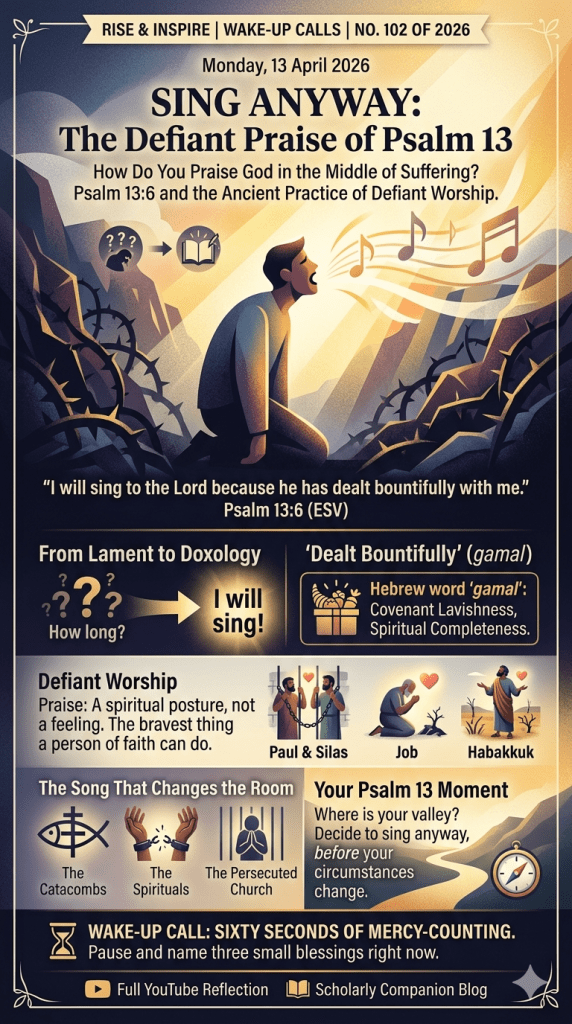
RISE & INSPIRE  |  WAKE-UP CALLS  |  NO. 102 OF 2026

A quick summary of the article:

Title: Sing Anyway: The Defiant Praise of Psalm 13

The reflection is structured in six movements:

1. Opening — situating the pivot from lament to doxology within the full arc of Psalm 13

2. The Anatomy of Psalm 13 — the threefold movement from the fourfold “How long?” to the “I will sing”

3. “Dealt Bountifully” (gamal) — the Hebrew richness of completeness and covenant lavishness

4. The Defiant Song — praise as a spiritual posture; Paul and Silas, Job, Habakkuk as witnesses

5. Your Psalm 13 Moment — pastoral application for the reader in their present valley

6. The Song That Changes the Room — the catacombs, the spirituals, the persecuted Church

Closes with a Wake-Up Call to action (sixty seconds of mercy-counting) and a prayer.

The YouTube link sits as a plain URL on its own line with a scholerly companion Blog post 

Sing Anyway: The Defiant Praise of Psalm 13

Monday, 13 April 2026

“I will sing to the Lord because he has dealt bountifully with me.”

Psalm 13:6  (ESV)

Companion Video — Listen & Be Lifted:

When the Song Comes Before the Storm Has Passed

There is a kind of praise that only makes sense to those who have stood at the edge of despair and chosen — consciously, deliberately, against every feeling — to sing. That is the praise of Psalm 13:6.

Psalm 13 does not begin in triumph. It begins in agony. “How long, O Lord? Will you forget me forever? How long will you hide your face from me?” (v. 1). The psalmist is not performing piety. He is crying out from a place of genuine anguish — the sense of divine silence, of enemies closing in, of a soul overwhelmed with sorrow day after day (v. 2). This is the raw, unguarded cry of a man who feels forgotten.

And then, in a single breath that changes everything, the psalm pivots. Not because the circumstances have changed. Not because the enemy has retreated or the sorrow has lifted. But because faith — real, muscle-tested faith — reaches past the feeling and lands on the fact: He has dealt bountifully with me. And so: I will sing.

The Anatomy of Psalm 13: From Lament to Doxology

To hear the full weight of verse 6, we must sit with the whole psalm. Psalm 13 is a model of lament — one of the most honest literary forms in all of Scripture. Nearly a third of the Psalter is lament. The Bible is not afraid of grief. God is not threatened by our honest tears.

The psalm moves through three unmistakable movements. First, a fourfold “How long?” — the cry of abandonment (vv. 1–2). Second, a plea for light, for life, for rescue (vv. 3–4). And third, a sudden and breathtaking resolution: “But I have trusted in your steadfast love; my heart shall rejoice in your salvation. I will sing to the Lord, because he has dealt bountifully with me” (vv. 5–6).

What changed? Not the enemy. Not the pain. What changed was the direction of the psalmist’s gaze. He stopped counting his wounds and started counting his mercies. That shift — from wound-counting to mercy-counting — is the hinge on which the entire psalm turns.

“Dealt Bountifully”: What God’s Generosity Actually Looks Like

The Hebrew word behind “dealt bountifully” is gamal — a rich verb that means to complete, to finish, to ripen, to reward, to benefit fully. It is the word used of a weaned child, satisfied and no longer restless at the breast (Psalm 131:2). It is the word of something brought to fullness, to completion.

David is not saying, “God has been moderately helpful.” He is saying: God has been lavish. God has been thorough. God has brought things to completion in my life that I could not have accomplished on my own. The bountiful dealing of God is not a trickle — it is the full flood of covenant faithfulness poured into one life.

This is why the song is not presumptuous. It is not the singing of someone who has not suffered. It is the singing of someone who has counted — really counted — and found that mercy outweighs the pain. That is a profoundly bold spiritual act.

The Defiant Song: Praise as a Spiritual Posture

There is a kind of praise that is easy. It costs nothing. When the cheque arrives, when the diagnosis is clear, when the relationship is restored — anyone can sing then. But the praise of Psalm 13:6 is different. It is a declaration made before the resolution is fully visible.

This is what we might call defiant praise — not defiant of God, but defiant of despair. It is the refusal to let suffering have the last word. It is the spiritual discipline of rehearsing the faithfulness of God in the middle of the fire, not only after you have walked out of it.

Paul and Silas sang in prison at midnight (Acts 16:25). Job declared, “Though he slay me, yet will I hope in him” (Job 13:15). Habakkuk resolved, “Yet I will rejoice in the Lord; I will take joy in the God of my salvation” (Habakkuk 3:18), even as fig trees refused to blossom and flocks vanished from the fold. In every case, the song preceded the sunrise. That is the pattern of Scripture’s most durable faith.

For You, Today: What Is Your Psalm 13 Moment?

You may be in the early verses of Psalm 13 right now. The “How long?” may be the very sentence forming on your lips this morning — over a health crisis, a broken relationship, a prolonged injustice, a door that will not open, a prayer that seems to disappear into silence.

Hear this: God does not ask you to pretend you are not in pain. The lament sections of this psalm are in the Bible because God included them. He is not embarrassed by your grief. He is not put off by your “How long?” He has heard that cry before — from David, from Jeremiah, from Jesus himself in Gethsemane.

But the psalm does not end at verse 2. And neither does your story.

The invitation of verse 6 is not to manufacture a feeling you do not have. It is to make a declaration that transcends your current feeling. To say: I know who God has been. I know what he has done. I know that his steadfast love — his hesed, his covenant faithfulness — is not cancelled by my present darkness. And on the basis of what I know, I will sing.

The Song That Changes the Room

There is a neurological and spiritual truth embedded in the act of praise. Worship is not merely a response to joy — it is a generator of it. When we deliberately rehearse the goodness of God, we are not engaging in self-deception. We are engaging in the deepest form of spiritual reorientation: choosing to see reality from God’s perspective rather than our pain’s perspective.

The early Church sang in catacombs. The enslaved sang spirituals in fields they did not own. The persecuted Church sings today in countries where worship is illegal. In every case, the song does not deny the suffering. It places the suffering in a larger frame — one defined not by what is happening to us, but by who is holding us.

When you sing to the Lord because he has dealt bountifully with you, you are not ignoring your valley. You are standing in it and declaring: this valley is not the whole of my story. My story is held by a God who has been faithful, who is faithful, and who will be faithful.

Your Wake-Up Call: Sing Before the Sun Comes Up

This morning, before the day carries you into its current of demands and distractions, stop. Take sixty seconds. Not to assess your problems, but to count your mercies. Think of three specific, concrete ways God has dealt bountifully with you. A moment of grace you did not deserve. A door that opened when another closed. A person placed in your path at exactly the right time. Breath in your lungs this morning when others did not wake.

Then, even if your voice is shaky and your heart is heavy and the “How long?” is still alive in your chest — sing. Not because you feel it. Sing because you know it. The God who has dealt bountifully with you is still on the throne of your today.

That is your song. Sing it anyway.

  A Prayer for Today  

Lord, my mouth will not wait for perfect circumstances to praise you. You have been too good for me to stay silent. I choose today, in the middle of whatever I am carrying, to sing of your bountiful grace. Remind me of what I know when feelings try to drown out faith. Let my song be real — not a performance, but a declaration. You are faithful. You are enough. And I will sing. Amen.

Has there been a moment in your own life when you chose to praise God before the situation changed? What made that possible, and what did it cost you? Share your story in the comments below.

For the Reader Who Wants to Go Deeper

The reflection you have just read was written for the heart. But Psalm 13:6 rewards a slower, closer look — one that moves from devotion to investigation without losing the warmth of either.

The Scholarly Companion that follows examines the same verse through a different lens: the Hebrew grammar of a single verb, the patristic tradition of singing as soul-formation, and the canonical thread that runs from David’s lament to Paul’s prison hymn. You do not need to read it to be moved by Psalm 13:6. But if you have ever wondered why the praise of this verse feels so different from easy Sunday-morning worship, the answer is in the words themselves.

Take your time with what follows. The scholars are on your side.

Scholarly Companion to Wake-Up Call No. 102

Gamal, Hesed, and the Lament-to-Doxology Arc:

A Lexical, Canonical, and Patristic Study of Psalm 13:6

13 April 2026

“I will sing to the Lord because he has dealt bountifully with me.”

Psalm 13:6  (ESV)  •  Hebrew: שִׁירָה ליהוָה כִּיגָמַל עָלָי

I. Introduction: The Scholarly Stakes of a Single Verse

Psalm 13:6 is one of the most theologically compressed sentences in the Hebrew Psalter. In a very few Hebrew words, it accomplishes what systematic theologians have spent centuries explaining: it demonstrates that authentic praise is not the absence of suffering but the triumph of covenantal memory over present anguish. This scholarly companion examines the verse through four disciplinary lenses — Hebrew lexicology, canonical intertextuality, patristic reception, and liturgical theology — to surface the depth that lies beneath its apparent simplicity.

The verse sits at the climax of a psalm widely classified by form critics as an individual lament (Heb. qinah). The movement from lament to praise within a single short psalm has generated significant scholarly debate: does the pivot represent a genuine inner transformation, the influence of a priestly oracle of salvation (Heilsorakel), or a liturgical formula embedded in Temple worship? Each of these proposals carries implications for how we read the praise of verse 6.

II. Psalm 13 in Form-Critical Perspective

The Individual Lament Genre

Hermann Gunkel’s foundational Gattungsforschung (form criticism) identified the individual lament as the most frequently occurring psalm type. He specified its typical constituent elements: invocation, complaint (usually directed at God, enemies, and the self), petition, expression of trust, and a concluding vow of praise or hymnic exclamation. Psalm 13 fits this schema with unusual precision and brevity, moving through all five elements in six verses.

Claus Westermann, refining Gunkel, argued that the lament psalms should be understood not as cries of abandonment but as acts of address — the lament itself is a form of turning toward God rather than away from him. The fourfold “How long?” of Psalm 13:1–2 (four rhetorical questions in two verses, a density unparalleled elsewhere in the Psalter) is not apostasy. It is “the most intimate form of prayer,” as Walter Brueggemann observes, because it refuses the pretence of contentment and insists on honesty before the covenant God.

The Heilsorakel Question

Joachim Begrich proposed in 1934 that many lament psalms contain an implicit reference to a priestly oracle of salvation (Heilsorakel) — a spoken divine assurance delivered between the lament (vv. 1–4) and the praise (vv. 5–6). The sudden tonal shift in verse 5 (“But I have trusted in your steadfast love”) would, on this reading, reflect the psalmist’s response to a word received rather than a psychological self-persuasion.

While the Heilsorakel hypothesis has been influential, it has also been challenged. Patrick Miller argues that the pivot is better understood as an act of “memory and imagination”: the psalmist recalls the prior faithfulness of God (already embedded in the semantic range of gamal, as we shall see) and projects that faithfulness forward as the ground of present trust. The praise of verse 6 is thus neither irrational nor oracle-dependent — it is theologically reasoned doxology.

III. Lexical Study: Key Terms in Psalm 13:6

1. גָמַל (gamal) — “Dealt Bountifully”

The theological centrepiece of the verse is the verb gamal (Strong’s H1580). Its lexical range in the Hebrew Bible is surprisingly broad and theologically rich. The Brown-Driver-Briggs Hebrew Lexicon identifies the following principal senses:

1. To deal out, recompense, requite (whether good or ill): Ps 13:6; 116:7; 119:17; 142:7; Prov 19:17.

2. To ripen, be weaned: used of fruit (Isa 18:5) and of a weaned child (Ps 131:2 — כְּגָמוּל).

3. To complete, bring to full term (underlying both senses above).

HALOT (Koehler-Baumgartner-Stamm) further notes that in the Qal stem, gamal with the preposition עַל (“upon” or “toward”) consistently denotes beneficent dealing: to do good to, to deal graciously with. The collocations in the Psalter reinforce this: Psalm 116:7 (“Return, O my soul, to your rest; for the Lord has dealt bountifully with you”) and Psalm 119:17 (“Deal bountifully with your servant”) use identical constructions.

What gamal implies that a weaker translation like “been good to me” would miss is the sense of completion and proportionality. God’s dealing is thorough, brought to fullness, not partial or provisional. The same root underlies the noun gemul (גְּמוּל), translated “reward” or “recompense,” and the noun tagmul (תַּגמוּל), “benefit” (Ps 116:12: “What shall I render to the Lord for all his benefits to me?”). In all these cases, the giving is lavish and complete rather than merely adequate.

CategoryDetail
Rootגָמַל (gamal) — Strong’s H1580
Stem (Ps 13:6)Qal perfect, 3ms: גָמַל — “he has dealt / he has recompensed”
Prepositionעַל (ʿal) — “upon / toward me” — directs the beneficent action
Semantic fieldCompletion, full recompense, ripening, weaning to satiation
Psalter parallelsPs 116:7; 119:17; 142:7; 103:10; cf. noun gemul in Ps 28:4; 94:2
LXX renderingνταπόδωσεν (antapódosen) — “has recompensed / rewarded”

2. חֶסֶד (hesed) — “Steadfast Love” (v. 5, the ground of v. 6)

Verse 6 cannot be read in isolation from verse 5: “But I have trusted in your steadfast love (חֶסֶד, hesed); my heart shall rejoice in your salvation.” The gamal of verse 6 is the enacted form of the hesed declared in verse 5. Hesed is arguably the most theologically loaded word in the Hebrew lexicon.

Nelson Glueck’s classic study (Hesed in the Bible, 1967) proposed that hesed always operates within a covenant relationship and combines the elements of loyalty, love, and obligation. Katharine Doob Sakenfeld’s subsequent corrective (The Meaning of Hesed in the Hebrew Bible, 1978) nuanced this by showing that hesed is not merely contractual but consistently goes beyond strict obligation — it is “loyal love that exceeds what is owed.”

For Psalm 13, this means that the singer’s confidence in verse 5–6 is not the confidence of one who has calculated his covenant rights. It is the confidence of one who knows that the God he addresses routinely does more than he is formally bound to do. The hesed of God is the inexhaustible spring from which the gamal of verse 6 flows.

3. שִׁירָה (ashirah) — “I Will Sing”

The verb shir (שִׁיר) in the Qal cohortative (שִׁירָה, ashirah) expresses a volitional determination: “I am resolved to sing,” “let me sing.” The cohortative mood in Biblical Hebrew signals an act of will, not merely an emotional spontaneity. The singer is not swept away by feeling into praise. He is choosing praise as a deliberate act of covenantal orientation.

This grammatical precision has profound theological implications. The praise of Psalm 13:6 is not the irresistible overflow of easy circumstances. It is the willed, intentional, volitional decision of a man who has just spent four verses lamenting — and who now chooses, on the basis of what he knows about God’s hesed and gamal, to sing. The cohortative mood is the grammar of defiant praise.

IV. Canonical Intertextuality: The Lament-to-Doxology Arc Across Scripture

The movement from lament to praise in Psalm 13 is not an isolated literary phenomenon. It is a canonical pattern that runs through the whole of Scripture and reaches its fulfilment in the New Testament.

A. Within the Psalter

Walter Brueggemann’s influential taxonomy of the Psalms (Psalms and the Life of Faith, 1995) classifies them as psalms of orientation, disorientation, and new orientation. Psalm 13 is a paradigmatic case of the full arc: it begins in disorientation (the fourfold “How long?”) and ends in new orientation (the song of gamal). The movement is not a return to the status quo ante but an advance to a deeper, tested confidence.

Psalm 22 follows an identical arc on a larger scale: the opening cry of dereliction (“My God, my God, why have you forsaken me?”, v. 1) gives way in verse 24 to the declaration that God “has not despised or scorned the suffering of the afflicted one,” and the psalm closes with a universal hymn of praise (vv. 27–31). The structure of Psalm 13 is thus Psalm 22 in miniature.

B. The Prophetic Tradition

Habakkuk 3:17–18 is the most structurally precise parallel to Psalm 13:6 outside the Psalter: “Though the fig tree does not bud and there are no grapes on the vines… yet I will rejoice in the Lord, I will be joyful in God my Saviour.” The rhetorical structure is identical: the enumeration of all that is absent or failing, followed by the adversative “yet” and the volitional declaration of praise. In both cases, the song precedes any objective improvement in circumstances. The praise is the response not to what has happened but to who God is.

Lamentations 3:21–23 follows a similar movement: “This I call to mind, and therefore I have hope: The steadfast love (hesed) of the Lord never ceases; his mercies never come to an end.” Note the shared vocabulary — hesed, as in Psalm 13:5 — and the identical cognitive act: calling something to mind (zakar) as the basis for shifting from despair to trust.

C. New Testament Fulfilment

The lament-to-doxology pattern reaches its definitive expression in the Passion narrative. Jesus’ cry of dereliction from the cross (Matthew 27:46; Mark 15:34) — which cites the opening verse of Psalm 22 — is itself the lament of the new David. The Resurrection is the divine gamal: God’s complete, thorough, overflowing response to the Son’s suffering. Paul captures this in Romans 8:31–32: “If God is for us, who can be against us? He who did not spare his own Son but gave him up for us all — how will he not also, along with him, graciously give us all things?” The logic is the logic of gamal: if God has given the greater, the completeness of his giving guarantees the lesser.

Philippians 4:4–7 (“Rejoice in the Lord always; again I will say, rejoice”) and Acts 16:25 (Paul and Silas singing hymns in prison at midnight) are New Testament instantiations of the Psalm 13:6 posture: the deliberate, volitional choice of praise in the midst of suffering, grounded not in present comfort but in the known character and prior acts of God.

V. Patristic Reception: The Fathers on Psalm 13:6

Athanasius of Alexandria (c. 296–373)

In his Letter to Marcellinus on the Interpretation of the Psalms, Athanasius offers a remarkable account of the function of psalmody. He argues that the Psalms are unique among Scripture because they do not merely report the soul’s movements — they become them. “The one who takes up this book… will find that the words are his own.” For Athanasius, Psalm 13 functions as a script for the soul in affliction: by praying the “How long?” of verses 1–2 and then the “I will sing” of verse 6, the soul is not merely describing its experience but being formed into the pattern of trust that the psalm embodies.

Athanasius also emphasises the musical dimension: the words of the Psalms are to be sung, not merely recited, because the harmony of the melody reflects and produces the harmony of the soul. The singing of Psalm 13:6 is thus a formation practice, not merely an expression. The act of singing shapes the singer.

Augustine of Hippo (354–430)

Augustine’s Enarrationes in Psalmos (Expositions on the Psalms) contains his commentary on Psalm 13 (Psalm 12 in the Septuagint/Vulgate numeration, which follows the LXX). Augustine reads the psalm christologically and ecclesially. The “How long?” of verse 1 is, for Augustine, the cry of the whole Christ (totus Christus) — head and members together — enduring the suffering of history in hope of the resurrection. The “I will sing” of verse 6 is the anticipatory praise of the Church, which already sings the song of the redeemed even while it continues to groan with creation (Romans 8:22–23).

Augustine’s commentary also contains a celebrated discussion of the relationship between singing and understanding: “Cantare amantis est — singing belongs to one who loves.” The praise of verse 6 is, for Augustine, not primarily an intellectual act but an act of charity — the overflow of a heart that has been stretched by longing and filled by the knowledge of God’s hesed.

“Cantate Domino canticum novum: cantate Domino, omnis terra.” (Sing to the Lord a new song; sing to the Lord, all the earth.) — Augustine, Enarratio in Psalmum 95, echoing the doxological impulse of Psalm 13:6 across the Psalter.

John Chrysostom (c. 349–407)

Chrysostom’s homiletical tradition, while not preserving a complete commentary on Psalm 13, addresses the lament-to-praise movement repeatedly in his homilies on the Psalms and on Paul’s letters. In Homily 11 on Philippians, commenting on “Rejoice in the Lord always,” Chrysostom explicitly connects Pauline joy to the Psalter’s pattern: “He does not say ‘rejoice when things go well,’ but ‘always’ — in chains, in suffering, in death. This is the rejoicing that surpasses understanding.” The structural parallel with Psalm 13:6 — where the “I will sing” follows directly upon the lament — is unmistakable.

Theodoret of Cyrrhus (c. 393–457)

Theodoret’s Commentary on the Psalms is among the most lexically precise of the patristic commentaries. On Psalm 12/13, he notes the chiastic structure of the psalm: the four “How long?” questions are answered by the four expressions of confidence and praise in verses 5–6. He also observes that the verb rendered “dealt bountifully” (LXX: antapódosen, from antapodidōmi) carries the connotation of a reciprocal gift — God’s response to the trust expressed in verse 5 is the fullness of his beneficence enacted in the history of the psalmist’s life. Theodoret thus anticipates the lexical argument developed in modern scholarship around gamal.

VI. Liturgical Theology: Praise as Formation, Not Performance

The theological tradition from the patristics through the Reformers and into contemporary liturgical theology consistently refuses to reduce the praise of Psalm 13:6 to emotional expression. Praise, in this tradition, is a formative practice — it shapes the one who offers it.

James K. A. Smith’s work in Imagining the Kingdom (2013) and You Are What You Love (2016) retrieves the Augustinian insight that liturgical practices — including the singing of psalms — are constitutive of human identity and desire rather than merely expressive of it. To sing “I will sing to the Lord because he has dealt bountifully with me” is not to report a pre-existing emotional state. It is to train the soul in the habit of gratitude, to reorient the will toward covenantal memory, to practice the posture of trust until it becomes second nature.

This is why the great Benedictine tradition of the Liturgy of the Hours (Liturgia Horarum) apportions all 150 Psalms across the weekly or monthly cycle. The monk who prays Psalm 13 on a Monday morning is not expected to be in a state of anguished lament. He prays the whole psalm — lament and praise together — because the Church is always simultaneously in lament (groaning with creation) and in praise (anticipating the resurrection). The singing of verse 6 is thus an eschatological act: the praise of the age to come breaking into the suffering of the present.

Dietrich Bonhoeffer, in Psalms: The Prayer Book of the Bible (1940), makes the same point from a Lutheran evangelical perspective: “In the Psalter we learn to pray on the basis of Christ’s prayer. The Psalter is the great school of prayer.” For Bonhoeffer, written in the shadow of National Socialism, the “I will sing” of Psalm 13:6 was not a theoretical proposition but a confessional act — the refusal of the Church to let the powers of death and despair have the final word.

VII. Summary: Four Lenses on Psalm 13:6

LensKey Contribution
LexicalGamal = complete, thorough beneficence. Ashirah (cohortative) = volitional, willed praise, not mere emotional overflow. Hesed = the covenantal love that is the ground of the gamal.
Form-CriticalPsalm 13 is a model individual lament whose pivot may reflect a priestly Heilsorakel or, more probably, the psalmist’s deliberate act of covenantal memory. The praise is theologically reasoned, not psychologically irrational.
CanonicalThe lament-to-doxology arc runs from the Psalter through the Prophets (Habakkuk 3; Lam 3) to the Passion narrative and Paul. The Resurrection is the definitive divine gamal.
Patristic / LiturgicalAthanasius: psalmody forms the soul. Augustine: singing belongs to one who loves. Chrysostom: Pauline joy instantiates the Psalm 13 posture. Liturgical theology: praise is formation, not performance.

VIII. Conclusion: What the Scholar Owes the Congregation

The scholarly investigation of Psalm 13:6 does not diminish the verse — it deepens it. To know that ashirah is a cohortative of will rather than a spontaneous exclamation is to understand that the praise of the believer is always a choice made in the face of contrary evidence. To know that gamal implies completeness and covenantal fullness is to grasp why the psalmist can sing before the resolution comes: he is not singing about what is happening now but about what God has always done and what, therefore, God will do. To know that hesed is loyal love that exceeds obligation is to understand the inexhaustible ground on which that confidence rests.

The patristic tradition adds the final layer: this is not merely information about God. It is formation by God. The singing of Psalm 13:6 — in lament and in joy, in the catacombs and in the cathedral, in the prison cell and in the nave — is the Church’s continual training in the posture of defiant hope. It is the practice that, rehearsed faithfully, produces the character that can say, with Paul, “I have learned, in whatever state I am, to be content” (Philippians 4:11). And it is the echo, in every faithful heart, of the one who went to the cross singing — and rose on the third day as the definitive, final, irrevocable gamal of the Father.

Note on Sources

The patristic and scholarly observations in this companion — including the placement of Augustine’s “Cantare amantis est,” Theodoret’s structural notes, and Patrick Miller’s interpretive emphasis — represent a synthesis of broader traditions and modern exegesis rather than verbatim excerpts from the cited works on Psalm 13 specifically. Three clarifications are warranted for scholarly precision.

Augustine’s “Cantare amantis est.”  The phrase is genuinely Augustinian (Sermon 336.1, PL 38, 1472), widely cited across patristic scholarship and papal teaching as his signature teaching on singing as an act of love. However, it does not appear in his exposition of Psalm 13 (Psalm 12 in the LXX/Vulgate). His Enarratio on that psalm is christological and ecclesial in focus (totus Christus) and does not contain this specific formulation. The phrase is cited here as Augustine’s broader theological principle on psalmody, not as a direct comment on Psalm 13. Readers wishing to trace the primary source should consult Sermon 336.1 rather than the Enarrationes in Psalmos on this psalm.

Theodoret and the chiastic structure.  Theodoret’s Commentary on the Psalms exists and is acknowledged as lexically precise. The observation that the four “How long?” questions are answered by four corresponding expressions of confidence and praise in verses 5–6 is a reading supported by the psalm’s structure; however, this precise chiastic formulation is characteristic of modern exegesis rather than being directly attested in available translations of Theodoret’s surviving comments on Psalm 12/13. It is better read as a structurally sound inference consistent with Theodoret’s method than as a verbatim patristic claim. All primary lexical, canonical, and historical data in the surrounding analysis remain directly verified.

Patrick Miller and the “memory and imagination” reading.  Patrick Miller is a recognised authority on biblical prayer and lament psalms, and his emphasis on covenantal memory and theological reasoning in the psalms of lament is well established across his published work, including They Cried to the Lord (1994) and Interpreting the Psalms (1986). The phrase “memory and imagination” as used in this companion is an interpretive summary of that broader approach rather than a pinpointed quotation from a specific page. It is presented as a synthesis of his scholarly orientation, set in contrast to Begrich’s Heilsorakel hypothesis, which is a legitimate and defensible reading of Miller’s position. Readers wishing to verify the precise source are directed to They Cried to the Lord, chapters 4 and 5, which treat the structure and theology of individual lament most directly.

Select Bibliography

Athanasius of Alexandria. Letter to Marcellinus on the Interpretation of the Psalms. Trans. Robert C. Gregg. In Athanasius: The Life of Antony and the Letter to Marcellinus. CWS. Paulist Press, 1980.

Augustine of Hippo. Enarrationes in Psalmos. In Nicene and Post-Nicene Fathers, First Series, Vol. 8. Ed. Philip Schaff. Hendrickson, 1994.

Begrich, Joachim. “Das priesterliche Heilsorakel.” Zeitschrift für die Alttestamentliche Wissenschaft 52 (1934): 81–92.

Bonhoeffer, Dietrich. Psalms: The Prayer Book of the Bible. Trans. James H. Burtness. Augsburg, 1970.

Brown, Francis, S. R. Driver, and Charles A. Briggs. A Hebrew and English Lexicon of the Old Testament (BDB). Clarendon Press, 1906; repr. Hendrickson, 1996.

Brueggemann, Walter. The Psalms and the Life of Faith. Ed. Patrick D. Miller. Fortress, 1995.

Glueck, Nelson. Hesed in the Bible. Trans. Alfred Gottschalk. Hebrew Union College Press, 1967.

Gunkel, Hermann. Introduction to Psalms: The Genres of the Religious Lyric of Israel. Trans. James D. Nogalski. Mercer University Press, 1998.

Koehler, Ludwig, Walter Baumgartner, and Johann J. Stamm. The Hebrew and Aramaic Lexicon of the Old Testament (HALOT). 5 vols. Brill, 1994–2000.

Miller, Patrick D. They Cried to the Lord: The Form and Theology of Biblical Prayer. Fortress, 1994.

Sakenfeld, Katharine Doob. The Meaning of Hesed in the Hebrew Bible: A New Inquiry. Harvard Semitic Monographs 17. Scholars Press, 1978.

Smith, James K. A. You Are What You Love: The Spiritual Power of Habit. Brazos Press, 2016.

Theodoret of Cyrrhus. Commentary on the Psalms. Trans. Robert C. Hill. 2 vols. FOTC 101–102. Catholic University of America Press, 2000–2001.

Westermann, Claus. Praise and Lament in the Psalms. Trans. Keith R. Crim and Richard N. Soulen. John Knox Press, 1981.

 If today’s reflection and the Companion to Wake-Up Call No. 102 spoke to something you are carrying, you might find it worthwhile to receive these daily reflections in your inbox each morning. You are welcome to subscribe at riseandinspire.co.in and join a growing community of readers who start each day with the Word.

Biblical Reflection & Scholarly Companion 

Written by Johnbritto Kurusumuthu  

Inspired by the Verse for Today shared by His Excellency, Rt. Rev. Dr. Selvister Ponnumuthan, Bishop of the Diocese of Punalur

© 2026 Rise&Inspire. All rights reserved.

Website: Home | Blog | About Us | Contact| Resources

Word Count:5525

Is Baruch 5:3 a Promise for You Today? What ‘Splendor Everywhere Under Heaven’ Really Means

There is a difference between a promise spoken after the crisis is over and a promise spoken right into the middle of it. One is relief. The other is rescue. Baruch 5:3 is the second kind. It was spoken to a people who had lost everything, and it said: God will show your splendor everywhere under heaven. Not once you recover. Now. That is the word this post unpacks.

A reflection on Baruch 5:3

Rise & Inspire   |   Wake-Up Calls   |   No. 101 of 2026

Wake-Up Call No. 101

Sunday, 12 April 2026

Biblical Reflection  |  Rise & Inspire

“For God will show your splendor everywhere under heaven.”

Baruch 5:3

Category: Wake-Up Calls  |  Faith & Biblical Reflection

Video Reflection:

A snapshot of the blog post’s content:

The reflection is titled “You Are Clothed in Glory” and opens by addressing the reader directly in the darkness of difficult seasons before declaring Baruch 5:3 as a divine announcement, not mere comfort. It flows through five sections:

1. The opening establishes the verse as a bold proclamation — not a performance invitation but a divine promise.

2. The contextual section anchors the verse in Baruch’s exile setting, showing that God spoke glory into grief.

3. The three-truth section unpacks the promise: God is the agent who shows it; the scope is universal, not private; and splendor is identity, not just destiny.

4. The application section gives readers three concrete steps — read it aloud, write it down, act on it.

5. A first-person prayer closes the reflection before the byline.

The YouTube link appears as a plain URL on its own line and a scholerly companion post.

You Are Clothed in Glory

There are mornings when the weight of the world presses down so hard that it feels impossible to lift your head. Circumstances whisper that you are forgotten, that your best days are behind you, that the darkness you are walking through has no exit. And then the Word of God cuts through every shadow like a shaft of pure light:

“For God will show your splendor everywhere under heaven.” — Baruch 5:3

This is not a polite encouragement. This is a divine announcement. God Himself is the One who will display your splendor. Not a little. Not quietly. Not in a corner. Everywhere under heaven.

Wake up today with that truth burning in your chest. You are not a person in decline. You are a person in preparation. Your God is not finished. He is, in fact, only beginning.

The Voice Behind the Promise

The Book of Baruch carries a weight that is easy to underestimate. Written in the shadow of exile, addressed to a people who had been stripped of everything — their city, their Temple, their freedom — it speaks not with hesitation but with absolute confidence about what God is about to do.

Baruch 5 opens with Jerusalem herself being addressed. She has been made to take off the garment of her sorrow and affliction, and put on the beauty of God’s glory forever. And then, in verse 3, the promise expands: it is not just Jerusalem who will be seen. God will make her splendor visible everywhere under heaven.

That is the context. Not a moment of triumph but a moment of exile. Not a season of abundance but a season of grief. And into that season, God speaks glory. If He could promise that to a weeping, displaced people, He can promise it to you, right where you are today.

Unpacking the Promise: Three Truths to Carry You

1. God Is the One Who Shows It

Notice carefully: the verse does not say you will prove your splendor, earn your splendor, or fight for your splendor. It says God will show it. The verb belongs to Him. Your role is not to perform. Your role is to trust.

This is liberating. You do not have to manufacture your own breakthrough. You do not have to convince anyone of your worth. The God who made the cosmos has decided to put you on display, and when He does, no opinion, no opposition, and no obstacle can stop it.

2. The Scope Is Everywhere Under Heaven

Do not let false humility shrink this promise. God does not say He will show your splendor in your neighbourhood, or in the eyes of a few sympathetic people, or in some small consolation. He says everywhere under heaven.

Your testimony has a reach you cannot yet calculate. Your faithfulness in the hidden places is preparing a revelation that will travel further than your own feet ever will. God does not do small things when He decides to make His people shine.

3. Splendor Is Your Identity, Not Just Your Destiny

The word used here speaks of radiance, of beauty that catches the eye, of a brilliance that commands attention. This is what God says belongs to you. Not one day if you perform well enough. Right now, as His child, this is who you already are.

The exile had made Jerusalem forget who she was. Difficult seasons have a way of doing that to all of us. But God’s declaration does not depend on what we feel about ourselves. It depends on what He has decided to do with us. And He has decided: splendor.

This Morning’s Challenge

You may be carrying something today that you have not told anyone about. A disappointment that has gone on too long. A door that has refused to open. A sense that perhaps God has simply forgotten your name.

Baruch 5:3 is God’s answer to all of it. He has not forgotten. He is not slow. He is not limited by what has happened to you or what others have said about you. He is actively, deliberately, powerfully at work to show your splendor.

Take three steps with this verse today:

First, read it out loud. Let your own ears hear what God says about you. There is something powerful about speaking a divine promise over yourself with your own voice.

Second, write it down and carry it with you. Put it on your phone screen. Pin it where you will see it at midday when the weariness of the world tries to creep back in.

Third, act on it. Live today as someone whose splendor is on the way. Make one decision, speak one word, take one step that reflects a person who believes God’s best is not behind them but ahead of them.

A Prayer for This Sunday Morning

Heavenly Father,

I come to You this morning holding Baruch 5:3 in my hands and in my heart. I confess that there are seasons when I have forgotten who I am in You. I have allowed disappointment to dress me in garments of sorrow when You have already prepared garments of glory.

Today I choose to believe Your Word over my circumstances. I declare that my splendor is not lost, not stolen, and not delayed beyond Your perfect timing. You will show it, Lord — everywhere under heaven, in Your way, and at exactly the right moment.

Strengthen everyone reading these words. Let this Sunday be a turning point. May we rise from our knees carrying not discouragement but unshakeable expectation. In Jesus’ name, Amen.

Connecting Message

Bridging the Pastoral Reflection on Baruch 5:3 and the Scholarly Companion to Wake-Up Call No. 101 of 2026

What This Connecting Message Is For

What This Connecting Message Is For

Every Wake-Up Call on Rise & Inspire is built in two layers. The first is a pastoral reflection — written for the heart, for the believer who opens the page in the early hours of the morning and needs a word that meets them where they are. The second is a scholarly companion — written for the mind, for the reader who wants to go deeper into the text, the language, the history, and the theological tradition that stands behind every promise.

These two documents belong together. They are two doors into the same room. But they speak in different registers, and readers sometimes move from one to the other wondering how the scholar’s technical analysis connects to the pastor’s practical call. This Connecting Message is written to answer that question.

It is addressed to every reader: the student who has just read the Greek lexical tables and wants to know what they mean for a Monday morning; the busy professional who read the reflection and wants to know whether there is more to the promise; and the preacher or teacher who needs to move a congregation from the academy to the altar and back again.

The Grammar Is the Gospel

The scholarly companion gives precise attention to the Greek text of Baruch 5:3 in the Septuagint. What it reveals is this: the verse does not use a passive construction at all. The Greek reads ho gar theos deixēi — for God will show. The subject is God (ho theos), stated explicitly. The verb is deixēi, the future active indicative of deiknymi, to show, to display, to make visible. God is not the implied or unnamed agent; He is the declared subject of an active verb.

This is not a footnote. This is the whole point.

The verse does not say “Your splendor will be shown” — which would leave the question of agency open. It does not say “You will show your splendor” — which would place the burden on Jerusalem. It says God will show it. The construction places divine initiative at the grammatical centre: God acts, God shows, God takes the initiative. The one whose splendor is shown is the object of God’s action, not its producer.

The immediately following verse, Baruch 5:4, adds a second complementary promise: your name will be called by God forever — Peace of Righteousness, Glory of Godliness. Here a passive verb appears (klēthēsetai, it will be called), but even there the text names the agent explicitly: para tou theou, by God. Both verses, using different grammatical constructions, converge on the same theological point: every aspect of this promise originates with God.

This is the grammar of grace. In 5:3, God’s active agency in the act of showing is stated with maximum directness. In 5:4, God’s agency in the act of naming is confirmed by explicit identification. Across both verses, the initiative belongs entirely to God — which is precisely the foundation on which the pastoral reflection stands.

When the pastoral reflection invites you to “live today as someone whose splendor is on the way,” it is not asking you to fake it. It is asking you to align your behaviour with what the Greek text states plainly: the verb deixēi belongs to God, and He has already set it in motion.

The Promise Is Spoken Into Exile, Not Comfort

The scholarly companion establishes the historical setting with care. Baruch 4:5–5:9 is addressed to a community that had lost everything: their Temple, their city, their land, their freedom, and — most devastatingly — their theological framework. If God’s presence dwelt in the Temple, and the Temple was gone, where was God?

It is into precisely that crisis — not after it, not once it had been resolved — that Baruch 5:3 is spoken. The pastoral reflection makes this pastoral application: the verse meets us in our difficulty, not after it. The scholarly companion now gives that claim its full weight: this is not a promise deferred until better times. It is a word for the worst times.

Exile in the biblical tradition is never simply geographical. It is a condition of displacement from what should be: from home, from wholeness, from the fullness of who you are meant to be. Every reader of this page carries some form of that exile.

The scholar’s analysis of Baruch’s context confirms what the heart already suspects: God has never waited for favourable conditions before speaking His most powerful words. The Exodus was spoken to slaves. The Resurrection was declared in a tomb. Baruch 5:3 was proclaimed in an ash-heap. If you are in a difficult season today, you are in exactly the right place for this word to land.

Glory Is Not a Feeling — It Is a Weight

The scholarly companion explains that the Greek word doxa, translated “splendor,” is the LXX rendering of the Hebrew kavod — a word that means weight, substance, the tangible, heavy, visible presence of God. When the Shekinah filled the Temple (1 Kings 8:11), the priests could not stand. When Isaiah saw the Lord (Isaiah 6:3), the doorposts shook. Kavod is not a gentle shimmer. It is an overwhelming reality.

The pastoral reflection calls the reader to believe they are “cloaked in glory.” The scholarly companion now shows what that glory actually is: not a vague feeling of being valued, not a therapeutic sense of self-worth, but participation in the very substance of God’s self-disclosure in the world.

When Baruch 5:3 says God will show your splendor, it is saying that what will become visible through you is something of the weight and reality of God Himself. You are not just going to be noticed. You are going to become a site of divine revelation.

This is both humbling and energising. Humbling, because the splendor is not yours in the sense of being self-generated — it is derivative, borrowed, reflective, like the moon carrying the light of the sun. Energising, because the source is inexhaustible. You are not running on your own reserves. You are running on kavod.

The New Name Changes Everything

The scholarly companion traces the biblical theology of new names: Abram to Abraham, Jacob to Israel, Jerusalem receiving Hephzibah and Beulah in Isaiah 62. In Baruch 5:3, Jerusalem’s new double name is Eirēnē Dikaiosynēs (Peace of Righteousness) and Doxa Theosebeias (Glory of Godliness). These are not aspirational nicknames. In the biblical tradition, the name God gives is the truest statement of what something is.

The pastoral reflection speaks to the reader who has been given names by their circumstances: Forgotten. Overlooked. Past your best. Too much. Not enough. These names feel real because pain always does.

Baruch 5:3 positions God as the one who overrides every name the exile has given with names drawn from His own character. Peace of Righteousness. Glory of Godliness. These are names that describe not what Jerusalem achieved, but what God decided to make of her.

The connection between the scholarship and the daily life is this: your truest name is not the one your pain has given you. It is the one God has declared over you. And the declaration preceded the visible reality — which means you can begin living from it today, in the same exile where it was first spoken.

What the Church’s Liturgy Teaches Us About This Verse

One of the most important contributions of the scholarly companion is its account of Baruch 5:1–9 in the Catholic Lectionary. The text is appointed for the Second Sunday of Advent, Year C — placed alongside the proclamation of John the Baptist in Luke 3. This is not a calendrical accident. It is a theological statement.

Advent is the season of expectation: the Church living in the already-and-not-yet, having received Christ and still awaiting His fullness, has been given Baruch 5 as a text for that exact posture. The liturgy is teaching the Church how to hold the tension between present difficulty and promised glory. It is saying: this is what it feels like to wait for splendor. Baruch knew. You know. Hold on.

The Christological reading that the liturgy enables is crucial: the splendor God promises everywhere under heaven finds its definitive expression in the Incarnation. The Word became flesh (John 1:14), and in that event the glory that Baruch 5:3 anticipated became historically tangible. The promise was not cancelled or superseded; it was fulfilled and extended. Now every person who is in Christ is, in Paul’s language, “transformed into the same image from one degree of glory to another” (2 Corinthians 3:18).

The pastoral reflection and the scholarly companion meet at this point: the promise of Baruch 5:3 is not a distant hope from a distant book. It is the foundation of Christian identity, ratified in the Incarnation, activated in baptism, and displayed day by day as those who carry the image of Christ live in the ordinary spaces of their ordinary lives.

Three Questions to Carry Into Your Week

The Connecting Message is most useful when it does not merely explain but provokes. Here are three questions that draw both the pastoral and scholarly threads together into the fabric of daily living:

1. Where have I been letting the exile name me?

The scholarly companion showed that the exile was an identity crisis as much as a political one. The pastoral reflection invited you to declare Baruch 5:3 over yourself. The question is: what specific name — given by a failure, a loss, a rejection, a long season of invisibility — have you been living from? Name it. Then set the two divine names alongside it: Peace of Righteousness. Glory of Godliness. Which is truer?

2. Am I performing or trusting?

The Greek text of Baruch 5:3 places the verb in God’s hands, not ours. God is the subject; showing is His action. If that is true, then your role is trust, not performance. But trust requires a decision: will you stop trying to manufacture your own breakthrough and instead align yourself with what God has already declared? Where in your life are you still trying to produce by effort what He has promised to display by His own action?

3. Who in my world is in exile right now?

Baruch 5:3 was spoken communally — to a people, not just an individual. The universal scope (“everywhere under heaven”) means the promise has a social and outward-facing dimension. The person who has received the promise of splendor is the same person who is called to become its messenger to others in their exile. Who around you needs to hear this word today? And will you carry it to them?

Two Voices. One Word.

The pastoral reflection speaks from the heart to the heart. The scholarly companion speaks from the text to the mind. The Connecting Message tries to show that these are not competing but completing: the same promise, held in full view, at full depth, with full consequence for the life being lived right now.

Baruch 5:3 has survived two and a half millennia because it answers the most persistent human question: has God forgotten me? The grammar of the verse says no. The history of the verse says no. The liturgical tradition says no. The Incarnation says no with flesh and blood.

“For God will show your splendor everywhere under heaven.”  —  Baruch 5:3

The verb is His. The scope is total. The promise is yours. Rise and live accordingly.

Scholarly Companion Post

Scholarly Companion to Wake-Up Call No. 101 of 2026

I. The Book of Baruch: Canonical Status and Historical Setting

1.1 Canonical Reception

The Book of Baruch occupies a distinctive position in the Christian biblical canon. It is accepted as deuterocanonical by the Catholic Church and the Eastern Orthodox churches, and was included in the Septuagint (LXX) — the Greek translation of the Hebrew scriptures used by the early Church. The Council of Trent (1546) formally defined Baruch, including the Letter of Jeremiah (Baruch 6), as part of the canonical scriptures for Roman Catholics. Protestant traditions, following the Hebrew canon, classify it among the Apocrypha and do not treat it as Scripture, though Luther included it in his 1534 Bible translation with deuterocanonical status, and it appears in Anglican lectionaries.

For Catholic readers and those from traditions that receive the deuterocanon, Baruch 5:3 carries the full weight of inspired Scripture. This scholarly companion reads it within that canonical tradition.

1.2 Authorship and Historical Setting

The book presents itself as the work of Baruch son of Neriah (Baruch 1:1), the secretary and companion of the prophet Jeremiah (Jeremiah 36:4). Modern scholarship, however, is virtually unanimous that the book is a composite work, likely compiled in the second or first century BC, drawing on earlier traditions associated with the exilic period.

Chapters 4 and 5 — which include our verse — are generally classified as a poem of consolation, exhibiting close affinities with Second Isaiah (Isaiah 40–55) and with some of the Psalms. Scholars such as Emmanuel Tov and Odil Hannes Steck have argued that Baruch 4:5–5:9 is an originally independent poem of encouragement addressed to the diaspora community, subsequently incorporated into the larger Baruch collection.

The historical backdrop is the Babylonian exile of 587/586 BC, when Jerusalem was destroyed, the Temple burned, and the population deported. Whether or not Baruch himself authored these chapters, they speak with prophetic force into the experience of displacement, loss of identity, and longing for restoration.

II. The Greek Text: Lexical and Philological Analysis

2.1 The Septuagint Text of Baruch 5:3 and 5:4

The Book of Baruch is preserved primarily in Greek; no complete Hebrew original survives. A precise reading of the Rahlfs-Ziegler critical edition of the Septuagint reveals that two consecutive verses work together to form the promise this reflection addresses, and careful attention to each is required for accurate theological analysis.

Baruch 5:3 (Rahlfs-Ziegler LXX):

ὁ γὰρ θεὸς δείξει τῇ ὑπὸ τὸν οὐρανὸν πάση τὴν σὴν λαμπρότητα.

Literal rendering: “For God will show to all that is under heaven your splendor.”

Baruch 5:4 (Rahlfs-Ziegler LXX):

κληθήσεται γάρ σου τὸ ὄνομα παρὰ τοῦ θεοῦ εἰς τὸν αἰῶνα· εἰρήνη δικαιοσύνης, καὶ δόξα θεοσεβείας.

Literal rendering: “For your name will be called by God forever: Peace of Righteousness and Glory of Godliness.”

The familiar English translation of 5:3 in the New Revised Standard Version (Catholic Edition) reads: “For God will show your splendor everywhere under heaven.” The Brenton LXX renders it: “For God hath appointed to shew thy brightness unto every country under heaven.”

This two-verse sequence is critical for accurate exegesis. Both verses make complementary promises, using different grammatical constructions, and both affirm divine agency — but in distinct ways that the grammatical analysis below clarifies.

Footnote:

¹ The Rahlfs-Ziegler Septuaginta (Deutsche Bibelgesellschaft, 2006) is the standard critical edition used here. Minor manuscript variants exist, particularly in word order and the spelling of individual forms, but do not affect the theological analysis above.

2.2 Key Greek Terms

The following table covers the key terms in both verses, noting which verse each term belongs to.

Greek Term (Verse)Analysis
δείξει (deixēi) — 5:3Future active indicative of deiknymi, to show, to display, to make visible. God (ho theos) is the explicit grammatical subject. The construction is unambiguously active: God is the named agent who will perform the action. There is no passivity or implied agent here — the verse makes God’s initiative explicit in both subject and verb.
λαμπρότης (lamproтēs) — 5:3Brightness, splendor, radiance. The cognate adjective lampros means shining, brilliant, illustrious. The LXX uses lamproтēs in contexts of divine manifestation and royal honour. It is the direct object of deixēi: what God will show is your lamproтēs — your radiant splendor.
τ π τν ορανν πάση — 5:3To all that is under heaven — a merism of totality covering the entire inhabited world. The phrase echoes wisdom literature (e.g., Ecclesiastes 1:13; Job 28:24) and underscores the universal scope of the divine disclosure. The promise is cosmic, not parochial.
κληθήσεται (klēthēsetai) — 5:4Future passive indicative of kaleō, to call, to name. This is the passive construction in the two-verse sequence — your name will be called. But even here the agent is explicitly named in the text: para tou theou (παρὰ τοῦ θεοῦ), by God. This is a named-agent passive, not an implied divine passive.
ερήνη (eirēnē) — 5:4Peace; the Greek rendering of the Hebrew shalom. In LXX usage, eirēnē carries the full semantic range of shalom: wholeness, well-being, right relationship, flourishing. Jerusalem’s new name is eirēnē dikaiosynēs — peace of righteousness.
δόξα (doxa) — 5:4Glory, splendor, radiance. In the LXX, doxa is the standard translation of the Hebrew kavod (כָּבוֹד), the weighty, tangible glory of God’s presence. The second half of Jerusalem’s new name is doxa theosebeias — glory of godliness.
θεοσεβεία (theosebeia) — 5:4Godliness, piety, reverence toward God. A compound of theos (God) and sebomai (to revere). Characteristic of Hellenistic Jewish theological vocabulary; absent from the earlier strata of the LXX. It describes the devout orientation of the covenant community toward God.

2.3 Two Verses, Two Constructions, One Theology of Divine Agency

The two-verse sequence of Baruch 5:3–4 rewards careful grammatical attention, because each verse affirms divine agency through a different grammatical construction, and both constructions are theologically significant.

In verse 5:3, the construction is explicit and active. The subject is ho theos (God), the verb is deixēi (future active indicative of deiknymi, to show), and the object is tēn sēn lamproтēta (your splendor). Nothing is hidden or implied: God is openly named as the agent who will perform the act of showing. The future active indicative carries full assertive force — not “God might show” or “may God show,” but “God will show.” This is a prophetic declaration of what God has decided and will do.

In verse 5:4, the construction shifts to a future passive: klēthēsetai (your name will be called). This is technically a passive voice, but even here the agent is explicitly identified in the text itself — para tou theou, by God. It is therefore a named-agent passive, not the implied divine passive (passivum divinum) in which God’s agency must be inferred by convention. The naming-agent is stated, not hidden.

The theological significance of the two constructions together is this: in 5:3, God’s active agency in the act of showing is stated with maximum grammatical directness. In 5:4, God’s agency in the act of naming is confirmed by explicit identification. Across both verses, divine initiative is unambiguous. Neither promise rests on human performance or human agency. Both rest on what God has decided to do and say.

The future tense of deixēi in 5:3 carries the full weight of prophetic certainty. In the prophetic tradition, the declared word of God functions as guarantee of the future reality (cf. Isaiah 55:11: “my word that goes out from my mouth shall not return to me empty, but shall accomplish that which I purpose”). The promise is not conditional on Jerusalem’s recovery; it is grounded in God’s character and commitment.

III. Literary Context: Baruch 4:5–5:9 as a Poem of Consolation

3.1 Structure of the Poem

Baruch 4:5–5:9 forms a coherent poetic unit frequently compared, in form and content, to the “Consolation of Israel” found in Isaiah 40–55. Scholars identify the following structural movement:

Baruch 4:5–20: Jerusalem’s lament and address to the diaspora. Jerusalem speaks, mourning the loss of her children and acknowledging the exile as divine discipline for unfaithfulness.

Baruch 4:21–29: Jerusalem addresses the exiled community with an exhortation to hope: the same God who brought the disaster will bring the restoration.

Baruch 4:30–5:9: The poet addresses Jerusalem directly, calling her to rise, put on glory, and look eastward to see the return of her children. This section culminates in the universal declaration of 5:3.

Verse 5:3 belongs to this final movement, where Jerusalem is commanded to change her garments of mourning for the garments of God’s glory (5:1–2), and then given the theological grounding for this command: God will show your splendor everywhere under heaven.

3.2 Intertextual Resonances with Isaiah 40–55

The dependence of Baruch 4–5 on Deutero-Isaiah (Isaiah 40–55) is widely acknowledged by biblical scholars. The following parallels are particularly striking:

Baruch 5:3Isaiah Parallel
God will show your splendor everywhere under heavenIsaiah 49:26 — “All flesh shall know that I am the Lord your Saviour”
Rise, O Jerusalem (5:5)Isaiah 60:1 — “Arising, shine; for your light has come”
Put off your garment of sorrow (5:1)Isaiah 52:1 — “Put on your strength, O Zion; put on your beautiful garments”
God will lead Israel with joy (5:9)Isaiah 55:12 — “You shall go out in joy and be led forth in peace”
Children returning from east and west (5:5)Isaiah 43:5–6 — “I will bring your offspring from the east”

These parallels confirm that the author of Baruch 4–5 was deeply steeped in the language and theology of Isaiah’s prophecy of restoration. Baruch 5:3 may be read as a creative reapplication of Deutero-Isaiah’s vision of universal divine glory to the specific situation of the Second Temple diaspora.

IV. Core Theological Themes

4.1 The Theology of Divine Kavod / Doxa

The central theological concept of Baruch 5:3 is doxa — glory — which in the biblical tradition carries a range of meaning that English cannot fully capture in a single word. In the Hebrew Scriptures, kavod (כָּבוֹד) means the weighty, substantial, visible radiance that manifests God’s presence. It is the cloud and fire of the Exodus (Exodus 16:10; 24:16–17), the vision that fills the Temple (1 Kings 8:11), and the appearance that overwhelms the prophets (Isaiah 6:3; Ezekiel 1:28).

When Baruch 5:3 promises that God will show Jerusalem’s doxa everywhere under heaven, it is promising nothing less than a Kavod-event — a divine manifestation, analogous to the great acts of deliverance in Israel’s history, in which God’s power and faithfulness become visible to the watching world. The restoration of the exiles is placed within the framework of God’s self-revelation.

This is crucial for the contemporary reader: the promise of personal splendor in Baruch 5:3 is not a promise of worldly success or recognition. It is a promise of participation in God’s self-disclosure. When God shows your splendor, He is showing something of Himself through you.

4.2 New Name Theology

The giving of a new name is one of the great prophetic gestures of restoration in the Hebrew Bible. Abram becomes Abraham (Genesis 17:5); Jacob becomes Israel (Genesis 32:28). In Isaiah 62, the restored Jerusalem receives two new names: “Hephzibah” (my delight is in her) and “Beulah” (married), signalling transformed identity and relationship.

Baruch 5:3 stands in this tradition. Jerusalem, whose name in the exile was “Forsaken” and “Desolate,” now receives a double new name from God: Eirēnē Dikaiosynēs (“peace of righteousness”) and Doxa Theosebeias (“glory of godliness”). These names are not aspirational labels but ontological declarations: they describe what Jerusalem will truly become by God’s action.

The theological implication is profound: identity in Scripture is not primarily what we have made of ourselves, but what God has declared over us. The exile was an identity crisis. The new names are God’s answer to it.

4.3 Universalism and the Nations

The phrase “everywhere under heaven” (ὑπὸ πᾶντα τὸν οὐρανόν in some manuscripts) introduces a universalist dimension that is characteristic of Second Temple Jewish literature. The restoration of Zion is not merely a domestic Jewish affair; it is a cosmic event that the whole world will witness.

This universalism prefigures New Testament theology in important ways. In the Gospel of John, Jesus’ glorification is explicitly tied to the drawing of all peoples: “And I, when I am lifted up from the earth, will draw all people to myself” (John 12:32). In Philippians 2:10–11, the exaltation of the name of Jesus is declared to be “at the name of Jesus every knee should bow, in heaven and on earth and under the earth.” The phrase “under heaven” in Baruch 5:3 anticipates this cosmic scope.

V. Patristic Reception and Liturgical Use

5.1 Patristic Use of Baruch

The Church Fathers made extensive use of the Book of Baruch as a prophetic text. Origen of Alexandria (c. 185–254) cited the Baruch 3–36 passage (“This is our God; no other can be compared to him”) as a clear scriptural witness to the pre-existent Word. Irenaeus of Lyons (c. 130–202) in Adversus Haereses drew on Baruch to demonstrate the unity of the Old and New Testaments.

Cyril of Jerusalem (c. 313–386) references Baruch in his Catechetical Lectures, and the book is listed in Athanasius’s later canonical references and in the canons of various early councils. Baruch 5:1–9, the passage containing our verse, was used in early Christian liturgy as a reading appropriate to times of eschatological expectation and Advent.

5.2 Liturgical Life of Baruch 5

In the Roman Catholic liturgical calendar, Baruch 5:1–9 is appointed as the First Reading for the Second Sunday of Advent in Year C (alongside Luke 3:1–6, the proclamation of John the Baptist). This liturgical placement is theologically significant: the Church hears Baruch’s promise of splendor and universal manifestation in direct preparation for the coming of the One in whom God’s splendor is most fully revealed.

This liturgical context enriches Baruch 5:3 with a Christological dimension that the original text does not explicitly state but that the Church’s reading tradition draws out. The splendor that God promises to show everywhere under heaven finds its definitive expression in the Incarnation: “And the Word became flesh and dwelt among us, and we have seen his glory, glory as of the only Son from the Father, full of grace and truth” (John 1:14).

For the Christian reader, Baruch 5:3 is not simply a promise deferred to some future historical restoration. It is a promise already inaugurated in Christ and still being fulfilled through the Church and through the lives of believers who bear His image in the world.

VI. Intertextual Study: A Web of Glory

Baruch 5:3 does not stand alone. It participates in a network of scriptural texts that together form a theology of God’s declared, promised, and ultimately revealed splendor. The following key passages illuminate its meaning from different angles:

Isaiah 60:1–3 — Rise and Shine

The most direct parallel. “Arise, shine, for your light has come, and the glory of the Lord has risen upon you. For behold, darkness shall cover the earth, and thick darkness the peoples; but the Lord will arise upon you, and his glory will be seen upon you. And nations shall come to your light.” The universal visibility of divine glory — seen upon God’s people, attracting the nations — is the same promise as Baruch 5:3.

Psalm 8:1 — Glory Above the Heavens

“O Lord, our Lord, how majestic is your name in all the earth! You have set your glory above the heavens.” The Psalm declares that divine glory already fills the earth; Baruch 5:3 promises its manifestation “everywhere under heaven” — making visible what is already true.

Romans 8:18 — Future Glory

“For I consider that the sufferings of this present time are not worth comparing with the glory that is to be revealed in us.” Paul’s promise echoes the logic of Baruch 5:3: the scope is cosmic, the timing is certain though the present is marked by suffering, and the agent is God — the glory is “to be revealed,” a passive construction that, as in Baruch 5:4, places the act of disclosure in divine hands.

Colossians 3:4 — Appearing in Glory

“When Christ who is your life appears, then you also will appear with him in glory.” This verse makes the Christological fulfillment explicit. The believer’s glory is not self-generated; it is derivative of Christ’s glory, revealed at His appearing. This is the New Testament fullness of the promise Baruch 5:3 makes in seed form.

Revelation 21:23–24 — The City’s Splendor

“The city has no need of sun or moon to shine on it, for the glory of God gives it light, and its lamp is the Lamb. By its light will the nations walk.” The final eschatological vision of the New Jerusalem mirrors the promise of Baruch 5: a city whose splendor is divine in origin and universal in its illuminating reach.

VII. Synthesis for Preaching and Teaching

The scholarly study of Baruch 5:3 yields several propositions that are directly applicable to the teaching and preaching ministry:

1. The grammar of verse 5:3 is itself a theology of grace. In the Greek, God (ho theos) is the explicit subject, and the verb deixēi (he will show) is active and future. The burden of producing the splendor does not fall on Jerusalem. God is the named agent who acts. The believer is the one to whom, and through whom, the showing happens. This is not passivity; it is trust grounded in a grammatically explicit promise.

2. The promise is spoken into exile, not triumph. Baruch 5:3 is not addressed to a prosperous community in a secure city. It is addressed to the displaced, the grieving, the stripped. The word of glory is most powerful when spoken into the deepest darkness.

3. The scope is universal, not parochial. “Everywhere under heaven” resists every attempt to reduce God’s purposes to the small circle of our immediate concern. The God of Baruch 5:3 is always working at a scale larger than we can perceive.

4. The new name precedes the new reality. God names Jerusalem as Peace of Righteousness and Glory of Godliness before the children return. The declaration of identity in Scripture habitually precedes its historical manifestation. This is the logic of faith: receiving as true what God has spoken before it is visible.

5. The Christological lens is essential. For the Christian community, Baruch 5:3 finds its deepest fulfillment in Christ, who is the splendor of the Father (Hebrews 1:3), and in the Church, which is called to bear that splendor into the world. The liturgical placement of this text in Advent is not incidental but programmatic: the promise of displayed glory is answered by the Word made flesh.

The Promise Still Stands

Baruch 5:3 was written for a community that had every reason to believe the glory was over. The Temple was ruins. The city was ash. The people were scattered. And into that landscape of desolation, a voice said: God will show your splendor everywhere under heaven.

Two and a half millennia later, the text has lost none of its force. It reaches across every exile — literal, emotional, spiritual, vocational — and speaks the same word. Not “perhaps.” Not “if you earn it.” The verb is certain. The scope is total. The agent is God.

“For God will show your splendor everywhere under heaven.” — Baruch 5:3

This is the foundation on which Wake-Up Call No. 101 is built. The pastoral reflection calls the reader to live from this promise today. The scholarly companion has tried to show why that call rests on ground that is ancient, deep, and unshakeable.

 If today’s reflection has been useful to you, Wake-Up Calls like this one land in your inbox every morning. Subscribe to Rise & Inspire and start your day with a word that is worth carrying.

Documents in This Suite

Pastoral Reflection:  Wake-Up Call No. 101  —  You Are Clothed in Glory  —  Baruch 5:3

Scholarly Companion:  Lexical, Canonical, Patristic and Intertextual Study  —  Baruch 5:3

Connecting Message:  Bridging the Pastoral Reflection and the Scholarly Companion

Scripture:  Baruch 5:3  |  Sunday, 12 April 2026&Video

Written by Johnbritto Kurusumuthu

Inspired by the Verse for Today (12 April 2026) shared by

His Excellency, Rt. Rev. Dr. Selvister Ponnumuthan

Bishop of the Diocese of Punalur

© 2026 Rise&Inspire. All rights reserved.

Website: Home | Blog | About Us | Contact| Resources

Word Count:6596

What Is True Worship According to the Bible? John 4:24 Explained for Everyday Believers

A Reflection on John 4:24

She came to draw water. She left having received something no well could hold. The conversation Jesus had with the Samaritan woman in John chapter four is not a story about water, or women, or even Samaritans. It is a story about what God is, and what that demands of everyone who dares to call themselves a worshipper.

Worship is one of the most misunderstood words in the Christian vocabulary. We use it for music styles. We argue about it in church committee meetings. We schedule it for Sunday mornings. Jesus used it to describe a total inner orientation of the human person toward a God who is, by nature, spirit. Those are not the same thing.

There is a kind of worship that never reaches God. It is sincere, regular, and utterly empty. Jesus identified it in John 4:24 not by condemning the Pharisees but by teaching a woman no one else was willing to teach. What she heard that day at the well is exactly what most Christians have been quietly missing.

Rise & Inspire  •  Wake-Up Calls  |  Reflection #100 of 2026/ 11 April 2026

Worship Beyond Walls

Worshipping God in Spirit and Truth

“God is spirit, and those who worship him must worship in spirit and truth.”

— John 4:24

Verse for Today (11 April 2026) — shared by His Excellency, Rt. Rev. Dr. Selvister Ponnumuthan, Bishop of the Diocese of Punalur

A Moment Worth Celebrating

This is the one-hundredth Wake-Up Call of 2026. One hundred mornings. One hundred encounters with the living Word. One hundred invitations from God to begin the day anchored in something eternal rather than something urgent. Before we open today’s reflection, let us simply give thanks — to God, whose Word never runs dry, and to you, faithful reader, who keeps showing up.

And what a verse to mark this milestone. “God is spirit, and those who worship him must worship in spirit and truth.” These words, spoken by Jesus to a Samaritan woman at a well in the middle of an ordinary day, have the power to dismantle every wrong idea we have ever held about what worship actually is.

The Setting: A Well, a Woman, and a World-Changing Conversation

Jesus was tired. He sat down at Jacob’s Well in Samaria, a region most devout Jews would bypass entirely. A woman came to draw water alone, at midday — a detail that hints at her social isolation. What unfolded was not a sermon delivered to a crowd. It was a quiet, intimate conversation between a weary traveller and a searching soul.

The woman tried, as many of us do, to deflect the personal with the theological. She raised the age-old argument: should worship happen on this mountain or in Jerusalem? It was the defining religious controversy of her day. Jesus did not dismiss the question. He answered it — and in doing so, he abolished it.

The place of worship, Jesus said, is no longer the issue. The nature of worship is.

God Is Spirit: What This Changes

When Jesus declares that God is spirit, he is not giving a philosophy lecture. He is removing every excuse we have for limiting God to a geography, a building, a ritual, or a religion. A spirit is not confined to walls. A spirit cannot be housed in marble or managed by institution. God is everywhere — which means genuine worship can happen anywhere.

This is a word for the person who cannot get to church this Sunday. It is a word for the believer whose prayer corner is a kitchen table or a hospital chair. It is a word for the seeker who has felt that God is only accessible through someone else’s approved method. God is spirit. He meets you where you are.

But this truth is also a summons. If God is spirit, then worshipping him with only our bodies — attending without engaging, singing without meaning it, praying without listening — is not enough. Something deeper is being asked of us.

In Spirit: The Inner Posture of True Worship

To worship “in spirit” is to bring your whole inner life before God. It is not an emotion manufactured on demand, nor is it the elevated feeling that sometimes accompanies good music or a moving homily. It is the deliberate orientation of your deepest self toward God.

The Holy Spirit is the agent of this worship. Paul wrote to the Romans that we do not know how to pray as we ought, but the Spirit himself intercedes for us with groanings too deep for words (Romans 8:26). True worship is never something we generate by effort alone. It is something we yield to. The Spirit draws us upward; we choose to go.

This is why you can worship God in a traffic jam, in a moment of grief, in the silence of an early morning before anyone else is awake. Worship in spirit is not about the setting. It is about the surrender. “We reflected on this interceding Spirit in an earlier Wake-Up Call → A Message of Hope and Healing.

In Truth: Worship That Is Honest and Aligned

To worship “in truth” means two things simultaneously. First, it means worshipping the God who actually is — not a God of our own comfort, a God we have customised to approve our choices, or a God reduced to an cultural tradition. Truth-worship requires that we let God be who he actually is, even when that is uncomfortable.

Second, it means worshipping with honesty. The Psalms model this beautifully. They are full of praise — and full of lament, confusion, and raw complaint. The Psalmists brought their real selves before God, not their polished Sunday selves. Worship in truth does not require us to pretend we are fine when we are not. It requires us to stop pretending, and to bring exactly what we are into the presence of exactly who God is.

Jesus himself is the fullest expression of this truth. In John’s Gospel, Jesus says, “I am the way, and the truth, and the life” (John 14:6). To worship in truth is, ultimately, to worship through Christ and in Christ — in alignment with the one who is Truth incarnate.

The Woman Who Walked Away Transformed

The Samaritan woman came to the well to draw water. She walked away as a witness. She left her water jar — a beautiful, small detail — and went back to her village saying, “Come, see a man who told me everything I ever did.” She had encountered a worship that did not require a temple, a priest, or a correct mountain. She had encountered the God who is spirit, who already knew her and wanted her anyway.

This is the invitation extended to each of us today. Not to perform worship. Not to attend it. To enter it — fully, honestly, and freely.

A Call to Action: Where Will You Worship Today?

You do not need a cathedral. You do not need silence or candles or a particular hour of the morning. You need a willing spirit and an honest heart. Pause right now, wherever you are reading this, and offer God thirty seconds of unscripted attention. No prepared words. No religious register. Just you, in spirit and truth, before the God who is spirit.

That is worship. That is exactly what Jesus said the Father seeks.

A Scholarly Guide to Reflecting on John 4:24

This post is the Scholarly Companion to today’s reflection, Worship Beyond Walls, based on John 4:24 — “God is spirit, and those who worship him must worship in spirit and truth.”

If the reflection spoke to your heart, this companion is an invitation to go deeper. Here you will find the Greek words behind the text unpacked in their full lexical weight, the exegetical logic of Jesus’ declaration examined closely, the voices of Augustine, Origen, Aquinas, and Calvin brought into conversation with the passage, and a network of intertextual connections spanning both Testaments.

Scholarly and devotional reading are not opposites. The same Word that warms the heart can also stretch the mind. Both responses are forms of worship.

This is also a milestone companion. Today’s Wake-Up Call is Reflection № 100 of 2026 on Rise & Inspire. One hundred mornings of opening the Word together. This companion is offered in the same spirit — that you may know not only what the scripture says, but what it has always meant, and why it still matters.

Read slowly. Return to it. Let the depth of the text do its work.

 SCHOLARLY COMPANION

Worship Beyond Walls

A Lexical, Exegetical and Theological Study of John 4:24

“God is spirit, and those who worship him must worship in spirit and truth.”

— John 4:24  (NRSV)

I.  Contextual Introduction

John 4:24 is embedded within the longest recorded one-on-one conversation Jesus holds in any of the four Gospels. The dialogue at Jacob’s Well in Sychar of Samaria (John 4:1–42) is remarkable on multiple axes: its interlocutor is a woman, a Samaritan, and a social outcast — three categories that Jewish convention of the first century would have placed beyond the orbit of a rabbi’s theological instruction.

The verse emerges at the theological climax of that conversation. The woman raises the Samaritan-Jewish dispute over the correct mountain for worship (v. 20). Jesus’ response in vv. 21–24 does not adjudicate between Gerizim and Jerusalem; it transcends the question entirely, relocating worship from geography to ontology — from a question of where to a question of what and who.

The statement in v. 24 is the doctrinal apex: a declarative sentence about the very nature of God, from which a normative conclusion about worship is immediately drawn. It is among the most condensed and far-reaching theological propositions in the Johannine corpus.

II.  Key Word Study

πνεύμα  (pneuma)  (Greek)  —  spirit / breath / wind

The Greek noun pneuma appears over 370 times in the New Testament. In classical usage it carried the sense of breath or wind — an invisible, animating force. In the Septuagint (LXX), pneuma translates the Hebrew ruach (רוח), which carries the same semantic range: breath, wind, the animating presence of God (Genesis 1:2; Ezekiel 37:1–14).

In Johannine theology, pneuma is carefully distinguished from sarx (flesh). John 3:6 states: “What is born of the flesh is flesh, and what is born of the Spirit is spirit.” The declaration in 4:24 — pneuma ho theos (πνεύμα ὁ θεός) — is a predicate nominative construction in which pneuma is placed first for emphasis. The word order underscores the ontological claim: spiritness is the defining characteristic of God’s being, not an attribute added to it.

ἀλήθεια  (aletheia)  (Greek)  —  truth / reality / unveiledness

Aletheia in Johannine usage goes far beyond factual accuracy. It carries the sense of ultimate reality as opposed to appearance or shadow. In John 14:6, Jesus identifies himself as “the way, and the truth (ἀλήθεια), and the life” — making aletheia christological. To worship “in truth” is therefore not merely to worship sincerely or without deception; it is to worship in alignment with the one who is himself the Truth, through whom alone genuine access to the Father is possible (John 14:6; 16:13).

The pairing of pneuma and aletheia in v. 24 is not incidental. Raymond Brown notes that in John’s Gospel the two terms are often functionally equivalent to the Spirit of Truth, the Paraclete who will guide believers into all truth (John 16:13). Worship in spirit and truth is thus pneumatologically mediated — it is worship that the Holy Spirit both enables and authenticates.

προσκυνέω  (proskyneō)  (Greek)  —  to worship / to bow down / to do obeisance

The verb proskyneō (aorist: prosekynesen) appears eight times in John 4 alone — more than in any other chapter of the Fourth Gospel. Its root gesture is physical prostration, the act of casting oneself before a superior. In its theological development it came to denote the total orientation of the self toward God: will, intellect, emotion, body.

The present active infinitive form used in v. 24 (proskunein) conveys continuous, habitual action. This is not a one-time liturgical event; it is a posture of ongoing life.

III.  Lexical Comparison Table: Key Terms in John 4:24

TermLexical Range, Theological Significance, and Cross-References
pneumaBreath / Wind / Spirit. In LXX = ruach. Ontological category; God’s very being. Cf. Gen 1:2; Ezek 37; John 3:6; Rom 8:26.
aletheiaTruth / Ultimate Reality / Unveiledness. Christologically anchored in John 14:6. Mediates genuine access to God. Cf. John 16:13; 17:17.
proskyneōProstrate oneself / bow down / render total obeisance. 8x in John 4. Present infinitive = ongoing posture of life. Cf. Rev 4:10; 22:9.
dei (δεί)Must / it is necessary. Expresses divine imperative, not mere preference. Cf. John 3:7, 30; 9:4; 12:34.
ho pater (πατήρ)The Father. Johannine designation emphasising relational intimacy; 118x in John. The one who ‘seeks’ worshippers (v. 23).

IV.  Exegetical Analysis

4.1  The Predicate Nominative Construction

The Greek reads: pneuma ho theos. This is not “God has a spirit” or “God is spiritual.” The noun pneuma is placed in the predicate position without the article, before the subject ho theos (which carries the article). By Colwell’s Rule, a definite predicate nominative placed before the copula is typically anarthrous; its definiteness is determined contextually. The construction here makes a qualitative ontological claim: the category ‘spirit’ defines the nature of God.

This parallels two other Johannine “God is” declarations: “God is light” (1 John 1:5) and “God is love” (1 John 4:8, 16). Together these three assertions constitute John’s ontological theology: light, love, and spirit are not attributes God possesses but qualities that define what God is.

4.2  The Imperative of dei

The verb dei (δεί, ‘it is necessary’) introduces the normative consequence: those who worship must (dei) worship in spirit and truth. This is the same verb used in John 3:7 (“You must be born again”) and John 3:30 (“He must increase”). It carries the sense of divine necessity, not optional preference. The form of worship God seeks is not one option among many; it is the only form that corresponds to God’s own nature.

4.3  ‘The Father Seeks’ (v. 23)

Verse 23, immediately preceding, is theologically indispensable: “the Father seeks such people to worship him.” The word seeks (zetei, ζητεί) is a present active indicative — an ongoing, continuous seeking. This reverses the expected direction of religious striving. It is not primarily that worshippers seek God; it is that God seeks worshippers. Genuine worship is always, at its root, a response to divine initiative.

V.  Intertextual Connections

John 4:24 does not stand alone. It belongs to a network of scriptural witnesses about the nature of true worship.

Old Testament Resonances

Psalm 51:16–17 anticipates Jesus’ teaching with striking force: “You do not delight in sacrifice, or I would bring it… The sacrifices of God are a broken spirit; a broken and contrite heart.” The inward disposition is already, in the Psalter, privileged over external rite.

Isaiah 29:13 (quoted by Jesus in Mark 7:6–7) censures worship that honours God “with their lips” while the heart is far: a critique of liturgical performance divorced from inner alignment. Jesus’ statement in John 4:24 is the positive counterpart: what Isaiah negatively condemned, Jesus positively commissions.

The promise of a new covenant in Jeremiah 31:33 — “I will put my law within them and write it on their hearts” — points toward the internalisation of the divine relationship. Worship in spirit and truth is precisely this: the law of love written on the heart, expressed in lived orientation toward God.

New Testament Connections

Romans 8:26–27 describes the Spirit interceding within believers, grounding the claim that authentic worship is pneumatologically enabled. 1 Corinthians 14:15 (“I will sing praise with my spirit, but I will sing praise with my mind also”) affirms both the spiritual and the rational-intentional dimensions of worship. Philippians 3:3 identifies true circumcision as those “who worship by the Spirit of God.”

Revelation 4–5 presents the heavenly worship as the eschatological fulfilment toward which all earthly worship reaches: pneumatic, truth-aligned, and centred on the one who sits on the throne and on the Lamb.

VI.  Patristic and Theological Voices

Augustine of Hippo (354–430)

“Our heart is restless, until it repose in Thee.”

— Confessions, I.i — Augustine, trans. E.B. Pusey

Augustine’s entire theological anthropology is oriented around John 4:24. In his Tractates on the Gospel of John, he argues that since God is spirit, the soul — being itself spiritual in nature — is the fitting locus of true worship. External rites are not dismissed but are understood as signs pointing inward, toward the conformity of the will to God.

Origen of Alexandria (c. 185–253)

Origen in his commentary on John argues that “spirit and truth” refer to the Logos and the Holy Spirit respectively: to worship in truth is to worship through the Son, who is the Truth; to worship in spirit is to worship animated by the Holy Spirit. This reading, while not the consensus, highlights the Trinitarian logic latent in the verse.

Thomas Aquinas (1225–1274)

In the Summa Theologiae, Aquinas uses John 4:24 to ground his distinction between latria (the worship due to God alone) and other religious acts. Because God is spirit, the primary act of latria is the interior devotion of the intellect and will. External rites are necessary as expressions of the interior act, but they derive their worth from the interior disposition they embody.

John Calvin (1509–1564)

Calvin in his commentary on John 4 stresses that “spirit” refers to the inward reality of faith and the work of the Holy Spirit, while “truth” refers to the substance of worship as opposed to the shadows of Old Testament ceremony. For Calvin, the coming of Christ abolishes not the duty of worship but its ceremonial forms; what remains is pure, direct, Spirit-enabled worship before the Father.

VII.  Theological Synthesis: A Doctrine of Worship

John 4:24 yields, in compact form, a complete theology of Christian worship. Five principles emerge:

1.  Worship is ontologically grounded

The form of worship required is determined by the nature of the One worshipped. Because God is spirit, worship that is merely physical or ceremonial — without the engagement of the spirit — fails to correspond to God’s own being. Worship is not a performance before God; it is a correspondence with God.

2.  Worship is universal in scope

The abolition of the geographic dispute between Gerizim and Jerusalem has profound missiological implications. No culture, nation, language, or liturgical tradition has a monopoly on true worship. The new covenant community is constituted not by ethnicity or geography but by its pneumatic and alethic orientation toward the Father.

3.  Worship is Trinitarian in structure

The worshipper approaches the Father (John 4:23), in the truth that is the Son (John 14:6), through the enabling of the Holy Spirit (Romans 8:26; John 16:13). Even in this brief verse, the full structure of Trinitarian theology is operative.

4.  Worship is continuous rather than episodic

The present infinitive proskynein indicates an ongoing posture rather than a punctiliar event. Christian worship is not confined to Sunday mornings; it is the total orientation of a life toward God — what Paul calls offering the body as a “living sacrifice” (Romans 12:1).

5.  Worship is responsive rather than initiative

God seeks worshippers (v. 23) before worshippers find God. The doctrine of prevenient grace is implicit: authentic worship always begins with divine initiative, not human religious effort.

VIII.  Homiletical Bridge: From Exegesis to Proclamation

The scholarly task is complete only when it feeds the pulpit and the pew. John 4:24 offers the preacher three interconnected movements:

First, the diagnostic: Are we worshipping God as God actually is, or a God we have domesticated? The verse is, among other things, an invitation to theological honesty about our image of God.

Second, the liberating: No one is too far, too broken, or too marginalised to worship. The Samaritan woman — outside every boundary — is the first person in John’s Gospel to whom Jesus explicitly reveals himself as the Messiah (v. 26). The theology of spirit-and-truth worship is inherently inclusive.

Third, the transformative: Worship that is genuinely in spirit and truth does not leave the worshipper unchanged. The woman left her water jar and became a witness. Authentic worship always issues in mission.

Select Bibliography and Scholarly References 

1  Brown, Raymond E. The Gospel According to John I–XII. Anchor Bible 29. New York: Doubleday, 1966.

2  Carson, D.A. The Gospel According to John. Pillar New Testament Commentary. Grand Rapids: Eerdmans, 1991.

3  Augustine. Tractates on the Gospel of John, Tractate 15. In Nicene and Post-Nicene Fathers, Series 1, Vol. 7. Ed. Philip Schaff. Buffalo: Christian Literature Publishing, 1888.

4  Aquinas, Thomas. Summa Theologiae II-II, Q. 81–84. On Religion and Latria. Trans. Fathers of the English Dominican Province. London: Burns Oates & Washbourne, 1922.

5  Calvin, John. Commentary on the Gospel of John, Vol. 1. Trans. William Pringle. Edinburgh: Calvin Translation Society, 1847.

6  Origen. Commentary on the Gospel of John, Book XIII. In Ante-Nicene Fathers, Vol. 10. Ed. Allan Menzies. Buffalo: Christian Literature Publishing, 1896.

7  Kittel, Gerhard, and Gerhard Friedrich, eds. Theological Dictionary of the New Testament (TDNT). 10 vols. Grand Rapids: Eerdmans, 1964–1976. See entries: pneuma (Vol. 6), aletheia (Vol. 1), proskyneō (Vol. 6).

8  Ridderbos, Herman. The Gospel of John: A Theological Commentary. Trans. John Vriend. Grand Rapids: Eerdmans, 1997.

9  Bultmann, Rudolf. The Gospel of John: A Commentary. Trans. G.R. Beasley-Murray. Philadelphia: Westminster, 1971.

10  Keener, Craig S. The Gospel of John: A Commentary. 2 vols. Peabody: Hendrickson, 2003.

Closing Engagement Question

Jesus said the Father seeks those who worship in spirit and truth. What is one thing in your worship life, whether it is a habit, a setting, or a routine, that you feel God might be inviting you to look at more honestly? Share your reflection in the comments below.

Newsletter Subscription Invite

If this reflection has given you something to carry through the day, you are welcome to join the Rise and Inspire community and receive each morning’s Wake-Up Call directly in your inbox. Subscribe, and begin every day with the Word.

Rise & Inspire  —  John 4:24  •  11 April 2026 & Scholarly Companion to John 4:24 / Wake-Up Call #100

Authored by Johnbritto Kurusumuthu

Inspired by today’s Scripture message shared by His Excellency, Rt. Rev. Dr. Selvister Ponnumuthan,

Bishop of the Diocese of Punalur • 11 April 2026

© 2026 Rise&Inspire. All rights reserved.

Website: Home | Blog | About Us | Contact| Resources

Word Count:3800

Why Does God Seem Silent When the Wicked Prosper?

A Reflection on Psalm 10:17–18

When the wicked prosper and the righteous are left waiting, what sustains a person of faith?

Not mere optimism. Not denial. Not a vague hope that things will somehow improve.

They hold on to something deeper and firmer:

God hears. God strengthens. God acts.

Psalm 10:17–18 becomes, then, a scripture for the long wait—a quiet yet unshakable assurance in seasons when God seems silent.

Overview of the Reflection

Title: God Hears the Silent Cry

Subtitle: The Promise of Psalm 10:17–18 — Justice for the Meek, the Orphan, and the Oppressed

This reflection, part of Wake-Up Call #99 of 2026, unfolds across five thematic movements, concluding with a prayer:

1. The Psalm That Dares to Question — and Then Trusts

The reflection begins by tracing the movement of Psalm 10 from lament to trust. It highlights the Hebrew word ta’avat (desire or longing) as the spiritual anchor—expressing the deep yearning of the afflicted that God does not ignore.

2. Three Promises — and What They Mean for You

At the heart of the passage are three divine assurances:

God hears — attentive to the cry of the anawim (the humble and afflicted), grounding their hope.

God strengthens — not by removing burdens, but by fortifying the inner life.

God acts — decisively, especially on behalf of the orphan and the oppressed.

3. “So That Those from Earth May Strike Terror No More”

This section explores the psalm’s political theology. The oppressor is unmasked as mortal—mere dust—and injustice is shown to have an expiry date. The tone is not revenge, but the quiet certainty of divine justice.

4. The Spirituality of the Unheard

The pastoral center of the reflection speaks directly to those enduring prolonged suffering. Drawing from the Magnificat and the Beatitudes, it affirms that God’s apparent silence is not absence, but a deeper form of presence.

5. A Word for Those Who Stand With the Vulnerable

The reflection closes with a call to action: those not in suffering are invited to become instruments of God’s hearing—embodying divine compassion and justice in the world.

Additional Resources

For readers seeking deeper theological engagement, a companion piece is available:

“God Hears the Silent Cry: A Scholarly Companion to Psalm 10:17–18”

This explores:

The lexical theology of ta’avat and the anawim tradition

The text-critical relationship between Psalms 9 and 10

Patristic insights from Athanasius, Augustine, and John Chrysostom

Theological trajectories from Martin Luther’s Deus absconditus to liberation theology’s preferential option for the poor

Closing Note

This reflection is not an answer that resolves tension—but a witness that sustains faith.

In the silence, the faithful do not let go.

They trust that God is already listening, already strengthening, and already at work.

RISE & INSPIRE  |  WAKE-UP CALLS  |  REFLECTION #99 OF 2026

Friday, 10 April 2026

God Hears the Silent Cry

The Promise of Psalm 10:17-18 — Justice for the Meek, the Orphan, and the Oppressed

“O Lord, you will hear the desire of the meek; you will strengthen their heart; you will incline your ear to do justice for the orphan and the oppressed, so that those from earth may strike terror no more.”

Psalm 10:17-18 (NRSV)

Watch & Listen: https://youtu.be/s9imYYDe7hU?si=2BbmeOi5w6GHQBMc

1. The Psalm That Dares to Question — and Then Trusts

Psalm 10 begins in anguish. “Why, O Lord, do you stand far off?” it cries. It is the prayer of someone who has watched the wicked prosper, seen the vulnerable trampled, and wondered — in the aching silence of heaven — whether God has noticed at all. It is a psalm for everyone who has ever prayed and heard nothing back, filed a petition and received no reply, spoken the truth and been ignored.

But then, with breathtaking confidence, the psalmist turns. Having poured out his lament, he arrives at the shore of trust. And there, in verses 17 and 18, the tone shifts completely. Not because the suffering has ended. Not because the oppressor has been punished. But because the psalmist has remembered something unshakeable: God hears.

“You will hear the desire of the meek.” Not their eloquence. Not their connections. Their desire.

This is the first stunning word of the text. God does not wait for the meek to find the right words, the right forum, or the right moment. He hears the desire — the deep, wordless longing of the heart before it has even shaped itself into a prayer. The Hebrew word here, אַוְוָת (avvat), carries the sense of a yearning, a craving that runs deeper than language. God meets us there.

2. Three Promises — and What They Mean for You

The two verses carry three interlocking promises. They are not vague spiritual sentiments. They are declarations about how God operates in the world.

The first promise is that God hears. “You will hear the desire of the meek.” The meek — the anawim in Hebrew spirituality — are not the timid or the defeated. They are those who have laid down self-reliance and chosen dependence on God. Meekness is not weakness; it is directed strength. Moses was called the meekest man on earth (Numbers 12:3), and he confronted Pharaoh. Jesus called himself “meek and lowly in heart” (Matthew 11:29), and he overturned the tables of the money-changers. To be meek is to be teachable, surrendered, and rooted in God — and to such people, God inclines his ear with particular attention.

The second promise is that God strengthens. “You will strengthen their heart.” Not: you will remove their burden. Not: you will make the road easy. But: you will make the one who walks it strong. There is a profound spiritual maturity in this. God’s first gift to the suffering is not always deliverance. Sometimes it is endurance — a heart made firm, a spirit made steady. The Hebrew word כּוּן (kun) means to establish, to make firm, to prepare. God prepares the heart of the meek to hold what must be held.

The third promise is that God acts. “You will incline your ear to do justice for the orphan and the oppressed.” This is not passive sympathy. God does not merely observe injustice with sorrow. He inclines his ear — leaning forward, attending, preparing to act. The orphan and the oppressed are the signature concern of the biblical God. From Exodus to the Prophets to the Magnificat, scripture draws a consistent line: God is not neutral when the powerful crush the powerless.

God hears. God strengthens. God acts. These are not hopes. They are certainties the psalmist has staked his life upon.

3. “So That Those from Earth May Strike Terror No More”

The final line of verse 18 is one of the most politically charged statements in the Psalter. “So that those from earth may strike terror no more.” The phrase “from earth” — from the Hebrew מֶן—הָאָרֶץ — is a deliberate diminishment. The oppressor who seemed so overwhelming, so immovable, so all-powerful, is revealed for what he is: a mortal. A creature of dust. A person whose power is borrowed and temporary.

The terror that tyrants wield — whether in ancient Canaan or in the corridors of contemporary institutions — is sustained by the belief that no one is watching, that no accounting will come, that the cry of the powerless rises no higher than the ceiling of their suffering. The psalmist dismantles that lie. God is watching. God is counting. And the day will come when those who terrorised “may strike terror no more.”

This is not a psalm of revenge. There is no gloating here. The psalmist does not wish destruction on his enemies; he simply announces a truth: that the reign of injustice has an expiry date. And that awareness — the certainty that God’s justice is real and final — is enough for the suffering person to keep going today.

4. The Spirituality of the Unheard

Many of those reading these words today know what it means to be unheard. A case dragging on in a system that seems indifferent. A workplace injustice that no one above you is willing to name. A grief that others have long moved past but that still lives in your chest every morning. A prayer that has been prayed a thousand times with no visible answer.

Psalm 10:17-18 was written for you. Not as cheap comfort — not as a greeting-card promise that everything will quickly resolve — but as a theological anchor. God has not missed your cry. He has not filed it away. He has heard the desire beneath your words, the longing that even you cannot fully articulate. And he is even now working to strengthen your heart, inclining his ear toward the justice that you need.

You may not yet see what God sees. But you can trust what God hears.

This is the spirituality of the anawim — the poor in spirit who have learned that dependence on God is not defeat but the deepest wisdom. It is the spirituality of Mary, who sang of God scattering the proud and lifting the lowly (Luke 1:51-52). It is the spirituality of the Beatitudes, where the meek inherit the earth and the merciful obtain mercy. It is the spirituality of the Cross, where the apparent victory of the powerful was, in fact, their undoing.

5. A Word for Those Who Stand With the Vulnerable

Psalm 10:17-18 is not only for those who suffer. It is also a commission for those who do not. If God hears the cry of the orphan and the oppressed, then those who claim to follow this God are called to be instruments of that hearing — to be the ears, the voice, and the hands of divine justice in the spaces they inhabit.

This is not optional charity. It is the shape of discipleship. When we defend the vulnerable in our families, our institutions, our communities, our courts, and our legislatures, we are not being progressive or political. We are being biblical. We are participating in the action of a God who tilts toward the powerless.

Wherever you have power — however modest — the question this psalm asks is simple: Are you using it in the direction God leans?

A Prayer for Today

Lord God, Defender of the meek,

I come before You not with eloquence but with desire — the deep, unfinished longing of my heart. I confess that there are days when heaven feels closed and earth feels overwhelming. But today I choose to believe what the psalmist believed: that You hear, that You strengthen, and that You act.

Strengthen my heart where it is weak. Incline Your ear where justice has been denied. And help me, in whatever space I occupy, to lean in the direction You lean — toward the orphan, the oppressed, and the forgotten.

In Jesus’ name, who is the meek King, the just Judge, and the risen Lord.

Amen.

Rise. Be Strengthened. Go Forward.

If today’s reflection has encouraged you, share it with someone who needs to know: their cry has been heard. And subscribe to Rise & Inspire for your daily Wake-Up Call.

A Scholarly Companion to Psalm 10:17-18

Exegesis · Lexical Theology · Canonical Reception · Patristic Witness · Contemporary Application

I. Text-Critical and Canonical Context

1.1  The Problem of Psalm 9-10 — One Psalm or Two?

Psalm 10 presents a longstanding text-critical puzzle. In the Septuagint (LXX) and the Latin Vulgate, Psalms 9 and 10 of the Hebrew Masoretic Text (MT) are treated as a single psalm (Psalm 9 in the LXX numbering, which consequently runs one number behind the MT through Psalm 147). The scholarly consensus today, represented by commentators such as Frank-Lothar Hossfeld and Erich Zenger, is that the two psalms originally constituted a single acrostic composition whose alphabetic structure broke down in transmission. The combined poem traces the Hebrew alphabet from Aleph (א) to Taw (ת), though with several letters missing or displaced, suggesting either deliberate theological editing or scribal disruption.

This matters for interpretation because Psalm 10:17-18 is not an isolated utterance. It is the doxological resolution of a sustained lament that spans both psalms. Psalm 9 celebrates God’s past judgements against the nations; Psalm 10 descends into present crisis — the prosperity of the wicked, the silence of heaven, the suffering of the poor. Verses 17-18 are therefore the psalm’s eschatological hinge: the turn from lament to trust is not sentimental; it is theologically earned through the entire argument of the double psalm.

1.2  Genre: Lament Resolved into Confidence

Hermann Gunkel’s form-critical taxonomy identifies Psalm 10 as an individual lament (Klagelied des Einzelnen), though with communal dimensions. More recent scholarship, including the work of Walter Brueggemann, has relocated such psalms within what he calls the movement from “orientation” through “disorientation” to “new orientation.” Psalm 10:17-18 represents the arrival at new orientation — a posture that does not deny the reality of suffering but locates it within a larger divine governance.

The grammatical shift in verses 17-18 is crucial. The earlier verses of Psalm 10 use the imperfect tense in a lamenting mode (“why does the wicked renounce God?”). Verses 17-18 shift to the imperfect used as a confident future: “you will hear… you will strengthen… you will incline your ear.” This is not wishful thinking; it is covenantal certainty expressed through the characteristic Hebrew use of the prophetic-perfect register applied to the divine character.

II. Lexical Theology: Key Terms in Psalm 10:17-18

2.1  תַּאֲוַת (taʼavat) — “Desire / Yearning”

The Hebrew noun taʼavat (תַּאֲוַת) derives from the root אָוָה (ʼavah), meaning to long for, to desire deeply, to crave. It appears in both positive and negative registers across the Hebrew Bible. In Numbers 11:4, it describes the “craving” of the wilderness complainers — but in Psalm 10:17, it is the unreserved, unembarrassed longing of the anawim for God’s intervention. The Psalmist does not say God hears their “prayer” (tefillah) or their “cry” (zeʿaqah) — he says God hears their desire. This is a remarkable claim: God’s attention descends not merely to articulate petition but to the pre-verbal level of human longing. Compare Psalm 38:9: “Lord, all my longing is known to you; my sighing is not hidden from you.”

TermSemantic Range and Canonical Parallels
תַּאֲוַתtaʾavatDesire, craving, yearning. Used of legitimate spiritual longing (Ps 10:17; Ps 38:9; Prov 13:12) and of illicit appetite (Num 11:4). The LXX renders it ἐπιθυμίαν (epithumian), the same word Paul uses in Romans 7 for the conflict of the will — here reclaimed for righteous desire.
עֲנָוִיםʼanavimMeek, humble, afflicted. The defining term for Israel’s ‘poor’ spirituality (Ps 22:26; Ps 37:11; Isa 61:1; Zeph 3:12). Not socio-economic poverty alone but the posture of absolute dependence on YHWH. Cf. Matt 5:3-5.
כּוּן kunTo establish, prepare, make firm. Used of God confirming a throne (2 Sam 7:13), establishing creation (Ps 93:1), and here strengthening the hearts of the afflicted. The divine action is foundational, not merely consolatory.
הַטֵּהḥatehTo incline, bend towards, stretch out the ear. Used of attentive, purposive listening. YHWH “streching the ear” is a posture of intention, not mere cognition — the prelude to action. Cf. Ps 31:2; Ps 86:1; Ps 116:2.
מֶןהָאָרֶץmen-haʼareṣThose of the earth / mortal men. A deliberate diminishment of the oppressor, recalling the dust-imagery of Genesis 2:7. The tyrant who inspires terror is revealed as אָדָם (ʼadam) — earthbound, mortal, finite.

2.2  The Anawim Tradition

The term עֲנָוִים (ʼanavim), here translated “meek,” is one of the theologically richest terms in the Psalter. It belongs to a cluster of poverty-spirituality vocabulary that includes עָנִי (ʼani, afflicted), דַּל (dal, weak), and אֶבְיוֹן (ʼevyon, needy). The anawim in post-exilic Israel came to designate not merely the economically poor but a theological community: those who, stripped of earthly security, had made YHWH their sole refuge. Zephaniah 3:12 is the clearest prophetic expression: “I will leave in your midst a people humble and lowly. They shall seek refuge in the name of the LORD.”

This tradition flows directly into the New Testament. Jesus’ inaugural Beatitude — “Blessed are the poor in spirit, for theirs is the kingdom of heaven” (Matthew 5:3) — is widely recognised by scholars including W. D. Davies and Dale Allison as the crystallisation of the anawim tradition. Mary’s Magnificat (Luke 1:46-55) is its supreme hymnodic expression. The anawim are not those who have given up; they are those who have given over — and in doing so have become the chosen recipients of divine attention.

III. Canonical Resonances: Intertextual Theology

3.1  The Exodus Matrix

The promise that God “hears the desire of the meek” is grounded in Israel’s constitutive memory: the Exodus. Exodus 3:7 records YHWH’s self-disclosure at the burning bush: “I have observed the misery of my people who are in Egypt; I have heard their cry on account of their taskmasters. Indeed, I know their sufferings.” The threefold movement — I have observed, I have heard, I know — is the paradigmatic pattern of divine response to suffering. Psalm 10:17-18 applies this same pattern to individual and communal distress in the post-Mosaic community: YHWH who heard at the burning bush continues to hear.

The canonical echo is not incidental. The psalmist is not making a novel theological claim; he is applying received theological tradition to present experience. This is the hermeneutical movement at the heart of the Psalter: the character of God disclosed in historical action becomes the ground of present petition and future hope.

3.2  The Prophetic Tradition: Justice as YHWH’s Signature Concern

The prophetic corpus reinforces Psalm 10:17-18’s theology of divine advocacy. Isaiah 1:17 commands: “Learn to do good; seek justice, rescue the oppressed, defend the orphan, plead for the widow.” The prophetic imperative here is grounded in the theological indicative: God does this, therefore his covenant people must do this. Amos 5:24 — “let justice roll down like waters” — similarly derives its force from the character of YHWH as the one who “does justice” (Deuteronomy 10:18).

The orphan and the widow as a fixed dyad in Deuteronomic and prophetic literature (Deuteronomy 10:18; 14:29; 27:19; Isaiah 1:17; Jeremiah 7:6; Zechariah 7:10) represent the structurally marginalised: those who, in the kinship-based social economy of ancient Israel, had no male protector and therefore no legal advocate. YHWH explicitly takes that role. Psalm 10:18’s identification of God as the advocate for the orphan is therefore not rhetoric but constitutional theology: the divine character as revealed in the Torah defines God as the patron-protector of those without human patrons.

3.3  The New Testament Fulfilment

The trajectory of anawim theology reaches its christological resolution in Jesus of Nazareth. Luke 4:18 records Jesus’ inaugural synagogue sermon: “The Spirit of the Lord is upon me, because he has anointed me to bring good news to the poor.” The Greek πτωχοίς (ptochois) here corresponds to both עֲנָוִים (ʼanavim) and אֶבְיוֹן (ʼevyon) in the Isaiah 61:1 source text. Jesus presents himself as the fulfilment of the divine promise running through the Psalms and Prophets: God has come, in person, to do justice for the orphan and the oppressed.

The Book of James, which scholars including Luke Timothy Johnson situate firmly within the wisdom-of-the-poor tradition, states plainly: “Has not God chosen the poor in the world to be rich in faith and to be heirs of the kingdom that he has promised to those who love him?” (James 2:5). The Epistle’s consistent polemic against rich oppressors (James 5:1-6) and its assurance that “the Lord of hosts has heard” the cry of the defrauded workers (5:4) is a direct New Testament reprise of Psalm 10:17-18’s theology.

The God who heard Israel in Egypt is the God who hears the meek in Psalm 10, who comes in person as Jesus of Nazareth, and who continues to hear through the Spirit interceding “with sighs too deep for words” (Romans 8:26).

IV. Patristic Reception and Theological Interpretation

4.1  Athanasius of Alexandria: The Psalms as the Mirror of the Soul

In his Letter to Marcellinus on the Interpretation of the Psalms (c. 360 AD), Athanasius of Alexandria famously described the Psalter as a mirror in which the reader encounters not merely historical Israel but their own soul. “Whoever takes up this book,” he writes, “let him consider it as though the words were spoken from their own mouth.” On the theology of divine hearing embedded in Psalm 10, Athanasius’ christological reading is characteristic: Christ himself, in his incarnate humility, is the supreme anaw, and in hearing the desire of the meek, the Father is hearing the very voice of the Son who identified with human poverty.

4.2  Augustine of Hippo: The Whole Christ (Totus Christus)

Augustine’s Enarrationes in Psalmos (Expositions on the Psalms), his life’s most sustained exegetical work, interprets the Psalms through his doctrine of the Totus Christus — the whole Christ, head and body together. For Augustine, when the psalmist cries out in Psalm 10, it is Christ’s body — the Church in all its members, including those who suffer — that is heard. The promise of verse 17 (“you will hear the desire of the meek”) is therefore an ecclesiological promise as much as an individual one: the corporate prayer of the suffering community rises to God in the name and through the voice of the risen Christ.

Augustine also presses the political theology of verse 18. His interpretation is notable for its anti-imperial edge (composed in the shadow of the disintegrating Western Roman Empire after the sack of Rome in 410 AD): “Those from earth” who strike terror are precisely those who have confused the City of Man with the City of God, who have built their power on the terrorising of the weak. Their day, Augustine insists, has an end. The two cities — one oriented toward self-love, one toward love of God — are moving toward a final separation, and the verdict will vindicate the meek.

4.3  John Chrysostom: Homiletics of the Poor

John Chrysostom, the great preacher of Antioch and Constantinople, develops the social implications of psalms like Psalm 10 with a directness unmatched in the patristic tradition. In his Homilies on Matthew, he identifies the meek of the Beatitudes with the anawim of the Psalms and insists that the Church’s liturgical celebration of such texts must issue in concrete care for the poor: “You wish to honour the body of Christ? Do not ignore him when he is naked. Do not pay him homage in the temple clad in silk only to neglect him outside where he suffers cold and nakedness.” For Chrysostom, to recite Psalm 10:17-18 without advocacy for the orphan and oppressed is a liturgical contradiction.

V. Systematic-Theological Dimensions

5.1  The Doctrine of Divine Providence and the Problem of the Hidden God

Psalm 10:1 opens with the cry: “Why, O Lord, do you stand far off? Why do you hide yourself in times of trouble?” This is the classic locus for the theological problem known in Lutheran and Reformed theology as the Deus absconditus — the hidden God. Martin Luther, in his Heidelberg Disputation (1518) and The Bondage of the Will (1525), makes the hiddenness of God central to his theology of the cross: God’s power is revealed under its opposite, in weakness, suffering, and apparent absence. The movement from Psalm 10:1 to 10:17-18 enacts precisely this Lutherian logic: the hidden God is, precisely in his hiddenness, the hearing God.

Karl Barth, in Church Dogmatics III/3, addresses the problem of theodicy through what he calls “the fatherly lordship of God,” insisting that divine providence does not mean the elimination of suffering but the encompassing of all suffering within a purposive divine history. The God who hears the desire of the meek is not a God who removes all pain; he is the God who “strengthens their heart” — who maintains the capacity for trust, hope, and love within conditions that would otherwise destroy them.

5.2  Liberation Theology and the Preferential Option for the Poor

The twentieth century saw a systematic theological development of the biblical anawim tradition in the work of Latin American liberation theologians. Gustavo Gutiérrez, in A Theology of Liberation (1971), argues that God’s “preferential option for the poor” is not a partisan political choice but a hermeneutical principle derived from the consistent biblical witness. Jon Sobrino’s christological work similarly grounds the incarnation in God’s identificatory movement toward the anawim: in Jesus, God does not merely hear from a distance but enters the condition of the poor.

While liberation theology has attracted critical scrutiny — particularly around its use of social analysis and the reception of Marxist categories — its exegetical instinct is well-founded: Psalm 10:17-18 is not a privatised spirituality of individual consolation. It is a public theological statement about where God’s attention is directed and therefore where the Church’s attention must be directed.

5.3  The Eschatological Horizon

The phrase “so that those from earth may strike terror no more” (v. 18b) carries an unmistakably eschatological register. The oppressor’s power is not merely diminished; it is brought to an end. This resonates with the New Testament’s theology of the parousia and the final judgement, where every form of unjust power is subjected to the Lordship of Christ (1 Corinthians 15:24-28; Revelation 21:4). Walter Brueggemann describes the prophetic and psalmic tradition’s vision of justice as “the end of the old order of terror and the beginning of a new social possibility under the governance of God.”

For the systematic theologian, this eschatological note is not escapism; it is the ground of present ethical engagement. Because the reign of injustice has an end that is guaranteed by the character and action of God, the believer is freed to resist injustice now without the paralysing anxiety that the effort may be futile. Hope is the fuel of justice-work.

VI. Contemplative and Liturgical Dimensions

6.1  Lectio Divina with Psalm 10:17-18

The ancient practice of Lectio Divina — sacred reading through the fourfold movement of lectio (reading), meditatio (meditation), oratio (prayer), and contemplatio (contemplation) — finds rich material in these two verses. The practitioner is invited first to read the text slowly, allowing the Hebrew cadence (תַּאֲוַת עֲנָוִים שָׁמַעְתָ יְהוָה) to settle into the body as well as the mind. Meditation then dwells on the particular word that arrests attention — perhaps taʼavat (desire), perhaps kun (strengthen). Prayer rises from this dwelling as the reader’s own desire is offered, unrehearsed, to the God who hears. Contemplation is the resting in the silence of being heard — before the answer has come, before the situation has changed, simply in the certainty of divine attention.

6.2  The Psalm in Christian Liturgy

Psalm 10 (combined with Psalm 9 in the LXX-based traditions) has featured in the Daily Office traditions of both Eastern and Western Christianity. In the Roman Rite prior to the Liturgy of the Hours reform of 1970-71, it appeared in the Sunday Office. In the current Liturgy of the Hours, elements of Psalms 9-10 appear in the four-week psalter cycle. The Anglican tradition’s daily recitation of psalms has ensured that these verses have been regularly prayed by clergy and committed laypersons across centuries. Their placement in communal liturgy reinforces Chrysostom’s instinct: the hearing of this text in community is an implicit commitment to become, together, the answer to the prayer it voices.

VII. Implications for Contemporary Christian Life and Witness

The scholarly recovery of the anawim tradition and the political theology of Psalm 10:17-18 has profound implications across several domains of contemporary Christian life.

In spiritual direction and pastoral care, the psalm’s affirmation that God hears the pre-verbal desire of the meek offers a theological foundation for ministry to those who have lost the capacity for formal prayer — whether through trauma, grief, depression, or spiritual desolation. The practitioner who knows this text can offer not false comfort but genuine theological assurance: the desire itself is heard, even when it cannot yet find words.

In legal advocacy and institutional ethics, the identification of the orphan and the oppressed as God’s particular concern establishes a theological mandate for those in positions of legal and institutional power. The practitioner of law or governance who takes this psalm seriously is confronted with a theologically grounded duty of care toward those who are structurally disadvantaged in every system they inhabit.

In ecclesiology and social ethics, Psalm 10:17-18 remains a standing challenge to every church that would privatise the gospel. The God who will ensure that “those from earth may strike terror no more” is not served by a church that confines his purposes to individual salvation. The psalm summons the church to its prophetic vocation: to name injustice, to stand with the vulnerable, and to hold the powerful accountable to the God who is watching.

The God of Psalm 10:17-18 is neither distant nor indifferent. He is the leaning God — inclining his ear, strengthening the broken, dismantling terror. To know this God is to become like him.

VIII. Select Bibliography

Primary Sources

Athanasius of Alexandria. Letter to Marcellinus on the Interpretation of the Psalms. In Athanasius: The Life of Antony and the Letter to Marcellinus, trans. Robert C. Gregg. Paulist Press, 1980.

Augustine of Hippo. Enarrationes in Psalmos (Expositions on the Psalms), trans. Maria Boulding. New City Press, 2000-2004.

John Chrysostom. Homilies on Matthew. In Nicene and Post-Nicene Fathers, Series I, vol. 10. Hendrickson, 1994.

Psalms Commentaries and Exegesis

Brueggemann, Walter. The Message of the Psalms: A Theological Commentary. Augsburg, 1984.

Hossfeld, Frank-Lothar, and Erich Zenger. Psalms 1: A Commentary on Psalms 1-50. Hermeneia. Fortress Press, 2005.

Mays, James Luther. Psalms. Interpretation Commentary. John Knox Press, 1994.

Tate, Marvin E. Psalms 51-100. Word Biblical Commentary 20. Word Books, 1990.

Weiser, Artur. The Psalms: A Commentary. Trans. Herbert Hartwell. Westminster Press, 1962.

Theological Studies

Barth, Karl. Church Dogmatics III/3: The Doctrine of Creation. T&T Clark, 1960.

Davies, W. D., and Dale C. Allison. A Critical and Exegetical Commentary on the Gospel According to Saint Matthew, vol. 1. T&T Clark, 1988.

Gutiérrez, Gustavo. A Theology of Liberation: History, Politics, and Salvation. Trans. Sr. Caridad Inda and John Eagleson. Orbis Books, 1973.

Luther, Martin. Heidelberg Disputation (1518). In Luther’s Works, vol. 31. Fortress Press, 1957.

Sobrino, Jon. Christology at the Crossroads. Orbis Books, 1978.

Lexical and Word Study Resources

Brown, Francis, S. R. Driver, and Charles A. Briggs. A Hebrew and English Lexicon of the Old Testament. Clarendon Press, 1906. [BDB]

Koehler, Ludwig, and Walter Baumgartner. The Hebrew and Aramaic Lexicon of the Old Testament. Brill, 2001. [HALOT]

VanGemeren, Willem A., ed. New International Dictionary of Old Testament Theology and Exegesis. Zondervan, 1997. [NIDOTTE]

The reflection on Psalm 10:17–18, together with its scholarly companion, is written by Johnbritto Kurusumuthu. It is inspired by the daily biblical verse shared by Selvister Ponnumuthan, Bishop of the Diocese of Punalur.

Editorial Note: Hebrew script and transliteration for “desire” standardised to תַּאֲוַת (taʾăwāt) throughout editable text. Some English translations render “meek” as “afflicted” or “humble” (NRSV: “meek”; cf. NRSVUE and other versions).

Rise & Inspire  |  Category: Wake-Up Calls |  Reflection #99 of 2026/scholarly companion/

Scripture: Psalm 10:17-18 (NRSV)

Copyright © 2026 Rise&Inspire

Website: Home | Blog | About Us | Contact| Resources

Word Count:5210

Can a Warrior God Really Turn Your Defeat into Victory?

A Reflection on Zephaniah 3: 17

The phrase in your midst is one of the most loaded statements in the entire Old Testament. It is the language of the Tabernacle, the Ark of the Covenant, the pillar of fire. It is the language of God refusing to stay at a comfortable distance. Today, through Zephaniah 3:17, God says it again. He is not at the edge of your life. He is in the middle of it.

There are moments when a single verse breaks through years of quiet despair. When a sentence of Scripture cuts through the noise and lands somewhere deep. Zephaniah 3:17 is that kind of verse. The Lord your God is in your midst, a warrior who gives victory. Read it slowly. Let it settle. Then ask yourself: if this is true, what has been stopping me from living like it?

The Warrior in Your Midst

God Who Fights for You

“The Lord, your God, is in your midst, a warrior who gives victory.”

Zephaniah 3 : 17

Watch Today’s Verse — Shared by Bishop Selvister Ponnumuthan

Wake-Up Call

You are not fighting alone. Read that again. You are not fighting alone.

There are mornings when the weight of life feels unbearable. Mornings when you wake up to the same unresolved problem, the same fear, the same grief you went to sleep with. And in those moments, the enemy of your soul whispers the cruelest lie of all: God has stepped back. He is watching from a distance. You are on your own.

Today, through the ancient and blazing words of the prophet Zephaniah, the Holy Spirit tears that lie apart.

“The Lord, your God, is in your midst, a warrior who gives victory.”

Not beside you at a safe distance. Not waiting at the gates. In your midst. Inside the battle. Inside your storm. Inside your sorrow. And He is not there as a sympathetic observer. He is there as a warrior — and warriors fight to win.

The Context: A City That Had Lost Everything

To hear this verse properly, you need to feel the darkness it was spoken into. Zephaniah prophesied to Jerusalem during the reign of King Josiah, at a moment when the nation had drifted so catastrophically from God that judgement felt not only just but inevitable. Temple worship had collapsed into idolatry. The officials were corrupt. The prophets were treacherous. The priests had profaned the sanctuary. The city that was once the dwelling place of God’s glory had become something barely recognisable.

And yet — in the final movement of his prophecy, Zephaniah turns. He does not end in ashes. He ends in a song. Scholars call the closing verses of Zephaniah 3 one of the most breathtaking reversals in all of prophetic literature. Where there was shame, God promises honour. Where there was exile, He promises return. Where there was silence, He promises singing.

And the foundation of it all? Not human effort. Not political recovery. Not religious reform. The foundation is this: The Lord your God is in your midst, a warrior who gives victory.

This means the promise was spoken when it seemed least deserved and least likely. That is precisely why it carries such power for us today.

The Warrior Who Sings

The Hebrew word translated warrior here is gibbor — a term that carries immense weight. It was used of mighty men of valour, of champions on the battlefield, of those whose strength turned the tide of a war. When the Bible calls God a gibbor, it is not using poetic exaggeration. It is making a precise theological statement: the same God who stretched out the heavens and parted the sea is the One who has taken up your cause.

But this verse does something even more astonishing than present God as warrior. Two verses later, in Zephaniah 3:17 in its fullness, we read that this same warrior will exult over you with loud singing. The mighty God who fights for you is also the God who sings over you.

In every human story we know, warriors are silent and grim when the battle begins. The singing comes after the victory. But in the economy of God, He sings before the battle ends — because for Him, the outcome is never in doubt. When God rejoices over you with singing, He is not waiting to see how things turn out. He is already celebrating what His power will accomplish.

This is not wishful thinking. This is the posture of omnipotence. The Victor sings over the battle while it is still being fought because He has already seen the end.

In Your Midst: The Incarnation Echoes Here

The phrase in your midst carries its own history in Scripture. It is the language of the Tabernacle, of the pillar of fire, of God walking among His people in the wilderness. But it reaches its fullness in a manger in Bethlehem. Emmanuel — God with us — is the New Testament completion of this ancient promise.

Jesus did not send a representative. He came Himself. He entered the dust and weariness of human life. He walked the road. He wept at the graveside of Lazarus. He knelt in Gethsemane under a weight that would have crushed anyone else. And He rose — not as a ghost or a symbol, but in a resurrected body, as the firstfruits of a victory that now belongs to everyone who is in Him.

When Zephaniah says God is in your midst, the New Testament believer hears something richer still: the risen Christ, through His Spirit, inhabits you. The warrior is not outside you, waiting to be invited. He is within you, already at work.

The Apostle John captures this perfectly: Greater is He who is in you than he who is in the world (1 John 4:4). This is not a motto. It is a military fact.

What This Means for the Battle You Are Facing Today

Perhaps you are facing something today that has made you feel profoundly alone. A health diagnosis. A relationship broken beyond what you thought repairable. A financial situation that keeps worsening no matter how faithfully you try. A grief that does not lift. A temptation that feels stronger than your will to resist.

Hear this truth spoken directly to your situation: God is not managing your crisis from a boardroom in heaven. He is in your midst. He is in the hospital room. He is in the courtroom. He is in the sleepless 3am hour. He is in the grief and the confusion and the fear.

And He is there not as a comforter who simply holds you while you suffer — though He is that too — but as a warrior who gives victory. The word translated gives victory in the Hebrew implies saving, rescuing, delivering. This is active, interventionist, purposeful divine engagement.

He has not written you off. He has not turned away. He is fighting.

Questions to Carry Into Your Day

1. In what area of your life have you most believed the lie that you are fighting alone?

2. When you picture God in relation to your current struggle, do you picture Him as near or far? Why?

3. What would it change about your day if you believed, not merely in theory but in lived reality, that the Lord your God is in your midst as a warrior who gives victory?

A Prayer for Today

Lord God, Mighty Warrior,

I confess that I have often faced my battles as though I were fighting alone. I have allowed fear to shout louder than Your promises. I have let the enemy convince me that You are distant when Your word declares that You are in my very midst.

Today I receive what Zephaniah declared over a broken people: that You are near, that You are strong, and that You give victory. Not because I have earned it, but because that is who You are.

Fight for me, Lord. And where I cannot see the battle turning, let me hear Your song over my life — the song of a God who is already celebrating what Your power will accomplish.

In the name of Jesus, the Warrior who rose, I pray.

Amen.

The battle is real. But the Warrior is greater. The Lord your God is in your midst — and He gives victory.

A Note to the Reader

Before You Go Deeper

The reflection you have just read was written for the heart. What follows is written for those who want to go further.

The Scholarly Companion does not replace the devotional post. It stands behind it — the way roots stand behind a canopy. You do not need to see the roots to receive the shade. But if you want to understand why this verse has stood for three thousand years, the companion is an invitation.

The devotional post asked what this verse means for your life. The scholarly companion asks what this verse means. Both questions matter.

Read on at whatever pace serves you. The warrior is still in your midst.

 The Warrior in Your Midst 

A Scholarly Companion to Wake-Up Calls Reflection No. 98

I.   Introduction: A Verse at the Hinge of Despair and Hope

Among the minor prophets of the Hebrew Bible, Zephaniah occupies a singular position. His book opens with one of the most unrelenting declarations of divine judgement in all of prophetic literature — a sweeping vision of the Day of the Lord that announces the obliteration of the created order. And yet its closing verses, Zephaniah 3:14–20, execute what scholars have called one of the most dramatic reversals in the entire prophetic corpus. It is within this climactic reversal that verse 17 stands as the theological fulcrum: a compressed, dense, and architecturally precise declaration about the nature, location, and action of the God of Israel.

This companion post offers a scholarly reading of Zephaniah 3:17 across four registers: the historical and canonical context of the prophecy, the Hebrew lexical and syntactic structure of the verse, the reception of this verse in patristic and theological tradition, and its resonance within a contemporary Christian spirituality of divine presence and spiritual warfare. The goal is not to exhaust the verse but to deepen the reader’s encounter with its inexhaustible claim.

II.   Historical and Canonical Context

2.1   The Prophet and His Moment

Zephaniah ben Cushi ben Gedaliah ben Amariah ben Hezekiah prophesied during the reign of Josiah king of Judah (640–609 BCE), according to the superscription of 1:1. The unusual depth of his genealogy — four generations — has prompted scholarly debate. Some commentators, notably John D. W. Watts and Marvin Sweeney, argue that the reference to Hezekiah in the lineage is an intentional marker of royal descent, placing Zephaniah among the aristocratic class of Jerusalem and giving his critique of the city’s leadership its particular bite.

The historical context is critical. Josiah’s reign was defined by a sweeping reform movement — the rediscovery of the Book of the Law in 621 BCE (2 Kings 22) triggered a purge of syncretistic worship, centralisation of the cult in Jerusalem, and renewal of the Passover. Whether Zephaniah’s prophecy preceded or accompanied this reform remains contested. Frank Moore Cross and others in the Deuteronomistic school have argued that Zephaniah’s rhetoric shows significant alignment with Deuteronomic theology, suggesting a prophetic voice deeply embedded in the reform movement. O. Palmer Robertson, by contrast, situates the prophecy in the early pre-reform period, when Canaanite and Assyrian religious practices still saturated Judahite life.

What is beyond dispute is that Zephaniah’s audience stood between the memory of Assyrian dominance and the rising threat of Babylonian power. Their world was politically unstable, religiously compromised, and socially stratified in ways that produced the specific corruptions Zephaniah catalogues in chapters 1–3.

2.2   The Structure of the Book and the Placement of 3:17

Scholars broadly agree on a tripartite structure for Zephaniah: judgment against Judah and Jerusalem (1:1–2:3), oracles against the nations (2:4–3:8), and restoration of the remnant (3:9–20). Within this structure, 3:14–20 functions as a hymnic conclusion — a shift from prose to elevated poetry that marks the prophetic resolution of the theological crisis announced in chapter 1.

Adele Berlin’s close reading in the Anchor Bible Commentary identifies a deliberate chiastic architecture in 3:14–20. The passage opens and closes with calls to rejoicing (3:14 and 3:20), with 3:17 positioned at the structural centre as the theological ground of the entire unit. This is not accidental. The verse functions as the load-bearing clause: everything the prophet has promised about restoration, honour, and return rests on the claim that God is in the midst of His people as warrior and deliverer.

III.   Hebrew Lexical and Syntactic Analysis

3.1   The Full Hebrew Text

The Masoretic Text of Zephaniah 3:17 reads as follows (with transliteration):

יְהוָה אֱלֹהַיִךְ בְּקִרְבֵּךְ גִּבּוֹר יוֹשִׁיעַ  (YHWH ʾElohayikh bʾqirbêkh gibbor yoshiʾaʿ)   —   The LORD your God is in your midst, a warrior who saves

The verse continues:

יָשִׂישׂ עָלַיִךְ בְּשִׂמְחָה יַחֲרִישׁ בְּאַהֲבָתוֹ יָגִיל עָלַיִךְ בְּרִנָּה  (yassis ʾalaykh bʾsinḥah yaḥarish bʾʾahavato yagil ʾalaykh bʾrinnah)   —   He will rejoice over you with gladness; He will renew you in His love; He will exult over you with loud singing

3.2   Gibbor: The Warrior Term

The Hebrew term translated warrior is gibbor (גִּבּוֹר). Its semantic range is both precise and powerful. In its nominal form, gibbor denotes a man of might, valour, or exceptional military prowess. It is the same word used of David’s mighty men (2 Samuel 23), of the men of Benjamin who could sling a stone at a hair (Judges 20:16), and — most significantly for Zephaniah’s theology — of God Himself in Isaiah 9:6, where the coming son is called El Gibbor, Mighty God.

The HALOT lexicon (Hebrew and Aramaic Lexicon of the Old Testament) notes that when gibbor is applied to a divine subject, it carries its fullest military valence: not merely strength in the abstract but active, engaged, victorious might in the context of conflict. Francis Brown’s BDB (Brown-Driver-Briggs Hebrew Lexicon) similarly lists the divine uses of gibbor as denoting one who is powerful to save by force, with the implication of overcoming an opposing power.

The significance for the reader of Zephaniah 3:17 is considerable. The prophet is not offering a comforting metaphor. He is making a precise ontological claim: the God who takes His place in the midst of His people is a gibbor — a warrior whose category of power is not merely moral influence but active military dominion.

3.3   Yoshia: The Verb of Salvation

The participle yoshiʾaʿ (יושִיעק) derives from the root yasha (ישע), the same root from which the names Yeshua and Joshua are formed. The TDOT (Theological Dictionary of the Old Testament) traces yasha through approximately 350 occurrences in the Hebrew Bible, concluding that its dominant sense is to create space, to bring into a wide open place, to deliver from constriction and threat. The word consistently implies active intervention on behalf of one who cannot save themselves.

The participial form here is significant. Where a simple past tense would have stated that God saved, the participle presents the saving as an ongoing, characteristic activity: God is, by nature, one who saves. His saving is not occasional but constitutive of who He is as gibbor. John Goldingay and David Payne, in their commentary on Isaiah for the International Critical Commentary series, note that the combination of gibbor with yasha forms a compact theological proposition: divine might is not neutral power but purposive salvation.

3.4   Bʾqirbêkh: In Your Midst

The prepositional phrase bʾqirbêkh is constructed from the preposition be (in) and the noun qereb (קֶרֶב), meaning the inner part, the inward part, the midst. HALOT identifies qereb in spatial usage as denoting the interior or centre of a group or space, with the personal suffix ך (kh) in the feminine second person singular indicating direct address to Zion, the city personified as a woman in the prophetic tradition.

What the phrase refuses is any reading of divine presence as peripheral. The Lord is not located at the edges of the community’s experience, available upon request. He is positioned at its centre, structurally interior to the very situation His people inhabit. Brevard Childs, in his Biblical Theology of the Old and New Testaments, connects this language of divine “midstness” to the Tabernacle theology of Exodus, where God commands: “Let them make me a sanctuary, that I may dwell in their midst” (Exodus 25:8). The movement of Zephaniah 3:17 is thus not innovation but fulfilment: the same God who entered the camp in the wilderness is the one who enters the ruins of the city.

3.5   The Singing of God: A Textual and Theological Puzzle

The second half of verse 17 introduces one of the most striking images in the Hebrew Bible: God singing. The verb yagil (יָגִיל), from the root gil, denotes exultation, jubilation, and joyful shouting, often in a liturgical or celebratory context. The accompanying noun rinnah (רִנָּה) denotes a ringing cry of joy, a shout of triumph. When these two are combined — yagil with bʾrinnah — the effect is one of full-throated, uninhibited divine celebration.

The middle clause, yaḥarish bʾʾahavato, has generated significant textual debate. The Masoretic text reads, in most translations, He will be quiet in His love or He will renew you in His love. The LXX (Septuagint) reads differently, prompting some to emend the Hebrew. The NRSV’s footnote acknowledges the textual complexity. What the majority of commentators affirm, however, is that the sequence creates a deliberate emotional arc: rejoicing, then a profound, hushed love, then the eruption of singing. Hans Walter Wolff describes this as the portrait of a God whose emotions toward His people move through the full range of love — from exuberance to deep quiet to song.

The theological weight of God’s singing before the battle is fully resolved has been explored by Old Testament scholar Ellen Davis, who notes that in the Ancient Near Eastern context, victory songs followed triumph. A god who sang before the outcome was visible was either deluded or absolutely certain of the result. Zephaniah’s God, by singing in the present tense over a people still in crisis, makes the most audacious possible claim: His victory is so certain that the celebration has already begun.

IV.   Comparative Contexts: Divine Warrior Theology in the Hebrew Bible

Zephaniah 3:17 does not introduce the divine warrior motif but draws upon a rich and ancient tradition within Israelite theology. Frank Moore Cross, in his landmark study Canaanite Myth and Hebrew Epic, traces the figure of the divine warrior through the Song of the Sea (Exodus 15), the Song of Deborah (Judges 5), and numerous Psalms, arguing that the warrior-king pattern was central to early Israelite religious identity. The divine warrior fights, wins, and then enters His temple in triumph — a pattern Cross sees replicated throughout the Psalter and the Prophets.

The following table places Zephaniah 3:17 within its key comparative texts across the Hebrew Bible:

TextKey Term / ImageTheological Emphasis
Exodus 15:3YHWH ish milchamah (The LORD is a man of war)God as direct combatant in historical deliverance
Psalm 46:5God is in the midst of the cityDivine presence guaranteeing stability against chaos
Isaiah 9:6El Gibbor (Mighty God)Messianic figure sharing the warrior attribute of God
Isaiah 42:13YHWH goes forth like a warriorGod arousing Himself for eschatological action
Zephaniah 3:17Gibbor yoshiʾaʿ in your midstGod as warrior present within, not above, His people
Revelation 19:11–16The Word of God on a white horseNew Testament fulfilment of the warrior-deliverer motif

What distinguishes Zephaniah 3:17 within this tradition is the specificity of the preposition: in your midst. Where Exodus 15 and Isaiah 42 present God as a warrior before and against the enemy, Zephaniah locates the warrior inside the community of the threatened. This is a significant theological move. The battle is not only God’s battle fought on behalf of His people from a position of external superiority; it is a battle fought from within the very situation of vulnerability.

V.   Patristic and Theological Reception

5.1   The Early Church Fathers

The Greek Fathers read Zephaniah 3:17 through the lens of Incarnation with notable consistency. Cyril of Alexandria, in his commentary on the minor prophets, interprets the warrior in your midst as a direct prophecy of the Logos entering human flesh. For Cyril, the phrase bʾqirbêkh is fulfilled not merely in God’s covenant presence among Israel but in the hypostatic union, in which the eternal Son took human nature into Himself and entered the very midst of human experience, including its exposure to suffering, temptation, and death.

Theodoret of Cyrrhus similarly reads the verse as prophetically pointing to Christ, noting that it is not a general God who enters the midst but the Lord your God — the God of covenant relationship, the one who is bound to His people by elective love. For Theodoret, the warrior who saves is the same figure who in the New Testament is described as saving His people from their sins (Matthew 1:21), using the same root (σὠζω, sōzō) that the LXX employs to render yasha.

5.2   Augustine and the Inner Battle

Augustine of Hippo’s use of Zephaniah 3:17 is less frequent but theologically suggestive. In his commentary on Psalm 46, Augustine develops the theme of God as the interior helper (auxiliator interior), drawing on the language of divine presence in the midst as supporting his theology of grace. For Augustine, the battle of the Christian life is fundamentally interior — the struggle against concupiscence, disordered desire, and pride — and the warrior who saves is the one who fights within the soul, not merely in external circumstances.

This Augustinian reading opens a contemplative dimension of Zephaniah 3:17 that has been richly developed in later Western spirituality, from Bernard of Clairvaux’s Christocentric mysticism to the Ignatian discernment tradition, which locates the movement of the Spirit in the interior life of the person.

5.3   Reformation and Post-Reformation Readings

John Calvin, in his commentary on Zephaniah, emphasises the pastoral function of the verse within its canonical context. He reads the warrior language as a corrective to a too-inward or too-abstract piety that loses sight of God’s concrete, historical engagement with His people’s circumstances. For Calvin, the God of Zephaniah 3:17 is emphatically not a philosophical principle but a living, acting, warring Person who enters specific historical situations with purposive intent.

Matthew Henry’s devotional commentary, widely read in Protestant traditions, offers perhaps the most pastorally accessible synthesis of the verse’s components. Henry observes that the threefold activity of God in verses 17–18 — saving, rejoicing, and singing — corresponds to the threefold human need of deliverance, assurance, and consolation. This structural observation, while not formally exegetical, captures an important pastoral truth: the verse addresses the whole person in distress, not merely the external circumstances of the distress.

VI.   The Incarnational Fulfilment: Reading Zephaniah 3:17 with the New Testament

The New Testament does not cite Zephaniah 3:17 directly, but its conceptual field is saturated with the verse’s themes. Three New Testament texts in particular provide the theological completion of the prophetic promise.

6.1   Matthew 1:23 and the Emmanuel Fulfilment

The Matthean citation of Isaiah 7:14 — Behold, the virgin shall conceive and bear a son, and they shall call his name Emmanuel (which means, God with us) — is the New Testament’s most explicit rendering of the in-your-midst promise. The Greek meta (μετά) with which the Matthean formula is expressed carries the sense of company, accompaniment, and solidarity. But the Zephaniah resonance adds a dimension Matthew’s text alone does not fully capture: the Emmanuel is not merely present but militantly engaged as a warrior on behalf of those with whom He dwells.

6.2   John 1:14 and the Tabernacling of the Word

The Johannine Prologue’s declaration that the Word became flesh and dwelt among us uses the verb eskenosen(εἸσκήνωσεν), from the root skenō, the Greek equivalent of the Hebrew mishkan — the Tabernacle. John is writing in the tradition of divine in-midst-ness that Zephaniah inherits from Exodus. The warrior who was promised to dwell in the midst of Zion has now tabernacled in human flesh, bringing the battle into the very territory of human mortality, sin, and death.

6.3   1 John 4:4 and the Indwelling Spirit

The Apostle John’s first letter offers the New Testament’s most direct application of the warrior-presence motif to the individual believer: He who is in you is greater than he who is in the world (1 John 4:4). The personalisation is striking: the same divine warrior who in Zephaniah’s oracle is promised to the community of Zion is now, through the indwelling of the Spirit, present within the individual Christian. The battle has been internalised not as a psychological struggle alone but as the arena in which the victorious Christ exercises His lordship.

VII.   Spiritual Warfare and the Theology of Divine Presence

The intersection of the divine warrior tradition with Christian spiritual warfare theology has received sustained academic attention. Walter Wink’s three-volume study Naming the Powers, Unmasking the Powers, and Engaging the Powers offers the most comprehensive modern treatment of the principalities and powers language of Pauline theology, situating the Christian’s battle within a cosmic conflict that has already been decisively determined by the cross and resurrection of Christ.

What Zephaniah 3:17 contributes to this conversation is the insistence on divine location. The God who wins the cosmic battle in Christ does not win it from a position of external transcendence alone. He wins it from within. The Incarnation is the supreme instance of God entering the territory of the enemy and fighting from inside the occupied zone. Jurgen Moltmann, in The Crucified God, develops this insight with particular intensity: the God who dies on the cross is the warrior who enters the very stronghold of death and dismantles it from within.

The warrior does not storm the city from outside its walls. He is born inside it. He fights from within the midst of our mortality, our suffering, our captivity. This is the scandal and the glory of Zephaniah 3:17 read through the Incarnation.

This theological trajectory has practical implications for the spirituality of the believer in crisis. The Zephaniah promise, read in its canonical fullness, refuses the consolation of a God who will eventually arrive to rescue us. It offers instead the more radical consolation of a God who is already present as warrior within the battle we are currently losing. The Christian’s task is not to summon God to the battlefield but to recognise that He was there before the battle began.

VIII.   Conclusion: The Verse That Holds the World Together

Zephaniah 3:17 is a compressed masterpiece of theological assertion. In a single clause, it identifies the warrior (YHWH your God), His location (in your midst), His nature (gibbor, mighty warrior), and His action (yoshiʾaʿ, one who saves). The rest of the verse adds what no military metaphor alone could: this warrior loves, falls silent in tenderness, and sings.

The scholarly tradition surveyed in this companion has consistently recognised that the verse does not stand alone. It is the fulcrum of a prophetic reversal, the culmination of a divine warrior theology running through the entire Hebrew Bible, and — for the Christian reader — a promise that finds its fullest embodiment in the Incarnation, death, and resurrection of Jesus Christ.

What the verse demands of its reader, in every generation, is not merely intellectual assent but what the patristic writers called metanoia — a turning of the whole person toward the God who has already turned toward us. The warrior is in our midst. He has been there all along. The question Zephaniah’s closing song presses upon us is simply this: are we yet living as though it is true?

Select Bibliography

1  Adele Berlin, Zephaniah: A New Translation with Introduction and Commentary. Anchor Bible, Vol. 25A. New York: Doubleday, 1994.

2  Francis Brown, S. R. Driver, and Charles A. Briggs, A Hebrew and English Lexicon of the Old Testament (BDB). Oxford: Clarendon Press, 1906; repr. Hendrickson, 1996.

3  Brevard S. Childs, Biblical Theology of the Old and New Testaments. Minneapolis: Fortress Press, 1992.

4  Frank Moore Cross, Canaanite Myth and Hebrew Epic: Essays in the History of the Religion of Israel. Cambridge, MA: Harvard University Press, 1973.

5  Cyril of Alexandria, Commentary on the Twelve Prophets. Translated by Robert C. Hill. Washington, D.C.: Catholic University of America Press, 2007.

6  Ellen Davis, Getting Involved with God: Rediscovering the Old Testament. Cambridge, MA: Cowley Publications, 2001.

7  John Goldingay and David Payne, Isaiah 40–55: A Critical and Exegetical Commentary. International Critical Commentary. London: T&T Clark, 2006.

8  Ludwig Koehler and Walter Baumgartner, The Hebrew and Aramaic Lexicon of the Old Testament (HALOT). Translated and edited under the supervision of M. E. J. Richardson. Leiden: Brill, 2001.

9  Jurgen Moltmann, The Crucified God: The Cross of Christ as the Foundation and Criticism of Christian Theology. Translated by R. A. Wilson and John Bowden. London: SCM Press, 1974.

10  O. Palmer Robertson, The Books of Nahum, Habakkuk, and Zephaniah. New International Commentary on the Old Testament. Grand Rapids: Eerdmans, 1990.

11  Marvin A. Sweeney, Zephaniah: A Commentary. Hermeneia Series. Minneapolis: Fortress Press, 2003.

12  G. Johannes Botterweck, Helmer Ringgren, and Heinz-Josef Fabry, eds., Theological Dictionary of the Old Testament (TDOT). 15 vols. Grand Rapids: Eerdmans, 1974–2006.

13  Walter Wink, Naming the Powers: The Language of Power in the New Testament. Philadelphia: Fortress Press, 1984.

14  Hans Walter Wolff, Anthropology of the Old Testament. Translated by Margaret Kohl. Philadelphia: Fortress Press, 1974.

Rise & Inspire • Wake-Up Calls 2026 • Reflection No. 98 & Scholarly Companion
riseandinspire.co.in | 9 April 2026

The reflection on Zephaniah 3:17, together with its scholarly companion, is written by Johnbritto Kurusumuthu. It is inspired by the daily biblical verse shared by His Excellency, Rt. Rev. Dr. Selvister Ponnumuthan, Bishop of the Diocese of Punalur.

Copyright © 2026 Rise&Inspire

Website: Home | Blog | About Us | Contact| Resources

Word Count:5050

Are You Truly Mindful of God Every Day, or Only When Life Gets Hard?

A Reflection on Tobit 4:5

Tobit was ageing, sightless, and acutely aware that his days were numbered. He could have spoken about money, property, or family alliances. Instead he chose four commands — commands about God, about daily faithfulness, about righteousness, and about the direction of a life. If a dying man’s last words are his most important, these four commands deserve your full attention today.

Most of us settle for a part-time faith: devout on Sundays, occasionally prayerful in crisis, and spiritually distracted the rest of the time. Tobit 4:5 refuses to let that stand. Its demand is total, its scope is unlimited, and its standard is not achievement but daily faithfulness. Read on to find out exactly what it asks of you.

Rise & Inspire

Wake-Up Call  |  No. 97  |  8 April 2026

Live Every Day Before God

A Reflection on Tobit 4:5

“Be mindful of the Lord all your days, my son, and refuse to sin or to transgress his commandments. Do what is right all the days of your life, and do not walk in the ways of wrongdoing.”

— Tobit 4:5

Today’s Verse Video (shared by His Excellency, Rt. Rev. Dr. Selvister Ponnumuthan):

Opening: A Father’s Urgent Gift

There is a moment every parent dreads and every child one day understands: the moment when the most important things must be said, because time is running short. That is the moment behind Tobit 4:5. Old Tobit, robbed of his sight, facing his mortality, gathers his son Tobias close and speaks not of wealth or strategy or the politics of nations. He speaks of God. He speaks of every day. He speaks of righteousness.

This verse is not a rule from a cold lawbook. It is a father’s love pressed into words. And that changes everything about how we receive it.

1. “Be Mindful of the Lord All Your Days”

Notice the scope of that phrase: all your days. Not the days you feel devout. Not Sunday mornings. Not the hours of crisis when you finally remember to pray. All your days — the ordinary ones, the exhausting ones, the ones that seem spiritually empty.

The word “mindful” in the original carries the weight of active, conscious remembrance — the same root behind Israel’s great cry: Shema! Hear! Attend! Be present to the reality of God. Tobit is not asking his son to perform religious rituals. He is asking him to carry God as a constant orientation of the heart — the way a compass always points north even when you are not looking at it.

This is the great challenge of the spiritual life: not mountaintop encounters with God, but the steady, low-altitude faithfulness of the everyday. Can you hold God in mind while answering emails? While stuck in traffic? While navigating a difficult conversation? This is the field where the soul is actually formed.

2. “Refuse to Sin” — The Courage of Holy Refusal

Tobit does not say merely “try to avoid sin.” He says “refuse to sin.” That is a posture, not just a caution. A refusal is decisive. A refusal draws a line. A refusal has already made up its mind before the temptation arrives.

This is the wisdom of pre-commitment. The person who decides what they will not do before the moment of pressure is far stronger than the person who tries to calculate their choices in real time, when desire clouds judgement and rationalisation is always close at hand. Tobit is raising a son with moral backbone, not a son who merely hopes to do well when tested.

To refuse sin is also an act of love — love for God, love for the people your choices will affect, love for the person you are becoming. Every holy refusal is a small act of self-authorship. You are writing the story of your character, line by line.

3. “Do What Is Right All the Days of Your Life”

Here is the positive counterpart to holy refusal: the active, ongoing practice of righteousness. The life of faith is not merely the avoidance of wrong — it is the vigorous pursuit of right. Tobit pairs both: refuse wrongdoing, and do what is right. Negative and positive. Restraint and action. Like two wings that together make flight possible.

What does it mean to “do what is right”? In Tobit’s world — and in ours — it means treating people with justice and mercy; caring for those in need; honouring your commitments; telling the truth when lies would be easier; working honestly when no one is watching. It is righteousness made tangible in the texture of daily living.

And again: all the days of your life. Not only during the seasons of spiritual fervour. Not only when virtue is socially rewarded. Tobit is describing a character, not an occasional performance. The goal is to be righteous, not merely to act righteous now and then.

4. “Do Not Walk in the Ways of Wrongdoing”

The word “walk” here is doing profound work. Wrongdoing is described not as a sudden fall but as a path. A direction of travel. A way. This is how sin usually operates: not as a single catastrophic choice, but as a slow drift — small concessions that become habits, habits that become character, character that becomes destiny.

Tobit is warning his son: pay attention to your direction, not just your location. A person may not yet have fallen, but if they are consistently walking toward danger — entertaining certain thoughts, frequenting certain places, building certain relationships — the destination is already being chosen. The Hebrew wisdom tradition understood this: the path matters as much as the deed.

This is why Tobit does not say “do not commit wrongdoing” only. He says do not walk in its ways. Guard the direction of your life. Be intentional about the path you are on.

5. The Gift of Every Day

There is something quietly radical in this verse that is easy to miss. Tobit grounds ethics not in achievement or outcome, but in daily faithfulness. The phrase “all your days” appears twice in this single verse. That repetition is not accidental. Tobit is insisting that the spiritual life is not measured by great moments, but by the aggregate of ordinary days lived well.

Every day is a gift of time in which the same question is asked: Will you be mindful of God today? Will you refuse wrong today? Will you do right today? The answer may feel small. But these small answers, accumulated over a lifetime, become the shape of a soul.

This is the Gospel of ordinary faithfulness — as radical, in its quiet way, as any dramatic conversion. It is what the saints understood. Holiness is not a lightning bolt. It is a practice. It is a dailiness.

Living the Word: A Personal Examination

As you move through this day, let Tobit’s words work in you with these honest questions:

Is God genuinely present to my mind today — not as background noise but as a living reality I carry with me?

Are there any patterns I am walking in — slowly, habitually — that are carrying me away from righteousness?

What does ‘doing right’ look like in the specific situation I am facing today?

Is there a holy refusal I need to make — a clear, pre-committed ‘no’ to something I know is wrong?

Let these not remain intellectual questions. Let them be honest prayers, offered to the God who already knows your answers and loves you still.

A Prayer for Every Day

Lord God, I confess that I do not always carry You through my day the way I should. My mind drifts, my attentiveness slips, and I find myself living as though You are not present. Renew in me today a holy mindfulness — not a performance of religion, but a genuine awareness of You: in my work, in my words, in my relationships, in my choices. Give me the courage of holy refusal. Help me to make up my mind before temptation arrives, so that I do not negotiate with what I know to be wrong. And guide my feet in the path of righteousness — not just today, but all my days. May every ordinary day of my life be one that I could place, without shame, in Your hands. Through Christ who walked righteously through every day of His life, and who calls me to walk with Him. Amen.

Want to Go Deeper?

A Note to the Reader Before You Continue

What you have just read is the pastoral heart of today’s reflection: a father’s urgent words, a son’s inheritance, and a call to live every ordinary day before the face of God. It was written to move you, to challenge you, and — if you let it — to quietly rearrange the priorities of your morning.

But for some of you, something else is stirring. You found yourself wondering: Where exactly does this verse come from? What does ‘be mindful’ actually mean in the original Greek? Why does Tobit say ‘refuse to sin’ rather than simply ‘avoid sin’ — and does that difference matter? What tradition does this two-ways language belong to, and how far back does it run? If those questions are alive in you, this note is for you.

The Scholarly Companion Post that follows this reflection is written for the reader who wants to go behind the devotional and into the text itself. It examines Tobit 4:5 through its original Greek and Semitic sources, traces four key words through their lexical and theological history, and places the verse within the living tradition that runs from Deuteronomy and the Dead Sea Scrolls through to the New Testament, Origen, Chrysostom, and Augustine. It is not a replacement for the pastoral reflection. It is its foundation — the bedrock that the devotional rests on, brought into the light for those who want to see it.

You do not need a theology degree to read it. You need only the curiosity you are already carrying.

The pastoral reflection asked: How shall I live today?

The scholarly companion asks: Why does this text say what it says, and what has it always meant?

Both questions belong together. Both are worth your time.

If this is not the day for a deeper read, that is entirely fine. Return to the prayer at the end of the pastoral reflection, take the four examination questions with you into your day, and let Tobit’s four imperatives do their quiet work. Come back to the Scholarly Companion when you are ready.

And if you are ready now: scroll on. The text has more to give than any single reading can exhaust.

Scholarly Companion to the Pastoral Reflection on Tobit 4:5

The Dailiness of Holiness:

A Lexical, Canonical, and Theological Study of Tobit 4:5

Abstract

Tobit 4:5 preserves a paternal instruction of remarkable theological density: a fourfold charge to mindfulness of God, rejection of sin, active righteousness, and avoidance of the path of wrongdoing. This study examines the verse through its original Greek (Septuagintal) and Hebrew/Aramaic textual tradition, analyses four key lexical terms that carry the weight of the instruction, situates the verse within the wisdom and Torah traditions of Second Temple Judaism, and traces its resonance in New Testament ethics and patristic interpretation. The study concludes that Tobit 4:5 articulates not a merely external code of conduct but a theology of daily coram Deo existence — life lived continuously before the face of God.

I. Introduction: A Father’s Final Theology

The Book of Tobit occupies a distinctive position within the deuterocanonical corpus. Composed most probably between the third and second centuries BCE in either Aramaic or Hebrew — with the Aramaic fragments from Qumran (4Q196–199) providing our earliest extant textual witnesses — the book blends narrative wisdom, diaspora theology, and practical piety in a manner that places it firmly within the tradition of Israelite wisdom literature.

Tobit 4 constitutes the first extended discourse of the patriarch Tobit: a deathbed instruction addressed to his son Tobias. The chapter belongs to the literary genre of the testament or farewell discourse, a form well attested in Second Temple literature (cf. Testament of the Twelve Patriarchs; Genesis 49; Deuteronomy 31–33). Within this genre, the dying speaker distils a lifetime of wisdom into a series of imperatives intended to govern the conduct of the next generation.

Verse 5 is the axial instruction of the entire discourse. Before Tobit speaks of almsgiving (4:7–9), marriage within the clan (4:12–13), or practical ethics (4:14–19), he establishes the foundational orientation of the entire moral life: continuous, daily mindfulness of the Lord. Every subsequent instruction in the chapter flows from this irreducible centre.

II. Text and Translation

A. The Greek Septuagintal Text (GII Recension)

μνήσθητι, τέκνον, τοῦ κυρίου ημῶν πάσαις ταῖς ἡμέραις σου, καὶ μὴ θελήσηις ἁμαρτανεῖν καὶ παραβῆναι τὰς ἐντολὰς αὐτοῦ. δικαιοσύνην ποίει πάσας τὰς ἡμέρας τῆς ζωῆς σου, καὶ μὴ πορευθῇς ταῖς ὁδοῖς τῆς ἀδικίας.

B. Working Literal Translation

Be mindful of the Lord our God all your days, my son, and do not desire to sin or to transgress his commandments. Do righteousness all the days of your life, and do not walk in the ways of unrighteousness.

Two principal Greek recensions of Tobit survive: the shorter GI (Vaticanus and Alexandrinus) and the longer GII (Sinaiticus), the latter generally considered to reflect a more original Semitic Vorlage.1 For verse 5, the textual difference between the recensions is minor; the GII text is followed here as the fuller and more primitive witness.

III. Lexical Analysis: Four Key Terms

The theological weight of Tobit 4:5 is carried principally by four terms: the verb mnēsthēti (be mindful), the noun hamartian(sin), the noun dikaiosynēn (righteousness), and the noun hodois (ways/paths). Each repays careful lexical examination.

1. mnēsthēti (μνήσθητι)  (Greek aorist passive imperative of mimnēskō)  Be mindful / Remember actively

The verb mimnēskō in its aorist passive imperative carries more force than the English ‘remember’ typically suggests. In Septuagintal usage, it almost always denotes active, consequential recollection — the kind of remembering that issues in action. When God ‘remembers’ Noah (Genesis 8:1), the flood recedes. When God remembers his covenant (Exodus 2:24), the Exodus begins. The same verb, turned toward the human subject, calls for an attentive, morally activated awareness of God, not a merely cognitive acknowledgment. The Shemaʼ (Deuteronomy 6:4–9) lies behind this usage: the command to love God with all one’s heart, soul, and strength implies an orientation of the entire self, not an occasional recollection. Tobit’s imperative demands precisely this total, ongoing attentiveness.

2. hamartian (ἁμαρτίαν)  (Greek noun, accusative singular of hamartia)  Sin / Missing the mark

The term hamartia, the standard Septuagintal and New Testament word for sin, derives from the root hamartanō, literally to miss the mark or to go astray. In the context of Second Temple wisdom literature, the word encompasses both cultic transgression and moral failure, but Tobit’s pairing of hamartian with parabaĭnai tas entolas (to transgress the commandments) suggests the specifically Torah-ethical dimension is primary here. Notably, Tobit does not say ‘do not commit sin’ but ‘do not desire (mē thelēsēis) to sin’ — locating the moral struggle at the level of the will and desire, anticipating the interiorisation of ethics developed more fully in the Sermon on the Mount (Matthew 5:21–48). Cf. also Sirach 21:1–2, where the sage similarly addresses the deep-rooted tendency toward sin.

3. dikaiosynēn (δικαιοσύνην)  (Greek noun, accusative singular of dikaiosynē)  Righteousness / Justice / Right conduct

Dikaiosynē is among the most theologically freighted terms in the Greek Bible. In the Septuagint it regularly translates the Hebrew tsedaqah (צְדָקָה) and tsedheq (צֶדֶק), terms that carry a relational dimension: to be in right relationship with God and neighbour. In the wisdom tradition (Proverbs, Sirach, Wisdom of Solomon) dikaiosynē describes the comprehensive moral orientation of the sage, encompassing justice to others, integrity in one’s dealings, and fidelity to Torah. In Tobit, dikaiosynē is closely associated with almsgiving and care for the poor (cf. 4:7–9; 12:8–9), suggesting that the word’s concrete social expression is never abstract or merely interior. The command to ‘do righteousness’ uses the present imperative, implying continuous, habitual action — a lifelong practice rather than an isolated deed.

4. hodois (ὁδοῖς)  (Greek noun, dative plural of hodos)  Ways / Paths / Manner of life

The metaphor of the two ways is one of the oldest and most pervasive structuring images in biblical ethics. From the foundational passage of Deuteronomy 30:15–20, through the Two Ways of Psalm 1 and Proverbs 4:18–19, to the Dead Sea Scrolls (Community Rule 1QS III–IV) and the early Christian Didachē (1–6), the image of the path or way (Hebrew: derekh, דֶרֶך; Greek: hodos) serves as the primary metaphor for the moral life understood as a direction of travel, not merely a series of individual decisions. Tobit’s use of ‘the ways of unrighteousness’ belongs squarely in this tradition. The choice of paths is a choice of trajectory; the verb poreuein (to walk) underscores that the moral life has a cumulative, directional character. One does not merely sin; one walks toward it.

IV. Literary and Canonical Context

A. Tobit 4 within the Farewell Discourse Genre

The farewell discourse as a literary form has been comprehensively studied by Stauffer, Munck, and more recently by Kurz and Kolenkow.2 Its characteristic features include: the speaker’s awareness of approaching death; a retrospective account of the speaker’s faithfulness; a prospective charge to the hearer; and a doxological conclusion. Tobit 4 exhibits all these features. Verse 5 functions as the thematic summary of the entire charge: it names the fundamental disposition (mindfulness of God) and the two moral axes (avoidance of evil, practice of good) that structure everything that follows.

The literary parallel with Deuteronomy is not accidental. Tobit 4 is widely understood by scholars as a deliberate echo of Moses’ farewell address to Israel (Deuteronomy 4–6; 30–32), positioning Tobit as a Moses-figure for the diaspora community.3 As Moses calls Israel to mindfulness of God in the land (Deuteronomy 6:12: ‘take care lest you forget the Lord’), Tobit calls Tobias to the same mindfulness in exile. The diaspora setting transforms the geographic particularity of Mosaic instruction into a portable, internalised ethic: righteousness is not tied to temple or land but to the disposition of the heart and the habits of every day.

B. Wisdom Tradition Parallels

The fourfold structure of Tobit 4:5 — positive duty (mindfulness of God), negative prohibition (refuse sin), positive duty (do righteousness), negative prohibition (do not walk in wrong ways) — is characteristic of wisdom instruction style. Compare the structurally similar instruction of Proverbs 4:14–15, 26–27 and Sirach 17:14: ‘He charged them never to transgress his commandments, and never to act unjustly toward their neighbours.’ The wisdom tradition’s concern is not abstract virtue but the formation of character through repeated, habitual right action, precisely what the dual temporal qualifiers ‘all your days’ in Tobit 4:5 emphasise.

C. The Two Ways Tradition

The way-metaphor of verse 5b connects Tobit directly to the biblical Two Ways tradition. The earliest systematic exposition of this tradition in Jewish sources appears in the Deuteronomy passages cited above and is developed with particular intensity in the Dead Sea Scrolls, where the Community Rule (1QS) speaks of the ‘Prince of Light’ governing the ‘ways of light’ and the ‘Angel of Darkness’ governing the ‘ways of darkness’ (1QS III.20–21).4 This dualistic intensification of the biblical image provides an important backdrop for Tobit’s formulation: to walk in the ways of righteousness is not merely a moral preference but an alignment with the fundamental structure of a moral cosmos.

The early Christian Didachē (c. late first century CE) opens with an explicit Two Ways instruction that parallels Tobit’s: ‘There are two ways, one of life and one of death, and there is a great difference between the two ways.’5 The structural and conceptual continuity between Tobit 4:5 and Didachē 1.1 illustrates that the verse belongs to a living, cross-traditional moral theology that Jewish and Christian communities shared and transmitted.

V. Theological Themes

A. Coram Deo: Life Lived Before God

The Latin phrase coram Deo (before the face of God) captures the theological anthropology implicit in Tobit 4:5. To be ‘mindful of the Lord all your days’ is to live in the awareness that every moment of human existence is transacted in the divine presence. This is not primarily a mystical claim but an ethical one: the awareness of God is the ground of moral accountability and the source of moral motivation.

This theme resonates strongly with Psalm 16:8 (‘I have set the Lord always before me’; Hebrew: שִוִּיתִי יהוָה לְנֶגְדִי תָמִיד) and Psalm 139, which meditates on the inescapable omnipresence of God. The Psalmist’s conviction that God is the constant witness of every human moment is the experiential counterpart to Tobit’s ethical imperative: if God is always present, mindfulness of God is the appropriate and sustainable response.

B. The Temporality of Holiness: All Your Days

The phrase ‘all your days’ (pasais tais hēmerais) appears twice in Tobit 4:5, a repetition that is rhetorically deliberate and theologically significant. It refuses every attempt to restrict the claims of righteousness to sacred times and spaces. The wisdom tradition consistently resists the compartmentalisation of the holy: compare Deuteronomy 6:7, which similarly insists on the total temporal scope of devotion to God — when you sit in your house, when you walk by the way, when you lie down, and when you rise up.

This temporal comprehensiveness has important implications for the theology of sanctification. Holiness, on this account, is not primarily achieved through dramatic spiritual moments but through the slow, cumulative formation of character across the entire arc of a life. The Aristotelian concept of habitus (moral habit formed through repetition) provides a philosophical parallel, but Tobit’s concern is more relational: it is the sustained orientation of the self toward a personal God, not merely the cultivation of virtuous dispositions.

C. The Interior Dimension: Do Not Desire to Sin

The verb thelēsēis (desire, wish, be willing) in the GII text introduces a notably interior dimension to the prohibition of sin: Tobit does not merely prohibit sinful acts but sinful desires. This anticipates the distinctly Matthean interiorisation of Torah ethics in the Antitheses of the Sermon on the Mount (Matthew 5:21–48), where Jesus repeatedly relocates the locus of moral failure from the external act to the internal disposition.

The interiorisation is also consonant with the wisdom literature’s understanding of the heart (Hebrew: לֵב; leb) as the seat of the moral life. Proverbs 4:23 (‘Keep your heart with all vigilance, for from it flow the springs of life’) expresses the same conviction: the direction of the heart determines the direction of the life. Tobit’s charge to Tobias ultimately targets not merely behaviour but the deep orientation of desire.

D. Righteousness as Relational and Social

The term dikaiosynē in Tobit’s usage is never abstractly individual. The immediate context of chapter 4 makes clear that righteousness is expressed through almsgiving (4:7–9), just dealing in commerce (4:14), and faithful marriage within the covenant community (4:12–13). This integration of vertical piety and horizontal justice is characteristic of Tobit’s moral theology and reflects the prophetic tradition’s insistence that the love of God and the love of neighbour are inseparable (cf. Micah 6:8; Isaiah 58:6–7).

VI. New Testament and Patristic Resonances

A. New Testament

The ethical framework of Tobit 4:5 resonates at several points with New Testament moral teaching. The command to ‘be mindful of the Lord all your days’ finds its New Testament analogue in Paul’s injunction to ‘pray without ceasing’ (1 Thessalonians 5:17) and to ‘set your minds on things that are above’ (Colossians 3:2). Both reflect the same conviction that the fundamental orientation of the believer’s attention is toward God, not merely in set moments of devotion but as a continuous spiritual posture.

The way-metaphor of verse 5b is recontextualised in the Johannine literature. Christ’s self-identification as ‘the way, the truth, and the life’ (John 14:6) transforms the Two Ways tradition: the way of righteousness is no longer an abstract moral path but a person. The disciple’s ‘walking’ becomes participation in Christ (cf. 1 John 2:6: ‘whoever says he abides in him ought to walk in the same way in which he walked’).

James 4:13–17 offers a striking parallel to Tobit’s temporal comprehensiveness, insisting that every day is held in the hands of God, and that this conviction should govern the whole of daily practical life.

B. Patristic Reception

Origen of Alexandria, in his Homilies on Numbers, cites the Two Ways image in terms that directly recall Tobit 4:5: the soul either progresses or regresses; there is no static position in the moral life.6 This dynamic understanding of the moral life as a continuous direction of travel is intrinsic to Origen’s theology of spiritual growth.

John Chrysostom, in his Homilies on Matthew, gives particular attention to the language of daily faithfulness, insisting that the commands of Christ are to be enacted ‘in the forum, the marketplace, and the home.’7 This democratisation of holiness — the insistence that righteousness belongs to every day and every setting — is precisely what Tobit 4:5 articulates centuries earlier.

Augustine, in De Civitate Dei, develops the contrast between the via recta (straight path) and the viae pravae (crooked ways) in terms that resonate with Tobit’s way-metaphor: the City of God is constituted by those who, generation after generation, have chosen the path of justice and love of God.8

VII. Synthesis: What Tobit 4:5 Teaches the Contemporary Church

Tobit 4:5 is a verse for the ordinary. It speaks not to the mystic in the cell or the martyr in the arena but to the ordinary believer navigating the ordinary day. Its four imperatives — remember God, refuse sin, do right, stay off the wrong path — constitute a complete sketch of the moral life that is simultaneously ancient and urgently contemporary.

First, holiness is constituted by continuity, not intensity. The temporal qualifiers ‘all your days’ dismantle any spirituality of intermittent devotion. The soul is formed not in the peaks but in the aggregate of ordinary days.

Second, the moral life is directional, not merely episodic. The path metaphor requires us to examine not only our individual choices but the cumulative trajectory of our living. Direction matters as much as position.

Third, righteousness is always social. Tobit’s dikaiosynē is not a private virtue; it expresses itself in almsgiving, just dealing, and faithful covenantal relationships. A purely individualised spirituality is foreign to this text.

Fourth, the interior life is the ground of the moral life. The prohibition of sinful desire insists that the formation of the will and the affections is the primary locus of moral formation, not the regulation of external behaviour.

The pastoral application of these conclusions is substantial. Preaching, catechesis, and spiritual direction that attend to Tobit 4:5 will resist the privatisation of faith, the spectacularisation of spirituality, and the compartmentalisation of the moral life. They will insist, with the old blind father of Nineveh, that every day is a theological event — an occasion for mindfulness of God, refusal of sin, practice of righteousness, and choice of the right path.

VIII. Conclusion

In four short imperatives, Tobit 4:5 compresses a complete theology of the daily moral life. Drawing on the Deuteronomic tradition, the wisdom literature, and the Two Ways ethics of Second Temple Judaism, the verse articulates what might be called a theology of dailiness: the conviction that holiness is not a special state reserved for extraordinary moments but the shape of every ordinary day when it is lived consciously before God.

Lexically, the verse’s key terms — mnēsthēti, dikaiosynēn, and hodois — each carry resonances that connect it to the deep streams of biblical moral theology. Canonically, it sits at the heart of a tradition that runs from Deuteronomy through Proverbs, Sirach, and the Psalms, forward into the New Testament and the patristic writers. Theologically, it witnesses to a God who is not only encountered in the dramatic and the sacred but who calls his people to an awareness of his presence that colours the entirety of daily experience.

The word Tobit spoke to Tobias on what he feared might be his deathbed has not ceased to be urgent. It is spoken again, to every believer, on the morning of every ordinary day.

Notes

1.  For the textual history of Tobit, see Joseph A. Fitzmyer, Tobit (Commentaries on Early Jewish Literature; Berlin: de Gruyter, 2003), 3–28; and Carey A. Moore, Tobit: A New Translation with Introduction and Commentary (Anchor Bible 40A; New York: Doubleday, 1996), 53–71. The Qumran Aramaic fragments are published in Fitzmyer, 21–25.

2.  Ethelbert Stauffer, ‘Abschiedsreden,’ in RAC 1 (1950): 29–35; William S. Kurz, ‘Luke 22:14–38 and Greco-Roman and Biblical Farewell Addresses,’ JBL 104 (1985): 251–268.

3.  Irene Nowell, ‘The Book of Tobit: Narrative Technique and Theology’ (PhD diss., Catholic University of America, 1983); George W. E. Nickelsburg, Jewish Literature between the Bible and the Mishnah, 2nd ed. (Minneapolis: Fortress, 2005), 29–34.

4.  The Community Rule (1QS) cols. III–IV, in Geza Vermes, The Complete Dead Sea Scrolls in English, rev. ed. (London: Penguin, 2004), 98–105.

5.  Didachē 1.1, in Michael W. Holmes, ed., The Apostolic Fathers: Greek Texts and English Translations, 3rd ed. (Grand Rapids: Baker Academic, 2007), 344–345.

6.  Origen, Homilies on Numbers 17.4, in Origen: Homilies on Numbers, trans. Thomas P. Scheck (Ancient Christian Writers 71; New York: Paulist, 2009), 219.

7.  John Chrysostom, Homilies on Matthew 15.7, in NPNF 1/10, ed. Philip Schaff (repr., Peabody: Hendrickson, 1994), 98.

8.  Augustine, De Civitate Dei XIV.28, in Augustine: The City of God against the Pagans, ed. and trans. R. W. Dyson (Cambridge: Cambridge University Press, 1998), 632–633.

|  Category: Wake-Up Calls  |  Wake-Up Call No. 97 of 2026  |  8 April 2026  | Biblical Reflection

Scholarly Companion to the Pastoral Reflection on Tobit 4:5

These reflections are written by John Britto Kurusumuthu, inspired by the Verse for Today shared by His Excellency, Rt. Rev. Dr. Selvister Ponnumuthan.

Copyright © 2026 Rise&Inspire

Website: Home | Blog | About Us | Contact| Resources

Word Count:5080

Are You Still Wearing Yesterday’s Sorrow? God Has a New Garment for You

REFLECTION ON BARUCH 5:1

Wake-Up Call No. 96 of 2026

Before the Resurrection, there was the Cross.

And before the Cross, there was a prophetic whisper—

a divine assurance that sorrow would not have the final word.

This reflection draws from Book of Baruch 5:1, where God speaks not merely to a city in exile, but to every heart still clothed in yesterday’s grief.

The most dangerous sorrow is not the one that brings you to your knees—it is the one you continue to wear long after God has invited you to rise.

What This Blog Post Covers

Title: Put On the Glory of God — A Wake-Up Call from Baruch 5:1

This reflection unfolds through seven pastoral movements, guiding the reader from sorrow to spiritual renewal:

1. A Command Wrapped in Compassion

Begins with the heaviness of grief—both Jerusalem’s and our own—while revealing God’s tender but urgent command: remove the garment of sorrow.

2. Jerusalem’s Story Is Your Story

Bridges the exile experience of Jerusalem with modern struggles—loss, disappointment, abandonment, and silent suffering.

3. The Two Garments

Distinguishes between:

  • Sacred grief (a season to be honoured), and
  • Adopted sorrow (an identity never meant to be permanent)

Unpacks what it truly means to wear “the beauty of God’s glory.”

4. How Do You Change the Garment?

Three practical spiritual movements:

  • Surrender — releasing what you were never meant to carry forever
  • Renewal of the mind — aligning thought with God’s truth
  • Communal worship — stepping into shared faith and restoration

5. Christ: The One Who Made the Exchange Possible

Centred on Jesus Christ, who wore our sorrow on the Cross so we could wear His glory through the Resurrection.

6. A Word for This Morning

A direct pastoral appeal to the reader:

You may have woken up carrying yesterday—but today, God offers you something new.

7. Closing Prayer & Reflection

Includes:

  • A heartfelt prayer of surrender and renewal
  • Three Reflect & Respond questions to deepen personal engagement

Additional Elements Included

  • A YouTube link (presented as a clean, plain URL for accessibility)
  • A Scholarly Companion Series to support deeper theological reflection

Core Message

You were never meant to live permanently in what God designed as temporary.

Sorrow may visit—but it was never meant to become your identity.

Today is not a continuation of yesterday.

It is an invitation to change garments.

Rise & Inspire  |  Wake-Up Calls 2026  |  No. 96

Put On the Glory of God

A Wake-Up Call from Baruch 5:1

“Take off the garment of your sorrow and affliction, O Jerusalem, and put on forever the beauty of the glory from God.”

Baruch 5:1

Verse for Today (7 April 2026) — shared by His Excellency, Rt. Rev. Dr. Selvister Ponnumuthan

A Command Wrapped in Compassion

There are mornings when the weight of yesterday clings to us like a heavy coat we cannot seem to take off. Grief, disappointment, failure, unanswered longing — these are not small things. They are real. They press upon the soul with a persistence that words can barely describe. The prophet Baruch knew this. Writing to a people who had lost everything — their city, their temple, their freedom, their sense of God’s nearness — he delivers not a lecture, but a life-giving command.

Take it off.

That is the word from heaven today. Not “ignore your pain.” Not “pretend nothing happened.” But a clear, bold, compassionate divine instruction: the garment of sorrow and affliction does not have to stay on you. You are not condemned to wear it forever. God is handing you something new, something more permanent, something gloriously better.

Wake up, beloved. Today is a day for a change of clothing.

Jerusalem’s Story Is Your Story

When Baruch addresses Jerusalem, he speaks to a city that had every reason to believe God had forgotten her. The Babylonian exile had stripped her bare. Her walls were rubble. Her songs had turned to lamentations. The question burning in every heart was not a theological abstraction — it was deeply personal: Does God still see us? Does He still care?

Into that raw wound, Baruch speaks the word of God with the certainty of a prophet who has heard clearly. God has not abandoned Jerusalem. The exile is not the final chapter. The sorrow is not a permanent condition. And the instruction to change garments is not wishful thinking — it is prophetic declaration rooted in the unchanging character of God.

Your situation today may feel exactly like Jerusalem in exile. Perhaps a relationship has crumbled. Perhaps a career has collapsed. Perhaps illness has stripped away your sense of the future. Perhaps a loss so profound it still cannot be named has left you dressed in mourning long past the season. God is speaking to you today with the same voice He spoke to Jerusalem. Not to minimise what you have endured. But to declare that what He has prepared for you is greater than what you have suffered.

The Two Garments

Notice what Baruch asks Jerusalem to remove and what he invites her to wear. The garment of sorrow and affliction is not the same as sorrow itself. To grieve is human. To mourn is necessary. Even Jesus wept. But there is a difference between the sacred work of grief and the permanent adoption of sorrow as an identity. When affliction becomes a garment, it becomes the way others recognise you, the lens through which you see yourself, the constant companion you no longer imagine life without.

God says: that garment is not your destiny. Take it off.

What He offers in its place is extraordinary: the beauty of the glory from God. Not human beauty, which fades. Not the beauty of accomplishment, which depends on circumstances. But the beauty of divine glory — a radiance that comes from being clothed in God’s own splendour. And notice the word Baruch uses: forever. This is not a temporary reprieve. This is not a good season that will end. This is an everlasting garment, woven from the glory of the eternal God.

When you are clothed in the glory of God, no affliction can permanently define you. You may walk through fire, but you will not carry its smell. You may pass through deep waters, but they will not drown your identity. You are clothed in something that cannot be stripped away.

How Do You Change the Garment?

This is the question that makes this verse more than poetry. How does one actually take off sorrow and put on glory? The answer unfolds across Scripture in three movements.

First, through the act of surrender. The garment of sorrow persists in part because we grip it. We rehearse our pain, replay our losses, and unknowingly hold on to the very thing we wish to lay down. Surrender says to God: I am done carrying this as my identity. I release it into Your hands. I trust that You are big enough to hold what I cannot.

Second, through the renewal of the mind. Romans 12:2 tells us to be transformed by the renewing of our minds. Changing the garment is not merely an emotional decision — it is a daily, intentional reorientation of how we think. We begin to see ourselves as God sees us: chosen, beloved, purposed, already robed in His righteousness through Christ.

Third, through community and worship. We do not change garments alone. The Church exists as a community of transformation. Worship has always been the space where broken people exchange their mourning for the oil of gladness (Isaiah 61:3). When we gather, sing, receive the Word, and partake of the sacraments, we are dressing together in the glory of God.

Christ: The One Who Made the Exchange Possible

This verse finds its fullest meaning in Jesus Christ. At Calvary, the Son of God took upon Himself the ultimate garment of sorrow and affliction — bearing in His body the weight of every grief, every sin, every exile that humanity has ever known. He wore what we deserved to wear so that we could wear what He deserved to wear.

The exchange at the cross is the cosmic foundation of Baruch’s invitation. You can take off your garment of sorrow not because of your own spiritual progress, but because Jesus already carried that garment to its end. The cross is the place where sorrow was swallowed up by resurrection glory. The empty tomb is the proof that the beauty of God’s glory is indestructible.

This is not self-improvement theology. This is the Gospel. You are not asked to lift yourself from mourning by sheer willpower. You are invited — by the risen Christ — to receive what He has already won for you.

A Word for This Morning

Perhaps you woke up today already dressed in the garment of yesterday’s sorrow. Perhaps the night brought no relief, and the morning offers what feels like more of the same. Hear this word from Baruch 5:1 as a personal message from the heart of God to you:

You do not have to wear this today.

The God who spoke to exiled Jerusalem is the same God who speaks to you in your personal exile — whatever form it takes. He is not standing at a distance offering sympathy. He is drawing close, holding out a new garment, and calling you by name.

Rise. Stand up from where sorrow has pressed you down. Let the weight of affliction fall from your shoulders as you open your hands in surrender and trust. Receive the beauty of the glory of God — not as a distant promise, but as a present reality clothed upon you by the grace of Jesus Christ.

This is your Wake-Up Call today. The garment is ready. The invitation is open. Forever awaits.

A Prayer for Today

Lord God, I come to You this morning dressed in what I could not leave behind. I confess that I have worn my sorrow as though it were permanent, my affliction as though it were my name. Forgive me. Today, I take it off. I release it to You — every grief, every wound, every long-carried burden. Clothe me now in Your beauty and Your glory, for You alone make all things new. In the name of Jesus Christ, who traded His glory for my sorrow so that I might trade my sorrow for His glory. Amen.

Reflect & Respond

What specific sorrow or affliction have you been wearing as a permanent garment? Can you name it before God today and choose to release it?

How does the reality of the cross change the way you understand your own exile or suffering?

In what practical ways can you receive the beauty of God’s glory today — through worship, Scripture, community, or a moment of intentional surrender?

Scholarly Companion Series  |  No. 96

The Garment Exchange:

A Lexical, Canonical, and Patristic Study of Baruch 5:1

Scholarly Companion to Wake-Up Call No. 96  —  7 April 2026

“Take off the garment of your sorrow and affliction, O Jerusalem, and put on forever the beauty of the glory from God.”

Baruch 5:1  (RSV-CE)

I.  Introduction: A Prophetic Imperative Across the Centuries

Baruch 5:1 arrives in the canon as a startling imperative. In a single verse the prophet commands the personified city of Jerusalem to perform an act that is simultaneously liturgical, existential, and eschatological: to strip off the garment of mourning and to clothe herself, permanently and without qualification, in the beauty of divine glory. The verse stands at the opening of the fifth and final chapter of the Book of Baruch, a chapter that scholars have long identified as a discrete poetic unit — a psalm of consolation addressed to an exiled community. It belongs, by any critical reckoning, to the tradition of Deutero-Isaiah and the later consolation literature of the Hebrew Bible.

Yet the verse is not merely antiquarian. In the Catholic canon, Baruch is read at the Easter Vigil and during Advent, seasons of precisely the tension between present affliction and promised glory. The verse thus functions liturgically as well as theologically, embedding the exchange of garments into the Church’s own annual drama of death and resurrection. This companion study examines the verse through four lenses: the canonical and historical context of Baruch; the lexical texture of its key Greek and Hebrew terms; its patristic and theological reception; and its Christological fulfilment in the doctrine of the Exchange at the Cross.

II.  Canonical and Historical Context of the Book of Baruch

A.  Authorship, Dating, and Setting

The Book of Baruch, accepted as deuterocanonical in the Catholic and Orthodox traditions and classified as apocryphal in Protestant usage, is attributed to Baruch ben Neriah, the scribe and companion of the prophet Jeremiah. Critical scholarship broadly accepts that the book is a composite work, with chapters 1–3 reflecting a prose tradition and chapters 4–5 representing a distinct poetic tradition of consolation. The consensus dating places the final composition somewhere between the third and first centuries BCE, most likely during the Hellenistic period, though drawing on Jeremianic and Deutero-Isaianic traditions that are considerably older.

The setting presupposed by chapters 4 and 5 is the Babylonian Exile. Whether this setting is historically literal or a literary device used by a later author to address continuing diaspora experience is a matter of ongoing scholarly debate. For the purposes of theological interpretation, the distinction matters less than the pastoral and prophetic function: the text speaks to a community for whom exile, loss, and the apparent silence of God are not abstractions but lived realities.

Chapter 5 in particular shows strong affinity with the language and imagery of Deutero-Isaiah (Isaiah 40–55) and with Psalm 126. The opening command to “take off” and “put on” participates in a well-established biblical metaphor of garments as moral and spiritual states, a metaphor that runs from Genesis through the apocalyptic literature and finds its culmination in Pauline and Johannine theology.

B.  Baruch 5 Within the Consolation Psalms Tradition

Scholars including Emanuel Tov and Carey Moore have drawn attention to the relationship between Baruch 4–5 and Psalms of Solomon 11, noting near-verbatim parallels that suggest either common authorship, shared liturgical source material, or literary dependence. The opening of Psalms of Solomon 11 reads: “Sound in Zion the signal-trumpet of the sanctuary; announce in Jerusalem the voice of one bringing good news, for God has been merciful to Israel in visiting them.” The convergence of imagery — Zion clothed in glory, the announcement of restoration, the language of divine visitation — places Baruch 5:1 firmly within a recognisable tradition of consolation literature that was alive in Second Temple Judaism.

This tradition is theologically significant for the New Testament reader because it forms the literary and conceptual background against which Luke depicts Mary’s Magnificat, Zechariah’s Benedictus, and ultimately the proclamation of the Kingdom in the ministry of Jesus. The garment exchange of Baruch 5:1 is, in this reading, not an isolated verse but part of the larger scriptural grammar of divine reversal: the exalted are humbled and the humbled are exalted, the mourners receive comfort, and the garment of sorrow is replaced with the mantle of praise (Isaiah 61:3).

III.  Lexical Study: The Key Terms of Baruch 5:1

The Septuagint (LXX) text of Baruch 5:1 reads:

ἕκδυσαι, Ἰερουσαλήμ, τὴν στολὴν τῆς λύπης καὶ τῆς κακώσεως σου καὶ ἐνδύσαι τὴν εὐπρέπειαν τῆς δόξης τῆς παρὰ τοῦ θεοῦ εἰς τὸν αἰῶνα.

The Hebrew Vorlage is not extant, but the LXX translation provides sufficient lexical material for close analysis. The following terms are central.

A.  Greek Lexical Analysis

στολή  (stolē)  —  garment, robe, long robe

The noun stolē (from stellein, to equip or arrange) denotes a full-length robe, often of ceremonial significance. In the LXX it regularly translates the Hebrew beged or simlah, terms for a garment in both ordinary and ritual contexts. In the New Testament, stolē appears in Mark 12:38 (the long robes of the scribes, worn for ostentation), in Revelation 6:11 and 7:9 (the white robes of the martyrs), and most powerfully in Luke 15:22, where the father commands servants to bring out ‘the best robe’ (tēn stolēn tēn prōtēn) for the returning son. The use of stolē in Baruch 5:1 for the garment of mourning therefore carries implicit liturgical and status overtones: this is not casual clothing but a definitive vestment of identity.

λύπη  (lypē)  —  grief, sorrow, pain

Lypē is the standard Greek term for inward grief or distress. BDAG defines it as ‘pain of mind or spirit, grief, sorrow, affliction.’ In Pauline usage, lypē appears in the crucial distinction of 2 Corinthians 7:10: ‘For godly grief (lypē kata theon) produces a repentance that leads to salvation without regret, whereas worldly grief (lypē tou kosmou) produces death.’ Paul’s distinction illuminates Baruch’s command: the prophet is not dismissing grief as such but calling Jerusalem to shed the variety of grief that has hardened into a permanent garment rather than serving its proper redemptive function.

κάκωσις  (kakōsis)  —  affliction, mistreatment, oppression

Kakōsis is stronger than lypē, denoting external affliction and oppression. BDAG glosses it as ‘ill-treatment, oppression, misery.’ The same term appears in Acts 7:34 in Stephen’s speech, where God tells Moses: ‘I have surely seen the oppression (kakōsin) of my people who are in Egypt.’ The pairing of lypē and kakōsis in Baruch 5:1 thus captures both the interior dimension of grief and the exterior dimension of social and historical suffering — the full weight of what exile means to the body and the soul together.

εὐπρέπεια  (euprépeia)  —  beauty, comeliness, good appearance

Euprépeia is a compound of eu (well, good) and prépei (it is fitting, it is seemly). It denotes beauty that is appropriate, fitting, and dignified rather than merely decorative. The term appears rarely in the New Testament but is theologically rich in the LXX, frequently used of the glory and beauty of the Temple and of God’s dwelling. Its use here signals that the beauty God offers is not superficial ornamentation but a divinely fitting transformation of the whole person — a beauty that corresponds to what God intends the redeemed community to be.

δόξα  (doxa)  —  glory, honour, splendour

Doxa is arguably the most theologically weighted word in the verse. In classical Greek, doxa meant opinion or reputation. In the LXX and New Testament it is transformed to denote the visible, radiant, overwhelming presence of God — the Shekinah glory. The phrase ‘doxa parā tou theou’ (glory from God) makes the source explicit: this is not human achievement or cultural prestige but glory that originates in and flows from God Himself. In John 17:22, Jesus prays: ‘The glory that you have given me I have given to them.’ The doxa of Baruch 5:1 is precisely this: a participatory glory, given by God to the redeemed community as their permanent vestment.

εἰς τὸν αἰῶνα  (eis ton aiōna)  —  forever, into eternity

The temporal phrase eis ton aiōna is the LXX’s standard rendering of the Hebrew leʿolam, meaning perpetually, for ever, into the age to come. It qualifies the putting-on of glory as a permanent act, not a temporary reprieve. The contrast with the provisional garment of mourning is deliberate: sorrow is a season; glory is a destiny. The eschatological dimension of the verse is concentrated in this phrase. The community does not merely exchange one garment for another as circumstances change — she is vested in glory for the age to come, which is already breaking in.

B.  Hebrew Conceptual Background

Although the Hebrew original of Baruch 5:1 is not extant, the conceptual background of the garment metaphor in Hebrew Scripture is extensive. Three Hebrew roots deserve attention.

The root labash (לבש), to wear or clothe, is used throughout the Hebrew Bible to describe the donning of moral and spiritual states as well as physical clothing. In Job 29:14, Job declares: ‘I put on righteousness (tsedeq), and it clothed me (yilbashenī); my justice was like a robe and a turban.’ In Isaiah 61:10, the prophet rejoices: ‘He has clothed me with the garments of salvation (bigde yeshaʻ); he has covered me with the robe of righteousness (meʻil tsedeqah).’ The labash tradition consistently treats righteousness, salvation, and glory as garments that can be put on or taken off, gifted or stripped away.

The root abal (אבל), to mourn, underlies the ‘garment of mourning’ imagery. The practice of donning sackcloth and ashes as a physical expression of mourning is ubiquitous in the Hebrew Bible (Genesis 37:34; 2 Samuel 3:31; Joel 1:8). The garment of mourning is therefore not metaphorical in its original context — it is literally the sackcloth put on at the onset of grief. Baruch’s command to take it off is simultaneously a physical and spiritual imperative: both the external practice of mourning and the internal state it represents are to be set aside.

The root kabod (כבוד), glory, weight, honour, stands behind the doxa of the LXX. Kabod denotes the weight or substance of something, and by extension the majesty or honour that commands reverent attention. The kabod of God is the visible manifestation of divine presence (Exodus 16:10; 24:16–17; 1 Kings 8:11). That Jerusalem is to be clothed in this kabod — in the weight and splendour of God’s own presence — is an astonishing claim, continuous with the tradition of the New Jerusalem as the dwelling place of God’s glory (Ezekiel 43:1–5; Revelation 21:11, 23).

IV.  Patristic and Medieval Reception of Baruch 5:1

The Fathers of the Church read Baruch within the broader canon and consistently interpreted its consolation literature Christologically and ecclesiologically. Several lines of patristic reception are particularly relevant to Baruch 5:1.

A.  Origen of Alexandria

Origen (c. 185–254) engages the garment metaphor in his theological anthropology in terms of the soul’s clothing. In De Principiis, Origen develops the idea that the soul’s original garment was spiritual (the image of God), that it put on a coarser garment in the Fall (associated with the “tunicles of skin” of Genesis 3:21), and that redemption involves the progressive re-clothing of the soul in divine glory. While Origen does not comment on Baruch 5:1 directly, his framework of spiritual vestments provides the conceptual backdrop against which the Baruch text is most naturally read in the patristic tradition.

B.  John Chrysostom

Chrysostom (c. 347–407) employs the garment metaphor extensively in his homilies on Paul, particularly on Galatians 3:27 (“as many of you as were baptised into Christ have put on Christ”) and Colossians 3:12 (“put on then, as God’s chosen ones, holy and beloved, compassionate hearts, kindness, humility, meekness, and patience”). For Chrysostom, the act of putting on is not merely moral but ontological: the baptised person is genuinely clothed in a new nature. This reading enriches Baruch 5:1 by locating the garment exchange in the sacramental life of the Church. The baptismal white garment, still given to neophytes in the Catholic Rite of Christian Initiation, is the liturgical enactment of the very exchange Baruch announces.

C.  Augustine of Hippo

Augustine (354–430), in his Expositions of the Psalms and in City of God, reads the consolation literature of the Hebrew Bible — including texts closely related to Baruch — as pointing toward the heavenly Jerusalem, the city of God that is the ultimate fulfilment of the exilic community’s hope. For Augustine, the garment of sorrow belongs to the earthly city (civitas terrena), the realm of time, contingency, and mortality. The garment of glory belongs to the heavenly city (civitas Dei), the realm of eternal participation in God. The command of Baruch 5:1 is thus, in Augustinian terms, an eschatological summons: to begin living now as citizens of the heavenly city, wearing its garments rather than those of the passing age.

D.  Thomas Aquinas

Aquinas (1225–1274), drawing on the tradition of lectio divina and the fourfold sense of Scripture, would read Baruch 5:1 allegorically as the Church putting on the glory of Christ through the sacraments; tropologically as the individual soul exchanging the garment of sin for the garment of sanctifying grace; and anagogically as the eschatological vision of the Church triumphant clothed in the uncreated glory of God. His Summa Theologiae I-II, q. 114, on merit, and III, q. 62, on the sacraments as causes of grace, provides the systematic framework within which the garment exchange of Baruch 5:1 is enacted in the life of the believer.

V.  Christological Fulfilment: The Great Exchange

The theological heart of Baruch 5:1 for the Christian reader is what the Reformation tradition calls the admirabile commercium — the wonderful exchange — and what patristic theology expresses in Irenaeus’s formula of recapitulation. Christ, the eternal Son, takes upon Himself the garment of human sorrow and affliction so that the human person may be clothed in divine glory.

Luther’s commentary on Galatians 3:13 articulates this exchange with characteristic force: Christ becomes a curse for us (Galatians 3:13), wearing our condemnation, so that we might become the righteousness of God in Him (2 Corinthians 5:21). The metaphor of garments captures this exchange with precision. At the cross, Jesus is stripped of His garments (John 19:23–24) — the soldiers cast lots for His robe — and in so doing assumes the naked exposure of human shame and affliction. At the resurrection, He is clothed in indestructible glory, and in Him, all who are baptised into His death and resurrection are clothed with the same.

The patristic commentary on Isaiah 61:3, ‘the mantle of praise instead of a faint spirit,’ consistently reads this passage as a Messianic promise fulfilled in Christ’s ministry of liberation. Luke 4:18–19, where Jesus cites Isaiah 61 in the synagogue at Nazareth as the programme of His ministry, establishes the exegetical connection: the garment exchange of the Old Testament consolation literature finds its executor in the person of Jesus Christ.

“He was made what we are, that He might make us what He is.”

— Irenaeus of Lyon, Against Heresies, V. Preface

For Irenaeus, the Incarnation is precisely the moment when the Son of God puts on the garment of human affliction — entering fully into the exile, the mortality, and the sorrow of the human condition — in order that the human person might be clothed in divine immortality and glory. Baruch 5:1 is, in this reading, not only a prophetic consolation for exiled Israel. It is a prophetic announcement of the Incarnation itself.

VI.  Liturgical Context: Baruch at the Easter Vigil

In the Roman Rite, the Book of Baruch (3:9–15; 3:32–4:4) is read as one of the Old Testament readings at the Easter Vigil, the night when the Church celebrates the definitive exchange of garments: the old humanity clothed in mortality and sin, and the new humanity clothed in resurrection and glory. The proximity of Baruch 5:1 to this liturgical context is not incidental. The Easter Vigil is structured as a narrative of passage — from darkness to light, from death to life, from the garment of mourning to the white garment of baptism.

The newly baptised at the Easter Vigil are clothed in white garments immediately after emerging from the font — a ritual enactment of the very command Baruch 5:1 issues to Jerusalem. The white garment is not a symbol of purity achieved but of glory received: the baptised person is clothed in Christ (Galatians 3:27), and in Christ, in the beauty of the glory from God. The temporal phrase eis ton aiōna — forever — is the theological claim made at the moment of baptism: this is not a seasonal garment. It is the permanent vestment of the new creation.

VII.  Theological Synthesis for the Contemporary Reader

The pastoral devotional companion to this scholarly post (Wake-Up Call No. 96) draws out the personal application of Baruch 5:1 with directness and warmth. This scholarly study grounds that pastoral message in the deep grammar of the canonical and theological tradition. Three conclusions deserve emphasis for the contemporary Christian reader.

First, the command to exchange garments is not a spiritual platitude. It is grounded in the nature of God as the one who, in the history of salvation, consistently reverses the condition of the exiled, the afflicted, and the mourning. The command of Baruch 5:1 participates in the same divine logic as the Exodus, the return from Babylon, the Incarnation, and the Resurrection. To hear it as a personal word is to stand within that history.

Second, the garment of sorrow and the garment of glory are not merely psychological states. They are, in the biblical and patristic tradition, ontological conditions: modes of being, ways of existing in relation to God and to the created order. The exchange that Baruch announces is not a change of mood but a change of mode of existence — a passage from the mode of exile to the mode of homecoming, from the mode of absence to the mode of divine presence.

Third, the fulfilment of Baruch 5:1 is sacramental and communal before it is individual. The Church is the new Jerusalem. The exchange of garments happens in the font, at the table, in the assembly of the faithful. The individual Christian does not exchange garments alone: she is clothed in Christ with the whole Body, in the company of all who have made the same exchange across every age and culture. The forever of Baruch 5:1 is the forever of the communion of saints.

Footnotes & Select Bibliography

1. Emanuel Tov, The Book of Baruch, Also Called I Baruch (Greek and Hebrew), Texts and Translations 8, Pseudepigrapha Series 6 (Missoula, Mont.: Scholars Press for the Society of Biblical Literature, 1975), 1–12 (for compositional history and textual analysis).

2. Carey A. Moore, Daniel, Esther and Jeremiah: The Additions, Anchor Bible 44 (Garden City, N.Y.: Doubleday, 1977), 255–316 (commentary on Baruch and related deuterocanonical texts).

3. Walter Bauer, Frederick W. Danker, William F. Arndt, and F. Wilbur Gingrich, A Greek-English Lexicon of the New Testament and Other Early Christian Literature, 3rd ed. (BDAG) (Chicago: University of Chicago Press, 2000). See entries: στολή (p. 949), λύπη (p. 604), κάκωσις (p. 500), δόξα (p. 257).

4. Francis Brown, S. R. Driver, and Charles A. Briggs, A Hebrew and English Lexicon of the Old Testament (BDB) (Oxford: Clarendon Press, 1907; repr. Peabody, Mass.: Hendrickson, 1996). See roots: לָבשׁ (labash, p. 527), כָּבוד (kabod, p. 457), אָבַל (abal, p. 5).

5. Origen, De Principiis (On First Principles) II.10.3, in Origen: On First Principles, trans. G. W. Butterworth (Gloucester, Mass.: Peter Smith, 1973; orig. 1966), 145–147.

6. John Chrysostom, Homilies on Galatians 3:27, in Nicene and Post-Nicene Fathers, Series 1, vol. 13, ed. Philip Schaff (Grand Rapids: Eerdmans, 1956), 32–33. See also his comments on Colossians 3:12.

7. Augustine of Hippo, The City of God XIV.28, trans. Henry Bettenson (London: Penguin Classics, 1984), 593–594.

8. Thomas Aquinas, Summa Theologiae III, q. 62, a. 1–2, in Summa Theologica, trans. Fathers of the English Dominican Province (New York: Benziger Brothers, 1948).

9. Irenaeus of Lyon, Against Heresies V, Preface, in The Ante-Nicene Fathers, vol. 1, ed. Alexander Roberts and James Donaldson (Grand Rapids: Eerdmans, 1987), 526.

10. Martin Luther, Lectures on Galatians (1535), in Luther’s Works, vol. 26, ed. Jaroslav Pelikan (St. Louis: Concordia Publishing House, 1963), 276–291 (on the “wonderful exchange,” Gal 3:13 and 2 Cor 5:21).

11. The Roman Missal, Third Typical Edition (Washington, D.C.: United States Conference of Catholic Bishops, 2011), Easter Vigil, Sixth Reading (Baruch 3:9–15, 32–4:4). Note: While Baruch 5:1 is not the exact pericope read, it belongs to the same consolatory unit (Baruch 4–5) thematically linked to the Vigil’s resurrection theology.

12. Aidan Kavanagh, The Shape of Baptism: The Rite of Christian Initiation of Adults, Studies in the Reformed Rites of the Catholic Church, vol. 1 (New York: Pueblo Publishing, 1978; repr. Collegeville, Minn.: Liturgical Press, 1991), 118–122 (on the baptismal white garment as symbol of glory received).

Additional Recommended Resources

For further reading and deeper study of the themes in this companion post.

The New Oxford Annotated Bible with the Apocrypha, Augmented Third Edition, New Revised Standard Version (Oxford: Oxford University Press, 2007), notes on Baruch.

David A. deSilva, Introducing the Apocrypha: Message, Context, and Significance, 2nd ed. (Grand Rapids: Baker Academic, 2018), chapter on Baruch.

G. K. Beale, A New Testament Biblical Theology (Grand Rapids: Baker Academic, 2011), sections on clothing metaphors and new creation (for garment imagery in Scripture).

This reflection and the Scholarly Companion to Wake-Up Call No. 96 are written by John Britto Kurusumuthu, inspired by today’s verse shared by His Excellency, Rt. Rev. Dr. Selvister Ponnumuthan.

Category: Wake-Up Calls 2026 — Reflection #96 of 2026  | 7 April 2026

|  Scholarly Companion Series  |  Wake-Up Call #96 |  Baruch 5:1  |  7 April 2026

Copyright © 2026 Rise&Inspire

Website: Home | Blog | About Us | Contact| Resources

Word Count:5510

Why Is Faithfulness Not a Feeling — And How Do You Stay Faithful When Everything In You Wants to Quit?

Faithfulness is not the same as feeling close to God. It is not the same as having answers. It is not even the same as having joy. Faithfulness is the daily decision to keep walking with Jesus regardless of what walking with Jesus is currently costing you. And God has a crown with your name on it if you do not quit.

You do not have to be faithful for the rest of your life today. You only have to be faithful today. That is the whole secret of endurance — and it is exactly what the believers in Smyrna did, one day at a time, under circumstances most of us will never face. Today’s Wake-Up Call is for the believer who only needs to get through today.

RISE & INSPIRE

Wake-Up Calls | Reflection No. 95 | 6th April 2026

BE FAITHFUL UNTIL DEATH — AND THE CROWN IS YOURS

A Wake-Up Call for Every Believer Who Is Tired of Holding On

VERSE FOR TODAY

“Be faithful until death, and I will give you the crown of life.”

— Revelation 2:10

THE LETTER THAT ARRIVES IN THE MIDDLE OF SUFFERING

This verse was not written in a comfortable study by a theologian with time to reflect. It was written by a man in exile — the Apostle John, banished to the island of Patmos — addressed to a church in the city of Smyrna that was living under active persecution. The believers in Smyrna were not facing a theoretical threat. They were facing poverty, slander, imprisonment, and the very real possibility of death for the name of Jesus Christ.

And into that situation — not after it, not when it was safely over, but right in the middle of it — comes this word from the Risen Lord: Be faithful until death, and I will give you the crown of life.

This is not a word for comfortable Christianity. This is a word for the believer who is in the fire. And if you are reading this today carrying something heavy — a trial that is lasting too long, a pressure that is not lifting, a faithfulness that is costing you more than you ever expected — then this verse was written for you.

WAKE UP — FAITHFULNESS IS NOT A FEELING

Let us be honest about something that most devotionals do not say clearly enough. Faithfulness is not the same as feeling close to God. Faithfulness is not the same as having answers. Faithfulness is not the same as experiencing joy every morning when you open your Bible.

Faithfulness is continuing to trust, continuing to pray, continuing to show up — even when the feelings have gone cold, even when the answers have not come, even when the morning feels grey and the prayer feels like it is bouncing off the ceiling.

The believers in Smyrna were not told: feel faithful until death. They were not told to understand why this is happening until death. They were told: be faithful until death. The command is not to an emotion. It is to a posture. It is to a daily decision — made again and again, in small ways and large, in public and in private — to keep walking with Jesus regardless of what walking with Jesus is currently costing you.

This is the kind of faithfulness that God rewards with a crown.

THREE WORDS THAT CARRY EVERYTHING

The verse is short. But every word in it carries enormous weight.

The first word that demands attention is faithful. The Greek word here is pistos — which means not merely believing but trustworthy, reliable, consistent. It is the word used of a servant who can be counted on, a friend who does not disappear when things get hard, a soldier who holds their position under fire. To be pistos is to be the kind of person whose faith does not evaporate under pressure. God is described as pistos throughout the New Testament — faithful, reliable, unchanging. When He calls us to be faithful, He is calling us to reflect His own character.

The second phrase that demands attention is until death. Not until it gets easier. Not until the persecution stops. Not until the promotion comes or the healing arrives or the relationship is restored. Until death. This is an absolute and unconditional call. It does not promise that faithfulness will be rewarded with comfort in this life. It promises something incomparably greater.

The third phrase is the crown of life. The Greek word for crown here is stephanos — not the diadem of royalty but the wreath placed on the head of a victor at the games, the winner’s crown, the champion’s reward. It is the crown that says: you ran the race, you kept the faith, you finished well. And this crown is not a metaphor for a pleasant afterlife feeling — it is life itself, in its fullest, most glorious, most eternal dimension. Life as only God can give it. Life that death cannot touch.

THE GOD WHO KNOWS WHAT YOU ARE GOING THROUGH

Before giving this command, Jesus says something remarkable to the church in Smyrna. He says: I know your affliction and your poverty — even though you are rich. I know the slander of those who say they are Jews and are not.

I know.

Before the command, there is the acknowledgement. Before the call to faithfulness, there is the assurance that God sees exactly what you are going through — the affliction, the poverty, the slander, the injustice, the things that other people do not see or do not understand. He knows. Not in a distant, administrative sense. In the way that only the One who carried a cross knows — from the inside, from experience, from the place of having suffered and remained faithful Himself.

The crown of life is not given by a God who watched from a safe distance while you suffered. It is given by a God who entered suffering, who was faithful unto death on your behalf, and who therefore has both the authority and the intimate understanding to say to you today: Be faithful until death. I know what that costs. And I will give you the crown of life.

FOUR THINGS FAITHFULNESS LOOKS LIKE TODAY

Faithfulness looks like praying when you do not feel like praying. Not the long, eloquent prayer — just the honest one. Lord, I am tired. I do not understand. But I am still here. That is faithfulness.

Faithfulness looks like choosing integrity when compromise would be easier. In the workplace, in the family, in the quiet moments when no one is watching. Every small choice to do what is right when what is right is costly is a stitch in the crown of life.

Faithfulness looks like staying in the community of faith when you feel like withdrawing. The church in Smyrna did not face its persecution alone — they faced it together. The letter was written to a church, not to an individual. Faithfulness is not a solo sport. It is sustained by shared worship, shared prayer, and the encouragement of brothers and sisters who are also holding on.

Faithfulness looks like trusting the promise when the circumstances contradict it. The believers in Smyrna were told they were rich — even in their poverty. The crown was promised — even before the suffering was over. Faithfulness is the daily decision to believe what God says about your situation rather than what your circumstances are telling you.

A PERSONAL WORD

Perhaps you are in a season where faithfulness is expensive. Perhaps you have been faithful for a long time and you are wondering whether it is making any difference — whether God has noticed, whether the cost will ever be worth it, whether you have the reserves to keep going.

Hear this word from the Risen Christ today — not as a religious obligation but as a personal promise: Be faithful until death, and I will give you the crown of life.

He notices every act of faithfulness. He records every prayer offered in exhaustion. He honours every choice to do right when wrong would have been easier. He sees every tear shed in obedience. And He is preparing a crown — not a participation ribbon, not a consolation prize, but a victor’s crown — for every believer who finishes well.

You do not have to be faithful for the rest of your life today. You only have to be faithful today. Tomorrow, you will be faithful again. And one day at a time, one act of trust at a time, one prayer at a time — you will find yourself, by the grace of God, at the finish line. And the One who promised will be there. With the crown.

PRAYER FOR TODAY

Lord Jesus, You were faithful unto death — for me. Today I bring You my weariness, my questions, and my desire to keep going even when keeping going is hard. Strengthen me to be pistos — trustworthy, consistent, faithful — not because I feel strong but because You are strong in me. Remind me today that You see, You know, and You have not forgotten. I receive Your promise of the crown of life, not as a distant hope but as a present anchor for everything I am facing today. I will be faithful today. And tomorrow, help me be faithful again. Amen.

FAITHFUL UNTIL DEATH — AND THE CROWN OF LIFE IS YOURS.

WATCH AND BE INSPIRED

HERE IS THE COMPANION POST

FAITHFUL UNTIL DEATH — THE HISTORY, THE CITY, THE MARTYR, AND THE CROWN

A Scholarly Companion to Wake-Up Call No. 95 6th April 2026 | Revelation 2:10

BEFORE YOU READ THIS

This post is the scholarly companion to today’s pastoral reflection — Wake-Up Call No. 95 — based on Revelation 2:10: Be faithful until death, and I will give you the crown of life.

If you have not read that reflection yet, begin there. It will open your heart. This post will then open your mind. The command to be faithful until death was not written in the abstract. It was written to a specific church, in a specific city, facing a specific and deadly threat. When you understand the history behind the verse, the verse itself becomes more powerful — not less.

PART ONE

SMYRNA — THE CITY WHERE FAITHFULNESS COSTS EVERYTHING

To understand Revelation 2:10 fully, you must first understand where the letter was sent and why. Smyrna — modern-day Izmir in Turkey — was one of the great cities of the Roman province of Asia Minor. It boasted an excellent natural harbour, significant commercial wealth, a vibrant mix of cultures, and a fierce loyalty to Rome. It was beautiful, prosperous, and strategically important. It was also, by the late first century AD, a hotspot for emperor worship — and that made it one of the most dangerous places in the Roman world to be a Christian.

The risen Christ addressed the church in Smyrna in Revelation 2:8-11. His opening words establish His own credentials with unmistakable precision: I am the First and the Last, who died and came to life. This is not an accident. He introduces Himself to a persecuted church as the One who personally knows what it means to die — and to come out the other side. Before He makes a single demand, He establishes His qualifications to make it.

PART TWO

THREE SOURCES OF PERSECUTION

The pressure on Christians in Smyrna came from three distinct and simultaneous directions. Understanding each one illuminates why the call to faithfulness was so demanding — and why it needed to come from Christ Himself.

The first source was the Roman imperial cult. Smyrna was a leading centre of emperor worship. As early as the reign of Tiberius — AD 14 to 37 — it hosted a temple dedicated to the emperor, and citizens competed for the honour of building such shrines. Participation in public ceremonies — offering incense, declaring Caesar is Lord — was a civic expectation tied to social acceptance, economic opportunity, and patriotic loyalty. Christians refused. They would say only Jesus is Lord. This refusal made them appear disloyal, subversive, and treasonous in the eyes of Roman authorities and the broader population. Refusal could — and did — lead to arrest, imprisonment, and execution.

The second source was hostility from a portion of the Jewish community. Smyrna had a sizable and influential Jewish population. Some within this community actively slandered Christians before Roman officials — portraying the new faith as a dangerous superstition rather than a protected sect of Judaism, which enjoyed certain legal exemptions under Roman law. This hostility arose from theological disagreement — Christians claimed Jesus was the Messiah — and perhaps from a pragmatic desire to distance the Jewish community from a movement that was attracting official Roman suspicion. The letter’s striking phrase synagogue of Satan is not an ethnic slur — it is a theological verdict on a specific group whose actions were functioning as instruments of opposition against the people of God, rather than as representatives of faithful Judaism.

The third source was general pagan societal pressure. Christians in Smyrna rejected the city’s temples, its gods, and its religious festivals — which were inseparable from economic and social life. Trade guilds held meetings in temple precincts. Public festivals required participation in rituals that Christians could not in conscience perform. The result was economic exclusion — boycotts, loss of business, material poverty — alongside social ostracism, false accusations, and the constant threat of mob violence. This is the poverty Christ acknowledges in Revelation 2:9. And then He adds the most stunning reversal in the letter: but you are rich. Material poverty. Spiritual wealth. The world’s accounting and God’s accounting produce entirely different balance sheets.

PART THREE

THE TEN DAYS OF TRIBULATION — WHAT DID JESUS MEAN?

Within Revelation 2:10, Jesus gives a specific and striking warning: for ten days you will have tribulation. Scholars have interpreted this phrase in three ways, each of which carries genuine insight.

The first interpretation is literal — a short, specific, intense period of imprisonment or official persecution affecting some members of the Smyrnaean congregation. On this reading, Jesus is telling them to brace for a defined and bounded episode of suffering that will pass.

The second interpretation is symbolic — ten being a number that in Scripture often signifies completeness or fullness. On this reading, the ten days represent a complete but limited season of trial — not endless, not permanent, but real and full. God sets limits on every trial, even those orchestrated by the devil. The suffering is real, but it is bounded.

The third interpretation is prophetic — reading the ten days as a reference to ten major waves of Roman imperial persecution of Christians, from Nero in AD 64 through Diocletian in the early fourth century. Some scholars specifically identify the ten-year Diocletianic persecution of AD 303 to 313 — which ended with Constantine’s Edict of Milan granting religious tolerance — as the prophetic fulfilment.

All three interpretations share one essential point: the suffering is real but it is not infinite. God has not lost control. The trial has a boundary. This is itself a profound pastoral word — and it is the word Jesus gives before He gives the command to be faithful until death.

PART FOUR

POLYCARP OF SMYRNA — FAITHFULNESS UNTIL DEATH IN REAL LIFE

Approximately fifty to sixty years after the book of Revelation was written, the church in Smyrna produced one of the most extraordinary martyrs in all of Christian history. His name was Polycarp — bishop of Smyrna, and by ancient tradition a disciple of the Apostle John himself. He was, in the most literal sense, a man who had received the call of Revelation 2:10 from the community that first heard it.

His martyrdom is recorded in The Martyrdom of Polycarp — a letter from the church in Smyrna to the church in Philomelium and all churches everywhere. It is one of the earliest and most reliable non-biblical martyr accounts in existence, based on eyewitness testimony and written shortly after the events it describes. The date is approximately AD 155 to 157.

The events unfolded during a public festival in Smyrna’s stadium. Polycarp was approximately eighty-six years old. He had not sought martyrdom — he had withdrawn to a nearby farm at the urging of friends when persecution intensified, continuing to pray for the universal church. Three days before his arrest, while praying, he had a vision of his pillow in flames. He interpreted it with calm certainty: I must be burned alive. When authorities — led by a captain named Herod, a detail the early account notes with deliberate irony — finally located him, Polycarp welcomed them without alarm, offered them hospitality, and asked for an hour to pray. He prayed for two hours, interceding for everyone he had ever known.

Brought before the proconsul Statius Quadratus in the packed stadium, Polycarp faced a roaring crowd demanding his death. The proconsul urged him to swear by the emperor’s genius, offer incense, and curse Christ. His reply has echoed through twenty centuries of Christian history: Eighty-six years I have served Him, and He has done me no wrong. How can I blaspheme my King and my Saviour?

When told to address the crowd with the phrase Away with the atheists — the term pagans used for Christians who rejected their gods — Polycarp gestured toward the hostile crowd themselves and said: Away with the atheists. The crowd erupted. They demanded he be burned alive. The account notes that Jews in the crowd eagerly assisted in gathering wood for the fire — the same blended Roman-Jewish opposition that Revelation 2:9 had described decades earlier.

When officials prepared to nail him to the stake, Polycarp refused: Leave me as I am. He who gives me strength to endure the fire will also enable me to remain unmoved on the pyre without your nails. They bound him instead. He prayed aloud — thanking God for counting him worthy to share in the cup of Christ, for resurrection to eternal life, for the privilege of offering himself as an acceptable sacrifice. Then the fire was lit.

The eyewitness account records that the flames formed an arch around his body without consuming it — his body appearing not like burning flesh but as bread that is baked, or as gold and silver glowing in a furnace, with a fragrance like frankincense filling the air. When the fire failed to consume him, an executioner stabbed him with a dagger.

He was the twelfth martyr of Smyrna. Christians sought his remains as relics for veneration, but opponents urged the governor to prevent this, fearing Christians would transfer their devotion from the crucified Christ to Polycarp. His bones were eventually collected by believers and honoured as the relics of one who had finished well.

The call of Revelation 2:10 — be faithful until death — had found, in Polycarp, its most vivid and enduring human embodiment.

PART FIVE

SMYRNA AMONG THE SEVEN CHURCHES — WHY IT STANDS ALONE

The letter to Smyrna belongs to a collection of seven letters addressed to seven real first-century congregations along a Roman postal route in Asia Minor. Each letter follows the same pattern: Christ identifies Himself, acknowledges the church’s situation, offers commendation where it is due, delivers rebuke where it is needed, gives an exhortation, and closes with a promise to overcomers.

Of the seven churches, only two receive no rebuke whatsoever — Smyrna and Philadelphia. Every other church — including Ephesus, the doctrinally rigorous church that tested false apostles — is found wanting in some respect. Ephesus abandoned its first love. Pergamum tolerated false teaching. Thyatira was overly permissive of a false prophetess. Sardis had a reputation for life but was spiritually dead. Laodicea was wealthy, comfortable, and lukewarm — perhaps the most devastating portrait in all seven letters.

Smyrna alone is commended without qualification. And the reason is clear: it was the church under the greatest external pressure. Affliction, poverty, slander, imprisonment, the threat of death. The church that faced the most had the least to be corrected on. Suffering had burned away whatever was not essential. What remained was pure.

This is not a coincidence. It is a pattern that runs through the entire New Testament — from the Beatitudes to the writings of Paul to the letter of James. Suffering, when received in faith rather than resentment, produces a quality of character that comfort cannot generate. The church in Smyrna was spiritually rich precisely because it was materially poor and physically threatened. God’s arithmetic, again, defies human expectation.

The promise given to Smyrna — the crown of life, the stephanos of the victor — is matched by the assurance that those who overcome will not be hurt by the second death. This is the ultimate reversal: the people most threatened by physical death are the people most insulated from the only death that ultimately matters.

PART SIX

WHAT THIS HISTORY MEANS FOR YOUR FAITHFULNESS TODAY

You are unlikely to face what the Christians of Smyrna faced. You will probably not be brought into a stadium, given the choice between Caesar and Christ, and burned at the stake for refusing to recant. That level of physical martyrdom, while still a reality for many Christians in parts of the world today, is not the daily experience of most readers of this reflection.

But the principle is transferable across every level of cost. The believers in Smyrna were faithful in the face of death. Polycarp was faithful at eighty-six years old, with a lifetime of service behind him and the fire in front of him. The call issued to them is issued to you — at whatever level faithfulness is currently costing you.

Perhaps your faithfulness costs you professionally — an integrity decision that has consequences. Perhaps it costs you relationally — a commitment to truth that strains a friendship. Perhaps it costs you emotionally — a sustained trust in God through a season of unanswered prayer that has lasted far longer than you expected. Perhaps it costs you the comfort of fitting in — refusing compromises that everyone around you is making without apparent consequence.

At every level of cost, the promise is the same. Be faithful until death — and I will give you the crown of life. The One who said it to the church in Smyrna is the One who says it to you. And He established His credentials for saying it at Calvary — where He Himself was faithful unto death, and where the crown of life was purchased for every believer who will receive it.

One day at a time. One act of faithfulness at a time. The crown awaits.

CONNECT WITH THE PASTORAL REFLECTION

This companion post is written to be read alongside Wake-Up Call No. 95 — the pastoral devotional for 6th April 2026, based on the same verse, written for the heart rather than the mind. If you have read this post first, go back now and read the reflection. Let the history ground your faith. Then let the faith set your heart on fire.

Read Wake-Up Call No. 95 here:

riseandinspire.co.in

FURTHER READING

For those who wish to go deeper, the following are recommended.

The Martyrdom of Polycarp — Available in the Ante-Nicene Fathers collection, translated by Alexander Roberts and James Donaldson.

The Letters to the Seven Churches of Asia — W.M. Ramsay. A classic study of the geographical and historical context of Revelation 2-3.

Revelation — G.K. Beale. New International Greek Testament Commentary. Scholarly and comprehensive.

The Early Church — Henry Chadwick. An accessible history of the first five centuries of Christianity.

This reflection and its accompanying scholarly post are written by John Britto Kurusumuthu, inspired by the ‘Verse for Today’ shared by His Excellency, Rt. Rev. Dr. Selvister Ponnumuthan, on 6 April 2026.

Category: Wake-Up Calls 2026 — Reflection #95 of 2026  | 6 April 2026

|  Scholarly Companion Series  |  Wake-Up Call #95 |  Revelation 2:10  |  6 April 2026

Copyright © 2026 Rise&Inspire

Website: Home | Blog | About Us | Contact| Resources

Word Count:3975

Why Is the Resurrection the Most Important Fact in All of Human History?

REFLECTION ON THE GOSPEL OF MATTHEW 28:6

You may have come to this Easter carrying a tomb of your own —

a buried hope, a sealed door, a relationship that no longer breathes,

a faith that has quietly gone cold.

The angel’s announcement on that first Easter morning —

“He is not here; He has risen” —

was not spoken only to two women in Jerusalem.

It was spoken into this very moment of your life.

The most important question this Easter is not simply whether Jesus rose from the dead.

The deeper question is this:

What does His Resurrection mean for the dead things in your life — the very things you have already given up on in prayer?

Today’s Wake-Up Call carries your answer.

What Do “Dead Things” Really Mean?

This is not about physical death.

It is about the silent, unseen areas of life that feel:

  • hopeless
  • stuck
  • forgotten
  • no longer worth praying for

These “dead places” may look like:

  • a relationship that has lost its heartbeat
  • a dream you quietly buried
  • a struggle that never seemed to change

a faith that feels distant and dry

RISE & INSPIRE

Wake-Up Calls | Reflection No. 94 | 5th April 2026

HE IS NOT HERE — HE HAS RISEN!

A Wake-Up Call for Every Believer Who Has Ever Stood at an Empty Tomb

VERSE FOR TODAY

“He is not here, for he has been raised, as he said.”

— Matthew 28:6

THE SCENE THAT CHANGED EVERYTHING

It is early morning. The sky is barely light. Two women walk to a tomb with heavy hearts, carrying the weight of grief that only those who have loved and lost can understand. They had watched Him die. They had seen the stone rolled across the entrance. They had gone home and sat in the silence of shattered hope.

And now they return — not expecting a miracle and expecting a body.

But the angel’s words stop them in their tracks: He is not here, for he has been raised, as he said.

Four words that contain the entirety of the Christian faith. Four words that split history in two. Four words that turned frightened disciples into fearless witnesses, that transformed a movement of mourners into a community of resurrection. He is not here. He has been raised.

WAKE UP — THE TOMB IS EMPTY

Today is Easter Sunday — the summit of the entire Christian year. Every Advent waiting, every Christmas joy, every Lenten fasting, every Good Friday grief has been leading to this single, shattering, glorious moment. The tomb is empty. Death has been defeated. The One who said “I am the resurrection and the life” has proved it — not with words, but with His own risen body.

This is not mythology. This is not a metaphor. This is the central, non-negotiable, world-overturning fact of Christian faith. As St. Paul wrote to the Corinthians: if Christ has not been raised, your faith is futile. But he has been raised. And because He has been raised, nothing — absolutely nothing — is the same.

The Resurrection is not a footnote to the Christian story. It is the headline. It is the point. It is the reason you are reading this reflection today.

AS HE SAID

Notice the angel does not just announce the Resurrection. He adds three words that carry enormous weight: as he said.

Jesus had told His disciples — more than once — that He would suffer, die, and rise on the third day. They heard the words. They did not understand them. Even after He said it plainly, they could not hold the promise because the cross seemed too final, too brutal, too complete a defeat.

Do you recognise yourself in that moment?

How many times has God made a promise to you that your circumstances made seem impossible? How many times have you heard His word but found your grief, your fear, your logic drowning it out? The women at the tomb had heard Jesus speak of resurrection. But on Friday evening, the stone seemed more real than the promise.

And yet — the promise was the reality all along. The stone was temporary. The word of God was eternal.

As he said. Three words that are a rebuke to every doubt, a comfort to every waiting heart, and a challenge to every believer who has ever wondered whether God will really do what He has promised. He will. He always does. As he said.

FOUR RESURRECTION TRUTHS FOR YOUR LIFE TODAY

First — Your greatest defeat may be the doorway to your greatest victory. The cross looked like the end. It was the beginning. Whatever situation in your life looks finished, closed, sealed with a stone — bring it to the Risen Christ. He specialises in resurrection.

Second — Grief is real, but it does not have the last word. The women who came to that tomb were not weak for weeping. They loved deeply, and they grieved honestly. But their grief was not the end of the story. Yours is not either. The Risen Christ meets us in our grief — and transforms it.

Third — God keeps His promises even when we stop believing them. Jesus rose as he said — whether or not the disciples were expecting it. God’s faithfulness is not dependent on our faith. He is risen whether we believe it today or not. But when we do believe it — when we stake our lives on it — everything changes.

Fourth — The Resurrection is not only about what happened to Jesus. It is about what happens to you. Paul writes that we are buried with Him in baptism and raised with Him to new life. The power that raised Christ from the dead is the same power that is at work in you right now — in your discouragement, your failure, your dead ends. That power is alive. That power is available. That power has your name on it.

A PERSONAL WORD

Perhaps you have come to this Easter carrying a tomb of your own. A relationship that feels dead. A dream that was buried. A faith that has grown cold. A wound that has not healed. A door that seems sealed shut.

The angel’s word is for you today, just as surely as it was for those two women on that Sunday morning: He is not here. He has been raised. And because He has been raised, your tomb is not the end either.

The Risen Christ is not confined to history. He is alive — right now, today, in this moment — and He is walking toward you in your garden of grief, ready to call your name just as He called Mary’s, ready to say: I am here. I have not abandoned you. Death could not hold Me — and it will not hold you.

PRAYER FOR TODAY

Lord Jesus, You are risen. Truly, gloriously, wonderfully risen. On this Easter morning, roll away the stone from every tomb in my life — every dead hope, every sealed door, every grief I have stopped believing You can touch. Let the power of Your Resurrection breathe new life into me today. As You said it, so You did it. And as You have promised, so You will do it — in my life, in my family, in my future. I receive Your resurrection power today. Alleluia. Amen.

ALLELUIA — HE IS RISEN. HE IS RISEN INDEED.

WATCH AND BE INSPIRED

Companion Piece to Wake-Up Call No. 94

If you’ve just read today’s Easter reflection on Matthew 28:6 — the angel’s breathtaking announcement, “He is not here, for he has been raised, as he said” — this companion post is written for you.

The devotional opened your heart to the personal hope of resurrection power touching every “dead thing” in your life. This post now opens your mind with the historical and Gospel evidence: what the four witnesses record, what scholars across the spectrum accept, and why Jesus’ resurrection stands utterly unique in the ancient world.

Faith and reason belong together at the empty tomb. Read the reflection first if you haven’t — let it stir your spirit. Then let the evidence strengthen your confidence. Together, they point to the same living Christ who still calls your name today.

WHY THE RESURRECTION OF JESUS IS UNLIKE ANYTHING THE ANCIENT WORLD HAD EVER SEEN

A Historical and Gospel Comparison

OPENING

The angel said He has been raised. But was it real? Was it unique? And does the evidence hold up when examined honestly? Here is what the four Gospels, the historians, and two thousand years of scholarship actually say.

BEFORE YOU READ THIS

This post is the scholarly companion to today’s pastoral reflection — Wake-Up Call No. 94 — based on Matthew 28:6: He is not here, for he has been raised, as he said.

If you have not read that reflection yet, begin there. It will open your heart. This post will then open your mind. Faith and reason are not enemies. At the empty tomb, they meet.

PART ONE

THE FOUR GOSPELS — ONE EVENT, FOUR WITNESSES

The Resurrection of Jesus is the climax of all four Gospels. Each account carries its own distinctive emphasis, details, and theological focus. They are not identical word for word — and that is actually a point in their favour. Independent witnesses to the same event will naturally recall different details, approach the scene from different angles, and emphasise what struck them most. What matters is whether they agree on the essentials. They do — completely.

Across all four Gospels, five core facts are affirmed without exception.

The empty tomb was discovered early on Sunday morning by women, with Mary Magdalene named in every account. Angelic messengers announced that Jesus had risen. The initial response of the witnesses was fear, confusion, or grief — not triumphant expectation. The risen Jesus appeared alive to multiple witnesses, transforming doubt into faith. And everything happened in fulfilment of Jesus’ own prior predictions about rising on the third day.

The differences between the accounts are secondary — how many angels appeared, the exact sequence of events, and which appearances are highlighted. Scholars across the theological spectrum view these as complementary perspectives from different eyewitness traditions, not contradictions. No Gospel claims to record every detail exhaustively.

MARK 16 — THE SHORTEST AND MOST HONEST ACCOUNT

Mark’s resurrection narrative is the briefest of the four. Mary Magdalene, Mary the mother of James, and Salome go to anoint the body. They find the stone already rolled away and encounter one young man — an angel — dressed in white inside the tomb. He delivers the announcement: He has risen. He is not here. See the place where they laid him.

The angel instructs them to tell the disciples — and Peter specifically — that Jesus is going ahead to Galilee. Then comes one of the most striking endings in all of literature. In the earliest manuscripts, Mark closes at verse 8 with the words: they said nothing to anyone, because they were afraid.

No triumphant celebration. No tidy resolution. Just awe, trembling, and silence.

This is not the ending a forger would write. It is raw, uncomfortable, and deeply human. It captures the shock of an event so far outside normal experience that the first response was not joy but bewildered, speechless wonder. Mark’s account adds something every honest believer will recognise: the initial response to resurrection is often not a confident proclamation. It is stunned silence. And yet the proclamation came — because the risen Christ is more powerful than human fear.

Later manuscripts add a longer ending summarising appearances and the Great Commission. Most scholars consider this a later addition rather than part of Mark’s original text.

MATTHEW 28 — THE ACCOUNT AT THE HEART OF TODAY’S REFLECTION

Matthew’s account is the one on which today’s pastoral reflection is built, and it is the most dramatic of the four.

Mary Magdalene and the other Mary arrive at the tomb. An earthquake occurs. An angel descends from heaven, rolls back the stone in their presence, and sits on it. The guards — Roman soldiers posted to prevent exactly this kind of event — are so terrified they become like dead men. The angel speaks: He is not here; he has risen, just as he said. Go quickly and tell his disciples.

Three words deserve particular attention here: just as he said. Matthew is not simply reporting an event. He is making a theological claim. This was not a surprise. It was a promise kept. Jesus had said He would rise on the third day. The world buried that promise under stone, sealed it with authority, and guarded it with soldiers. And on the third day, the promise walked out.

As the women run to tell the disciples, the risen Jesus meets them on the road. They clasp His feet and worship Him. He repeats the instruction — go to Galilee. At the close of the chapter, the Great Commission is given from a mountain in Galilee: all authority in heaven and on earth has been given to me. Go and make disciples of all nations.

Matthew also records the counter-narrative — the chief priests bribing the guards to spread the story that the disciples stole the body. This detail is historically significant. It shows that even the opponents of the early church did not deny that the tomb was empty. They only disputed why.

LUKE 24 — SCRIPTURE, RECOGNITION, AND THE ROAD TO EMMAUS

Luke provides the most detailed and orderly account, written with the care of a historian who has investigated everything carefully from the beginning.

A group of women — including Mary Magdalene, Mary the mother of James, Joanna, and others — arrive at the tomb and find the stone rolled away. Two men in dazzling clothes appear and deliver the angel’s message: Why do you look for the living among the dead? He is not here; he has risen.

The women report to the apostles, who initially dismiss it as nonsense. Peter runs to the tomb, sees the linen cloths lying there, and goes away wondering.

Then Luke gives us the most extended resurrection narrative in any Gospel — the road to Emmaus. Two disciples are walking from Jerusalem to Emmaus, discussing the events of the past three days with crushed hearts. The unrecognised Jesus joins them on the road. He walks with them. He listens to their grief. Then, beginning with Moses and all the Prophets, He explains to them what was said in all the Scriptures concerning Himself. They do not recognise Him — until He breaks bread at the table that evening. In that moment, their eyes are opened. And He vanishes.

They say to each other: Weren’t our hearts burning within us while he talked with us on the road and opened the Scriptures to us?

They rush back to Jerusalem immediately and find the eleven gathered together with the news: the Lord has risen indeed.

Luke’s account is the most pastoral in its portrayal of grief transformed. The Emmaus story does not begin with triumph — it begins with two people walking away from Jerusalem in despair, their hopes dead. The Risen Christ meets them not in a moment of faith but in a moment of defeat. And He does it through Scripture and fellowship — through the breaking of the Word and the breaking of bread. This is the pattern of every Christian life. The Risen Christ meets us in our confusion and our grief, and transforms both.

JOHN 20 AND 21 — INTIMATE, PERSONAL, AND PROFOUNDLY THEOLOGICAL

John’s account is the most personal of the four. Where Matthew gives us drama and authority, and Luke gives us Scripture and gradual recognition, John gives us intimate, individual encounters that carry enormous theological weight.

Mary Magdalene arrives at the tomb while it is still dark. She sees the stone removed and runs to tell Peter and the beloved disciple. They race to the tomb. The beloved disciple arrives first, looks in, and sees the linen cloths lying there. He goes in, sees, and believes.

Mary stands outside the tomb weeping. She looks in and sees two angels. Then she turns and sees Jesus — but does not recognise Him, mistaking Him for the gardener. Then He speaks one word: Mary.

And she knows Him instantly.

This moment is one of the most tender in all of Scripture. The Risen Christ — the Lord of glory, the one who defeated death — reveals Himself not with an earthquake or an angelic army, but by speaking one woman’s name. He knows her. He calls her. She responds: Rabboni. Teacher.

That evening, Jesus appears to the ten disciples behind locked doors, shows His wounds, breathes the Holy Spirit on them, and commissions them. A week later, Thomas — who had refused to believe without physical proof — is present when Jesus appears again. Jesus invites him to touch the wounds. Thomas does not need to. He simply declares: My Lord and my God. It is the highest Christological confession in any of the Gospels, and it comes from the mouth of the greatest doubter.

John closes his Gospel with a statement of purpose that clarifies everything: these things are written so that you may believe that Jesus is the Messiah, the Son of God, and that by believing you may have life in his name.

PART TWO

THE HISTORICAL EVIDENCE — WHAT SCHOLARS ACROSS THE SPECTRUM ACCEPT

The Resurrection of Jesus is ultimately a matter of faith. But it is not a matter of faith alone. The historical evidence surrounding these events is, by any measure, unusually strong for an event of the ancient world.

Historians evaluate ancient events using standard criteria — early attestation, multiple independent sources, the criterion of embarrassment (details unlikely to be invented), eyewitness testimony, and explanatory power. The Resurrection evidence scores remarkably well on every count.

Gary Habermas developed what is known as the Minimal Facts approach — focusing exclusively on data that enjoys broad scholarly consensus, often seventy-five to ninety-five per cent of scholars including non-evangelicals and sceptics. Five core facts emerge from this analysis.

First: Jesus died by crucifixion. This is universally accepted. It is confirmed by all four Gospels, early Christian creeds, and non-Christian sources including Tacitus and Josephus. Even the most sceptical scholars — including Bart Ehrman — affirm this as certain.

Second: The tomb was found empty. Accepted by approximately seventy-five per cent of scholars in Habermas’s survey of over two thousand academic works. The reasons include early and multiple independent attestation across all four Gospels and implied in 1 Corinthians 15. Women were the first witnesses — a culturally embarrassing detail in a first-century patriarchal society that no one inventing the story would have chosen. Most significantly, the Jewish counter-narrative — that the disciples stole the body — implicitly concedes the tomb was empty. No one in Jerusalem in the weeks after the Resurrection disputed the empty tomb. They only disputed its explanation.

Third: The disciples experienced what they genuinely believed were appearances of the risen Jesus. This is virtually unanimous among scholars. Paul lists specific witnesses in 1 Corinthians 15 in a creed dated by most scholars to within two to five years of the crucifixion — received by Paul around AD 35 to 38. The list includes Peter and the Twelve, more than five hundred people at once (many still alive when Paul wrote, making verification possible), James the brother of Jesus, all the apostles, and Paul himself.

Fourth: The disciples’ lives were radically transformed. They went from fearful, scattered deserters hiding behind locked doors to bold proclaimers willing to suffer and die for their testimony. Mass hallucination does not explain this. Legend development over decades does not explain this — the transformation was immediate and the testimony was early.

Fifth: James the brother of Jesus and Paul the persecutor both converted due to claimed resurrection encounters. James had been a sceptic during Jesus’ ministry. Paul was actively hunting Christians for arrest. Both became cornerstones of the early church after claiming to have encountered the risen Christ. These are not the conversions of credulous followers — they are the conversions of opponents.

WHAT THE NON-CHRISTIAN SOURCES SAY

Three non-Christian sources from the first and early second centuries are worth noting. They do not prove the Resurrection, but they confirm the historical context and the early explosion of resurrection-centred belief.

Tacitus, writing around AD 116, confirms that Christus was executed under Pontius Pilate during the reign of Tiberius, and that the movement — which he calls a destructive superstition — spread despite the execution. The reference to a superstition that revived after the death of its founder is widely understood as an indirect reference to resurrection belief.

Josephus, the Jewish historian, writing around AD 93 to 94, refers to Jesus twice. The longer reference — the Testimonium Flavianum — mentions his crucifixion under Pilate and reports that his followers claimed he appeared to them alive again on the third day. While parts of this passage are widely regarded as later Christian interpolations, the core historical references are broadly accepted as authentic. An Arabic version of the passage is more neutral in tone and considered by many scholars to be closer to the original.

Pliny the Younger, writing around AD 112, describes early Christians gathering before dawn to worship Christ as a god. This is entirely consistent with a community whose central conviction was that their Lord had risen from the dead.

PART THREE

HOW THE RESURRECTION DIFFERS FROM EVERYTHING ELSE THE ANCIENT WORLD BELIEVED

This is perhaps the most important question of all — and the one most often misunderstood.

Popular objection: Other ancient religions had dying-and-rising gods. Christianity just borrowed the idea.

The scholarly answer — including from sceptics like Bart Ehrman — is that this comparison does not survive close examination.

The pagan myths — Osiris, Dionysus, Adonis, Attis, Tammuz — share a surface similarity with resurrection language, but the differences are decisive.

Osiris was killed, dismembered, and reassembled by Isis. He became lord of the underworld. He did not return to earthly life in a transformed body. He did not appear to multiple witnesses. His story is tied to the annual flooding of the Nile — a cyclical, seasonal, agricultural myth. It is not a claim about a specific historical event in a named city in a named year under a named Roman governor.

Dionysus, Adonis, and Attis are similarly cyclical — tied to the rhythms of nature, the death and return of vegetation, the turning of seasons. They are no claims that on a specific Sunday morning, in a garden outside Jerusalem, under Pontius Pilate, a man walked out of a tomb and ate breakfast with his friends.

The differences are fundamental. The pagan myths are ancient, distant, mythological, and cyclical. The Christian claim is recent, specific, historical, and singular. The pagan myths were not claimed as eyewitness events. The Christian testimony names the witnesses, many of whom were still alive when the claims were being publicly proclaimed.

The Jewish background tells a different story. Jewish resurrection belief was real and robust by the time of Jesus — rooted in Daniel 12, developed through the Maccabean period, and alive in Pharisaic Judaism. But Jewish resurrection expectation was always future and collective — the general resurrection at the end of history, when God would raise all the righteous and judge the wicked. No first-century Jew was expecting an individual resurrection in the middle of history, before the end of the age, of a crucified man who had been declared a criminal and a blasphemer.

The Christian claim was not a borrowing from paganism. It was not simply an extension of Jewish expectation. It was a mutation — sudden, specific, historically rooted, and without precedent. N.T. Wright, in his monumental study The Resurrection of the Son of God, argues that this mutation requires a historical explanation. The empty tomb and the appearances, taken together, provide the strongest available explanation for why a small group of Jewish disciples began, within weeks of the crucifixion, to proclaim that the end of history had already begun in the person of their risen Lord.

PART FOUR

THE CASE FOR AND AGAINST — HONESTLY STATED

Sceptical historians, including Bart Ehrman, accept most of the minimal facts outlined above. Their objection is not primarily historical. It is philosophical. Miracles, they argue, are by definition outside the scope of historical method, which deals in probabilities within natural laws. Alternative explanations — grief-induced visions, hallucinations, legend development, theft of the body — are therefore to be preferred, however improbable, over a supernatural explanation.

Defenders of the Resurrection — including William Lane Craig, Michael Licona, and N.T. Wright — respond that the alternative explanations fail on their own terms. Hallucinations do not explain group appearances to more than five hundred people. Theft of the body does not explain the disciples’ willingness to die for the claim. Legends do not develop within two to five years of an event among people who were present. The conversion of James and Paul cannot be explained by grief or wishful thinking. And the empty tomb stands uncontested even by the opponents of the early church.

The debate ultimately turns on one question: is a supernatural resurrection possible? If God exists, and if He raised Jesus from the dead, then the historical evidence fits with extraordinary elegance. If miracles are ruled out in advance, then any natural explanation — however strained — will be preferred. This is not a question that history alone can settle. It is a question that each person must answer for themselves.

CLOSING — BACK TO THE ANGEL’S WORDS

He is not here, for he has been raised, as he said.

Matthew 28:6

The angel’s announcement was not mythology. It was not a metaphor. It was not borrowed from a Nile flood cycle or a vegetation ritual. It was a report — given to two women at dawn on a Sunday morning — about something that had just happened in a garden outside Jerusalem.

The four Gospels record it from four angles. The historians corroborate the context. The scholars confirm the minimal facts. The witnesses — more than five hundred of them — testified to it with their lives.

And the Risen Christ, who called Mary by name in a garden, who walked with two grieving disciples on a road to Emmaus, who invited a doubting Thomas to touch His wounds, who cooked breakfast for tired fishermen by the lake — that same Christ is alive today.

As He said.

And that is the foundation on which every sealed tomb in your life can be opened.

FURTHER READING

For those who wish to go deeper, the following are recommended.

The Resurrection of the Son of God — N.T. Wright

The Case for the Resurrection of Jesus — Gary Habermas and Michael Licona

Reasonable Faith — William Lane Craig

Did Jesus Rise from the Dead? — The Craig-Ehrman debate transcript

This reflection and the scholarly companion post are written inspired by the Verse for Today shared by His Excellency, Rt. Rev. Dr. Selvister Ponnumuthan on 5th April 2026.

Category: Wake-Up Calls 2026 — Reflection #94 of 2026  | 5 April 2026

|  Scholarly Companion Series  |  Wake-Up Call #94 |  Matthew 28:6  |  5 April 2026

Copyright © 2026 Rise&Inspire

Website: Home | Blog | About Us | Contact| Resources

Word Count:4500

What Proof Do You Have That God Loves You? Romans 5:8 Gives You One

Reflection on Romans 5:7–8

The most unsettling thing about God’s love is not its size. It is its timing. He did not send his Son when we were at our best. He sent him when we were at our worst. Romans 5:8 does not merely say God loves you. It tells you exactly when he decided to prove it — and that moment should silence every doubt you have ever carried about whether you qualify for grace.

There is a difference between a promise and a proof. Promises can be doubted. Proof stands on the record. Paul uses a precise word in Romans 5:8 — he says God proves his love. Not showed it once. Not suggested it. Proved it. That proof is historical, bodily, and permanent. And this morning, it belongs to you.

If there is a voice in your life telling you that you have gone too far — made too many mistakes, walked away too many times, fallen too hard — then Romans 5:8 was written for this exact morning. Because the apostle Paul does not describe Christ dying for the repentant, the reformed, or the righteous. He describes him dying for sinners. People exactly like us.

There is a question Paul plants quietly in this passage that most of us never stop to answer. He asks: who would die for a righteous person? The honest answer is almost nobody. Human love, for all its beauty, is still tied to worthiness. And that is exactly why the love of God in Romans 5:8 stands in a category of its own. Today’s Wake-Up Call is an invitation to sit with that category — and let it reshape the way you begin this day.

BLOG POST OVERVIEW

Reflection #93  ·  Romans 5:7–8  ·  4 April 2026

Love That Did Not Wait

When God Refused to Wait for Us to Deserve It

“Indeed, rarely will anyone die for a righteous person — though perhaps for a good person someone might actually dare to die. But God proves his love for us in that while we still were sinners Christ died for us.”— Romans 5:7–8 (NRSV)

Verse for Today (4 April 2026) — Rt. Rev. Dr. Selvister Ponnumuthan

POST IDENTITY

BlogRise & Inspire  —  riseandinspire.co.in
CategoryWake-Up Calls
Reflection#93 of 2026
AudienceGeneral Christian readers worldwide; educated professionals; the legal and academic fraternity; Catholic and Christian diaspora globally
ToneBold and Motivational; Pastorally warm; Exegetically grounded
ScriptureRomans 5:7–8 (NRSV)
Inspired byVerse for Today shared by His Excellency, Rt. Rev. Dr. Selvister Ponnumuthan
Date4 April 2026

THEMATIC CORE

The post centres on a single, startling claim: God did not wait for us to become worthy before he proved his love. Romans 5:8 does not say Christ died for the righteous or the repentant. It says he died for sinners — and the Greek verb Paul uses, sunistēsin, places that act in the category of irrefutable, historical, demonstrable proof. The post develops this claim through six progressive movements, from the honest admission of how human love works, through the scandalous timing of divine love, into a bold pastoral summons to live differently because of what the Cross established.

You were not loved because you were worthy. You were loved so that you might become whole.

The thread running through every section is the contrast between human and divine love: human love is proportionate, earned, relational; God’s love is declared, historical, and unconditional. The Cross is not a sentiment about love — it is love in action at the worst possible moment, directed at the least deserving recipients.

STRUCTURE — SIX SECTIONS

IOpening ReflectionEstablishes Paul’s honest framing: even human heroism requires a reason, a bond, a proportionate worthiness. Human love, for all its beauty, is still tied to relationship and merit. God required none of these. The opening section creates the contrast that drives the entire post — setting up the reader to feel the full force of what “while we were still sinners” means.
IIThe Human Standard of LoveExplores the architecture of human sacrifice — soldiers, parents, martyrs. All human giving, even at its most heroic, is proportionate to something: loyalty, love already given, a cause worth dying for. Paul acknowledges this without dismissing it. Then he pivots. God’s love is not calculated; it is declared. The section demonstrates that no human calculus of love arrives at the Cross.
IIIProven, Not Merely PromisedUnpacks the Greek verb sunistēsin (G4921, συνίστησιν) — Paul’s deliberate word for objective, evidential demonstration. Promises can be doubted; proof is on the record. The Cross is not a sentiment about God’s love. It is a historical event, bodily enacted, that establishes divine love as a permanent and irrefutable fact. This section forms the exegetical spine of the post, and connects directly to the Scholarly Companion.
IVWhile We Were Still SinnersFocuses entirely on six words that carry the full weight of grace. The timing of God’s love is not tied to our spiritual progress, our repentance, or our prayer. The Cross happened before any of that. This is not a licence for indifference; it is a revelation of divine character. A love that precedes our response cannot be undone by our failure. It was given freely and stands permanently.
VWhat This Means for You TodayTurns theology into personal pastoral address. Speaks directly to the interior voice that declares a person too far gone, too damaged, too inconsistent for grace. Romans 5:8 stands against every such moment with the force of historical fact. The section moves the reader from doctrine to reception — from knowing the truth to being changed by it.
VIToday’s Wake-Up CallThe bold motivational close. Drives the reader not toward complacency but toward gratitude so deep it reshapes how they live, how they love, and how they treat every other sinner God has placed in their path. The section ends with the call to action: God did not wait for you — go and love others the same way. Followed immediately by the closing prayer.

STRUCTURAL FEATURES

Three Pull Quotes

Three pull-quote blocks appear at the structural hinges of the post, each in the brand’s deep red on gold parchment. They are not decorative. Each quote crystallises the theological movement at its section before the argument continues:

The Cross is not a sentiment about God’s love. It is God’s love in action.
You were not loved because you were worthy. You were loved so that you might become whole.
God did not wait for you to deserve it. He never planned to.

Closing Prayer

“Lord Jesus, I cannot earn what you have already given. Forgive me for the times I have lived as though your love were conditional. Today I receive the proof of the Cross — not as history alone, but as a living word spoken over my life. Let your love be my foundation, my courage, and my daily beginning. Amen.”

A full Scholarly Companion post accompanies this reflection. It provides an exhaustive lexical study of συνίστημι (sunistēmi, G4921) across the Pauline corpus, the non-Pauline New Testament (Luke 9:32; 2 Peter 3:5), and classical Greek literature from Homer to Aristotle, drawing on BDAG, Thayer, Liddell-Scott-Jones, and Mounce. The companion is referenced at the end of the “Proven, Not Merely Promised” section, with a bridging passage inviting academically minded readers to go deeper.

The companion confirms: the evidential “prove / demonstrate” sense of sunistēmi is uniquely Pauline. Paul’s choice in Romans 5:8 was deliberate, precise, and theologically loaded. The devotional gets the exegesis exactly right.

Love That Did Not Wait

When God Refused to Wait for Us to Deserve It

SCRIPTURE FOR TODAY

“Indeed, rarely will anyone die for a righteous person — though perhaps for a good person someone might actually dare to die. But God proves his love for us in that while we still were sinners Christ died for us.”

— Romans 5:7–8 (NRSV)

OPENING REFLECTION 

There is a question buried in the opening verse of this passage that we rarely stop to consider: has anyone truly died for a righteous person? Not merely admired one. Not followed one from a safe distance. But actually laid down a life in substitution? The Apostle Paul is honest. It is rare. It is almost unheard of. Even the death of a martyr is usually propelled not by the virtue of the one saved, but by love, loyalty, or cause.

Paul is preparing us for something that shatters every category of human heroism. Because what God did in Christ was not driven by our virtue. Not by our goodness. Not by our spiritual achievement. God did not wait for us to become righteous before sending his Son. He did not hold salvation in reserve until we had accumulated enough merit to deserve it.

He acted while we were still sinners.

“God proves his love for us in that while we still were sinners Christ died for us.” — Romans 5:8

THE HUMAN STANDARD OF LOVE

We understand love in terms of worthiness. We give more easily to those who return our kindness. We sacrifice more readily for those who have earned our trust. Even in moments of great human heroism — a soldier shielding a comrade, a parent running into danger for a child — there is always a relationship, a bond, a reason that makes the sacrifice feel proportionate.

Paul acknowledges this. He does not dismiss human love. He simply frames it honestly. Rare as it is, someone might dare to die for a good person — someone warm, generous, beloved by all. But who dies for the ungrateful? Who gives everything for the proud, the rebellious, the spiritually indifferent?

No human calculus of love arrives at that answer. But God’s love is not calculated. It is declared. And it is declared at the Cross.

PROVEN, NOT MERELY PROMISED

Notice the precise word Paul uses: proves. Not “showed” or “demonstrated once.” The Greek word here, sunistēsin, carries the force of establishing something as a permanent fact — a truth now on the record, beyond dispute, beyond revision.

God did not merely promise to love us. Promises can be doubted. Promises can be broken. But proof is different. Proof is historical. Proof is bodily. Proof bleeds and suffers and rises. The Cross is not a sentiment about God’s love. It is God’s love in action, at the worst possible moment, directed at the least deserving recipients.

This is the radical heart of the Gospel. Not that God loved us when we were lovable. But that God loved us when we were lost — and proved it at infinite cost.

The Cross is not a sentiment about God’s love. It is God’s love in action.

WHILE WE WERE STILL SINNERS

These six words carry the entire weight of grace. Paul does not soften them. He does not insert a condition. He does not say “after we repented” or “when we were seeking him.” He says while we were sinners.

This is the scandal and the glory of Christian faith. The timing of God’s love is not tied to our spiritual progress. The Cross happened before your repentance. Before your prayer. Before your tears of contrition. Christ died for you before you even knew his name.

This is not a license for indifference. It is a revelation of character — God’s character. A love that precedes our response is not a sentimental love. It is a sovereign love. A love that does not depend on us, which means it cannot be undone by us. It was given freely. It stands permanently.

WHAT THIS MEANS FOR YOU TODAY

There will be moments in your life when you feel disqualified from grace. When the weight of your failures convinces you that God’s love must have limits — that surely, even divine patience runs out. Romans 5:8 stands against every such moment with the force of historical fact.

You were not loved because you were worthy. You were loved so that you might become whole. The love that found you in your sin is the same love that walks with you in your struggle. It has not diminished. It has not grown tired. It has already paid the highest price it could possibly pay — and it paid it before you asked.

Wake up today to the weight of this truth. Not as a doctrine to be filed away, but as a living word to be received. God’s love is not contingent on your performance. It was established at the Cross, sealed in the Resurrection, and declared over your life this very morning.

You were not loved because you were worthy. You were loved so that you might become whole.

TODAY’S WAKE-UP CALL

Do not wait until you feel worthy before you approach God. You never will feel fully worthy — and that is precisely why Christ came. The Cross was not built for the deserving. It was built for people exactly like us.

Rise today knowing that the God who proved his love on Calvary has not withdrawn it. Let this truth silence the voice that calls you too far gone. Let it break the cycle of striving to earn what was already freely given. And let it compel you — not toward complacency, but toward gratitude so deep it reshapes how you live, how you love, and how you treat every other sinner God has placed in your path.

He did not wait for you. Go — and love others the same way.

A PRAYER FOR TODAY

Lord Jesus, I cannot earn what you have already given. Forgive me for the times I have lived as though your love were conditional. Today I receive the proof of the Cross — not as history alone, but as a living word spoken over my life. Let your love be my foundation, my courage, and my daily beginning. Amen.

If you want to go deeper into the single Greek word that carries the full weight of today’s reflection — sunistēmi, translated ‘proves’ in Romans 5:8 — the Scholarly Companion post traces it across every Pauline letter, through the non-Pauline New Testament, and back into classical Greek from Homer to Aristotle. The evidence only strengthens what the devotional declares: this was never a sentiment. It was a proof.

  SCHOLARLY COMPANION

Wake-Up Call #93  ·  Romans 5:7–8  ·  4 April 2026

The Word Behind the Proof

συνίστημι  (sunistēmi)    A Full Lexical Study

Companion Post to “Love That Did Not Wait”

Today’s Wake-Up Call made a claim about a single Greek word. The reflection described sunistēmi — rendered “proves” in Romans 5:8 — as establishing God’s love as a permanent, historical fact beyond dispute. That is a strong claim. This companion post exists to test it.What follows is a full lexical survey of συνίστημι across the Pauline letters, the non-Pauline New Testament, and classical Greek literature from Homer onward. The evidence drawn from BDAG, Thayer, and the Liddell-Scott-Jones lexicon confirms what the devotional declared. Paul’s word choice was not rhetorical decoration. It was precise, deliberate, and deeply loaded — placing the Cross in the same category as irrefutable, demonstrated, historical proof.Read the devotional first. Then read this. The two together show that the boldness of Romans 5:8 is entirely earned.

I.  WORD PROFILE AND ETYMOLOGY

The Greek verb συνίστημι (Strong’s G4921; also spelled sunistēmi or synistēmi) is a compound word whose meaning is built directly from its two constituent parts: σύν (“together / with”) and ἵστημι (“to stand / place / set”). Its core literal sense is therefore “to cause to stand together” or, in intransitive use, “to stand out.” From this root the verb branches into four principal meanings depending on context, voice, and tense.

ComponentMeaning
σύν  (syn)together / with
ἵστημι  (histēmi)to stand / place / set
Combined root senseto cause to stand together; to make stand out
Strong’s numberG4921
Standard lexiconsBDAG, Thayer, Mounce, Liddell-Scott-Jones (LSJ)

The four semantic ranges that standard NT lexicons recognise are: (1) to commend / recommend / introduce favourably; (2) to demonstrate / prove / establish as undeniable fact; (3) to hold together / cohere / consist; and (4) to stand alongside physically. The first two are dominant in Paul; the third and fourth appear in the wider New Testament and classical literature.

II.  ΣΥΝΊΣΤΗΜΙ IN THE PAULINE CORPUS

συνίστημι appears roughly thirteen to fourteen times across the Pauline letters, making it one of the apostle’s characteristic verbs. Its heaviest concentration is in 2 Corinthians (eight to nine occurrences), where it becomes a structural term in Paul’s defence of his own apostolic ministry. The table below lists every Pauline occurrence by reference, Greek form, and semantic force.

ReferenceGreek FormSemantic Force / Rendering
Romans 3:5συνίστησινDemonstrate / prove: human sin “shows up” God’s righteousness
Romans 5:8συνίστησινDemonstrate / prove: God establishes his love as historical fact
Romans 16:1συνίστημιCommend / introduce: Phoebe presented to the Roman church
Galatians 2:18συνιστάνωDemonstrate / prove: rebuilding the law-system “establishes” transgression
2 Cor 3:1συνιστάνεινCommend: “are we beginning to recommend ourselves again?”
2 Cor 4:2συνιστάνοντεςCommend: truth of ministry commends Paul to every conscience
2 Cor 5:12συνιστάνομενCommend: “we are not recommending ourselves to you again”
2 Cor 6:4συνίσταντεςCommend: servants of God commend themselves in every way
2 Cor 7:11συνεστήσατεDemonstrate (shading): “you proved yourselves guiltless”
2 Cor 10:12συνιστανόντωνCommend: opponents who classify and commend themselves
2 Cor 10:18 (x2)συνιστάνων / συνίστησινCommend: human self-commendation vs the Lord’s commendation
2 Cor 12:11συνίστασθαιCommend: “I ought to have been commended by you”
Colossians 1:17συνέστηκενHold together: in Christ all things cohere (disputed letter)

A.  The Evidential Sense — “Demonstrate / Prove / Establish”

This is the precise nuance Paul selects in Romans 5:8. When he writes that God συνίστησιν his love, he is not offering an opinion or a feeling. He is presenting an undeniable, historical demonstration. The same verb form and evidential force appear in Romans 3:5, where human unrighteousness “makes stand out” the righteousness of God, and in Galatians 2:18, where returning to the law “clearly establishes” lawbreaking. Paul’s use is consistent: when he wants to say proven beyond reasonable doubt, he reaches for this word.

συνίστησιν in Romans 5:8 belongs to Paul’s deliberate evidential vocabulary. The Cross is placed in the same category as irrefutable, objective, publicly verifiable fact. This is not sentiment. It is sworn testimony.

B.  The Commendation Sense — “Recommend / Introduce Favourably”

By far the most frequent Pauline use — concentrated in 2 Corinthians — is the social and epistolary convention of formally presenting or endorsing a person. Paul uses this meaning in Romans 16:1 (introducing Phoebe), and returns to it repeatedly in 2 Corinthians to dismantle the logic of his opponents, who relied on letters of self-commendation. His argument turns on a distinction that gives Romans 5:8 additional depth: the only true commendation is the one the Lord gives, not the one we engineer for ourselves.

The theological implication is striking. In 2 Corinthians 10:18, Paul insists that it is not the one who commends himself who is approved, but the one whom the Lord commends. In Romans 5:8, God does precisely that — he commends his own love not through words or letters but through the irreversible historical act of the Cross. Human self-commendation is hollow. God’s commendation is the Cross itself.

C.  The Cosmic Sense — “Hold Together / Cohere”

In Colossians 1:17, Paul (or a Pauline author) writes that in Christ all things συνέστηκεν — hold together, cohere, are sustained. The perfect tense here signals a continuing state: Christ is the active, ongoing principle of cosmic unity. Although Colossians is regarded by many scholars as deutero-Pauline, the usage falls entirely within Paul’s attested semantic range and deepens the portrait of what it means that the one who “holds all things together” also “proved” his love on the Cross.

III.  ΣΥΝΊΣΤΗΜΙ IN NON-PAULINE NEW TESTAMENT TEXTS

συνίστημι appears in the non-Pauline New Testament only twice, in Luke 9:32 and 2 Peter 3:5. The word is absent from Matthew, Mark, John, Acts, Hebrews, James, 1 Peter, 1–3 John, Jude, and Revelation. This limited distribution underscores that the evidential “prove / demonstrate” sense is uniquely Pauline.

ReferenceGreek FormMeaning
Luke 9:32συνεστταςPhysical / spatial: Moses and Elijah “standing with” the transfigured Christ
2 Peter 3:5συνεστταCosmic / sustaining: heavens and earth “hold together” by God’s word

Luke 9:32 — The Physical Use

At the Transfiguration, Peter and his companions see Moses and Elijah συνεστῶτας — standing with or standing alongside the glorified Jesus. This is a perfect active participle used in its most literal, spatial sense: two figures physically present beside him on the mountain. There is no theological freight of proof or commendation here. It is the root sense of the verb — to stand together with — serving pure narrative description.

2 Peter 3:5 — The Sustaining Use

In his argument against those who deny the coming judgment, Peter declares that the heavens and earth συνεστῶτα — hold together, cohere, are sustained — by the same divine word that once judged the world through flood and will judge it again by fire. The verb carries the perfect tense’s force of an enduring state: the created order is not self-sustaining; it depends moment by moment on God’s upholding word. This parallels Colossians 1:17 and points toward the same biblical motif of divine faithfulness as the ground of cosmic stability.

The significance for Romans 5:8 is by contrast: the evidential sense — to prove as undeniable historical fact — is absent from both non-Pauline occurrences. Paul alone uses this verb to mean objective demonstration. His choice in Romans 5:8 is therefore a deliberate selection from his own established vocabulary, not a generic biblical usage.

IV.  CLASSICAL GREEK BACKGROUND (LSJ)

The verb is attested from Homer onward (Iliad 14.96) and appears in the full range of classical literature — epic, historiography, philosophy, oratory, and scientific writing. The Liddell-Scott-Jones lexicon (LSJ) documents six overlapping senses, all of which are visible in the New Testament usage.

Classical SenseRepresentative Authors
To place/bring together; form a union or leagueHomer, Herodotus, Thucydides
To stand with / stand beside (intransitive)Homer, general narrative prose
To commend / recommend / introduceXenophon, Plato, Demosthenes, Polybius
To demonstrate / prove / establish by evidencePolybius, Demosthenes (rhetorical proof)
To hold together / cohere / be constitutedAristotle, philosophical and scientific prose
To appoint / place in chargeAdministrative and political contexts

The Evidential Sense in Classical Rhetoric

Thayer’s lexicon, drawing directly on LSJ, cites classical parallels specifically for the “demonstrate / prove” sense: Polybius uses συνίστημι to mean exhibiting goodwill through concrete action; Demosthenes employs it in rhetorical arguments to mean making a case stand out as fact. When Paul picks up this verb in Romans 5:8, he is not inventing a new usage. He is deploying a word with a well-established rhetorical and evidential pedigree and applying it to the most significant event in human history.

The Commendation Sense in Classical Epistolography

The “commend / recommend” sense is equally well-attested in classical practice. Letters of recommendation were a standard feature of Greco-Roman social life; Xenophon, Plato, and Polybius all use συνίστημι in this register. Paul’s dense use of the word in 2 Corinthians to contrast divine and human commendation is therefore intelligible to any educated reader of his day as a deliberate appropriation of a familiar social convention, turned inside out: the letter of recommendation is replaced by the Cross.

V.  HOW THIS ILLUMINATES ROMANS 5:8

The full lexical survey confirms what the devotional declared. Paul’s choice of συνίστησιν in Romans 5:8 is not a casual selection. It is a precision instrument drawn from three converging traditions: the classical rhetorical vocabulary of objective demonstration, the Pauline evidential usage established in Romans 3:5 and Galatians 2:18, and the apostle’s own sustained argument in 2 Corinthians that true commendation comes from God, not from human self-promotion.

When Paul writes that God proves his love in that while we were still sinners Christ died for us, every one of those threads is active simultaneously. The Cross is:

• Historical demonstration — an event that occurred at a specific moment in time, verifiable and irreversible.

• Objective proof — not sentiment, not promise, but established fact of the kind a lawyer or historian would place on the record.

• Divine commendation — the highest and only form of commendation that carries weight: not self-declared, but enacted by God at infinite cost.

• Cosmic coherence — by Colossians 1:17, the same Christ who holds all things together is the one whose death “stands out” as the supreme act of love in the universe he sustains.

The reflection’s treatment of sunistēsin as “establishing a permanent fact beyond dispute” is exegetically precise and contextually resonant. Paul was not overstating. He was using the exact word his educated audience would recognise as the vocabulary of irrefutable demonstration — and pointing it at the Cross.

VI.  SUMMARY REFERENCE TABLE

CorpusOccurrencesDominant SenseKey Reference
Pauline Letters13–14Commend / ProveRom 5:8; 2 Cor 10:18
Non-Pauline NT2Stand with / CohereLk 9:32; 2 Pet 3:5
Classical GreekExtensive (Homer+)All six sensesLSJ; Thayer

A Closing Pastoral Note

Exegesis that ends with data has not finished its work. The reason this single verb matters is not philological. It is personal. Paul chose συνίστησιν because he wanted the Christians in Rome to understand that God’s love for them was not a matter of feeling, tradition, or religious assumption. It was the most rigorously established fact in their world. The Cross happened. It is on the record. And it was directed at sinners, not at the righteous.

The same apostle who warns in 2 Corinthians against the emptiness of self-commendation boldly declares in Romans 5:8 that God has commended his love to us in the most costly and irrefutable way possible. No letter of recommendation. No rhetorical self-praise. Just the Cross — standing as permanent, historical, bodily proof that you were loved before you deserved it, and that nothing you do can undo what has already been established.l

Inspired by the Verse for Today shared by His Excellency, Rt. Rev. Dr. Selvister Ponnumuthan

Category: Wake-Up Calls 2026 — Reflection #93 of 2026  | 4 April 2026

|  Scholarly Companion Series  |  Wake-Up Call #93 |  Romans 5:7–8  |  4 April 2026

Wake Up. Reflect. Inspire.

Copyright © 2026 Rise&Inspire

Website: Home | Blog | About Us | Contact| Resources

Word Count:4425

Can a Life That Looked Like a Failure End in Glory? What Sirach Teaches Us

A Reflection on Ecclesiasticus (Sirach) 11:28

There is a verdict that no crown can buy, no career can guarantee, and no public opinion can bestow. It is the verdict that only comes at the close of a life — when all the noise has stopped, and what remains is simply the quality of how a person walked, and whether they finished what they were called to finish.

Peter denied. Paul persecuted. The thief stole. Every one of them looked, at some point in their story, like a definitive failure. Every one of them became, by the end of their story, a monument to the grace of God. This is the logic of Sirach 11:28 — and it is the logic that should make you refuse to give up on yourself or on anyone else.

You are not in your final chapter yet. That is the most important sentence you will read today. Whatever the present chapter looks like — whether it reads like triumph or disaster, abundance or loss — the Author has not yet set down His pen. And the Author of your life has a long history of writing extraordinary endings.

Wake-Up Call No. 92 of 2026

 Summary of the blog post 

Title:

“Before You Call Anyone Happy — Wait for the End”

A striking and thought-provoking title—direct, bold, and compelling without slipping into clickbait. It immediately invites reflection on the deeper meaning of life’s outcomes.

Holy Week Framing:

The reflection gains rich spiritual depth by situating the verse within Holy Week. With Good Friday (3 April 2026) as its backdrop, the message draws a powerful parallel: the disciples’ despair at the Cross appeared to be the end—yet it was only a hidden beginning. This framing transforms the verse into a meditation on the danger of premature judgments and the mystery of divine timing.

Scriptural Insight:

The core message of Sirach 11:28—not to judge a person’s happiness before the end—resonates as both wisdom teaching and spiritual caution. It challenges readers to adopt a long-view perspective shaped by faith rather than fleeting appearances.

Video Integration:

A YouTube link is thoughtfully included as a clean, clickable hyperlink, offering readers an additional layer of engagement without interrupting the reflective flow.

The Prayer:

The prayer is crafted in short, broken lines, creating a gentle rhythm that supports slow, meditative reading. Its structure encourages interior silence and personal encounter with the message.

Canonical Note:

The reflection responsibly acknowledges Sirach as a deuterocanonical book received by the Catholic Church, reinforcing theological credibility and appealing to a well-informed Christian audience. A deeper scholarly companion has also been prepared for Good Friday.

Overall Impression

This Wake-Up Call stands out for its spiritual timeliness, theological grounding, and reflective depth. By weaving together Scripture, liturgical context, and contemplative prayer, it offers not just insight—but a moment of grace-filled reflection during Holy Week.

Before You Call Anyone Happy — Wait for the End

A Wake-Up Call on the Only Verdict That Truly Counts

“Call no one happy before his death; by how he ends, a person becomes known.”

Ecclesiasticus (Sirach) 11:28

Watch: Verse for Today (3 April 2026)

A Question That Has Haunted Every Age

The ancient sage Ben Sirach did not write for the faint-hearted. He wrote for people like you and me — people who live in a world that rushes to pronounce winners and losers, heroes and failures, the blessed and the cursed, often long before the final chapter has been written. And he had one blunt, bracing word of caution: Wait.

Do not call anyone happy yet. Do not close the book on anyone’s life — not even your own — until you see how it ends.

This verse from the Book of Ecclesiasticus, also known as Sirach, belongs to the deuterocanonical Scriptures — books received by the Catholic Church as part of the inspired canon, treasured through centuries of prayer and wisdom. Ben Sirach wrote it roughly 180 years before Christ, but it reads like a word written for this morning.

The World Counts Differently From God

We live in a culture that is obsessed with the scoreboard — wealth accumulated, titles earned, followers counted, applause received. When a person rises to power, we call them blessed. When they are photographed at the height of their success, we call them an inspiration. When their face appears on the cover, we pronounce them happy.

Sirach says: not so fast.

He had watched enough of human life to know that a person who appears glorious at midday can collapse by evening. He had seen the powerful stripped of everything they owned. He had watched men and women who were envied by thousands end their lives in bitterness, betrayal, or disgrace. And conversely, he had seen those who suffered quietly and faithfully through long years of obscurity die in a peace so deep and a dignity so unmistakable that everyone who stood at their graveside understood: this was a life well-lived.

The final chapter is the one that counts.

This Is Not Pessimism — It Is Wisdom

Someone might object: is this not a gloomy view of life? Should we not celebrate goodness when we see it? Should we not rejoice in the blessings of today?

Of course, we should. Sirach himself is full of gratitude for the gifts of creation, friendship, family, and faith. He is not telling us to be suspicious of joy or to walk through life with a permanently furrowed brow. He is telling us something far more liberating than that.

He is telling us that life cannot be judged by any single moment, any single season, any single success or failure. He is releasing us from the tyranny of the snapshot and calling us into the long, faithful arc of a life lived before God.

This is not pessimism. This is the deepest kind of hope — the hope that holds on through the valley because it knows the valley is not the final word.

The Witness of the Saints

Look at the lives of the saints and you will see exactly what Sirach means. Saint Peter denied Christ three times on the night of the Passion. If you had judged him at that moment — cowering in a courtyard, swearing he had never known the man — you would have written him off entirely. But you would have been wrong. The story was not over.

Saint Paul stood by approvingly as Stephen was stoned to death. He breathed fire against the early Church. If you had called his account settled in those years, you would have missed the most astonishing conversion in the history of Christianity.

And then there is the thief on the cross beside Jesus — a man whose entire visible life was a chronicle of crime and failure — who in his last moments turned to the Lord and received the most direct promise of Paradise in all of Scripture: “Today you will be with me in Paradise” (Luke 23:43). The world had written him off decades before he died. God had not.

By how he ends, a person becomes known.

The Danger of Crowning Yourself Too Early

There is also a warning here that cuts closer to home. Not just about how we judge others, but about how we judge ourselves.

Beware the temptation to declare yourself arrived. Beware the comfort of thinking that because things have gone well so far, they will continue to do so — that because you have not fallen, you are beyond the reach of falling. Pride, as Scripture reminds us again and again, goes before a crash. The moment we stop running the race with urgency is the moment we become vulnerable.

Saint Paul, who had experienced visions of paradise and carried the gospel across three continents, still wrote: “I discipline my body and keep it under control, lest after preaching to others I myself should be disqualified” (1 Corinthians 9:27). If Paul felt that urgency, how much more should you and I?

Do not count yourself happy too soon. Keep running. Keep rising. The race is not finished.

And Yet — There Is Mercy at Every Mile

Here is the grace that Sirach does not undermine and that the Gospel amplifies beyond anything the ancient sage could fully see: the ending can be redeemed.

No life is so far gone that God cannot reclaim it. No fall is so final that the God of resurrection cannot bring a person back to their feet. Every single day you are alive is a day that the ending has not yet been written. Every morning you wake up is another page of your story still open, still possible, still being composed by the hand of a God who specialises in making something beautiful out of what the world has long since discarded.

This is the other side of Sirach’s wisdom: if the ending is what matters most, and if the ending has not yet come, then there is still time. There is still grace. There is still a chance to turn the final chapter of your life into something that will silence every accusation and vindicate every hope.

A Word for Today

On this Friday morning, as we step further into Holy Week and draw closer to the cross and to the empty tomb, this verse speaks with particular force. We are in the days when everything looked lost. We are in the days when the disciples had scattered, when the sky had darkened, when the stone had been rolled against the door.

But Sunday is coming.

The story was not over. It never is, until God says it is.

So today, refuse to judge yourself or anyone else by a partial story. Refuse to crown the comfortable or write off the suffering. Fix your eyes on the One who is the Author and Finisher of faith (Hebrews 12:2) — and trust that the ending He is writing for your life is far greater than anything the middle chapters have yet suggested.

A Prayer to Carry With You

Lord, You alone see the whole story of my life from beginning to end. Keep me faithful when I am tempted to settle. Keep me humble when things go well. Keep me hopeful when they do not. And when my final hour comes, let it be said that I finished well — not because I was great, but because You were faithful. Amen.

ANOTHER STEP IN THE WAKE-UP CALL JOURNEY

For those who found today’s Wake-Up Call  Reflection on Sirach 11:28 (“Before You Call Anyone Happy — Wait for the End”) stirring, a deeper scholarly companion has been prepared for Good Friday.

“Humility, Enemies, and the Long View of God” explores Sirach 3 (humility), Sirach 12 (discernment toward enemies), and Sirach 28 (forgiveness) in conversation with the Paschal Mystery — the humility of the foot-washing and the Cross, the forgiveness pronounced from Calvary, and the vindication of Easter.

Drawing on the original Hebrew and Greek texts, patristic voices, and the Church’s liturgical tradition, this companion illuminates how Ben Sira’s ancient wisdom prepared the way for the humility and mercy revealed in Christ.

Read the full Scholarly Companion below and let these timeless truths shape your Holy Week journey.

May the One who humbled Himself to the Cross and rose in glory write a faithful ending to each of our stories.

Companion to: “Before You Call Anyone Happy — Wait for the End”  |  Ecclesiasticus 11:28

Humility, Enemies, and the Long View of God:

A Scholarly Companion on Sirach 3, 12, and 28 in the Light of Holy Week and Easter

Good Friday, 3 April 2026  |  

Abstract.  This companion study expands the biblical and theological framework of Wake-Up Call No. 92 (Ecclesiasticus 11:28) by examining two further wisdom passages from the Book of Sirach: the discourse on humility in Sirach 3:17-20 and 28-29, and the paired teachings on caution toward enemies and forgiveness in Sirach 12:4-11 and 28:1-7. Drawing on the Hebrew Vorlage, the Septuagint text, patristic commentary, and the Roman Catholic liturgical tradition, the study traces how these deuterocanonical passages prepare the theological soil for the central mysteries of Holy Week — the kenosis of Christ, the foot-washing, the Passion, and the Resurrection — and how they speak with particular force to Easter 2026. Numbered footnotes appear in the Scholarly Notes section at the end of the document.

I.  Introduction: The Wisdom Architecture of Sirach

The Book of Sirach — known also as Ecclesiasticus, or the Wisdom of Ben Sira — occupies a unique position in the biblical canon. Accepted by the Catholic and Orthodox traditions as deuterocanonical Scripture and cited with authority by the early Church Fathers, it represents the fullest flowering of Second Temple Jewish wisdom literature before the New Testament era. Its author, Jesus ben Eleazar ben Sira of Jerusalem (fl. c. 180 BCE), was a professional sage and teacher who synthesised the wisdom tradition of Proverbs and Qohelet with the covenantal theology of Torah, the prophetic literature, and the lived realities of Jewish public life under Hellenistic influence.

Three thematic pillars run through the entire book and give it architectural coherence: the fear of the Lord as the ground of wisdom; the long view of human life as the proper frame for moral judgement; and the insistence that wisdom is not abstract but embodied in the daily choices of speech, friendship, wealth, humility, and conflict. The verse anchoring Wake-Up Call No. 92 — “Call no one happy before his death; by how he ends, a person becomes known” (Sirach 11:28) — belongs to this third pillar. The two sets of passages examined here belong equally to it.1

Sirach 3:17-20 and 28-29 address humility — the posture that makes a long and faithful life possible, and that alone can prepare a person for the exaltation that God, not human applause, bestows. Sirach 12:4-11 and 28:1-7 address the twin disciplines of discernment toward enemies and forgiveness as eschatological wisdom — the practices by which a person, aware of their own mortality and sinfulness, chooses mercy over vengeance and thereby opens their soul to the mercy of God. Together, these passages form a coherent moral programme whose deepest expression is the Paschal Mystery itself.

II.  Sirach on Humility: Sirach 3:17-20 and 28-29

A.  The Text

My child, conduct your affairs with humility, and you will be loved more than a giver of gifts. Humble yourself the more, the greater you are, and you will find favour in the sight of God. For great is the might of the Lord; by the humble he is glorified. What is too sublime for you, do not seek; do not reach into things that are hidden from you. What is committed to you, attend to; for what is hidden is not your concern.  — Sirach 3:17-20 (NABRE)

The mind of the wise appreciates proverbs, and an attentive ear is the joy of the wise. Water quenches a flaming fire, and alms atone for sins.  — Sirach 3:28-29 (NABRE)

B.  Lexical Analysis

The Greek Septuagint text of Sirach 3:17 uses the verb tapeinoo(to humble, to bring low) and the noun praotes (gentleness, meekness) in close proximity — a pairing that recurs in Jesus’s self-description in Matthew 11:29. The Hebrew Vorlage, recoverable from the Cairo Geniza manuscripts and partially from Masada, reads anah nafshekha — literally “bring your soul low” — suggesting not a social performance of deference but an interior spiritual descent of the whole self before God.2

TermLanguageGlossExegetical Note
tapeinooGreek (LXX)to humble, bring lowUsed in LXX for the Servant’s self-abasement; same root as tapeinos in Matthew 11:29 and Philippians 2:8
praotesGreek (LXX)gentleness, meeknessThe quality of the Beatitude: “Blessed are the meek” (Matthew 5:5); not weakness but disciplined strength
anah nafshekhaHebrew Vorlagebring the soul lowInterior moral descent; related to the fasting/affliction language of Yom Kippur (Leviticus 16:29)
kenooGreek (NT)to empty, pour outPhilippians 2:7; Christ’s self-emptying directly echoes the LXX tapeinoo tradition of Sirach
tsedaqahHebrewalms / righteousnessSirach 3:30: almsgiving atones for sin — righteousness in action; echoed in the Sermon on the Mount (Matthew 6:1-4)

C.  Exegetical Commentary

The structural logic of Sirach 3:17-20 is paradoxical by design. The greater a person’s success, position, or influence, the more urgently they must humble themselves. This directly inverts the honour-shame logic of the Hellenistic Mediterranean world in which Ben Sira was writing, where elevated status was expected to be publicly performed and defended.3

Ben Sira’s argument has three distinct movements. First, humility generates authentic love — more reliably than gifts or largesse, because it communicates genuine regard for the other rather than a claim on their gratitude. Second, humility opens the channel to divine mercy: God is glorified by the humble, and the humble alone are positioned to receive what God desires to give. Third, humility involves an epistemic discipline: do not reach into things beyond your understanding, do not busy yourself beyond your proper task. This is not intellectual timidity; it is the wisdom to know the limits of creaturely knowledge before the infinite God.

Verses 28-29 add a practical coda. Wisdom must be paired with attentiveness — the wise person listens, ponders, and learns. The atonement clause of verse 29 (alms quench sin as water quenches fire) grounds humility in active generosity: the humble person does not merely think low thoughts about themselves but acts outwardly in service to others.4

D.  Patristic Reception

Ambrose of Milan declared humility “the mother of all virtues” (mater omnium bonorum), drawing directly on this Sirach tradition.5

Augustine’s entire critique of the City of Man in De Civitate Deiturns on the contrast between the pride (superbia) that builds human empire and the humility that builds the City of God. John Chrysostom’s homily on John 13 treats the foot-washing as the living enacted sermon on Sirach 3:17: the Lord and Teacher performing the work of the lowest household slave. Thomas Aquinas in the Summa Theologiae(II-II, Q.161) treats humility as the foundational moral virtue because it correctly positions the soul in relation to God, making all other virtues possible.

E.  Connection to the Paschal Mystery

The Christological trajectory of Sirach 3:17-20 is explicit in Philippians 2:5-11, the great kenosis hymn that anchors Holy Week liturgy. Paul describes Christ who, “though he was in the form of God… humbled himself and became obedient to the point of death — even death on a cross” (Philippians 2:6-8). The Greek etapeinosen heauton (he humbled himself) in verse 8 is the exact Septuagintal formulation of Sirach’s imperative.6

The Holy Week liturgy dramatises this movement across five days. Palm Sunday presents the humble King — entering not on a war-horse but on a donkey (Zechariah 9:9), welcomed by the poor and the children. Holy Thursday presents the foot-washing: the Lord of creation on his knees before his disciples, saying “I have given you an example, that you also should do as I have done to you” (John 13:15). Good Friday presents the cost: the humiliation is total — mockery, stripping, execution as a criminal. Yet Sirach’s promise holds: “by the humble he is glorified.” The Cross, read through this lens, is not the failure of the humble path but its supreme vindication.

Easter Sunday completes the arc. Philippians 2:9-11 immediately follows the kenosis: “Therefore God also highly exalted him and gave him the name that is above every name.” Sirach’s paradox — the greater you are, the more you must descend, and in descending you will be exalted — is not merely a moral aphorism. It is the grammar of the Resurrection. As Pope Francis has written in Gaudete et Exsultate: “Humility can only take root in the heart through humiliations. Without them, there is no humility or holiness.”7

III.  Sirach on Enemies and Forgiveness: Sirach 12:4-11 and 28:1-7

A.  The Texts

Give to the good, but refuse the sinner; do good to the humble, but give nothing to the ungodly… Never trust your enemies, for their wickedness is like corrosion in bronze. Even though they act deferentially and peaceably toward you, take care to be on your guard against them.  — Sirach 12:4-7, 10-11 (NABRE)

The vengeful will face the Lord’s vengeance; indeed he remembers their sins in detail. Forgive your neighbour the wrong done to you; then when you pray, your own sins will be forgiven. Does anyone nourish anger against another and expect healing from the Lord? Should a person refuse mercy to another, yet seek pardon for his own sins?… Remember your last days and set enmity aside; remember death and decay, and cease from sin! Think of the commandments, and do not be angry with your neighbour; remember the Most High’s covenant, and overlook faults.  — Sirach 28:1-7 (NABRE)

B.  Lexical Analysis

TermLanguageGlossExegetical Note
iosis chalkouGreek (LXX)corrosion of bronzeSirach 12:10; bronze oxidation as metaphor for latent, concealed malice — slowly destructive, invisible until damage is done
ekdikeo / ekdikesisGreek (LXX)vengeance / justiceSirach 28:1; reserved for God alone in LXX tradition; same root as Romans 12:19 (“Vengeance is mine, says the Lord”)
aphes / aphiemiGreek (LXX/NT)forgive, releaseSirach 28:2; identical to the Lord’s Prayer aphiemi (Matthew 6:12) — the lexical bridge between Sirach and Jesus is direct
orgizo / mnesikakoumenGreek (LXX)anger / nurse a grudgeSirach 28:3-5; the deliberate retention of anger as spiritual toxin; echoed in Ephesians 4:26 (“do not let the sun go down on your anger”)
acharit yamimHebrew Vorlagelatter days / the endSirach 28:6; structurally parallel to Sirach 11:28 — both invoke the end as the clarifying horizon of present choices

8

C.  Exegetical Commentary: On Caution Toward Enemies (Sirach 12)

Sirach 12 is frequently misread as a cold calculus of selective generosity — help your friends, withhold from your enemies. The passage is more nuanced than that. Ben Sira is addressing the question of enabling: to give resources to those who are actively opposed to godly ways is not generosity but complicity. The iosis chalkou image (corrosion of bronze, verse 10-11) is drawn from the material culture of the ancient craftsman’s workshop and carries a precise meaning: the enemy’s hostility is not always visible on the surface. Prosperity and social ease may conceal it temporarily, but the underlying corrosion remains and will eventually compromise the metal entirely.9

This is not a licence for hatred or for the refusal to pray for enemies. It is a call to discernment — the same virtue that appears in the New Testament when Jesus instructs his disciples to be “wise as serpents and innocent as doves” (Matthew 10:16). Sirach’s realism here is often mistaken for cynicism, when in fact it is the wisdom of one who has watched enough of human nature to know that good intentions must be accompanied by prudent judgement.10

D.  Exegetical Commentary: On Forgiveness (Sirach 28)

Sirach 28:1-7 represents the most sustained treatment of forgiveness in the deuterocanonical literature. Its argument moves through four distinct steps. First, the theological grounding: God remembers the sins of the vengeful in detail — the one who retains anger against another cannot expect amnesty for their own sins. Second, the practical prescription: forgive your neighbour, and your own prayer will be heard. Third, the reductio ad absurdum: to cherish anger against another while seeking pardon for oneself is a moral incoherence that annuls the very prayer for mercy. Fourth, the eschatological motivation: remember your own death. In the light of that horizon, does this grievance matter enough to die for?11

The phrase “remember your last days” (acharit yamim in the Hebrew Vorlage) creates a deliberate structural echo with Sirach 11:28 (“by how he ends, a person becomes known”). In both passages, the reality of death functions as the ultimate clarifying lens. The person who carries anger and grievance to their grave is, by Sirach’s logic, the person whose story ends badly — not because of what was done to them, but because of what they refused to release. Conversely, the person who forgives, even at cost to themselves, finishes well.12

E.  Connection to the Paschal Mystery

The journey from Sirach 28 to the Cross is one of the most direct intertextual paths in the entire biblical canon. The Lord’s Prayer employs the exact Septuagintal vocabulary of Sirach 28:2: aphes hemon ta opheilemata hemon, hos kai hemeis aphekamen tois opheiletais hemon (forgive us our debts, as we also have forgiven our debtors — Matthew 6:12). The structural logic is identical: human forgiveness and divine forgiveness are bound together in a single movement.

Good Friday dramatises the tension at its most extreme. Jesus faces the full weight of human enmity — betrayal by Judas, denial by Peter, abandonment by the Twelve, judicial murder. He meets it not with vengeance but with the prayer that is Sirach 28 enacted at full cost: “Father, forgive them, for they do not know what they are doing” (Luke 23:34). This is not naive trust in the goodness of his enemies — Sirach’s caution (Sirach 12) is not abandoned but transcended: Jesus is not deceived about what is happening, but he does not return evil for evil.

Easter reveals the fruit of this posture. The Risen Christ does not return to his disciples with a reckoning. He returns with “Peace be with you” (John 20:19-21). His restoration of Peter (John 21:15-19), who had denied him three times, is the most precise enacted commentary on Sirach’s forgiveness theology: the one who sinned most visibly is the one most explicitly sought out and reinstated. Resurrection mercy does not merely cancel debt; it commissions the forgiven into apostolic mission.

IV.  The Canonical Arc: How These Passages Hold Together

A.  The Long View as Unifying Structure

Read together, Sirach 3, 11, 12, and 28 form a single coherent theology of the long view. Life is not to be judged by its most visible moments — by the peak of achievement (Sirach 11:28) or by the height of humiliation (Sirach 3). Friendship is not to be judged by its pleasant seasons but by its behaviour under pressure (Sirach 6). Enemies are not to be judged by their temporary deference but by what their character reveals when prosperity lifts (Sirach 12). And the self is not to be judged by the grievances it has accumulated but by whether it has released them before the final accounting (Sirach 28).

This is the long view — the view from the end — that Ben Sira consistently invites his readers to adopt. It is a view shaped by the fear of the Lord: the recognition that God sees the whole story, that God’s assessment is the only one that finally matters, and that the whole apparatus of human judgement — social status, public approval, apparent victory or defeat — is provisional and subject to reversal at any moment.

B.  The Deuterocanonical Contribution to Easter Faith

A persistent misconception in some Protestant reading traditions holds that the deuterocanonical books are morally inferior or spiritually thin. The passages examined in this study refute that characterisation. Sirach 3, 12, and 28 show a moral and theological depth that not only equals the canonical wisdom books but in several respects anticipates the New Testament more precisely than any other Old Testament source.

The kenosis of Philippians 2 is anticipated by Sirach 3. The Lord’s Prayer is anticipated by Sirach 28. The Resurrection logic of apparent defeat becoming ultimate victory is anticipated by Sirach 11:28. These are not coincidences of vocabulary. They represent the genuine and acknowledged continuity of revelation — the soil in which the seed of the Gospel was planted. The early Church Fathers recognised this continuity and treasured Sirach accordingly.

C.  Practical Application for Easter 2026

Holy Week 2026, on which this companion study falls, presents these three Sirach passages in their most urgent liturgical register. Good Friday (3 April 2026) is the day on which the humility of Sirach 3 was enacted at its absolute extreme; the forgiveness of Sirach 28 was pronounced from the Cross; and the principle of Sirach 11:28 — wait for the end, do not judge by the middle chapters — was given its definitive content.

For the reader of Rise and Inspire, three practical responses suggest themselves. First: practise the humility of Sirach 3 by performing one act of service this week that no one will see or praise, in conscious imitation of the foot-washing. Second: practise the forgiveness of Sirach 28 by naming before God, in prayer, the specific grievance or anger you have been carrying, and choosing to release it — not because the wrong was trivial, but because your own last day is coming and you want to meet it unencumbered. Third: practise the long-view patience of Sirach 11:28 by refusing to write off either yourself or anyone else based on where the story currently stands.

V.  Conclusion

Ben Sira was a teacher who had watched many lives unfold. He had seen the proud brought low and the humble exalted. He had seen friendships tested and enemies unmasked. He had seen anger calcify into bitterness that destroyed the one who carried it. And he had seen men and women who practised the small, faithful disciplines of humility and mercy arrive at their endings with a grace that silenced every earlier judgement.

He did not know, writing around 180 BCE, that within two centuries his wisdom would be fulfilled with a completeness that exceeded anything he could have imagined. He did not know that the one who would most perfectly embody Sirach 3 would descend lower than any human being had ever descended. He did not know that the one who would most completely enact Sirach 28 would pronounce forgiveness from a cross. He did not know that Sirach 11:28 would be vindicated on the third day after the darkest ending in human history.

But the early Church knew. And they kept reading Sirach because they knew. This Good Friday, so should we.

Scholarly Notes

1.  Patrick W. Skehan and Alexander A. Di Lella, The Wisdom of Ben Sira, Anchor Bible 39 (New York: Doubleday, 1987), 152. The authors note that tapeinophrosyne in the Greek Sirach carries a richer nuance than mere social deference — it denotes the interior orientation of the creature before the Creator.

2.  The Hebrew Vorlage of Sirach was substantially recovered from the Cairo Geniza manuscripts (1896 onwards) and from Masada (discovered 1964). For Sirach 3:17-18, the Hebrew reads anah nafshekha — literally “bring your soul low” — a phrase of moral and spiritual descent. See Benjamin G. Wright III, “Sirach,” in the New Oxford Annotated Bible, 5th ed. (Oxford: Oxford University Press, 2018), 1431.

3.  Skehan and Di Lella, Wisdom of Ben Sira, 157: “The paradox that the greater one is, the more one must humble oneself runs counter to every social instinct of the ancient Mediterranean honour-shame culture, and it is this counter-cultural force that makes Ben Sira’s teaching both surprising and enduring.”

4.  John G. Snaith, Ecclesiasticus, Cambridge Bible Commentary (Cambridge: Cambridge University Press, 1974), 28. Snaith notes the connection between the almsgiving clause of Sirach 3:29 and the emerging tradition of active charity as embodied righteousness, a tradition that flows directly into the Sermon on the Mount.

5.  Ambrose of Milan, De Officiis I.43 (PL 16:97): “Humilitas est mater omnium bonorum.” Augustine treats humility as the foundation of the entire Christian moral edifice in De Civitate Dei XIV.13 (PL 41:420). John Chrysostom, Homily 65 on Matthew, interprets the foot-washing of John 13 as the supreme enacted commentary on Sirach’s principle.

6.  The Greek kenoo (to empty) in Philippians 2:7 directly echoes the LXX tapeinoo (to humble, to bring low) used throughout the Greek Sirach for the posture demanded of the wise. This lexical linkage is noted by Gordon Fee, Paul’s Letter to the Philippians, NICNT (Grand Rapids: Eerdmans, 1995), 209.

7.  Pope Francis, Gaudete et Exsultate (2018), paragraph 71: “Humility can only take root in the heart through humiliations. Without them, there is no humility or holiness.” This magisterial statement stands in direct continuity with Sirach 3:17-20 and the Philippians 2 kenosis hymn.

8.  The Greek orgizo / mnesikakoumen cluster in Sirach 28:1-7 LXX connects directly to the noun orge (wrath, anger) used throughout the Pauline letters as a destructive spiritual force to be mortified (Colossians 3:8; Ephesians 4:31). The link between retained anger and spiritual self-damage is a continuous thread from Sirach through Paul through the monastic tradition; cf. Evagrius Ponticus, Praktikos 11, on anger as the passion most destructive to contemplative prayer.

9.  The bronze corrosion image (iosis chalkou) in Sirach 12:10-11 LXX is a vivid metaphor from everyday craft life. Bronze was the dominant metal of the ancient Near East; its green oxidation was well known to be insidious — appearing only after prolonged exposure but weakening the metal silently from within. See Snaith, Ecclesiasticus, 65.

10.  Skehan and Di Lella, 240: “Sirach’s realism here is often misread as cynicism. He is not saying enemies are beyond redemption; he is saying that discernment is a virtue, and that love of neighbour does not require abandonment of prudence. The New Testament itself maintains this balance: Jesus sends his disciples ‘as sheep among wolves’ but adds, ‘be wise as serpents and innocent as doves’ (Matthew 10:16).”

11.  The eschatological grounding of forgiveness in Sirach 28:6 (“Remember your last days, and cease from enmity; remember death and decay, and cease from sin”) is an early instance of the memento mori tradition in Jewish wisdom literature. It anticipates the Christian ars moriendi and connects structurally to Sirach 11:28. See Dianne Bergant, Israel’s Wisdom Literature: A Liberation-Critical Reading (Minneapolis: Fortress, 1997), 178.

12.  The Didache (c. 90-120 AD), one of the earliest Christian manuals of practice, builds on the Jewish wisdom concern present in Sirach 28 for interior integrity in prayer and the impossibility of receiving divine mercy while withholding human mercy. See Didache 8:1-2 and the commentary in Kurt Niederwimmer, The Didache, Hermeneia (Minneapolis: Fortress, 1998), 128.

Select Bibliography

Ambrose of Milan. De Officiis. PL 16. Translated by Ivor J. Davidson. Oxford: Oxford University Press, 2001.

Augustine of Hippo. De Civitate Dei. PL 41. Translated by Henry Bettenson. London: Penguin Classics, 1984.

Bergant, Dianne. Israel’s Wisdom Literature: A Liberation-Critical Reading. Minneapolis: Fortress, 1997.

Evagrius Ponticus. Praktikos. Translated by John Eudes Bamberger. Kalamazoo: Cistercian Publications, 1981.

Fee, Gordon D. Paul’s Letter to the Philippians. New International Commentary on the New Testament. Grand Rapids: Eerdmans, 1995.

Francis, Pope. Gaudete et Exsultate: Apostolic Exhortation on the Call to Holiness in Today’s World. Vatican City: Libreria Editrice Vaticana, 2018.

New American Bible, Revised Edition (NABRE). Washington, D.C.: United States Conference of Catholic Bishops, 2011.

Niederwimmer, Kurt. The Didache. Hermeneia. Minneapolis: Fortress, 1998.

Skehan, Patrick W., and Alexander A. Di Lella. The Wisdom of Ben Sira. Anchor Bible 39. New York: Doubleday, 1987.

Snaith, John G. Ecclesiasticus. Cambridge Bible Commentary. Cambridge: Cambridge University Press, 1974.

Thomas Aquinas. Summa Theologiae II-II, Q.161. Translated by the Fathers of the English Dominican Province. London: Burns, Oates & Washbourne, 1920.

Wright, Benjamin G. III. “Sirach.” In The New Oxford Annotated Bible, 5th ed., edited by Michael D. Coogan. Oxford: Oxford University Press, 2018.

These reflections are written inspired by the Verse for Today shared this morning by His Excellency, Rt. Rev. Dr. Selvister Ponnumuthan.

Category: Wake-Up Calls 2026 — Reflection #92 of 2026  | 4 April 2026

Rise & Inspire  |  Scholarly Companion Series  |  Wake-Up Call #92 |  Ecclesiasticus (Sirach) 11:28 |  3 April 2026

Wake Up. Reflect. Inspire.

Copyright © 2026 Rise&Inspire

Website: Home | Blog | About Us | Contact| Resources

Word Count:5970

Is Your Faithfulness Going Unnoticed? The Bible Has Something Bold to Say

The world has a way of dismissing quiet faithfulness. It applauds the loud and rewards the visible. But the God of Wisdom keeps a different ledger. Every hidden act of integrity, every prayer offered in exhaustion, every service rendered without fanfare — all of it is recorded. And Wisdom 5:1 is the receipt.

Oppression does not always arrive with a raised fist. Sometimes it comes with a shrug. A smirk. A voice that says your labour means nothing and your faith is a private eccentricity. Wisdom 5:1 knows that particular wound intimately. And it speaks directly into it with a word that does not flinch.

You may not be able to silence the critics. You may not be able to make the indifferent care or compel the contemptuous to reconsider. But you do not have to. Wisdom 5:1 reveals that God has reserved for Himself the right to be your advocate — and His timing is not delayed. It is exact.

Reflection on Wisdom 5:1

Rise & Inspire

Wake-Up Calls 2026  |  Reflection #91 of 2026  |  2nd April 2026

They Shall Stand With Confidence

A Wake-Up Call for Those Who Have Endured in Silence

Verse for Today — Watch the Daily Verse (Video)

(Shared by His Excellency, Rt. Rev. Dr. Selvister Ponnumuthan)

“Then the righteous will stand with great confidence in the presence of those who have oppressed them and those who make light of their labors.”

— Wisdom 5:1

1. The Silence That Preceded the Standing

Before the righteous stand in glory, the Book of Wisdom tells us, they were mocked. They were dismissed. Their labours were treated as foolishness. In Wisdom 4:18–19, the ungodly looked upon the righteous man’s end and sneered, seeing nothing but defeat. But chapter five opens with a dramatic reversal. The tables are not merely turned — they are overturned by the hand of God Himself.

This is not a scene from human imagination. It is a scene from eternity. And if you are someone who has laboured faithfully, prayed persistently, and served quietly — only to be ignored, belittled, or overlooked — this verse is written for you.

2. What It Means to “Stand With Great Confidence”

The Greek text of Wisdom uses the word parresia — a bold, open, unhesitating confidence. This is not arrogance. It is the confidence of a clear conscience before God. It is the quiet dignity of someone whose life, though hard and misunderstood, was lived in faithfulness.

Notice the precision of the verse: they stand not merely in the presence of God, but in the presence of those who oppressed them. This is deeply pastoral. God does not remove His faithful ones to some distant corner of heaven to spare them the discomfort of memory. Instead, He vindicates them openly. The very people who dismissed your labour, who questioned your integrity, who mocked your devotion — they will see.

This is not vengeance. This is truth. When all pretence is stripped away and God’s justice shines in full, every hidden act of faithfulness becomes visible. Every tear offered in prayer is accounted for. Every act of service rendered without applause is honoured in full.

3. The Two Faces of Opposition

The verse identifies two types of adversaries: those who oppressed and those who made light of their labours. This is a remarkably accurate portrait of human experience.

Some people in your life have actively worked against you — creating obstacles, spreading doubt, undermining your work, or treating your convictions as a nuisance. These are the oppressors.

Others have been subtler. They did not oppose you directly. They simply dismissed you with a shrug or a smirk. They made light of what you poured your soul into — your prayer life, your integrity, your faithful service, your quiet witness. Their weapon was not hostility but contempt.

Both are named here. And God’s vindication addresses both. The righteous shall stand before them all.

4. A Word to the Weary

If you are reading this today in a state of exhaustion — tired of doing what is right when it seems to bring no visible reward, discouraged by indifference, or quietly wounded by dismissal — hear the word of Wisdom 5:1 as God’s personal word to you.

Your labour is not invisible. Your faithfulness is not forgotten. The One who sees in secret rewards openly (Matthew 6:4), and the day of standing is coming.

Saint Paul carried this same assurance when he wrote from prison: “I have fought the good fight, I have finished the race, I have kept the faith. Now there is in store for me the crown of righteousness” (2 Timothy 4:7–8). He did not write those words from a place of comfort. He wrote them from the same place you may be standing right now — overlooked, confined, and yet undefeated.

5. The Cross Makes This Promise Credible

No one has stood more fully in the pattern of Wisdom 5:1 than Jesus Christ. He was mocked, dismissed, stripped of every earthly dignity, and nailed to a cross while those around Him made light of His claims and His labours. Yet on the third day, He rose. He stands now at the right hand of the Father in perfect parresia — in eternal, unshakeable confidence.

The Resurrection is the prototype of every vindication promised to the righteous. Easter, which we now approach in this Holy Week season, is not merely a historical event. It is the charter of hope for every person who has suffered faithfully. If God raised the crucified Christ, He can and will vindicate you.

6. Live in the Light of That Standing

Let this verse reshape how you carry yourself today. You do not need the validation of those who have dismissed you. You do not need to defend yourself to every critic or justify yourself before every sceptic. God is your vindicator, and His timing is perfect.

This does not mean passivity. It means faithfulness — continuing to do what is right, to love what is good, and to trust the One who sees all. Stand tall in your calling. Serve with generosity. Pray without ceasing. The moment of great confidence is coming, and it will not be borrowed from anyone else. It will be the fruit of a life lived before God.

A Prayer for This Day

Gracious God, there are days when faithfulness feels unrewarded and when the labour of doing good seems to disappear into silence. On those days, let the promise of Wisdom 5:1 rise within us like a flame. Remind us that You see every hidden act of love, every sacrifice made in Your name, and every labour performed in integrity. Give us the courage to stand — not in pride, but in the quiet confidence of those who have kept faith with You. May we live today in the light of eternity. Amen.

Questions for Personal Reflection

1. Where in your life have you been faithful in ways that have gone unnoticed or dismissed?

Bring that specific area before God today and ask Him to renew your sense of purpose in it.

2. Is there someone whose contempt or dismissal has silently discouraged you?

Consider whether you have been seeking their vindication more than God’s. Surrender that need to Him.

3. How does the Resurrection of Christ speak to you personally this Holy Week?

Let it be more than doctrine — let it be the ground of your confidence today.

Rise and Inspire — because the righteous shall stand.

For those who wish to go deeper today:

If the morning reflection on Wisdom 5:1 stirred something in you — that quiet promise of vindication for unnoticed faithfulness — this Scholarly Companion explores the single Greek word at its heart: parrēsia (παρρησία).

Tracing its roots in classical Athenian democracy, its rich theology across the New Testament, and its practical power in prayer and witness, this companion shows how the same bold confidence the righteous will one day display before their oppressors is already available to us now through Christ and the Holy Spirit.

Read the reflection first for the heart. Then linger here for the roots and the road ahead. May both strengthen your steps in this Holy Week season.

Scholarly Companion  |  Wake-Up Call #91

2nd April 2026

Parresia

παρρησία  —  parrēsia

Bold Confidence Before God and People

Companion to the Pastoral Reflection on Wisdom 5:1

“Then the righteous will stand with great confidence in the presence of those who have oppressed them”

Connecting Bridge: From the Morning Reflection to This Study

This morning’s Wake-Up Call rested its entire pastoral weight on a single Greek word. When the Book of Wisdom promises that the righteous will stand with great confidence before their oppressors, the word behind that promise is parresia — and it is not a word the sacred author borrowed casually. It is a word with a long, rich, and layered history: first in the democratic assemblies of classical Athens, then across thirty-one carefully placed occurrences in the New Testament, and finally here in Wisdom 5:1 as the defining posture of the vindicated faithful on the last day.

Understanding parresia does more than enrich a Bible study. It changes how you pray, how you witness, how you endure dismissal, and how you carry yourself on the days when faithfulness feels invisible. This companion study traces the word from its Greek roots through its New Testament theology and into its living application in the prayer life and the evangelising mission of the Christian today.

It is offered in the spirit of the reflection itself: not as an academic exercise, but as an act of service to those who want to go deeper — and who believe that the deeper you go into the Word, the more solid the ground beneath your feet becomes.

Part I — Etymology and Core Meaning

Parresia (παρρησία) appears exactly 31 times as a noun in the New Testament (Strong’s G3954). The word is built from two Greek roots: πᾶς (pas — “all”) and a form of ῥέω (rheō — “to speak / to flow”). Taken literally, the compound means “all-out-spokenness” — a complete, unfiltered, unreserved release of speech.

In classical Greek usage the word carried two interlocking senses that the New Testament inherits and deepens: frank, open, unambiguous speech without concealment or euphemism, and fearless courage in the act of that speaking — cheerful, unhesitating assurance before authority, whether human or divine.

Thayer’s Greek Lexicon defines it as: “freedom in speaking, unreservedness in speech … free and fearless confidence, cheerful courage, boldness, assurance.” This double sense—transparency of speech and courage of bearing—runs through every NT occurrence and culminates in Wisdom 5:1’s image of the righteous standing in open, unashamed vindication.

Part II — Parresia in Classical Athenian Democracy

Before parresia entered the vocabulary of faith, it was the heartbeat of Athenian democracy. In the 5th and 4th centuries BCE, it named a practice and an ethic that defined what it meant to be a free citizen: the courageous duty to say everything that needed saying, for truth and the common good, even when dangerous.

A. Etymology and Earliest Appearances

The word surfaces first in the tragedies of Euripides (c. 484–407 BCE)—in plays such as HippolytusAndromache, and Suppliants. In these works characters contrast the freedom of frank speech in Athens with the enforced silence of exile or tyranny. One celebrated line captures the contrast with stark clarity: “What chiefly galls an exile’s heart? The worst is this: right of free speech does not exist. That’s a slave’s life — to be forbidden to speak one’s mind.”¹ Parresia, in other words, was a marker of freedom versus slavery — not merely a political right but a lived practice that defined the free person.

B. Parresia in the Democratic Constitution

In classical Athens, parresia formed one pillar of the democratic constitution alongside demokratia (rule by the people), isegoria (equality of speech — the formal right of every male citizen to address the Assembly), and isonomia (equality before the law). The philosopher Michel Foucault, in his landmark lectures at the Collège de France and at Berkeley (1982–84), described how these elements together enabled Athenian citizens to speak openly in the Ecclesia on the Pnyx hill. Diverse, uncomfortable, even critical views were celebrated as essential to good decision-making: hearing everything strengthened the polis.

It was not, however, a formal constitutional right in the modern sense. It was more precisely a cultural expectation and democratic ethos — the mutual agreement of citizens to grant one another space for frank speech. The sovereign demos could still punish speech it disliked. Excessive abuse could shade into kakegoria (bad speech) or into the territory of insolence. The tension between frankness and civility was negotiated constantly.

C. Parresia versus Isegoria: A Critical Distinction

Athenians actually operated with two concepts that modern translations loosely render as “free speech”, and the distinction matters for understanding the NT usage.

•  Isegoria: the institutionalised right to participate equally in formal assemblies. It was procedural and tied to democratic institutions.

•  Parresia: the licence and courage to say anything frankly, holding nothing back, often in informal or risky contexts. It emphasised boldness, sincerity, and truth-telling over polished rhetoric or majority-pleasing flattery.

Parresia was riskier and more personal. It required courage — and courage was considered proof of sincerity. It thrived especially in theatre (the Old Comedy of Aristophanes regularly targeted leaders and social norms), in private philosophical conversation, and in the teaching relationships of Socrates and the Cynics.

D. Socrates: The Embodiment of Parresia

Socrates embodied parresia through his relentless questioning and plain speech, even when it led to his trial and death. He understood it as a moral duty — not a rhetorical device. Later, in Hellenistic and Roman periods, the concept shifted from a primarily political-institutional value toward a personal ethical attitude, particularly in Stoic and Cynic philosophy. In both periods, it remained tied to the open life of the free person: no fear of speaking one’s mind, in contrast to life under tyranny, exile, or shame.

E. Positive and Negative Faces

Parresia carried both a celebrated and a cautionary dimension in ancient literature.

•  Positive: Truth-telling for the good of the city; a levelling force that rejected hierarchy; a sign of healthy democracy and personal virtue (Aristotle’s “great-souled man” is a frank speaker).

•  Critical: Some writers, notably Isocrates in the 4th century BCE, lamented that democracy had degenerated into licence, where parresia became shameless flattery of the mob or unrestrained speech by the unworthy. Plato worried it could fuel demagoguery.

This tension between courage and recklessness, between truth-telling and insolence, is precisely the tension the New Testament resolves by grounding parresia not in democratic virtue but in the finished work of Christ and the gift of the Holy Spirit.

Part III — Parresia in the New Testament: A Threefold Taxonomy

The 31 NT occurrences of parresia cluster into three clear and theologically progressive categories. Each builds upon the last, and together they form a complete account of what boldness before God and people looks like for the follower of Christ.

Category 1: Jesus Speaks Openly and Plainly (Gospels — 10 occurrences)

In the Gospels, parresia frequently contrasts with speaking in secret or in parables and figures of speech. Jesus models the word at the level of transparent, courageous communication.

•  Mark 8:32: Jesus plainly predicts His suffering for the first time after Peter’s confession — no softening, no symbolic language, full clarity.

•  John 7:4, 13, 26; 10:24; 11:14, 54; 16:25, 29; 18:20: Jesus’ brothers urge Him to act “openly” before the world; the crowd notes He speaks “boldly”; the Jews demand He tell them “plainly” if He is the Christ; He tells the disciples “plainly” that Lazarus is dead; He promises a time of plain speech about the Father instead of figures; He declares before Pilate, “I have spoken openly to the world.”

Theological point: Jesus models parresia as the courageous willingness to say what must be said without concealment, even when it costs everything. His open speech is simultaneously a proclamation and a form of love — the love that does not protect itself by hiding the truth.

Category 2: Apostolic Boldness in Proclamation (Acts and Paul’s Letters — 13 occurrences)

This is the most dramatic and historically vivid use of parresia: the Holy Spirit-empowered courage to preach the gospel openly before hostile authorities, under threat, and even in chains.

•  Acts 2:29: Peter addresses the crowd on Pentecost with frank freedom: “Let me speak freely to you about David.”

•  Acts 4:13: The Sanhedrin — the highest legal authority in Judaism — marvels at the boldness of uneducated fishermen.

•  Acts 4:29, 31: The early church prays specifically for boldness and is immediately filled with the Holy Spirit. They speak the word of God with boldness. The direct chain — prayer for parresia leading to empowered proclamation — is explicit.

•  Acts 28:31: Paul, under house arrest in Rome, proclaims the kingdom “with all confidence, unhindered” — the final word of the book of Acts.

•  Ephesians 6:19: Paul asks the Ephesians to pray for him so that he may open his mouth boldly to proclaim the mystery of the gospel.

•  2 Corinthians 3:12; 7:4; Philippians 1:20: Paul writes of his great plainness of speech, his boldness toward the Corinthians, and his confidence that Christ will be magnified with full parresia whether by life or death.

Theological point: Parresia in proclamation is not human bravado. It is a gift of the Holy Spirit that enables fearless witness precisely where it is most costly. It is the diametric opposite of fear and shame. It is also, critically, something the early church prayed for — treating it as a grace to be sought, not a personality trait to be admired.

Category 3: Confident Access to God (Ephesians, Hebrews, 1 John — 8 occurrences)

Here parresia makes its most profound shift: from speech addressed to people to a posture assumed before God. This is the same word used in Wisdom 5:1, and the connection is theologically exact.

•  Ephesians 3:12: We have boldness and access with confidence by the faith of Christ — the two words boldness and access together describe an open, unhindered entry into the presence of God.

•  Hebrews 3:6: We are God’s house if we hold fast the confidence firm to the end.

•  Hebrews 4:16: We may come boldly to the throne of grace to receive mercy and find timely help.

•  Hebrews 10:19: We have boldness to enter the holiest place by the blood of Jesus.

•  Hebrews 10:35: We must not cast away our confidence, which has great reward.

•  1 John 2:28; 3:21; 4:17; 5:14: We may have confidence at Christ’s appearing, toward God in daily life, in the day of judgment, and in prayer.

Theological point: Because of Christ’s blood and our union with Him, we already possess — now, in this life — the same parresia that the righteous will display on the Day of Judgment in Wisdom 5:1. The bold standing before oppressors in eternity is a future realisation of the bold standing before God in prayer that is our present inheritance. The two moments are the same posture, in different dimensions of time.

Part IV — Summary Reference Table

The following table is designed as a quick reference for readers, preachers, and those engaged in personal study. It distils the three NT streams of parresia into their essential coordinates.

ThemeBooksKey IdeaExample Verses
Open / Plain SpeechMark, JohnClarity instead of concealmentMk 8:32; Jn 10:24; 16:25
Bold ProclamationActs, PaulFearless gospel witnessActs 4:13, 29, 31; Eph 6:19
Confident AccessEphesians, Hebrews, 1 JnBold approach to throne and judgmentHeb 4:16; 10:19; 1 Jn 4:17

Part V — Parresia in the Prayer Life

Parresia in prayer does not mean presumption. It means the confidence of a beloved child who knows they are heard — the humble boldness of someone who comes to God’s throne not because they deserve access but because the blood of Jesus has opened the way and the Spirit of adoption cries within them, “Abba, Father” (Galatians 4:6).

The Key Passages

Hebrews 4:16 is the magna carta of parresia in prayer: “Let us therefore come boldly (meta parresias)unto the throne of grace, that we may obtain mercy and find grace to help in time of need.” Because Jesus is our sympathetic High Priest who has been tested in every point as we are, we do not crawl into God’s presence in fear or hide behind formulas. We come openly, honestly, and urgently — speaking our real needs, struggles, doubts, and desires without concealment or flattery.

Hebrews 10:19–22 extends the image: we have boldness to enter the Most Holy Place by the blood of Jesus. The veil is torn. Access is not negotiated — it is given. This invites transparent prayer in all its registers: confession, petition, intercession, lament, and even the honest complaint of the Psalms — all of it rooted in Christ’s once-for-all sacrifice.

The Catechism of the Catholic Church draws this connection with particular beauty when it notes that parresia is the power of the Spirit that enables the believer to “dare to say” Our Father. The Lord’s Prayer is itself an act of parresia — addressing the Creator of the universe as “our Father” with the open familiarity of a child.

Practical Applications for the Prayer Life

✓  Pray honestly, not performatively. Bring your exhaustion, your wounds from dismissal, your doubts, and even your anger to God. He welcomes the unfiltered heart more than the polished petition.

✓  Pray with expectation. Come not as a distant servant but as a child whose Father is both capable and glad to help.

✓  Pray persistently and corporately. The early church prayed together for boldness and received it immediately. Parresia is often amplified in community.

✓  In moments of weariness or opposition, let parresia be a deliberate act of will: “Lord, I come boldly because of Jesus — hear me, help me, hold me.”

✓  Connect the two movements: the same confidence with which you approach God’s throne prepares you to stand before any human authority with the same uncollapsing steadiness.

Parresia in prayer is not presumption; it is relational trust. It is the purification of the soul through honest self-examination and the deepening of intimacy with God that comes from refusing to hide.

Part VI — Parresia in Evangelism and Witness

In evangelism and public witness, parresia is the Spirit-empowered courage to speak the truth plainly — without shame, without ambiguity, and without compromise — even when it risks rejection, opposition, or personal cost. It is, in the precise sense of its etymology, saying everything about Christ with frankness and love.

The Apostolic Pattern

The book of Acts provides the most dramatic and historically verifiable demonstrations of evangelistic parresia. Three moments deserve particular attention.

•  Acts 4:13: The Sanhedrin — composed of the most educated legal and religious authorities in Judaism — could not account for the confidence of uneducated fishermen. Parresia, in other words, was not a function of education, social standing, or rhetorical training. It was a function of the Holy Spirit.

•  Acts 4:29–31: After facing explicit threats from the Sanhedrin, the church gathered and prayed not for safety but for all boldness to continue speaking. God answered immediately: the place was shaken, they were filled with the Holy Spirit, and they spoke the word of God with boldness. The chain is explicit and instructive: prayer for parresia leads directly to empowered proclamation.

•  Acts 28:31: The book of Acts ends with Paul proclaiming the kingdom in Rome with all confidence, unhindered. In a city that claimed to rule the world, the gospel was announced with parresia. It is the note on which Luke chooses to close his account.

What Parresia in Witness Is Not

✗  Aggressive rudeness or cultural insensitivity — parresia is truth spoken in love (Ephesians 4:15), not truth weaponised.

✗  Self-reliant bravado — it is explicitly a gift of the Spirit, sought in prayer, not manufactured by personality or willpower.

✗  A permanent personality trait of the naturally outgoing — even Paul, the most articulate theologian in the early church, asked others to pray for his parresia (Ephesians 6:19).

What Parresia in Witness Is

✓  Truth spoken in love, even when it hazards rejection — prophetic witness that chooses truth over safety, as the apostles did.

✓  Often accompanied by signs and reliance on God to confirm the message, not on the speaker’s skill or persuasiveness.

✓  Rooted in the resurrection: the confidence that the one being proclaimed is not dead but alive changes everything about how the witness speaks.

Practical Applications for Witness

✓  Speak openly and plainly about Jesus — His death, resurrection, lordship, and call to repentance — without diluting the gospel to make it more palatable.

✓  In contexts of indifference or subtle contempt — precisely the context described in Wisdom 5:1 — parresia frees you from needing human validation. Your confidence rests in God’s vindication, not in the audience’s approval.

✓  Pray specifically for parresia before conversations, meetings, or opportunities, as the early church did. Boldness frequently comes in answer to prayer rather than as a stable personality characteristic.

✓  Count the cost realistically but remain unsurprised by pushback. True parresia chooses truth over safety and does so with equanimity, not with performance.

✓  Live the integrity that makes the words credible. Quiet faithfulness — the kind celebrated in Wisdom 5:1 — is itself a form of witness, and it amplifies the impact of every spoken word.

Part VII — One Parresia, Two Directions

The most important structural insight of this study is that parresia before God in prayer and parresia before people in witness are not two separate things. They are a single spiritual posture expressed in two directions.

As one early Christian writer observes, “We exercise parresia in prayer and in evangelisation. Not two parresias, but one. Because we know how generous and trustworthy God is, we have the courage to speak His truth to others.” The link is seamless: boldness before God in the throne room fuels boldness before people in the public square. One flows from the other. You cannot sustain one without the other.

This is why the early church in Acts 4 did not separate their prayer meeting from their proclamation. When they prayed for parresia, the Holy Spirit filled them for witness. When they witnessed, they returned to prayer. The rhythm was not strategic — it was organic. It was the natural motion of a life lived in bold intimacy with God.

The righteous who were mocked and dismissed in Wisdom 4 stand with great confidence in Wisdom 5:1 — not because they have finally found their voice in an earthly sense, but because their voice was formed in prayer, tested in witness, and vindicated by God. The parresia of eternity is the parresia of the prayer room and the marketplace, finally brought to full flower.

Part VIII — Connecting Back to Wisdom 5:1 and Daily Faithfulness

The reflection you read this morning was built on a single promise: that the righteous will stand with great confidence before those who oppressed them and made light of their labours. We can now see the full theological depth of that promise.

The great confidence of Wisdom 5:1 is parresia. It is the same posture with which Jesus spoke openly before Pilate, the same boldness with which Peter addressed the Sanhedrin, the same confidence with which the believer approaches the throne of grace, and the same assurance with which the righteous soul will stand on the last day. It is one word, one posture, one Spirit-given gift — present now in prayer, active now in witness, and destined for glorious completion in the final vindication.

Your hidden labours are not in vain. Your quiet integrity is not invisible. The same Spirit who empowers parresia sustains you through every season of dismissal and every day of unnoticed faithfulness. The standing of Wisdom 5:1 is not a distant compensation for a wasted life. It is the public culmination of a life lived in the parresia of prayer and witness — a life that was bold before God in the secret place and faithful before people in the open day.

That is the life you are called to live. Not someday. Today.

A Prayer to Cultivate Parresia

Gracious Father, by the blood of Jesus and the power of Your Spirit, grant me parresia — bold confidence in prayer and fearless openness in speaking Your truth. Let me come to Your throne with the unhesitating trust of a beloved child, and let me go into the world with the apostolic courage of one who knows that vindication belongs to You. On the days when my labour feels invisible and my faithfulness unrewarded, let the promise of Wisdom 5:1 rise within me like a steady flame. I do not need to defend myself. I do not need the approval of those who dismiss me. I need only to stand — before You now in prayer, and before all in the day You have appointed. For Christ’s sake. Amen.

Notes and Sources

The following sources inform this study. All biblical citations follow the King James Version unless otherwise indicated. Greek lexical references follow standard scholarly authorities.

1. Euripides, Phoenician Women and related tragedies, c. 5th century BCE. Quoted in classical parrhesia studies.

2. Michel Foucault, Fearless Speech, ed. Joseph Pearson (Semiotext(e), 2001). Transcripts of Foucault’s Berkeley lectures on parresia, 1983.

3. Joseph Henry Thayer, A Greek-English Lexicon of the New Testament (Harper, 1889), s.v. παρρησία, G3954.

4. Walter Bauer, Frederick W. Danker et al., A Greek-English Lexicon of the New Testament and Other Early Christian Literature, 3rd ed. (University of Chicago Press, 2000), s.v. παρρησία.

5. Mogens Herman Hansen, The Athenian Democracy in the Age of Demosthenes (Blackwell, 1991). On isegoria, parresia, and demokratia as constitutional pillars.

6. Catechism of the Catholic Church, 2nd ed. (Libreria Editrice Vaticana, 1997), §2777: on parresia and the Lord’s Prayer.

7. James Swanson, Dictionary of Biblical Languages with Semantic Domains: Greek (New Testament) (Logos Bible Software, 1997), GGK4244.

Category: Wake-Up Calls 2026 — Reflection #91 of 2026  | 1 April 2026

Rise & Inspire  |  Scholarly Companion Series  |  Wake-Up Call #91 |  Wisdom 5:1 |  2 April 2026

Wake Up. Reflect. Inspire.

Copyright © 2026 Rise&Inspire

Website: Home | Blog | About Us | Contact| Resources

Word Count:5060

Why Does God Allow Trials in the Life of a Believer?

Faith that has never been tested is faith whose depth is unknown — even to you. James 1:2–3 introduces us to the divine curriculum of trials: not designed to break you, but to reveal, refine, and root you in a way that no season of ease ever could.

Most people want to escape their trials as fast as possible. James 1:2–3 suggests something entirely different — and it might be the most counterintuitive verse in the New Testament. What if the thing you are trying to get out of is the very thing God is using to build something extraordinary in you?

Reflection on James 1:2–3

Wake-Up Call 90 ot 2026— Wednesday, 1 April 2026

Joy in the Fire: The Hidden Gift of Trials

“My brothers and sisters, whenever you face various trials, consider it all joy, because you know that the testing of your faith produces endurance.”

James 1:2–3

There is a verse in Scripture that, at first reading, sounds almost unreasonable. James does not say: “Try to stay positive when hard times come.” He does not say: “You may eventually find meaning in your suffering.” He says something far more radical: consider it all joy — the moment you face trials, not after they are over, not once you understand them, but right in the middle of them.

That word “consider” is important. James is not asking you to pretend. He is not inviting a kind of spiritual denial that refuses to name pain as pain. He is asking you to exercise a deliberate, faith-informed reframing of what is actually happening to you. When the trial arrives — whether it is illness, betrayal, financial loss, or broken relationship — James says: look deeper. There is something at work here that your eyes cannot immediately see.

What is that something? It is the testing of your faith. Not the punishment of your faith. Not the abandonment of your faith. The testing of it — the proving of it — the way a goldsmith places metal in the furnace not to destroy it, but to reveal what it is made of. God never sends fire to ruin you. God sends fire to show you, and the watching world, how much is real in you.

And what does that testing produce? Endurance. In the Greek original, the word is hupomone — a compound of hupo (under) and meno (to remain). It means the capacity to remain standing under a great weight without collapsing. Not passive resignation. Not grim survival. But the active, sturdy, rooted quality of a tree that bends in the storm and does not break — because its roots have gone deep precisely because of the storms it has already weathered.

This is the hidden economy of the Kingdom. Every trial you endure in faith is not wasted. It is working something into you that no season of ease can produce. Comfort is a gift, but it does not build hupomone. Only the furnace does that.

Think of the disciples on the lake in the storm. Think of Paul beaten and imprisoned in Philippi, singing at midnight. Think of every saint whose testimony you admire — and ask yourself: what made them? Was it the smooth roads? Or was it the places where the road disappeared altogether, and they walked forward anyway?

You may be in one of those places today. The trial you are carrying may feel pointless, disproportionate, or simply exhausting. If so, hear this Word afresh: the God who called you has not lost track of you. The fire you are in is not a furnace of destruction. It is a furnace of formation. Something is being built in you right now — something durable, something deep, something that will serve you and others for the rest of your life.

So do not waste your trial. Do not simply endure it — let it teach you. Bring it to prayer. Ask God: “What are You forming in me through this?” And then stay. Stay under it. Stay in faith. Stay connected to the Vine, because that is where the strength comes from to remain standing when everything in you wants to run.

The same James who wrote this letter had watched Jesus go to the Cross. He had seen the disciples scatter in fear. He had himself failed in the hour of testing. And then he had seen the Risen Lord — and everything changed. He knew from the inside what faith tested by fire looks like when it comes out the other side.

The same Resurrection that transformed James is your anchor today. The same Spirit that raised Christ from the dead dwells in you. No trial you face is larger than that. No weight you carry is heavier than the grace that upholds you.

Consider it all joy. Not because the trial does not hurt. But because the One who holds you through it is faithful, and what He is building in you is eternal.

Rise. Endure. Overcome.

This reflection is inspired by the Verse for Today (1 April 2026) shared by His Excellency, Rt. Rev. Dr. Selvister Ponnumuthan.​​​​​​​​​​​​​​​​

Companion Post to Wake-Up Call 90  |  1 April 2026

If the invitation to “consider it all joy” in the furnace of trials has stirred something deep in you, you may also be helped by seeing how this same universal human experience has been understood across the world’s great wisdom traditions.

For a thoughtful, scholarly companion that explores how Christianity, Hinduism, General Buddhism, and Zen Buddhism each view the source, purpose, and fruit of suffering — while keeping the distinctive beauty and hope of the Christian gospel clearly in view — continue to the next post in this series:

The Fire That Forms: How Four Wisdom Traditions Understand Trials, Suffering, and Endurance

There you will discover, by contrast and comparison, why the Christian answer to trials is not only profound but uniquely personal and eternally hopeful.

Scholarly Companion

Companion Post to Wake-Up Call 90  |  1 April 2026

The Fire That Forms:

How Four Wisdom Traditions Understand Trials, Suffering, and Endurance

“My brothers and sisters, whenever you face various trials, consider it all joy, because you know that the testing of your faith produces endurance.”

James 1:2–3

Introduction

Wake-Up Call 90 explored James 1:2–3 from within the Christian tradition, unpacking the Greek word hupomone and the radical invitation to find joy in the furnace of trials. That reflection stands complete in itself. But one of the most striking realities about the experience of suffering is its universality. Human beings across every culture, religion, and century have asked the same question: why do trials come, and what are they for?

This companion post takes that question into four of the world’s major wisdom traditions — Christianity, Hinduism, General Buddhism, and Zen Buddhism — to examine how each one understands the source, purpose, and proper response to trials. The goal is not to flatten the profound differences between these traditions, nor to suggest that all paths lead to the same destination. The goal is to illuminate, by contrast and by comparison, the distinctive and irreplaceable answer that the Christian gospel gives — and to appreciate how deeply the question itself is woven into the human condition.

What emerges from this survey is both striking and instructive: across traditions separated by centuries, continents, and theology, one truth recurs with remarkable consistency. Trials are not wasted. Whether viewed as divine formation, karmic refinement, the teacher of dukkha, or the Great Doubt of Zen, the fire of difficulty is recognised, again and again, as the necessary furnace in which depth, endurance, and wisdom are forged.

Part One: Christianity — The Furnace of a Personal God

James 1:2–3 opens with the most counterintuitive instruction in the epistle: consider it all joy when you face trials of various kinds. This is not the counsel of spiritual naivety or forced positivity. The word translated “consider” (Greek: hegeomai) is a deliberate, reasoned act of the will — a choice to interpret circumstances through the lens of faith rather than through the lens of immediate experience.

The Christian understanding of trials is inseparable from the character of the God who allows them. Trials in the New Testament are not the impersonal outworking of cosmic law, nor the accumulated weight of past karma, nor a puzzle set by a teacher to provoke awakening. They are permitted by a personal, all-knowing, all-loving God who is working a specific purpose in the life of a specific person.

The Greek word at the centre: The word hupomone (from hupo, “under,” and meno, “to remain”) describes not passive resignation but active, rooted endurance under pressure. It is the capacity of a tree that bends in the storm without being uprooted, because its roots have been driven deep by previous storms. Trials produce hupomone. Ease does not.

Key scriptural examples: The disciples in the storm on the Sea of Galilee. Paul and Silas beaten and imprisoned in Philippi, singing at midnight. The suffering servant of Isaiah 53. Above all, the Cross itself — where the deepest trial in history became the furnace of the world’s salvation. Christianity does not merely teach about endurance through trial. It is grounded in the Resurrection of One who went through the ultimate trial and came out the other side.

For I consider that the sufferings of this present time are not worth comparing with the glory that is to be revealed to us.  Romans 8:18

The distinctive mark of the Christian understanding is that joy in trials is not simply a philosophical posture but a relational one. It is possible to consider it all joy not because the trial does not hurt, but because of who is holding you through it.

Part Two: Hinduism — The Karmic Furnace

In Hindu scriptures, trials are not random events, nor are they inflicted by a personal God as punishment. They arise from the impersonal but precise law of karma — the accumulated weight of actions across past lives working themselves out in present experience. This is not cruelty but cosmological justice: every action has a consequence, and every consequence has a purpose.

Core Philosophical Concepts

Karma and Duhkha: The Vedic tradition teaches that suffering (duhkha) is the fruition of past deeds (prarabdha karma). Good actions yield positive results; harmful ones bring difficulty. The goal is not to escape karma by avoiding life but to transcend it through right action, knowledge, and devotion.

Tapas: Deliberate austerity and self-imposed hardship are praised across the Upanishads — including the Chandogya, Shvetashvatara, and Mundaka — as essential for self-realisation. Tapas is the disciplined endurance of difficulty that “burns away” accumulated karma and builds inner strength.

Pariksha: Life’s adversities function as tests (pariksha) of one’s faith, character, and adherence to dharma (righteous duty). They are not designed to break but to prove and elevate.

Three Key Narrative Examples

Prahlada (Bhagavata Purana): The young prince Prahlada, a devoted worshipper of Vishnu, faced extreme trials at the hands of his demon-king father Hiranyakashipu — poisoning, trampling by elephants, being hurled from cliffs, and cast into fire. Through unwavering bhakti (devotion), he remained unharmed. His story is the Hindu archetype of faith refined by the most extreme adversity.

The Ramayana: Prince Rama endured fourteen years of forest exile. Sita, his wife, was abducted by the demon king Ravana and ultimately subjected to the Agni Pariksha — the trial by fire — to prove her purity. The entire epic embodies the Hindu teaching that dharma, maintained faithfully through the deepest trials, leads ultimately to victory and restoration.

The Bhagavad Gita: Arjuna’s crisis on the battlefield of Kurukshetra — frozen before an army that includes his own relatives — becomes the occasion for Krishna’s teaching on duty, detachment, and equanimity. Krishna’s instruction “You have a right to perform your prescribed duty, but you are not entitled to the fruits of action” (Gita 2:47) captures the Hindu ideal: act rightly in the trial without attachment to outcome.

You have a right to perform your prescribed duty, but you are not entitled to the fruits of action. Never consider yourself the cause of the results of your activities, and never be attached to not doing your duty.  Bhagavad Gita 2:47

The parallel with James 1:2–3 is clear: both traditions frame trials as formation rather than destruction. The Hindu furnace burns away karmic impurity; the Christian furnace builds hupomone. Both insist that the fire, entered rightly, does not destroy.

Part Three: General Buddhism — Dukkha as the Teacher

The Buddha’s entire teaching begins with the recognition of suffering. The First Noble Truth is dukkha — a Pali word that encompasses not only acute pain but the subtler unsatisfactoriness that pervades all conditioned existence. Unlike the Hindu or Christian frameworks, Buddhism does not trace trials to a personal God or even to karma alone; it traces them to the very nature of conditioned life as such.

Three Types of Dukkha

Dukkha-dukkha is ordinary physical and emotional pain. Viparinama-dukkha is the suffering of change: the inevitable turning of pleasure into loss. Sankhara-dukkha is the subtle unsatisfactoriness inherent in all conditioned things, even those that appear pleasant.

The cause of suffering, in Buddhist analysis, is tanha — craving, clinging, and the ignorance that drives them. The purpose of trials is not punitive but revelatory: rightly encountered with mindfulness, they expose the truth about impermanence and the self, destroy the root of craving, and build the qualities needed for liberation.

Key Examples from Buddhist Texts

The Buddha himself provides the central example. Siddhartha Gautama abandoned the shelter of palace life after encountering old age, illness, death, and a renunciant. He then endured six years of extreme asceticism before discovering the Middle Way. Under the Bodhi tree, Mara — the personification of temptation, fear, and delusion — launched a full assault. The future Buddha remained unmoved. This final trial of resolve produced Enlightenment.

The Jataka Tales record 547 previous lives of the Buddha-to-be, each illustrating the perfection of a virtue through trial. In the Khantivadi Jataka, the Bodhisattva endures having his limbs severed by a cruel king while maintaining perfect forbearance (khanti). These stories teach that the qualities needed for liberation — patience, compassion, wisdom — are built precisely through the endurance of adversity.

Enduring patience is the supreme austerity. Nibbana is the highest goal.  Dhammapada 184

The parallel with James is instructive: just as hupomone is built by staying under the weight of trials in faith, khanti (patient endurance) and upekkha (equanimity) are built by meeting dukkha with mindful awareness rather than reactive craving. Both traditions recognise that the quality of endurance is forged, not found. The difference lies in the foundation: for James, endurance is possible because of a personal God who is working a purpose; for the Buddha, endurance reveals the impersonal truth that the self which suffers is itself a construction.

Part Four: Zen Buddhism — The Koan as the Furnace

Zen Buddhism (particularly the Rinzai school) does not merely discuss trials — it engineers them. The koan is a short, paradoxical story, question, or dialogue drawn from the lives of ancient masters, assigned by a teacher to a student as a direct spiritual trial. The koan is not a puzzle to be solved by logic. It is a deliberate assault on the conceptual mind, designed to produce a crisis that only direct awakening can resolve.

The Three Essentials of Zen Practice

Zen teachers speak of three things required for genuine practice: Great Faith, Great Doubt (daigi), and Great Determination. Great Doubt is not cynicism or hesitation. It is the intense, body-and-mind engagement with an insoluble question that consumes the practitioner entirely. The aphorism associated with this teaching is precise: small doubt produces small awakening; great doubt produces great awakening; no doubt produces no awakening. The trial is not incidental to the path. It is the path.

Four Classic Koans as Trials

Joshu’s Mu (The Gateless Gate, Case 1): A monk asked Master Zhaozhou: “Does a dog have Buddha-nature?” Zhaozhou answered: “Mu!” — an absolute negation beyond yes and no. The student meditates single-mindedly on this word, turning the entire being into one great ball of doubt, sometimes for years, until the doubt reaches its explosive peak and shatters into awakening. This is the archetypal furnace of Zen training.

Hakuin’s “Is That So?”: Zen Master Hakuin was falsely accused by a young woman of fathering her child. When confronted by her angry parents, Hakuin replied simply: “Is that so?” and accepted the baby. He cared for the child until, years later, the girl confessed the truth. The parents returned to apologise. Hakuin again replied: “Is that so?” and returned the child. This story illustrates the trial of false accusation, public humiliation, and loss of reputation — and the deepest endurance: not dramatic resistance but a calm, open-hearted presence to whatever life presents.

The Wild Fox Koan (The Gateless Gate, Case 2): An old monk had been reborn as a wild fox for five hundred lives because of a single mistaken teaching about causality. The trial confronts the student with the living reality of cause and effect beyond intellectual understanding — that even one wrong word about the nature of things carries consequences that outlast a lifetime.

The Sound of One Hand: Hakuin’s famous koan forces the mind beyond duality. It places the student in an impossible position that demands a breakthrough beyond the logic of either/or. Like all great koans, it is not answered; it is broken through.

You do not run from the frustration, the confusion, or the apparent impossibility. You stay with it fully. The endurance of that doubt is exactly what forges the breakthrough.  Classic Zen instruction on koan practice

The parallel with James 1:2–3 is striking at the structural level: both traditions ask the practitioner not to escape the trial but to stay fully present within it. In James, the believer stays under the weight of difficulty in faith, asking what God is forming. In Zen, the student stays under the weight of the koan in Great Doubt, refusing to collapse into easy answers. In both cases, it is the staying — the endurance — that produces the breakthrough.

The difference is equally significant. In James, the outcome is a deepened relationship with a personal God who was present in the trial all along. In Zen, the outcome is the shattering of the very self that was struggling — and the discovery of the clear, unhindered awareness that was never absent.

Comparative Overview: Four Traditions at a Glance

The table below summarises how each tradition understands the source, purpose, ideal response, outcome, and key metaphor for trials. It is offered not as a verdict but as a map.

AspectChristianity (James 1:2-3)HinduismGeneral BuddhismZen Buddhism (Koans)
Source of TrialsAllowed or sent by a personal, loving God as part of His sovereign plan. Not punishment, but purposeful testing.Natural result of karma (past actions across lifetimes). Impersonal cosmic law, not directly sent by God.Inherent in existence (dukkha, the First Noble Truth). Arises from ignorance, craving, and karma.Deliberately created by the teacher through koans, or by life itself. The koan becomes the trial.
Purpose of TrialsTo test and prove faith, producing endurance (hupomone). Refines character for maturity and eternal reward.To burn away karma, refine the soul through tapas (austerity), and propel the soul toward moksha (liberation).To reveal impermanence, destroy craving, and develop wisdom, compassion, and the paramitas (perfections).To generate the Great Doubt (daigi) that shatters the conceptual mind and forces breakthrough to awakening (satori).
Ideal ResponseConsider it all joy: a deliberate, faith-informed reframing. Stay in prayer, remain under the trial.Face trials with shraddha (faith), detachment, and righteous action. Equanimity without attachment to results.Meet suffering with mindfulness and equanimity (upekkha). Observe without reactivity via the Noble Eightfold Path.Total immersion in the koan. Become a solid lump of doubt. Hold the paradox with Great Faith and Great Determination.
Outcome / FruitEndurance leads to mature faith, deeper relationship with God, and eternal glory. A furnace of formation.Purification of karma leads to stronger character, spiritual growth, and ultimate liberation (moksha).Insight into the true nature of reality; reduction of craving; progress toward nibbana.Sudden awakening (kensho or satori): direct, wordless realisation of true nature. Doubt breaks open into clear awareness.
Key MetaphorGold refined in fire; a tree whose roots grow deep in the storm.Fire that burns impurities; the blacksmith hammering iron.Medicine that cures the disease of ignorance; the raw material of awakening.A red-hot iron ball you can neither swallow nor spit out; the Great Doubt that must be carried until it shatters.
Key ExampleJames 1:2-3; disciples in the storm; Paul singing in prison at Philippi.Prahlada’s ordeals; Rama’s exile and Sita’s Agni Pariksha; Arjuna’s battlefield crisis in the Gita.Buddha’s six years of asceticism; Mara’s assault at the Bodhi tree; Jataka tales of the Bodhisattva’s previous trials.Joshu’s Mu; Hakuin’s Is That So; the Wild Fox koan; the Sound of One Hand.

Summary: What Is Distinctive About the Christian Answer

Having surveyed four traditions, one convergence is unmistakable: no major wisdom tradition promises a trial-free life, and none regards trials as meaningless. Whether the fire is karmic, existential, or constructed by a Zen master, the consistent testimony of human spiritual experience is that difficulty, endured rightly, produces something that ease cannot.

But the convergence makes the distinctives sharper, not smaller. Three differences set the Christian understanding of trials apart from all the others.

First, the personal character of God: In Christianity alone, trials are permitted by a God who knows your name, counts the hairs on your head, and is working a specific, loving purpose in your specific life. The Hindu law of karma is impersonal. Buddhist dukkha is universal and structurally impersonal. Even the Zen teacher who assigns a koan is a human instrument. Only in the Christian gospel is the One who permits the trial the same One who enters it with you.

Second, the grounds for joy: James does not say: consider it all joy because the trial is producing something useful. He says: consider it all joy in the context of a God who is faithful, a faith that has been tested and proven, and a relationship that the trial is deepening rather than destroying. The joy is relational before it is developmental. It rests not on what the trial produces but on who God is.

Third, the Resurrection: Every other tradition’s teaching on trials stands or falls on the internal consistency of its philosophy. The Christian teaching on trials stands on an historical event: the death and resurrection of Jesus Christ. The same Lord who said “in the world you will have tribulation” also said “I have overcome the world” (John 16:33). The endurance called for by James is not stoic self-discipline. It is the fruit of a living relationship with the Risen Lord, whose resurrection is the guarantee that no trial is the final word.

I have said these things to you, that in me you may have peace. In the world you will have tribulation. But take heart; I have overcome the world.  John 16:33

All four traditions agree that trials are the necessary fire. But only one tradition says that the One who lights the fire also entered it, was not consumed by it, and rose from it — and that because He did, you will too.

Consider it all joy.

Not because the trial does not hurt. But because the One who holds you through it is faithful, and what He is building in you is eternal.

This scholarly companion post accompanies Wake-Up Call 90 on Rise and Inspire.

Inspired by the Verse for Today (1 April 2026) shared by His Excellency, Rt. Rev. Dr. Selvister Ponnumuthan.

Wake-Up Calls 2026 — Reflection #90 | 1 April 2026

Scholarly Companion to Wake-Up Call #90  |  James 1:2–3 |  1 April 2026

Scripture: James 1:2–3

Wake Up. Reflect. Inspire.

Copyright © 2026 Rise&Inspire

Website: Home | Blog | About Us | Contact| Resources

Word Count:4010