What Does It Mean That God Conceals His Glory? The Answer Will Change How You Pray

If God is all-knowing, why does He conceal things at all? It is one of the oldest questions in theology. But Proverbs 25:2 answers it not with doctrine alone, but with a declaration about who you are and what you were made to do.

The God who conceals things is the same God who placed eternity in your heart. And today, through one verse in Proverbs, He is asking a pointed question: Have you stopped searching? This reflection is for every believer who has confused comfort with arrival.

Reflection #67. Here is a summary of what is in the document:

Title: “The Glory of Seeking — When God Hides, Kings Search”

Verse: Proverbs 25:2 (ESV)

The reflection is structured in four pastoral movements:

1. The Mystery That Moves Us — opening that reframes divine concealment as invitation rather than absence

2. God Conceals — And That Is His Glory — draws on Romans 11:33 to present hiddenness as the shape revelation takes when infinite meets finite

3. Kings Search — And That Is Their Glory — a bold declaration of royal identity and active faith, grounded in Ecclesiastes 3:11

4. The Tension That Sanctifies — uses the Emmaus road (Luke 24) to show that the journey of seeking is itself the gift

Followed by a closing call to action, a prayer, four reflection questions, and the YouTube video link.

RISE & INSPIREWake-Up Calls  |  Reflection #6709 March 2026  |  Biblical Reflection  |  Faith

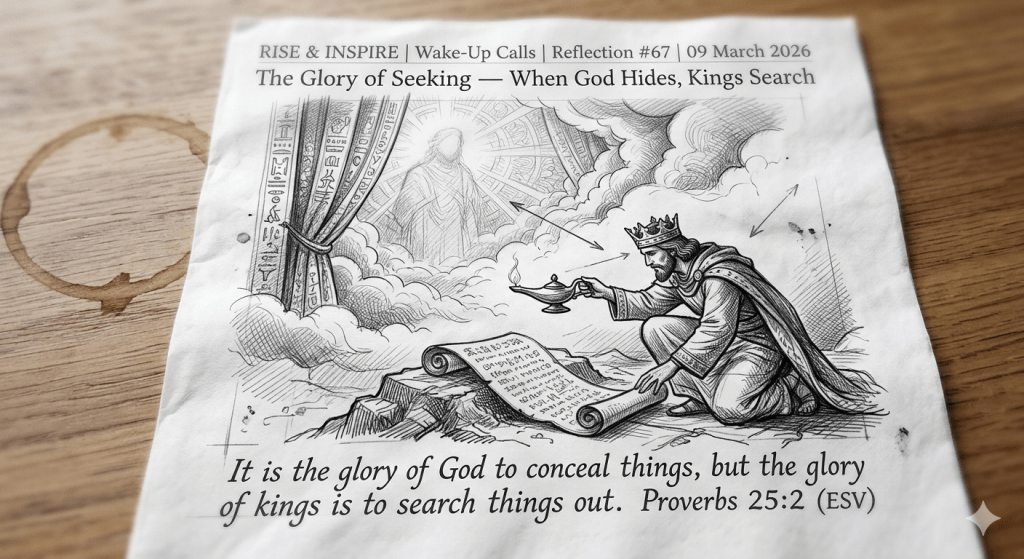
The Glory of Seeking

When God Hides, Kings Search

VERSE FOR TODAY  —  09 MARCH 2026“It is the glory of God to conceal things, but the glory of kings is to search things out.”Proverbs 25 : 2  (ESV)Verse shared by His Excellency, Rt. Rev. Dr. Selvister Ponnumuthan

The Mystery That Moves Us

There is a particular kind of wonder that stirs in the human heart when it stands before a locked door. Not the panic of being shut out, but the quiet, burning pull of what might lie just beyond. That pull, that sacred restlessness, is precisely what Proverbs 25:2 is speaking into.

This verse arrives in two magnificent halves, and together they form one of the most profound statements about the nature of God, the calling of humanity, and the dignity built into the act of seeking. King Solomon, the wisest man who ever lived, lays before us a theology of holy hiddenness and royal pursuit.

God Conceals — And That Is His Glory

The first half of the verse unsettles us in the best possible way. God conceals things. Deliberately. Purposefully. And Scripture calls this His glory.

We live in an age that despises mystery. We want algorithms that explain everything, podcasts that unpack every complexity, and search engines that surface every answer in under a second. So when we read that God intentionally hides things, our first instinct can be discomfort.

But Solomon is not describing a God who is distant or evasive. He is describing a God who is infinite. A God whose wisdom is so vast, whose ways are so deep, that concealment is not an absence of revelation — it is the shape revelation takes when it encounters the finite. The Apostle Paul echoed this centuries later: “O the depth of the riches both of the wisdom and knowledge of God! How unsearchable are his judgments, and his ways past finding out!” (Romans 11:33).

When God conceals, He is not playing games. He is inviting relationship. A God who gave you every answer at once would leave nothing for you to discover, nothing to draw you closer, nothing to make the journey your own. His hiddenness is an act of profound love — it is how He keeps calling your name.

Kings Search — And That Is Their Glory

The second half of the verse makes a declaration over you that you may not have heard recently: you are royalty. Not metaphorically. Spiritually and scripturally, you carry the standing of a king.

The verse does not say it is the glory of kings to receive things, to be handed things, or to sit passively and wait for things to fall into their lap. The glory of kings is to search things out. To pursue. To investigate. To press in.

This is deeply counter-cultural in a faith environment that sometimes confuses surrender with passivity. True surrender to God does not make you inert; it makes you alive. It sets you on fire with holy curiosity. The one who has truly tasted the goodness of God does not sit back satisfied — they lean forward, hungry for more.

You were made to seek. That hunger in you for meaning, for purpose, for the “more” that you cannot quite name — it is not a sign that something is wrong. It is a sign that you were made by Someone who placed eternity in your heart (Ecclesiastes 3:11).

The Tension That Sanctifies

What makes this verse so extraordinarily rich is the tension it holds without resolving. God conceals. King’s search. These two truths do not cancel each other — they create each other. The concealment is what makes the search glorious.

Think of the disciples on the road to Emmaus. The risen Christ walked beside them, and “their eyes were kept from recognising him” (Luke 24:16). Why would the Lord do that? Because the journey of conversation, of scripture being opened, of hearts burning within them — that journey was the gift. The revelation at the breaking of bread was sweeter because it had been walked toward.

God does not withhold good things to frustrate you. He conceals them to form you. Every question you wrestle with in prayer, every passage of scripture you sit with until the light breaks through, every season of darkness that eventually yields a dawn — in every one of those moments, you are doing what kings do. You are searching things out.

Rise and Search

This Wake-Up Call is not a gentle suggestion. It is a summons. You are being called today to stop treating your faith like a finished puzzle and start treating it like a living pursuit.

Have you grown comfortable with the surface of scripture? Go deeper. Has your prayer become a monologue of requests? Begin to sit in the silence and listen. Have you stopped asking God the hard questions because you are afraid of what the silence might mean? Ask them. Kings are not afraid of the hidden — they are drawn to it.

The great men and women of faith who shaped the Church did not have fewer questions than you. They had greater hunger. They searched with everything they had, and in the searching, they were transformed. St. Augustine wrestled for years before he found rest in God. St. Thomas Aquinas wrote that the more he came to know God, the more he understood how little he knew — and that awareness deepened, not diminished, his love.

The concealed things of God are not obstacles on the road to faith. They are on the road. And you, beloved, are a king. Start searching.

🙏  A Prayer for the Seeking HeartLord God, You are infinite and I am finite, and in that vast difference You have placed a gift: the hunger to seek You. Forgive me for the times I have settled for half-answers and shallow waters. Today I rise as one who was made to search. Open my eyes to what You are concealing for me, not from me. Grant me the courage of a king and the wonder of a child, and let the glory of seeking lead me always deeper into You. Amen.

Reflection Questions

1.  Where in your spiritual life have you stopped searching? What familiar territory have you mistaken for the fullness of God?

2.  In what area of your life right now is God concealing something? How might He be using that hiddenness to draw you closer rather than to hold you back?

3.  What does it mean to you personally that seeking is described as the glory of kings? How does that reframe the questions and doubts you carry?

4.  Who in your faith community models what it looks like to search with holy hunger? What can you learn from their example this week?

Watch Today’s Verse Reflection

Verse for Today — 09 March 2026  |  Proverbs 25:2

RISE & INSPIRECompanion Study  |  Wake-Up Call #67Proverbs 25:2  |  09 March 2026  |  Scholarly Supplement

The Scholar-Kings Behind Proverbs 25

A Companion Study to Wake-Up Call #67

Exegesis  •  Translation Comparison  •  Historical Background  •  Commentary Synthesis

This companion study is designed for readers who have finished Wake-Up Call #67 and want to go deeper. It does not replace the pastoral reflection; it supports it. Here you will find the scholarly and historical scaffolding behind Proverbs 25:2, a comparison of major translations, summaries of key commentaries, and a closing bridge that returns you to the devotional core of the reflection.

The verse in focus is Proverbs 25:2. In the ESV: “It is the glory of God to conceal things, but the glory of kings is to search things out.”

Part 1  —  Core Meaning and Hebrew Background

The Hebrew Word Kabōd

The word translated glory in both halves of the verse is the Hebrew kabōd, one of the richest words in the Old Testament. Its root carries the sense of weight, heaviness, and substance. When something or someone has kabōd, they carry a kind of moral and ontological density that commands recognition. It is used for the glory of God revealed at Sinai (Exodus 24:16), for the honour due to parents (Exodus 20:12), and for the prestige of rulers.

That the verse assigns kabōd to both God and kings is deliberate and striking. It is not an equivalence of persons but a parallelism of roles: each is most fully themselves, most fully glorious, when doing the thing the verse describes. God is most God-like when concealing; kings are most kingly when searching.

The Structure: Antithetical Parallelism

Proverbs 25:2 is a classic example of antithetical parallelism, a poetic device prevalent in Hebrew wisdom literature where two contrasting ideas are placed in structural tension to illuminate both. The contrast here is not adversarial but complementary: God’s concealment creates the very conditions that make the king’s searching meaningful. Without hiddenness, there is nothing to seek. Without seeking, the hiddenness is never honoured.

This is the dynamic the verse is designed to hold. It is not a problem to be resolved but a tension to be inhabited. The wisest readers of Proverbs have always understood that the unresolved quality of this parallelism is itself the teaching.

Concealment as Theological Statement

The first half of the verse, stating that it is the glory of God to conceal things, draws on a broader theology of divine incomprehensibility. Deuteronomy 29:29 provides the clearest parallel: “The secret things belong to the Lord our God, but the things that are revealed belong to us and to our children forever.” God is not obligated to disclose. His self-sufficiency means He does not require human understanding to validate His actions.

This concealment is not deception. It is transcendence made visible in the only way transcendence can be made visible to finite minds: through the awareness of limit. When a believer reaches the edge of what can be known about God and stands there in reverence rather than frustration, they are touching the hem of divine glory.

The Royal Duty to Search

The second half of the verse situates the glory of kings specifically in the act of searching out. In the ancient Near East, the king was the supreme judge and the final arbiter of disputed matters. His glory was not merely ceremonial; it was judicial and investigative. A king who rendered verdicts without careful inquiry dishonoured his office. The great kings of Israel and surrounding nations were praised precisely for their diligence in uncovering truth before pronouncing judgment.

The verb translated search out carries the sense of thorough investigation, not casual enquiry. It is the same posture the Bereans were later praised for in Acts 17:11, searching the Scriptures daily to see whether Paul’s teaching was true. In both cases, the searching is an act of honour, not suspicion.

Part 2  —  Translation Comparison

The following table surveys six major English translations of Proverbs 25:2 and notes the key choices each makes in rendering the original Hebrew. These differences are not errors; they reflect legitimate interpretive decisions about how to carry the verse into English while preserving its meaning.

TranslationRendering of Proverbs 25:2Key Phrase Notes
ESVIt is the glory of God to conceal things, but the glory of kings is to search things out.Uses conceal / search out. Strong chiastic structure between divine and royal roles.
NIVIt is the glory of God to conceal a matter; to search out a matter is the glory of kings.Conceal a matter / search out a matter. Parallel structure made explicit with repetition of matter.
NASBIt is the glory of God to conceal a matter, but the glory of kings is to search out a matter.Closest to ESV; retains formal equivalence. Matter appears twice, reinforcing parallel.
KJVIt is the glory of God to conceal a thing: but the honour of kings is to search out a matter.Uses honour rather than glory for kings, softening the parallel contrast. Thing vs. matter shifts nuance slightly.
NLTIt is God’s privilege to conceal things and the king’s privilege to discover them.Privilege replaces glory entirely, shifting from honour language to rights/prerogative. Most interpretive rendering.
MSGGod delights in concealing things; scientists delight in discovering things.Paraphrase replaces kings with scientists, reflecting modern application. Loses the royal-judicial context of the original.

The most significant translational divergence is between the formal equivalence versions (ESV, NASB, NIV) and the dynamic equivalence versions (NLT, MSG). The formal translations preserve glory as the governing concept in both halves, maintaining the verse’s theological weight. The NLT’s use of privilege and the MSG’s replacement of kings with scientists both domesticate the verse in ways that soften its original force. For devotional and homiletical purposes, the ESV, NASB, or NIV are generally preferred because they hold the glory-of-God and glory-of-kings parallelism intact.

A Note on the KJV RenderingThe KJV uses honour rather than glory for the second half (the honour of kings is to search out a matter). While this may seem a minor variation, it introduces a subtle hierarchy: glory belongs to God, honour belongs to kings. Some expositors prefer this rendering because it avoids any appearance of equating divine and royal dignity. Others argue it weakens the symmetry Solomon intended. Both readings are defensible from the Hebrew.

Part 3  —  Hezekiah and the Historical Context of Proverbs 25

The Superscription: Proverbs 25:1

Proverbs 25 opens with an editorial note that is unique in the entire book: “These also are proverbs of Solomon, which the men of Hezekiah king of Judah copied.” This single verse is the only place in Proverbs where a named king other than Solomon is associated with the text, and the role attributed to Hezekiah is not authorship but stewardship.

Hezekiah did not write these proverbs. Solomon, who reigned approximately 970 to 930 BC, composed them. What Hezekiah’s scribes did, sometime between 715 and 686 BC, was collect, transcribe, and organise material that had existed in some form for over two centuries. The Hebrew verb translated copied carries the sense of careful, deliberate transmission, not mere mechanical reproduction. It implies editorial discernment: choosing what to preserve, arranging what to include, and presenting it in a form that would serve the next generation.

Who Was Hezekiah?

Hezekiah is one of the most thoroughly documented kings in the Old Testament record. The accounts in 2 Kings 18 to 20 and 2 Chronicles 29 to 32, along with significant attention in the book of Isaiah, present a portrait of a reforming king who took the spiritual state of Judah with extraordinary seriousness.

His reign began in a context of deep religious compromise. His father Ahaz had closed the temple, introduced foreign altars into Jerusalem, and led the nation into widespread idolatry. Hezekiah’s first act upon taking the throne was to reopen and purify the temple (2 Chronicles 29:3), a renovation completed in just sixteen days. He reinstated the Levitical priesthood, restored the Passover observance (inviting even the northern tribes to participate), and dismantled the high places and Asherah poles that had accumulated across the land.

When Sennacherib of Assyria besieged Jerusalem in 701 BC, Hezekiah responded not with political capitulation but with prayer, spreading the Assyrian king’s threatening letter before the Lord in the temple and asking God to act. Isaiah’s prophecy that the city would not fall was fulfilled: 185,000 Assyrian soldiers died in a single night, and Sennacherib withdrew (2 Kings 19:35 to 36).

2 Kings 18:5 offers a sweeping evaluation: “He trusted in the Lord, the God of Israel, so that there was none like him among all the kings of Judah after him, nor among those who were before him.” This is the context in which the scholarly and literary work of preserving Solomon’s proverbs took place.

The Men of Hezekiah

The scribes referred to as the men of Hezekiah were almost certainly members of the royal court: trained scholars, administrators, and custodians of ancient texts. Courts in the ancient Near East maintained scribal schools, and the preservation of wisdom literature was considered a significant part of governance. A king who neglected the accumulated wisdom of his ancestors was not merely culturally negligent; he was administratively reckless.

Solomon is credited in 1 Kings 4:32 with composing 3,000 proverbs. The canonical book of Proverbs preserves far fewer, which indicates that what survives is a selection, not a comprehensive record. Hezekiah’s scribes appear to have recovered or prioritised a body of Solomonic material that had not yet been incorporated into the earlier collections of Proverbs 10 to 22. Chapters 25 to 29 represent the product of their work.

Proverbs 25 to 29: Hezekiah’s Collection

Key Facts About the CollectionChapters:  Proverbs 25 to 29 (five chapters)Approximate proverb count:  137, depending on versification methodPrimary attribution:  Solomon (c. 970 to 930 BC)Editorial custodians:  The men of Hezekiah (c. 715 to 686 BC)Time gap:  Approximately 250 years between composition and preservationOpening focus:  Royal conduct and wisdom (25:2 to 7), possibly a dedication to both Solomon and Hezekiah as scholar-kingsRecurring themes:  Justice, humility before authority, wise governance, patience, integrity in administration

The opening verses of chapter 25 (verses 2 to 7) are particularly significant because they deal directly with the relationship between divine mystery and royal wisdom. Some scholars have proposed that Proverbs 25:2 functions as a kind of epigraph for the entire collection, framing what follows as the product of kingly inquiry. If concealment is God’s glory, and searching is the king’s glory, then this collection is itself a monument to the searching that Hezekiah’s court undertook.

The structural features of these chapters also reflect editorial care. Chapters 25 and 26 tend toward comparisons and metaphors, while chapters 27 to 29 move toward more direct moral instruction. This shift in style may reflect different source documents assembled by the scribes, or deliberate arrangement to create a progression from the illustrative to the prescriptive.

Hezekiah as Scholar-King: A Tribute in the Text?

Several commentators, including David Guzik and others working within the Hezekiah’s Collection tradition, have noted that the placement of Proverbs 25:2 at the very head of this editorial section is unlikely to be accidental. By opening his collection with a proverb about the glory of kings who search things out, Hezekiah’s scribes may have been offering a quiet tribute to their patron. Hezekiah was himself a king who searched: he searched the scriptures, searched the ancient wisdom of Solomon, and searched out justice for his people.

In this reading, the collection is not merely a preservation project. It is a declaration of identity. Hezekiah positions himself in the lineage of Solomon not through blood alone but through the same posture of wisdom-seeking that made Solomon great.

Part 4  —  Commentary Source Summaries

The following summaries draw on major exegetical and devotional commentaries. Each represents a distinct tradition of interpretation and together they provide a layered picture of how the church and academy have understood this verse across centuries.

Enduring Word  —  David Guzik   —   Evangelical / Pastoral
Guzik views this verse as a tribute to what he calls the scholar-king tradition, exemplified by both Solomon and Hezekiah. He notes the historical context of the Hezekiah Collection (Proverbs 25 to 29) as essential for interpreting the verse: the very act of compiling these proverbs was itself an exercise in the glory described. God’s concealment is not capricious but rooted in His infinite nature; no finite mind can demand full access to divine counsel. The king’s searching, by contrast, is a moral obligation, not merely an intellectual luxury. Guzik applies this to the Christian life by connecting the king’s role to the believer’s identity as kings and priests in Revelation 1:6, making active pursuit of wisdom both a right and a responsibility.
Key Insight:  Every believer participates in the royal dignity of seeking when they press into Scripture, prayer, and holy curiosity rather than settling for surface-level faith.
Gill’s Exposition of the Entire Bible  —  John Gill   —   Reformed Baptist / 18th Century
Gill provides the most exhaustive list of what God conceals: the specific details of predestination, the timing of final judgment, the reasons behind particular providential dispensations, the full nature of the Trinity, and the mechanics of the incarnation. His point is that the concealed things are not peripheral mysteries but the very centre of Christian theology. God’s decision not to disclose these matters fully is not a withholding of what humanity deserves but an expression of His absolute sovereignty and self-sufficiency. For kings and rulers, Gill’s application is specifically judicial: the glory of good governance lies in thorough investigation before verdict. He cites examples from ancient judicial practice and connects this to Proverbs’ broader concern for righteous administration.
Key Insight:  The things God conceals are not the small print of theology; they are its most profound substance. The appropriate response is reverent acknowledgment of limit, not frustrated demand for clarity.
Pulpit Commentary  —  Multiple Authors   —   Victorian Anglican / Homiletical
The Pulpit Commentary treats this verse primarily as a homiletical resource and develops it along two parallel tracks. The first is apologetic: God’s concealment defends His independence and vindicates His transcendence. He does not owe humanity an explanation of His ways, and the recognition of this is the beginning of true worship. The second track is ethical and political: the honour of earthly rulers depends on their willingness to do the hard work of investigation. A king who decides without searching is not exercising authority; he is abusing it. The commentary draws connections to the Wisdom literature tradition more broadly, situating this verse within Proverbs’ consistent concern for rulers who govern with discernment rather than assumption.
Key Insight:  Divine concealment and royal inquiry are not in tension; they are in partnership. God hides so that His creatures may be ennobled by the act of seeking.
Benson Commentary  —  Joseph Benson   —   Wesleyan Methodist / Early 19th Century
Benson emphasises the relational dimension of divine concealment in a way that distinguishes his reading from purely sovereignty-focused interpretations. For Benson, God conceals not only to demonstrate His transcendence but to cultivate a seeking posture in His people. Concealment is pedagogical: it teaches dependence, humility, and the discipline of patient inquiry. He cites Isaiah 45:15, God is a God who hides himself, and argues that this hiddenness is precisely what makes the revelation of grace so profound when it comes. The searching of kings is therefore analogous to the seeking of every soul that refuses to be satisfied with easy answers and presses deeper into relationship with God.
Key Insight:  God hides not to frustrate us but to form us. The space between concealment and discovery is the classroom of the soul.
Ellicott’s Commentary for English Readers  —  Charles Ellicott   —   Anglican / 19th Century Academic
Ellicott takes a more restrained exegetical approach, resisting allegorical extension and staying close to the verse’s original judicial context. His interpretation focuses on the kingly duty to investigate: wise rulers do not assume, presuppose, or accept surface appearances. They probe, inquire, and refuse to let complexity obscure justice. Ellicott connects this to the specific historical setting of the Hezekiah Collection, noting that the verse’s placement at the head of a section assembled by royal scribes is itself a demonstration of the principle it states. He also notes the contrast with false or lazy kings throughout Proverbs who accept bribes, pervert justice, and issue verdicts without genuine investigation.
Key Insight:  The glory of rulers is inseparable from the rigour of their inquiry. A searching king and a just king are, in the wisdom tradition, the same king.
BibleRef.com / Knowing Jesus Synthesis   —   Contemporary Evangelical / Devotional
These contemporary sources bring the verse into direct dialogue with the New Testament and the Christian life. They note the connection to Isaiah 55:8 to 9, where God declares that His thoughts and ways are higher than human ones, and to Acts 17:11, where the Bereans are commended for their daily searching of Scripture. For these commentators, the verse is both a caution and a commission: a caution against presuming to fully comprehend divine action, and a commission to pursue understanding with everything available. The Berean model becomes a template for how the royal searching of Proverbs 25:2 looks in the life of a believer: not passive reception but active, rigorous, joyful investigation.
Key Insight:  Searching the Scriptures is not an academic exercise. It is a royal act. Every time a believer opens the Bible with genuine inquiry, they are doing what kings do.

Part 5  —  A Devotional Bridge Back to Wake-Up Call #67

Scholarship serves devotion best when it leads back to it. Everything covered in this companion study, the Hebrew weight of kabōd, the editorial courage of Hezekiah’s scribes, the centuries of commentary wrestling with divine concealment, points toward a single practical truth: the life of faith is a life of active, honoured, royal seeking.

Wake-Up Call #67 opened with the image of a locked door and the pull of what lies beyond. This companion post has now supplied the historical and exegetical walls of that same room. The door is still there. The invitation to press through it is still standing.

What Hezekiah’s men did in assembling these proverbs was itself an act of worship. They did not sit and wait for wisdom to be handed to them. They searched out what had been concealed in the archives and gave it to the next generation. That is the same movement this reflection series is part of: finding the buried things, bringing them into the light, and offering them to readers who are hungry for more than the surface of their faith.

A Closing Word“It is the glory of God to conceal things, but the glory of kings is to search things out.”Proverbs 25:2  (ESV)You have now searched further into this verse than most readers ever will. That is not self-congratulation. It is exactly what Solomon was praising. The glory is not in arriving at a final answer. The glory is in the searching itself, conducted with reverence toward the One who conceals and gratitude for the royal dignity He has placed in every soul who refuses to stop asking.

Rise & Inspire  •  Companion Study  •  Wake-Up Call #67  •  09 March 2026

Biblical Reflection / Faith  •  Scholarly Supplement  •  Proverbs 25:2
Rise & Inspire  •  Wake-Up Calls  •  Reflection #67

Series Category: Biblical Reflection / Faith  •  09 March 2026

Copyright © 2026 Rise&Inspire

Website: Home | Blog | About Us | Contact| Resources

Word Count:4666

Is God Really Listening When You Pray? The Deuteronomy Promise That Proves He Is

What makes your faith different? Not your theology, your denomination, or your worship style. The real distinction lies in a single, stunning reality that Deuteronomy captures in one provocative question. It is a reality so profound that it should fundamentally alter how you approach every single day. Yet most believers live as though it were not true. They pray as though God were far away. They struggle as though they were alone. They carry burdens as though no one were listening. This reflection is your invitation to stop.

The biblical reflection on Deuteronomy 4:7 explores the deep truth of God’s nearness. The reflection connects the ancient context with our contemporary spiritual lives, offering both theological insight and practical application.

The reflection emphasises three key themes:

1. The revolutionary nature of divine accessibility in contrast to ancient pagan deities

2. The personal, relational dimension of God’s nearness through Christ

3. A call to awaken to and live in constant awareness of God’s presence

Daily Biblical Reflection

Verse for Today (7th January 2026)

This morning, His Excellency, Rt. Rev. Dr. Selvister Ponnumuthan forwarded this Verse for Today (7th January 2026), which inspired me to write these reflections.

For what other great nation has a god so near to it as the Lord our God is whenever we call to him?”

Deuteronomy 4:7

Today the 7th day of 2026

This is the 7th reflection on Rise&Inspire in 2026 under the category/series: Wake-up calls

The Gift of Divine Nearness

In the ancient world, gods were distant, unpredictable, dwelling on remote mountaintops or hidden in temples accessible only to the privileged few. The nations surrounding Israel imagined their deities as capricious powers who required elaborate rituals, costly sacrifices, and the mediation of countless intermediaries to gain their attention. Against this backdrop, Moses poses a revolutionary question to the people of Israel: What other nation can claim such intimacy with the Divine?

This question is not merely rhetorical. It is an invitation to awakening, a wake-up call that resonates across millennia to reach us today, on this 7th day of the new year. The God of Israel, the God we serve, is not distant or disinterested. He is near. Remarkably, wonderfully, intimately near.

The Hebrew word for “near” used here is qarov, which speaks not just of physical proximity but of relational closeness, of being at hand, accessible, ready to respond. Our God does not need to be summoned through complex ceremonies or appeased through fearful offerings. He is already present, already listening, already leaning toward us with compassionate attention whenever we call.

This divine accessibility is the beating heart of our faith. It transforms prayer from a religious duty into a living conversation. It changes worship from performance into encounter. It converts our spiritual life from striving to reach a distant deity into recognising the One who has already drawn near to us.

Consider the profound implication: the Creator of galaxies, the Author of existence itself, makes Himself available to you. Not occasionally. Not conditionally. But whenever you call. In your morning confusion, in your midnight fears, in your moments of joy and seasons of sorrow, He is near. The God who shaped mountains listens to your whispered prayer. The One who commands the stars bends His ear to your heart’s cry.

This nearness is not earned through our righteousness or merited by our spiritual achievements. It is the gracious nature of God Himself. He chose to be Emmanuel, God-with-us. In Jesus Christ, this divine nearness took on flesh and walked among us, demonstrating in the most tangible way possible that our God is not remote but radically present.

Yet how often do we live as though God were far away? How frequently do we carry our burdens alone, wrestle our questions in isolation, or face our challenges as though we were orphaned in the universe? This reflection is indeed a wake-up call, urging us to recognise and respond to the extraordinary privilege we possess: direct access to the throne of grace.

The invitation embedded in this verse is clear: Call to Him. Not someday when you feel more worthy. Not after you have sorted out your life or cleaned up your act. Now. Today. In whatever state you find yourself. He is already near, already attentive, already ready to respond with wisdom, comfort, strength, and love.

As we journey through these early days of 2026, let us awaken to this reality. Let us cultivate an awareness of God’s presence that transforms ordinary moments into opportunities for communion. Let us develop the habit of turning to Him throughout the day, not just in crisis but in celebration, not only in desperation but in gratitude.

What makes our faith distinctive is not simply what we believe about God, but the relational reality we experience with God. We are not followers of a distant philosophy or adherents to an abstract principle. We are children in conversation with our Father, friends in fellowship with our Lord, beloved in communion with Love Himself.

This is your inheritance as a believer: a God who is near. This is your privilege today: to call upon Him and find Him responsive. This is your invitation for 2026: to live in the constant awareness of divine presence, allowing that nearness to reshape how you pray, how you decide, how you love, and how you serve.

May this wake-up call rouse us from spiritual slumber. May we cease living as practical atheists who believe in God’s existence but not His presence. May we instead walk through our days aware that we are never alone, never unheard, never beyond the reach of the One who has made Himself wonderfully, graciously, eternally near.

The question Moses asked Israel echoes to us today: What other great nation has such a God? Indeed, what other people have been granted such access, such intimacy, such assurance? Let us not take this extraordinary gift for granted. Let us call upon Him, and in calling, discover again that He is already there, already listening, already near.

Wake up to this reality. Your God is not far off. He is here, now, waiting for your voice. Call to Him today.

The focus of this reflection is the nearness of God and His readiness to listen whenever we pray, as revealed in Deuteronomy 4:7.

At its heart, the reflection is a wake-up call inviting believers to:

✔️ Recognise the unique privilege of divine accessibility—a God who is not distant but near

✔️ Understand prayer as a living, relational conversation, not a ritual or performance

✔️ Awaken to a daily, moment-by-moment awareness of God’s presence, especially through Christ

In short, the reflection calls readers to stop living as though they are alone and to begin living consciously in the reality that God is already near, already listening, whenever they call.

The “wake-up call” motif is woven seamlessly throughout this reflection and finds concrete expression in the accompanying YouTube video—a brief, prayerful audio reading of Deuteronomy 4:7 set to music, titled “Wake-up Call – 07 January 2026.” The reflection also draws its spiritual impetus from the verse shared that morning by His Excellency, Rt. Rev. Dr. Selvister Ponnumuthan, grounding the meditation in a lived, pastoral context rather than abstract theology.

2025 Johnbritto Kurusumuthu | Rise & Inspire Devotional Series

Word count:1241

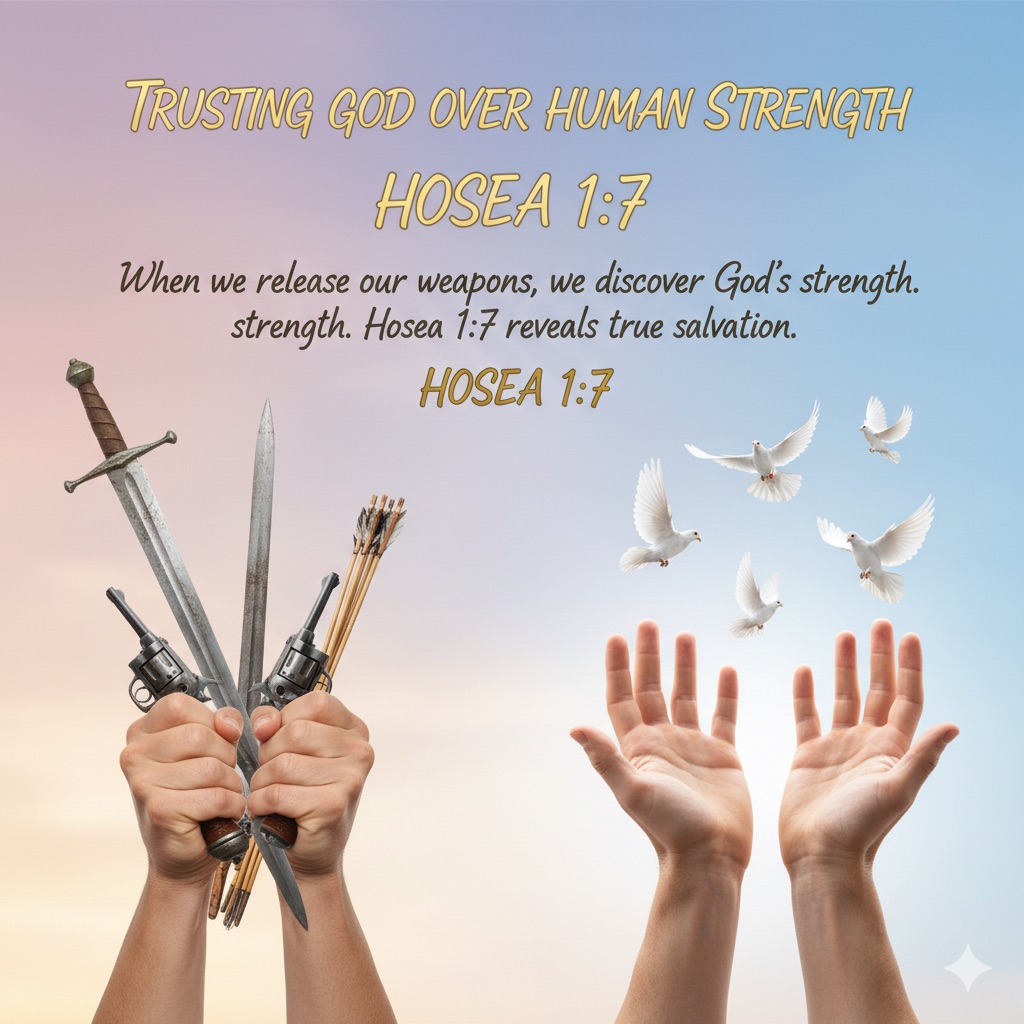
What Does It Mean That God Saves By Himself, Not By Human Power?

Look at your hands right now. What invisible weapons are you gripping? Professional success? Financial security? Carefully constructed plans? We all hold something, convinced it’s our lifeline. But Hosea 1:7 whispers a radical invitation: the God who saved an entire nation without a single sword wants to save you the same way. No prerequisites. No human machinery. Just mercy.

Daily Reflection on Hosea 1:7

But I will have pity on the house of Judah, and I will save them by the Lord their God; I will not save them by bow or by sword or by war or by horses or by horsemen.

In a world that constantly calls us to rely on our own strength, strategies, and resources, this verse from Hosea reveals a liberating truth: God’s salvation comes not through human might, but through divine mercy.

The Power of Divine Compassion

The prophet Hosea speaks during one of Israel’s darkest periods, yet God’s promise to Judah shines like a beacon through the storm. Notice the beautiful progression: “I will have pity… I will save them.” God’s compassion precedes His action. His heart moves before His hand extends. This teaches us that our redemption is rooted in God’s character, not our merit.

Beyond Human Solutions

The verse deliberately lists the instruments of human power—bow, sword, war, horses, horsemen—only to declare them unnecessary. How often do we exhaust ourselves marshalling our own “weapons” to fight life’s battles? We strategise, worry, control, and manipulate circumstances, forgetting that the One who created the universe doesn’t need our military arsenal to accomplish His purposes.

This isn’t a call to passivity, but to proper dependence. It’s an invitation to stop placing our ultimate trust in our professional achievements (the sword), our financial security (the horses), our social connections (the horsemen), or our careful planning (the war strategies).

Salvation by the Lord Alone

“I will save them by the Lord their God”—what a remarkable phrase! God Himself is both the Saviour and the means of salvation. He doesn’t use external tools; He uses His own divine nature. His mercy is the method. His faithfulness is the weapon. His love is the strategy.

Living This Truth Today

As you face this new day, consider: What “bows and swords” are you clutching too tightly? Where have you been fighting battles in your own strength? Can you surrender your struggles to the One who saves by His very nature?

God’s invitation today is simple: Release your grip on human solutions and rest in divine provision. The same God who preserved Judah without weapons is present with you now, ready to work in ways that transcend human understanding.

Let this verse reshape your anxieties into trust, your striving into surrender, and your fear into faith. For when God moves, He needs nothing but His own compassionate heart to accomplish what no army ever could.

Prayer: Lord, teach us to release our trust in worldly power and place our complete confidence in You. Save us, not by our strength, but by Your mercy. In our weakness, reveal Your strength. Amen.

Check the Rise & Inspire “Wake-Up Calls” archive at riseandinspire.co.in

© 2025 Johnbritto Kurusumuthu | Rise & Inspire Devotional Series

Word count:548

Why Does God Wound the People He Blesses?

When Wrestling Becomes Worship: A Night That Changed Everything

Daily Biblical Reflection – October 15, 2025

Genesis 32:26 | Feast of Saint Teresa of Ávila

What do you do when God shows up in the darkness and you don’t recognise Him? When the encounter you’ve been longing for arrives not as comfort but as combat? When the blessing you desperately need is hidden inside a struggle that threatens to break you? Jacob found himself in exactly this place—alone by a river, wrestling with a mysterious stranger through the long night, refusing to surrender even when wounded, gasping out the most audacious prayer ever prayed: “I will not let you go unless you bless me.” This is the story of a man who became a nation, a night that changed everything, and a wrestling match that reveals the secret to transformation. If you’ve ever felt like your faith is more fight than peace, more questions than answers, more desperate grip than confident certainty—this ancient story might just be your story too.

Opening Prayer

Lord, You meet us in the darkness of our wrestling,
mark us in our struggles, and rename us in our surrender.
Teach us to hold on when strength fails,
to insist on Your blessing when dawn threatens to pull us away,
and to discover that the wound You give becomes the badge of our transformation.
Through Christ, who wrestled with death and rose victorious. Amen.

The Story Begins in Darkness

Jacob stands alone beside the Jabbok River in the dead of night. Behind him lie twenty years of labour—wives, children, flocks, built through cunning and compromise. Ahead waits Esau, the brother he betrayed, approaching with four hundred men. Jacob has sent everyone across the river—its name, Jabbok, echoing “wrestle” in Hebrew, as if the place itself foretells what’s coming.

Then, Someone appears.

No trumpets. No clear identity. Just a presence in the dark, a figure who seizes Jacob, and suddenly he’s fighting for his life—or perhaps for his life in a way he never has before. The text is spare: “A man wrestled with him until the breaking of the day” (Genesis 32:24). No explanation, just struggle, sinew, sweat, and silence broken by labored breathing.

Hours pass. The darkness is total. Jacob doesn’t know who he’s fighting, but deep down, he senses this isn’t an ordinary foe. This is the encounter he’s been running from his entire life.

As dawn breaks, the figure speaks: “Let me go, for the day is breaking.”
Jacob, gasping, wounded, transformed by the struggle, responds with audacity: “I will not let you go, unless you bless me” (Genesis 32:26).

What You’ll Discover Here

This reflection explores what it means to wrestle with God, why He meets us in darkness, and how the wounds we receive become marks of identity. You’ll see how Jacob’s desperate grip mirrors Saint Teresa of Ávila’s determined prayer, how ancient wrestling connects to modern anxiety, and why the greatest act of faith is refusing to let go until something changes. This isn’t about easy answers—it’s about faith emerging when you’re pushed to the edge and discover surrender and persistence are one.

The Verse That Won’t Release Us

Genesis 32:26 — “Then he said, ‘Let me go, for the day is breaking.’ But Jacob said, ‘I will not let you go, unless you bless me.’”

The Hebrew is stark: “Shalcheni ki-alah hashachar” (“Send me away, for the dawn rises”). It’s urgent, time-bound. This encounter belongs to the night, the liminal space between who Jacob was and who he’s becoming.

Jacob’s reply—“Lo ashaleiachakha ki im-beirachtani” (“I will not send you away unless you bless me”)—turns the stranger’s words back on him, using the same verb (shalach, to release). It’s linguistic wrestling. Jacob demands: “Name what’s happening here. Make this transformation official.”

The word “bless” (barach) carries weight in Jacob’s story. It’s what he stole from Esau, chased across deserts, and now seeks honestly, face to face with someone he can’t deceive.

The Night Behind the Night

Jacob is returning home after twenty years of exile, fleeing a brother he cheated out of birthright and blessing. He worked fourteen years for his wives under his uncle Laban, prospered through cunning, and now faces Esau’s approach with four hundred men. Jacob schemes: dividing his family, sending gifts to appease Esau, placing less-favored members at the front. But before the meeting, he sends everyone across the Jabbok and stays behind. Alone. For the first time, he can’t talk or scheme his way out. It’s just him, the night, and whatever comes.

What comes is God.

Wrestling with the Unnamed One

The text doesn’t name Jacob’s opponent in the moment. Only later does Jacob call the place Peniel (“the face of God”), saying, “I have seen God face to face, and yet my life has been delivered” (Genesis 32:30). Hosea confirms: “He strove with the angel and prevailed… He met God at Bethel” (Hosea 12:4-5).

In the moment, Jacob doesn’t know who he’s fighting. That’s key. He’s wrestling in the dark with something—like our struggles with depression, doubt, loss, or a God we can’t believe in anymore. We don’t always know what we’re fighting, but we know we can’t stop.

The rabbis debate: Was it an angel? Esau’s guardian spirit? A test of worthiness? A theophany? Perhaps the deepest reading is that Jacob wrestled with himself—his guilt, fear, past—and found that wrestling with these is wrestling with God, because God is present in every honest struggle for transformation.

Saint Teresa’s Connection: Wrestling in Prayer

Today we celebrate Saint Teresa of Ávila (1515–1582), the Spanish mystic, reformer, and Doctor of the Church. What does a 16th-century nun share with a Bronze Age patriarch? Everything.

Teresa knew wrestling with God. After years of lukewarm faith, a statue of the wounded Christ sparked her conversion in her late thirties. Her prayer life became intense, often exhausting, marked by ecstasies and spiritual dryness. She described prayer’s higher stages as a dismantling of the self, requiring determination to persist when God seemed absent.

In her autobiography, she wrote: “This path of prayer is long… We shouldn’t think that if we’ve only just begun, we’ll immediately eat of the banquet.” Like Jacob, she replied to God’s “That’s enough” with: “Not until You bless me.” The lectionary pairs Genesis 32:26 with Teresa’s feast because both teach that authentic encounter with God feels more like wrestling than peaceful contemplation, and the blessing comes through the struggle.

The Wound That Names Us

The mysterious figure touches Jacob’s hip, dislocating it. Jacob is permanently wounded. He’ll limp for life.

This is radical. God wounds the man He blesses. In a culture worshipping strength and perfection, we pray for success or healing, not “God, wound me so I can’t run from You.” But Jacob’s limp reminds him he met Someone stronger, who dismantled his self-sufficiency. Every step testifies: “I wrestled with God, and I’m different.”

St. Paul echoes this in 2 Corinthians 12, with his “thorn in the flesh.” God’s response: “My grace is sufficient for you, for my power is made perfect in weakness” (2 Corinthians 12:9). The wound is part of the blessing. What wounds do you carry from wrestling with God? What if your limp is your testimony?

The Renaming: From Deceiver to God-Fighter

The figure asks Jacob’s name. “Jacob,” he says—meaning “heel-grabber” or “supplanter,” a name tied to his deception. Then: “Your name shall no longer be called Jacob, but Israel, for you have striven with God and with men, and have prevailed” (Genesis 32:28).

Israel means “he who strives with God” or “God strives.” Jacob’s identity shifts from deceiver to God-fighter. The name doesn’t erase his past—he’s still called Jacob in Genesis—but adds a new dimension. Biblical transformation follows this pattern: Abram to Abraham, Sarai to Sarah, Simon to Peter. New names come after struggle, breaking, and renaming. Who are you becoming through your wrestles? What new name is God writing on your heart?

The Blessing Withheld and Given

When Jacob asks the stranger’s name, he’s refused: “Why is it that you ask my name?” Then the figure blesses him and departs. God says: “You can have the blessing, but not Me on your terms. I remain mystery.” In the ancient Near East, knowing a name gave power. Jacob wants mastery, but God remains holy Other.

This matters for us. We want answers: “Why this suffering? Why this silence?” But the blessing often comes without full explanation. We limp into our new identity with questions, knowing we’ve met Someone real who won’t be domesticated.

Dawn: Why Timing Matters

Why must the figure leave at dawn? Night is liminal, when heaven and earth blur, allowing encounters daylight might prevent. Dawn also signals Jacob’s next step: facing Esau. The struggle prepared him; he couldn’t stay wrestling forever. Theologically, full divine revelation is dangerous (Exodus 33:20). God meets us in forms we can survive—burning bushes, clouds, strangers in the night.

For us, the dark night of wrestling is real, but dawn comes. God calls us back to the world, to relationships and work, transformed by the struggle. The blessing sends us forth, limping but changed, into the light of day.

Echoes Across Scripture

Jacob’s wrestling echoes throughout Scripture:

  • Moses at the burning bush (Exodus 3) argues with God, receiving a mysterious name: “I AM WHO I AM.”
  • Job wrestles verbally, answered not with explanation but majesty: “Now my eye sees you” (Job 42:5).
  • Jesus in Gethsemane (Matthew 26:36–46) wrestles in prayer, sweating blood, surrendering to the Father’s will.
  • Paul on the Damascus Road (Acts 9) is blinded, dismantled, and renamed with a new mission.

Each involves struggle, darkness, physical impact, and transformation. God changes us through intensity, wounding us to mark us forever.

The Church Fathers Speak

  • St. Ambrose: “Jacob held on to Christ… The man who holds on in the night will see Him in the day.”
  • St. Augustine: “How does man prevail over God? By God allowing him to prevail. God wishes to be overcome by our prayers.”
  • Origen: “The soul must struggle until it receives the blessing, until it becomes Israel—one who sees God.”

The wrestling isn’t adversarial. God transforms Jacob through struggle, not defeat.

Living This Today: By Your Own River

What does this mean for you in 2025, facing your own Jabbok?

  1. Recognize your wrestling. Your depression, doubt, or loss is honest prayer. Wrestling isn’t lack of faith; it’s faith engaging reality.
  2. Don’t stop too soon. Transformation takes time. Stay in the struggle, like Teresa’s years of persistent prayer.
  3. Expect to be wounded. Transformation costs. Your limp isn’t failure—it’s evidence of encounter.
  4. Ask for the blessing. Demand meaning: “I need forgiveness, belief, strength.” Hold on until transformation comes.
  5. Accept the mystery. The blessing may come without full answers. Can you walk forward, limping but renamed?

A Modern Witness

Maria, a university student, lost her brother in a car accident. Her faith exploded into questions and anger. But she didn’t walk away—she wrestled. She attended Mass while internally raging, prayed angry prayers, read Job and the Psalms. Her spiritual director witnessed her struggle without fixing it. Gradually, her prayers shifted from “Why?” to “Don’t leave me.” Two years later, she said: “I’m not the same. I still don’t understand, but God can handle my anger. My limp feels more real than my old faith.” Maria became Israel, wounded and renamed.

The Psychological Truth

Psychology confirms what Scripture knows: transformation often requires crisis. Post-traumatic growth—deeper relationships, greater strength, spiritual development—comes from wrestling with challenges, not denying them. Viktor Frankl wrote: “When we are no longer able to change a situation, we are challenged to change ourselves.” Jacob couldn’t change Esau’s approach, but he let God change him. Wrestling doesn’t guarantee growth, but refusing to wrestle guarantees stagnation.

For Families: Telling This Story to Children

“Jacob was scared because his brother was angry and coming with lots of men. Alone by a river, someone came and wrestled with him all night. Jacob didn’t know who it was, but he held on, even when his leg got hurt. At sunrise, he said, ‘I won’t let you go until you bless me.’ God gave him a new name, Israel—‘someone brave enough to wrestle with God.’ Even though Jacob limped, he knew he’d met God. When you’re scared or sad, it’s okay to wrestle with God. He’s strong enough, and He’ll stay with you.”

Art and Imagination

  • Rembrandt’s “Jacob Wrestling with the Angel” (1659) shows an exhausted embrace, both combat and intimacy.
  • Eugène Delacroix (1861) depicts fierce motion, supernatural light, and Jacob’s desperate resolve.
  • Marc Chagall paints dreamlike figures blending heaven and earth, reflecting Israel’s struggle and survival.
  • Rainer Maria Rilke writes: “This is how he grows: by being defeated, decisively, by constantly greater beings.”

The wrestling is a universal metaphor for struggle with the divine and transformation.

A Wake-Up Call from Bishop Ponnumuthan

“Brothers and sisters, we want spirituality without struggle, blessing without cost. Jacob teaches us: God isn’t tame. He wrestles with you in your Gethsemane, touches your self-sufficiency, and leaves you limping. Don’t run from your night by the river. Don’t sedate yourself with distractions. Hold on when dawn comes and you’re exhausted. The blessing waits in the darkness. Your limp is your testimony that you met the Living God.”

Common Questions

Q: Was Jacob fighting God or an angel?
A: The text says “a man,” but Jacob concludes he saw God, and Hosea confirms a divine encounter. It’s likely a theophany or the Angel of the Lord. The ambiguity underscores the physical and spiritual nature of the struggle.

Q: Why wrestle? Couldn’t God just bless him?
A: Transformation requires participation. Wrestling engaged Jacob’s whole self, breaking his defenses for real change.

Q: Is it okay to be angry at God?
A: Yes. Abraham, Moses, Job, and the psalmists argue with God. Honest wrestling is more faithful than false piety.

Q: What if I wrestle and don’t feel blessed?
A: Jacob didn’t feel the full blessing immediately. It unfolded as he faced Esau and lived into his new identity. The blessing often reveals itself in time.

Spiritual Practices

  1. Nighttime Prayer Vigil: Spend an evening in unstructured prayer, staying with your struggles until something shifts.
  2. Name Your Wrestling: Write your real faith struggles. Pray: “I won’t let You go until You transform this.”
  3. Embrace Your Limp: Reflect on your wounds. How have they revealed God’s strength? Pray in thanksgiving.
  4. Study the Laments: Read Psalms 13, 22, 44, 88 to learn a vocabulary for honest struggle.

The Eschatological Hope

Jacob’s wrestling points to our ultimate transformation: “We will all be changed, in a moment, at the last trumpet” (1 Corinthians 15:51–52). Our struggles prepare us for seeing God face to face. The saints receive “a white stone, with a new name” (Revelation 2:17). Our wounds, like Jesus’ glorified scars, will be places where grace entered deeply.

Blessing and Sending Forth

Go into your Jabbok crossing, your wrestle. Don’t fear the struggle or apologize for your doubts. These are signs of real faith. Hold on, even when exhausted, even when dawn breaks without answers. The blessing is near. Your wound is your testimony.

May the God who wrestles with us in love,
who wounds to heal, who renames in struggle,
bless and keep you.
May His face shine upon you in the darkness.
May He give you peace—not of easy answers,
but of knowing you’re held, even in the fight.

Go in persistence. Hold on. Demand the blessing.
Discover the One you wrestle is the One who loves you most.
Amen.

What You’ve Discovered

You’ve journeyed through a night that changed history. Wrestling with God is fidelity, not failure. Wounds are blessings. Transformation comes through struggle. Jacob’s grip and Teresa’s prayer teach that God meets us when we refuse to settle for less than real encounter. Your wrestlings—with doubt, suffering, silence—are where faith deepens, where you’re renamed from one with answers to one who’s met the Answer.

The call is terrifyingly simple: Don’t let go until He blesses you, until the struggle transforms you, until you emerge wounded, glorious, and carrying a new name into the dawn.

📚 Selected Archive Posts & Rationale

1. What Makes Blogging a Unique and Powerful Platform for Writers?

→ This post discusses identity, expression, purpose, transformation through writing. It complements my theological reflection on transformation through struggle.

2. What’s the Real Purpose of Blogging Today?

→ This post explores deeper “why” behind blogging — legacy, voice, service — and will resonate with readers thinking about spiritual purpose and calling.

3. My Journey: From Work to Passion

→ This post is personal and narrative, showing my own growth and life transitions. It can lend authenticity and continuity when linking with my spiritual reflections.

Rise & Inspire – Where Scripture Meets Life

Check the Rise & Inspire “Wake-Up Calls” archive at riseandinspire.co.in

Resources for Further Reflection

Bible Gateway – Genesis 32 (NRSV)

© 2025 Johnbritto Kurusumuthu | Rise & Inspire Devotional Series

Word count:2858

Are You Trusting God or Testing Him?

Understanding Jesus’ Words in Matthew 4:7

A Biblical Reflection by Johnbritto Kurusumuthu

Opening Meditation: The Thin Line Between Faith and Testing

My dear friends, have you ever stood at the edge of a cliff and wondered what would happen if you jumped? Not out of despair, but out of curiosity about whether God would catch you? This morning, as we reflect on Jesus’ profound words in Matthew 4:7, we encounter a moment that reveals the delicate boundary between genuine faith and dangerous presumption.

Picture this scene: Jesus, weakened by forty days of fasting, faces Satan’s cunning challenge. The tempter quotes Scripture itself, suggesting Jesus throw himself from the temple’s pinnacle to prove God’s protection. But our Savior’s response cuts through the deception with surgical precision: “Again it is written, ‘Do not put the Lord your God to the test.’”

In this moment, Jesus shows us that even the enemy can weaponize Scripture when we approach God with the wrong heart. The devil’s suggestion wasn’t about faith—it was about forcing God’s hand, demanding proof, creating spectacle. How often do we find ourselves walking this same dangerous path?

When we demand signs before we obey, when we take reckless risks expecting God to bail us out, when we use our prayers as ultimatums rather than submissions—we’re not exercising faith. We’re testing God. And Jesus, in His perfect wisdom, shows us there’s a better way.

True faith trusts without demanding proof. It obeys without requiring guarantees. It rests in God’s character rather than seeking spectacular demonstrations. Today, let’s examine our hearts and ask: Are we trusting God, or are we testing Him?

A Prayer for Discernment

Heavenly Father, You who know the depths of our hearts, we come before You with humility. Forgive us for the times we’ve confused our presumption with faith, our demands with trust. Help us discern between stepping out in faith and stepping out in arrogance. Teach us to trust Your timing, Your methods, and Your love without needing to see the safety net first. Give us the wisdom of Your Son Jesus, who perfectly balanced faith with reverence, trust with respect. May our lives reflect genuine faith that honors You rather than tests You. In Jesus’ precious name, we pray. Amen.

The Verse in Context

Jesus said to him, ‘Again it is written, Do not put the Lord your God to the test.’ “ – Matthew 4:7

This powerful declaration emerges from the wilderness temptation narrative, where Jesus faces Satan’s threefold assault on His mission. The second temptation finds our Lord transported to the temple’s highest point—likely the southeastern corner of the temple complex, which towered some 450 feet above the Kidron Valley below.

Satan’s strategy here is particularly insidious. He quotes Psalm 91:11-12, promising angelic protection for God’s faithful ones. The temptation appears spiritual, even biblically grounded. Yet Jesus recognizes the poison within the pretty package: this isn’t faith—it’s manipulation.

The broader context of Matthew 4:1-11 reveals Jesus preparing for His public ministry through this spiritual crucible. Each temptation attacks a different aspect of His calling: His physical needs, His relationship with the Father, and His mission methodology. This middle temptation specifically challenges Jesus to prove His divine sonship through spectacular demonstration rather than faithful obedience.

Impact on Faith and Daily Life

Friends, this verse revolutionizes how we approach both crisis and opportunity in our daily walk with God. How many times have we found ourselves backing God into corners with our prayers? “If You really love me, God, You’ll give me this job.” “If You want me to trust You, You need to show me a sign first.”

Jesus’ response teaches us that mature faith doesn’t demand proof—it provides proof. When we stop testing God and start trusting God, our lives become testimonies of His faithfulness rather than exhibitions of our doubt.

Consider how this applies to our decision-making. Instead of forcing God’s hand through reckless choices (quitting jobs without direction, making major purchases without provision, entering relationships without peace), we learn to wait for His leading. We discover that God’s guidance comes through His Word, His Spirit, wise counsel, and circumstances—not through spectacular bailouts from our poor decisions.

This verse also transforms our prayer life. Rather than bargaining with God or demanding signs, we approach Him with reverent expectation. We present our requests while submitting to His wisdom. We trust His love without requiring Him to prove it repeatedly.

Key Themes and Central Message

The main message resonates clearly: Authentic faith trusts God’s character without demanding proof of His commitment. Several crucial themes emerge:

The Nature of True Faith: Genuine faith operates from trust, not from testing. It believes God’s promises without requiring Him to demonstrate them spectacularly.

The Danger of Presumption: Presumption masquerades as faith but actually reveals unbelief. When we force situations expecting God to rescue us, we’re not trusting—we’re testing.

The Proper Use of Scripture: Satan quotes Scripture accurately but applies it wrongly. Jesus shows us that biblical literacy must be matched with spiritual discernment.

The Character of God: Our Father’s love doesn’t need to be proven through spectacular demonstrations. His cross already provides the ultimate proof.

Connection to the Liturgical Season

As we journey through Ordinary Time, this verse calls us to examine the “ordinariness” of our faith. The liturgical calendar reminds us that most of our spiritual growth happens not in the spectacular moments but in the daily choices to trust without testing.

This season emphasizes discipleship—the steady, consistent following of Jesus through life’s ordinary challenges. Jesus’ wilderness victory becomes our template for navigating temptation. We don’t need mountaintop experiences to validate our faith; we need valley faithfulness that honors God in the mundane.

The church calendar teaches us that between the great celebrations of Christmas and Easter lies the long journey of faithful living. This verse anchors us in that journey, reminding us that spectacular faith often masks immature faith, while quiet trust reflects deep maturity.

Living Out This Truth: Practical Applications

Before Making Major Decisions: Instead of creating ultimatums for God (“If You don’t give me clear direction by Friday, I’m taking this as a no”), spend time in prayer, study His Word, seek wise counsel, and trust His timing.

In Financial Stewardship: Rather than taking financial risks and expecting God to cover our foolishness, we budget wisely, give generously, and trust His provision through responsible choices.

In Relationships: We don’t force romantic relationships or friendships through manipulation, then expect God to bless what He hasn’t ordained. Instead, we trust His timing and His choices for our lives.

During Trials: When facing difficulties, we don’t demand immediate deliverance as proof of God’s love. We trust His purposes, seek His strength, and allow His character to be revealed through our patient endurance.

In Ministry: We serve where God has placed us without demanding signs and wonders to validate our calling. Faithful service in small things often matters more than spectacular ministry.

Supporting Scriptures

Deuteronomy 6:16 – “Do not put the LORD your God to the test as you did at Massah.” This original command, which Jesus quotes, reminds us that testing God reveals our fundamental distrust of His character.

1 Corinthians 10:9 – “We should not test Christ, as some of them did—and were killed by snakes.” Paul warns the Corinthians about the deadly consequences of testing God through rebellious attitudes.

James 1:13-14 – “When tempted, no one should say, ‘God is tempting me.’ For God cannot be tempted by evil, nor does he tempt anyone; but each person is tempted when they are dragged away by their own evil desire and enticed.” This passage clarifies that God doesn’t orchestrate our temptations—our own hearts do.

Psalm 78:18 – “They willfully put God to the test by demanding the food they craved.” The Israelites’ wilderness testing of God through their complaints and demands serves as a cautionary example.

Hebrews 11:6 – “And without faith it is impossible to please God, because anyone who comes to him must believe that he exists and that he rewards those who earnestly seek him.” True faith believes without demanding proof.

Historical and Cultural Background

The temple’s pinnacle, where this temptation occurred, held special significance in Jewish culture. This southeastern corner of the temple complex was called “the wing of the temple” and rose dramatically above the Kidron Valley. Jewish tradition held that when the Messiah came, He would appear at this very location.

Satan’s choice of this location was strategic—he was essentially suggesting Jesus announce His messiahship through spectacular demonstration rather than through sacrificial service. The crowds would gather daily in the temple courts below, making this the perfect stage for a divine spectacle.

The phrase “put to the test” comes from the Hebrew word massah, referencing Israel’s testing of God at Massah and Meribah (Exodus 17:1-7). There, the Israelites demanded water and questioned God’s presence: “Is the LORD among us or not?” Their testing revealed not faith but fundamental doubt about God’s character and commitment.

Understanding this background helps us see that Satan wasn’t just tempting Jesus to show off—he was tempting Him to adopt the same faithless attitude that had characterized Israel’s wilderness generation.

Divine Wake-Up Call

His Excellency, the Rt. Rev. Dr. Selvister Ponnumuthan, often reminds us that our spiritual maturity can be measured by how much we need to see before we believe. The infant Christian requires constant signs and confirmations. The mature believer trusts God’s character revealed in Christ and confirmed in Scripture.

This divine wake-up call invites us to examine our motivations in prayer and our expectations in trials. Are we approaching God as loving children who trust our Father’s heart, or as demanding customers who expect God to prove His worth repeatedly?

The Bishop’s wisdom echoes through this verse: faith that constantly requires proof isn’t really faith at all—it’s doubt dressed in religious language. True faith rests in what God has already revealed about His character through Christ’s life, death, and resurrection.

Addressing Common Questions

Question 1: “But doesn’t the Bible encourage us to test God in some ways, like in Malachi 3:10 with tithing?”

The distinction lies in the heart’s motivation and the nature of the testing. Malachi 3:10 presents God’s invitation to experience His faithfulness through obedience, not our demand for proof through disobedience. When God says “test me in this,” He’s inviting us to discover His character through faithful stewardship. When we test God by forcing situations or demanding signs before we obey, we’re questioning His character rather than discovering it.

Question 2: “How do we know when we’re stepping out in faith versus testing God presumptuously?”

Faith steps forward in response to God’s leading, even when the outcome isn’t guaranteed. Presumption steps forward to force God’s response, expecting Him to validate our choices. Faith seeks God’s will and timing; presumption demands God endorse our will and timing. Faith trusts God’s character; presumption tests God’s commitment. Ask yourself: Am I obeying God’s leading, or am I trying to manipulate His response?

Question 3: “What about situations where we need to make decisions and truly need God’s guidance?”

God absolutely wants to guide His children, but He does so through His Word, His Spirit, wise counsel, and circumstances—not through spectacular signs on demand. Seek His wisdom through prayer and Scripture study. Consult mature believers. Look for doors He opens and closes. Trust that He will guide willing hearts without requiring dramatic demonstrations. His guidance often comes through peace in our spirits rather than signs in the sky.

Question 4: “How do we balance trusting God with being responsible in practical matters?”

Faith doesn’t eliminate wisdom; it enhances it. Trusting God means making wise decisions based on biblical principles and then trusting Him with the outcomes. We don’t quit jobs without having other provision and call it faith. We don’t avoid medical treatment and call it trust. We don’t ignore practical planning and call it dependence on God. True faith expresses itself through wise stewardship of the resources and opportunities God provides.

Question 5: “What if I’ve already been testing God in my attitudes and prayers? How do I change?”

Begin with repentance—acknowledge that demanding proof from God reveals distrust rather than faith. Thank Him for His patience with your spiritual immaturity. Start approaching Him as a loving Father rather than as someone who owes you explanations or demonstrations. Focus on His revealed character in Scripture rather than demanding private revelations. Practice gratitude for His past faithfulness instead of requiring fresh proof of His commitment. Remember, spiritual maturity is a journey, not a destination.

Word Study: Deeper Understanding

“Test” (Greek: ekpeirazō) – This compound word combines ek (out of) and peirazō (to try or test). It carries the idea of testing something beyond its limits or testing with evil intent. Unlike legitimate testing that seeks to prove quality, this word implies testing designed to trip up or expose weakness. When we test God in this way, we’re essentially trying to find fault with His character or catch Him in a failure.

“Lord” (Greek: Kyrios) – This title acknowledges supreme authority and ownership. When Jesus says we shouldn’t test “the Lord your God,” He’s reminding us of the fundamental relationship—God is the authority, we are His servants. Testing God reverses this relationship, positioning ourselves as judges of His performance.

“Written” (Greek: gegraptai) – This perfect passive form indicates something written in the past with continuing authority in the present. Jesus appeals to Scripture’s permanent authority, showing that God’s Word settles the matter definitively.

For a deeper exploration of these themes and their practical applications, I encourage you to watch this insightful teaching:

Insights from Trusted Voices

John Chrysostom observed, “The devil is conquered not by miracles, but by Scripture. Christ does not work a miracle, lest He should seem to be driven by vainglory, but He resists with Scripture, teaching us that we have no need of anything else.”

Matthew Henry noted, “It is a great sin to make trial of God’s power, goodness, and faithfulness, without warrant from His Word. Such a trial is a tempting of God, and it argues great distrust and unbelief.”

Charles Spurgeon warned, “Faith never demands a sign from God, for faith has better evidence than signs—it has the Word of the living God, and that is enough.”

D.L. Moody wisely stated, “The Bible was not given for our information but for our transformation. When we test God, we’re seeking information about His character that He’s already revealed in His Word.”

Conclusion: The Path Forward

My dear friends, as we close this reflection, let’s remember that Jesus’ victory in the wilderness becomes our template for spiritual triumph. When we stop testing God and start trusting God, we discover that His faithfulness was never in question—our faith was.

The enemy’s strategy hasn’t changed. He still tempts us to confuse presumption with faith, to demand proof rather than trust promises, to force God’s hand rather than rest in His heart. But Jesus shows us the way forward: Scripture-anchored trust that honors God’s character without requiring Him to prove it repeatedly.

Today, let’s choose the path of mature faith. Let’s approach our heavenly Father as beloved children who trust His heart, not as skeptical observers who demand His performance. Let’s find our security in His revealed character rather than in spectacular demonstrations.

The wilderness tested Jesus, but it didn’t defeat Him. Our wilderness seasons—those times when we’re tempted to test God rather than trust Him—can become opportunities for spiritual victory when we follow our Savior’s example.

Remember, friends: God’s love doesn’t need to be tested—it needs to be trusted. His faithfulness doesn’t need to be proven—it needs to be praised. His character doesn’t need to be questioned—it needs to be celebrated.

May we walk forward in the confidence that our God is who He says He is, will do what He says He’ll do, and loves us far more than we could ever imagine. That’s not presumption—that’s faith. That’s not testing—that’s trusting. And that makes all the difference in our journey with Him.

I’ve crafted a comprehensive biblical reflection on Matthew 4:7

Key features included:

• Opening meditation and heartfelt prayer

• Detailed verse context and biblical background

• Practical applications for daily Christian living

• Connection to the liturgical season

• Supporting scriptures and word study

• Historical/cultural background about the temple pinnacle

• Bishop Ponnumuthan’s divine wake-up call perspective

• Five pastoral Q&A responses

• Trusted theologian quotes

• Strategic placement of the YouTube video link forwarded by His Excellency, the Rt. Rev. Dr. Selvister Ponnumuthan

• Rise & Inspire brand voice throughout

The reflection emphasises the crucial distinction between genuine faith (trusting God’s character) and presumptuous testing (demanding proof), helping readers understand this often-misunderstood spiritual principle in practical, life-changing ways.

Explore more at the Rise & Inspire archive | Wake-Up Calls

Categories: Astrology & Numerology | Daily Prompts | Law | Motivational Blogs | Motivational Quotes | Others | Personal Development | Tech Insights | Wake-Up Calls

© 2025 Rise & Inspire. All Rights Reserved.
Follow our journey of reflection, renewal, and relevance at @RiseNinspireHub
Website: Home | Blog | About Us | Contact| Resources

Word Count:2867

What Ancient Wisdom Can Hannah’s Temple Encounter Teach Our Prayer-Starved Generation?

Experience a prophetic and poetic exploration of 1 Samuel 1:17—deep insights into Hannah’s divine encounter, Eli’s blessing, and God’s faithful response to desperate prayer for a Spirit-led life.

Verse Anchor: 1 Samuel 1:17
“Go in peace; the God of Israel grant the petition you have made to him.”

🔹 Introduction: The Cry That Heaven Cannot Ignore

In a world addicted to noise and numbed by spiritual distraction, we are a generation fluent in performance but starved of prayer. Our souls scroll endlessly, but our hearts seldom kneel. We swipe for answers that only silence can provide. Yet across the ancient corridors of time, a woman named Hannah stands in trembling contrast—wordless lips quivering before the Presence, pouring out a pain too sacred for speech.

This is not just her story—it is ours.

The encounter in 1 Samuel 1:17 is more than a dramatic turn in Israel’s history; it is a divine blueprint for how heaven responds when human desperation meets holy intercession. When Eli uttered, “Go in peace; the God of Israel grant the petition you have made to Him,” he wasn’t merely soothing a grieving woman. He was voicing the kind of blessing this generation aches for—words spoken in authority over prayers birthed in brokenness.

In this reflection, we return to Shiloh—not to observe, but to encounter. Not to analyze, but to awaken. May the sacred story of Hannah provoke, disturb, and invite us back into the mystery of a God who hears the silent, honours the desperate, and still blesses through flawed yet chosen vessels.

Go in Peace: When Heaven Touches Earth Through Human Blessing

A Biblical Encounter: Rise & Inspire Reflections with Johnbritto Kurusumuthu

Prophetic Wake-Up Trumpet

His Excellency, the Rt. Rev. Dr. Selvister Ponnumuthan speaks into the spiritual drought of our age: “The church has forgotten the art of holy intercession. We petition heaven with grocery lists instead of broken hearts. We seek God’s hand while ignoring His face. But in every generation, the Almighty raises up priests like Eli—flawed vessels who nonetheless carry the authority to bless what heaven has already ordained. Today, Christ calls you beyond shallow requesting into the sacred space where divine sovereignty meets human desperation.”

Verse Unveiled: Exploring the Sacred Core

“Go in peace; the God of Israel grant the petition you have made to him.” These words, spoken by the aging priest Eli to a woman named Hannah, contain the DNA of every authentic spiritual breakthrough in human history.

Hannah had come to Shiloh’s temple carrying the unbearable weight of barrenness—not merely physical, but existential. In ancient Israel, childlessness represented cosmic disorder, divine displeasure, social shame. She had prayed with such intensity that Eli initially mistook her silent, lip-moving anguish for drunkenness. Yet within this misunderstanding lay a profound spiritual truth: desperate prayer often appears as madness to those who have never tasted the depths of holy longing.

Eli’s response reveals the mystery of priestly authority. Though he initially misjudged Hannah’s condition, the Spirit granted him discernment to recognize authentic petition when confronted with it. His blessing becomes a prophetic declaration—not merely wishful thinking, but a priestly seal upon what God had already purposed in Hannah’s womb and in Israel’s future.

Wisdom Echoes: Voices from the Saints and Scholars

St. Augustine understood this dynamic: “You have made us for yourself, O Lord, and our hearts are restless until they rest in you.” Hannah’s petition emerged from that divine restlessness—the soul’s recognition that earthly fulfillment cannot satisfy heavenly design.

Gregory the Great taught that “prayer is the raising of the mind to God.” Hannah’s temple encounter exemplifies this elevation—from personal anguish to divine encounter, from human desperation to heavenly intervention.

Dietrich Bonhoeffer, writing from prison, captured the essence of Eli’s blessing: “The profound this-worldliness of Christianity… I mean living unreservedly in life’s duties, problems, successes and failures.” Eli’s words sent Hannah back into ordinary life carrying extraordinary promise.

Henri Nouwen reminds us that “prayer is not a pious decoration of life but the breath of human existence.” Hannah’s breathing became prayer; her prayer became divine encounter; her encounter became historical transformation.

Sacred Stillness: Soul Meditation

Close your eyes and enter Shiloh’s ancient courts. Feel the weight of your deepest longing—that ache you carry but rarely voice. See yourself approaching the throne of grace, lips moving in silent desperation. Now hear the voice of divine authority speaking over your petition: “Go in peace.” Feel that word “peace”—not as absence of struggle, but as presence of divine order. Your request has been heard. Your name is written in heaven’s ledger. Your waiting has divine purpose.

Spirit-Breathed Prayer

Ancient of Days, You who heard Hannah’s silent cry and moved Eli’s heart to prophetic blessing, hear us now. We come bearing petitions born from the depths of human need—for healing, for breakthrough, for provision, for purpose. Like Hannah, we have wept before Your altar. Like Eli, we sometimes misunderstand the movements of Your Spirit. Teach us to pray with Hannah’s desperation and to bless with Eli’s authority. Grant us the peace that surpasses understanding, the peace that comes not from answered prayer but from knowing You hear every whispered request. Through Christ, who intercedes for us with groans too deep for words. Amen.

Living Word Testimony

Maria, a young mother in São Paulo’s favelas, had prayed for three years for her son’s release from drug addiction. Each night she knelt before a small wooden cross, whispering prayers that felt like they hit the ceiling and fell back down. One evening, Father Miguel found her weeping in the empty chapel after evening Mass. Instead of offering platitudes, he placed his hands on her shoulders and spoke with unexpected authority: “Go in peace, Maria. The God of miracles has heard your petition.” Within six months, her son entered rehabilitation and began the long journey toward healing. The priest’s blessing had somehow awakened faith that her own prayers were not falling into a void but into the very heart of God.

Holy Habit of the Day

Practice the Prayer of Petition with Authority. Each morning, bring one deep request to God. After presenting your petition, speak Eli’s words over yourself: “Go in peace; the God of Israel grant the petition you have made to him.” Carry this priestly blessing throughout your day, not as presumption but as faith in God’s attentive sovereignty.

Today’s Mirror: Cultural & Personal Relevance

Our achievement-obsessed culture teaches us to demand results, measure outcomes, quantify spiritual progress. Hannah’s story subverts this narrative. She received peace before she received pregnancy, blessing before breakthrough, divine assurance before visible answer.

In our Instagram-filtered spirituality, we showcase answered prayers while hiding the years of silent weeping. Hannah’s encounter reminds us that God’s timeline rarely matches our urgency, yet His faithfulness never fails our genuine petition.

Biblical Culture & Word Study

The Hebrew word “shalom”—translated “peace”—contains layers of meaning our English cannot capture. It suggests wholeness, completion, divine order restored. When Eli spoke “go in peace,” he was declaring that Hannah’s fragmented world was being rewoven by divine threads.

The phrase “God of Israel” grounds this personal petition in covenantal relationship. Hannah wasn’t addressing a distant deity but the covenant-keeping God who had heard Abraham’s request for an heir, Sarah’s laughter, Rachel’s tears. Her petition joined the great chorus of biblical women who dared to ask the impossible.

From the Word to the World

In a world where one in eight women struggle with infertility, Hannah’s story speaks directly to contemporary anguish. Beyond physical barrenness lies spiritual, creative, relational barrenness—the sense that life refuses to yield the fruit we desperately long to see.

Hannah’s encounter also addresses our crisis of spiritual authority. In an age of religious skepticism, Eli’s blessing reminds us that God still works through imperfect human vessels to speak divine truth into desperate situations.

Sacred Screen

[Video Integration: A contemplative piece showing women from various cultures in prayer—hands raised, heads bowed, lips moving in silent petition—overlaid with Eli’s words spoken in multiple languages, ending with the image of sunrise breaking over ancient temple ruins.]

Liturgical Grounding

In the church calendar’s Ordinary Time, Hannah’s story reminds us that extraordinary encounters with God often occur in life’s most ordinary moments. Her temple visit was routine; her petition was personal; yet from this ordinary desperation came Samuel the prophet, who would anoint Israel’s greatest kings.

The liturgical tradition of priestly blessing finds its roots in encounters like this—moments when human authority becomes vehicle for divine intervention.

Kingdom Response

Identify someone in your sphere who carries the weight of unanswered prayer. Without offering advice or false comfort, speak a blessing over their petition: “Go in peace; may God grant the request you have made to Him.” Sometimes we are called to be Eli—the imperfect priest through whom perfect love speaks divine assurance.

Burning Questions: Reader FAQs

Q: How do we know when our prayers are heard if we don’t receive immediate answers?

A: Hannah’s story teaches us that divine hearing precedes divine answering. God’s “yes” often comes wrapped in peace before it arrives packaged in provision. The assurance that we are heard is itself a form of answer.

Q: What if our deepest petitions seem to go against God’s will?

A: Authentic petition always submits to divine sovereignty. Hannah asked for a son but vowed to give him back to God’s service. True prayer aligns our desires with God’s purposes rather than demanding He align His purposes with our desires.

Q: How can imperfect people like Eli speak with spiritual authority?

A: God’s authority flows through yielded vessels, not perfect ones. Eli’s own failures as a father didn’t disqualify him from blessing Hannah’s future motherhood. Divine authority operates through human availability, not human perfection.

Q: Why does God sometimes use others to confirm what He’s already spoken to our hearts?

A: Community confirmation serves as divine mercy. In our isolated spirituality, we often doubt the voice we hear in private. God graciously provides external confirmation through other believers who carry spiritual authority.

Q: What’s the difference between presumption and faith when making bold requests?

A: Presumption demands; faith petitions. Presumption manipulates; faith surrenders. Hannah’s request was bold but bounded by submission—she asked for a son but vowed to return him to God’s service.

Candlelight Challenge: Final Invitation

Here stands the haunting question that will not let you sleep tonight: What petition lies buried so deep in your heart that you’ve stopped bringing it to God? What dream has disappointment convinced you to abandon? What impossible request have you relegated to the category of “God’s mysterious ways”?

Hannah dared to ask the impossible from the God of the impossible. Eli dared to bless what seemed beyond blessing. Tonight, in the sacred space between desperation and divine encounter, what will you dare to petition? And having petitioned, will you have the courage to “go in peace”—to live as though your request has already reached the throne of grace?

The altar is open. Your priest is waiting. Your petition is welcome.

Go in peace.​​​​​​​​​​​​​​​​

🔹 Conclusion: When Petition Becomes Peace

Hannah walked away from the temple still barren—but no longer empty. Eli’s blessing had sealed something deeper than immediate gratification; it had deposited the peace of divine recognition. And that peace carried her through the waiting, into the fulfillment, and beyond into sacrificial obedience.

In our search for quick answers, may we rediscover what Hannah knew: God’s response begins in the soul, not the circumstances. The whispered petition, the misunderstood anguish, the quiet authority of a priestly blessing—all converge in a holy moment where heaven bends low.

You may not see the miracle yet. But if the voice of the Spirit echoes today through this reflection, then hear again these words—personalized, eternal, and alive:
“Go in peace; the God of Israel grant the petition you have made to Him.”

He has heard you. He has not forgotten. And in the silence, something sacred is already beginning.

Explore more at the Rise & Inspire archive | Wake-Up Calls

Categories: Astrology & Numerology | Daily Prompts | Law | Motivational Blogs | Motivational Quotes | Others | Personal Development | Tech Insights | Wake-Up Calls

© 2025 Rise & Inspire. All Rights Reserved.
Follow our journey of reflection, renewal, and relevance at @RiseNinspireHub
Website: Home | Blog | About Us | Contact| Resources

Word Count:2069

How Can Psalm 86:7 Give You Confidence When You’re in Trouble?

This image of praying hands is a powerful symbol of faith and hope. It is used to illustrate the message of Psalm 86:7, which reminds us that God is always with us and will hear our prayers, even amid our troubles.

In the day of my trouble, I call on you, for you will answer me. (Psalm 86:7)

The Psalmist David, who wrote Psalm 86, was a man who knew a lot about trouble. He was hunted by his enemies, betrayed by his friends, and faced many difficult challenges throughout his life. But even amid his darkest moments, David always turned to God for help.

In Psalm 86:7, David expresses his confidence that God will answer his prayers, even on the day of his trouble. He says, “In the day of my trouble, I call on you, for you will answer me.”

This is a powerful verse that reminds us of God’s faithfulness and love. Even when we are going through difficult times, we can be confident that God is with us and that He will hear our prayers.

Some authentic resources from the Bible and other works that support this argument

Psalm 50:15: “Call on me in the day of trouble; I will deliver you, and you will honour me.”

Jeremiah 33:3: “Call to me and I will answer you and will tell you great and hidden things that you have not known.”

Matthew 7:7-8: “Ask, and it will be given to you; seek, and you will find; knock, and it will be opened to you. For everyone who asks receives, and the one who seeks finds, and to the one who knocks it will be opened.

1 Peter 5:7: “Cast all your anxiety on him because he cares for you.”

Conclusion

The next time you are going through a difficult time, remember Psalm 86:7. Call on God for help and be confident that He will answer your prayer. He is a faithful God who loves us and wants to help us in our time of need.

References

The Holy Bible, New International Version

Commentary on the Old Testament: Psalms, by Derek Kidner

The Message of the Psalms, by James Montgomery Boice

🌹Each morning, I receive an inspiring wake-up call from His Excellency, the Rt. Rev. Dr. Selvister Ponnumuthan, the Bishop of Punalur in Kerala, India. Today’s blog post draws inspiration from the verses he shared in his morning message.

Explore more insights from Rise&Inspire