What’s the Difference Between Vector and Raster Images?

Vector or Raster

Which Image Format Should You Use?

Your Ultimate Guide to Choosing the Right Image Format

Hey there, digital explorer! Ever zoomed into a logo only to find it pixelated beyond recognition? Or wondered why some images stay crystal clear no matter how large you make them? You’re about to discover the fascinating world of image formats that could transform your digital creation game forever.

The Tale of Two Technologies

Picture this: You’re designing your brand’s new logo. You create the perfect image, but when you try to use it on a billboard, it looks like it was built in Minecraft. Frustrating, right? This is where understanding the difference between vector and raster images becomes your secret weapon.

Your Vector Superpower

Think of vector images as digital origami made of mathematical formulas. Instead of being built from tiny squares (pixels), they’re constructed from precise mathematical equations that define curves, lines, and shapes. It’s like having a set of instructions that can recreate your image perfectly at any size.

When you work with vectors, your designs scale infinitely without losing quality, file sizes stay surprisingly small for simple graphics, you can edit individual elements even after creation, and your work stays crisp and professional across all devices.

The Raster Reality

Now, imagine painting on a digital canvas. Each brushstroke creates tiny colored squares (pixels) that form your image. That’s raster graphics in action. It’s like working with digital photography – perfect for capturing complex details and subtle color variations.

Making the Right Choice: Your Decision Guide

Here’s the truth – neither format is universally better. They’re different tools for different jobs. Let’s break down when to use each.

Choose Vector When:

You’re creating your brand’s logo, icons for your website, infographics that need to scale, clean geometric illustrations, or animated UI elements.

Go Raster When:

You’re working with photography, complex digital artwork, detailed textures, screenshots, or realistic imagery.

The Hybrid Approach: Best of Both Worlds

Here’s a pro tip that might surprise you: the most successful digital projects often use both formats strategically. Think of it as choosing the right tool for each specific job.

For your website, you might use SVG for your logo (vector), PNG for navigation icons (raster), JPG for blog post images (raster), and SVG for interactive charts (vector).

File Formats: Your Quick Reference Guide

Vector Champions:

SVG is your go-to for web graphics. AI/EPS is perfect for print projects. PDF is ideal for documents.

Raster Heroes:

JPG is your photography friend. PNG is best when you need transparency. WebP is the modern web optimizer. TIFF is the print professional.

Beyond the Basics: Pro Tips for Your Journey

Start with the end in mind. Before creating any graphic, ask yourself where it will be used, how it might need to scale, and whether it will need future editing.

Consider performance. While vectors are fantastic, complex vector graphics can impact website performance. Sometimes, a well-optimized raster image might be the better choice.

Future-proof your work. Always save your source files in the highest quality format available. You can always compress later, but you can’t add quality that wasn’t there to begin with.

Your Next Steps

Now that you understand the power of both vector and raster images, you’re equipped to make better decisions for your digital projects. Start by auditing your current image assets, identifying opportunities to optimize, and planning future graphics with this knowledge in mind.

Remember, the goal isn’t to choose between vector and raster – it’s to use each format’s strengths to create the best possible experience for your audience.

The Rise & Inspire Take

As we continue to explore the intersection of technology and creativity, understanding these fundamental concepts becomes increasingly important. Whether you’re a designer, content creator, or business owner, making informed choices about your image formats can significantly impact your digital presence.

What’s your experience with vector and raster images? Have you faced any challenges we haven’t covered? Share your story in the comments below – let’s learn and grow together!

Category: Tech Insights
Tags: Digital Design, Tech Tips, Creative Process, Web Development, Design Basics

🌐 Home | Blog | About Us | Contact| Resources

📱 Follow us: @RiseNinspireHub

© 2025 Rise&Inspire. All Rights Reserved.

Word Count:711

What type of gadget do you need in your daily life which can solve your daily problems that are not invented yet?

Personal Idea and Content Generator

As a blogger, I’ve often wished for a gadget that could streamline my creative process and make my day-to-day tasks more efficient. If such a device existed, it would be a “Personal Idea and Content Generator.” Imagine a gadget that could instantly analyze my past posts, trending topics, and even my audience’s preferences, then generate fresh content ideas and outlines in seconds. It would save me hours of brainstorming and research by pulling real-time information from multiple sources, helping me craft posts that are both relevant and engaging. Moreover, it could integrate with my writing tools to automatically suggest improvements in tone and style, ensuring my content stays consistent. This gadget would let me focus more on refining my voice and connecting with my readers, rather than getting caught up in the mechanics of content creation.

🌐 Home | Blog | About Us | Contact | Resources
Social Media: @RiseNinspireHub
For inquiries or collaborations, reach us at: kjbtrs@riseandinspire.co.in
© 2024Rise&Inspire. All Rights Reserved.

This blog post contains a total of 184 words

How Many Days Can You Blog Continuously?

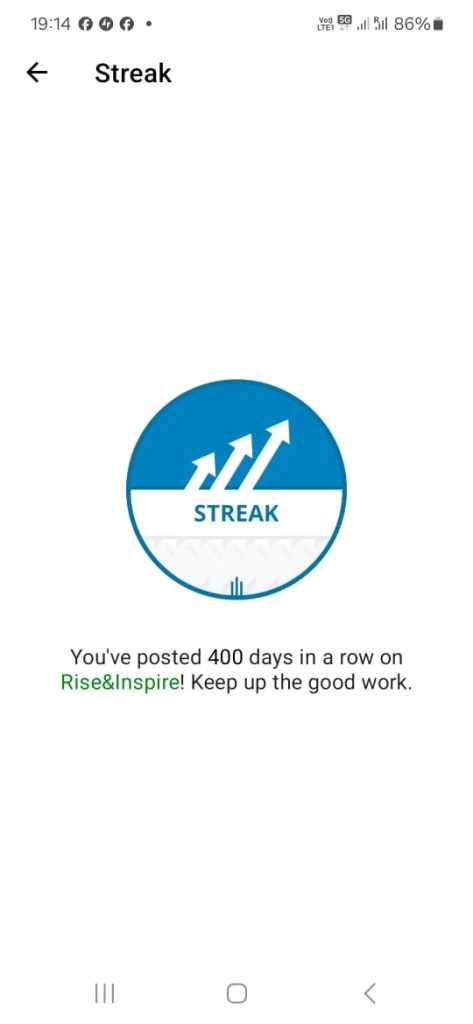
Reaching a milestone of 400 consecutive days of blogging on Rise&Inspire is something I never imagined when I first started this journey. But here I am, celebrating this achievement with you, my wonderful readers. It got me thinking: how long can someone keep up a streak like this? Is there a limit? The answer isn’t so simple. Life has a way of throwing curveballs, and as much as we’d like to maintain consistency, there are real challenges along the way. But one thing is certain: continuous blogging requires passion, adaptability, and a bit of strategy.

The Reality of Daily Blogging

Starting a daily blogging streak is exhilarating. There’s that initial burst of excitement that propels you forward, helping you to write day after day. Even on hectic days, the thrill of seeing your streak grow keeps you motivated. But as the days turn into weeks and then months, the reality sets in—life doesn’t always cooperate.

Between the demands of work, personal responsibilities, and unexpected life events, finding time to sit down and craft a meaningful post can become a real challenge. Whether it’s a family emergency, an overwhelming workload, or just pure mental exhaustion, there are bound to be days when blogging feels less like a joy and more like an obligation.

So, how do you maintain that momentum? I’ve found that it’s a delicate balance. Pre-scheduling posts, drawing inspiration from everyday moments, and allowing yourself to experiment with different formats can all help. But let’s be honest, there are days when it’s tough to keep going, no matter how much you love what you do.

The Pressure of Consistency

One of the biggest challenges I’ve faced during this 400-day streak is the pressure to constantly deliver fresh, engaging content. Creativity ebbs and flows, and some days, inspiration just doesn’t come. But the streak? It doesn’t wait for inspiration.

I’ve learned that preparation is key. On lighter days, I try to create a backlog of content so that on those days when I’m swamped or just not feeling inspired, I’ve got something ready to go. Sometimes that means writing shorter posts or experimenting with different styles. I’ve come to realize that consistency doesn’t have to mean perfection; it’s about showing up for your readers, even if you don’t have a masterpiece to offer.

The Power of Pausing

It might sound counterintuitive, but sometimes the best thing you can do for your blog is to take a break. Skipping a day or two can feel like defeat when you’re in the midst of a streak, but in reality, breaks can give you the space to recharge and come back stronger. They prevent burnout, give you a fresh perspective, and allow you to refocus on what really matters—delivering value to your audience.

Instead of viewing a missed day as a failure, I’ve come to see it as an opportunity to reconnect with my creativity and ensure that I’m bringing my best self to the blog. Many bloggers build in contingency plans, like having guest posts or scheduled content in place for those times when life demands attention elsewhere.

The Journey of Continuous Blogging

Blogging every day for 400 days has taught me so much. It’s a journey that goes beyond just posting content—it’s about finding your rhythm, adapting to life’s challenges, and staying connected to your passion. While some bloggers thrive with daily posting for years, others find that taking regular breaks keeps them refreshed and inspired.

For me, this streak has been a testament to the power of dedication and resilience. But I’ve also learned that adaptability and self-care are just as important. Continuous blogging isn’t a race to see how long you can last without a break; it’s about finding your unique path and enjoying the journey, wherever it may lead.

Conclusion

So, how many days can you blog continuously? There’s no definitive answer. It’s as many days as you’re willing to commit to, driven by your passion and the joy of sharing your voice with the world. Each blogger’s journey is different, and that’s what makes it so rewarding.

For me, these past 400 days have been filled with challenges, growth, and so much inspiration. I’m excited to see where this journey continues to take me—and I’m so grateful to have you along for the ride.

Whether you blog for 10 days, 100 days, or 1,000 days, remember this: It’s not about the streak; it’s about the impact you make with your words and the connection you build with your readers.

Here’s to more blogging, more growth, and more inspiration—one day at a time.

Thank you for being a part of Rise&Inspire. This milestone is as much yours as it is mine, and I look forward to continuing this journey together.

How Do We Bring Ideas to Life? A Behind-the-Scenes Look

Behind the scenes (video)

Responsible Venom Extraction Practices

Ever wondered what goes on behind the scenes of our creative endeavors? From the initial spark of an idea to the final product, our journey is filled with collaboration, innovation, and dedication. In this post, we take you behind the curtain to reveal the steps, challenges, and triumphs that shape our work. Join us as we share the process that brings our ideas to life.

Venom extraction serves research, antivenom production, and educational goals, prioritizing ethical practices and the well-being of snakes. Professionals and institutions follow strict ethical guidelines, ensuring the humane treatment of animals during the extraction process.

To gain insights into this procedure for research purposes, you can watch informative videos illustrating the responsible and ethical methods employed by experts in the field.

#VenomExtraction #EthicalResearch #SnakeWellBeing #AntivenomProduction #EducationalGoals #ResearchEthics

Video credit to the respective owner

Discover the magic of positivity at Rise&Inspire