
“The man who prays with doubt in his heart is like a hunter shooting with an unloaded gun” -Charles Haddon Spurgeon, the renowned 19th-century Baptist preacher.
“Modern Christianity often presents faith as another lifestyle choice rather than a complete surrender of will.”
A Rise & Inspire Biblical Reflection
Discover the powerful spiritual meaning of James 1:7-8 about double-mindedness and faith. Learn how to overcome doubt, strengthen your faith, and receive God’s blessings through unwavering trust. Biblical reflection with practical applications for modern Christian living.
A Wake-Up Call from His Excellency, the Rt. Rev. Dr. Selvister Ponnumuthan
“Beloved children of God, in our modern age of endless choices and competing voices, we find ourselves at the crossroads of decision. The ancient wisdom of Prophet James speaks with urgent relevance to our contemporary struggles. Are we not like children standing before two doors – one leading to unwavering faith, the other to the chaos of divided loyalty? Today, I challenge you to examine your heart. Are you serving God with your whole being, or are you like a ship without anchor, driven by every wind of circumstance? The time has come to choose – not tomorrow, not next week, but today. Will you stand firm in faith, or will you remain tossed by the waves of doubt? Your eternity depends on this sacred choice. Choose wisely, choose boldly, choose Christ completely.”
The Verse That Pierces the Soul
“For the doubter, being double-minded and unstable in every way, must not expect to receive anything from the Lord.” – James 1:7-8
These words from the Epistle of James cut through the noise of our chaotic world like a surgeon’s blade, exposing the spiritual malady that plagues countless believers today. In an era where we pride ourselves on keeping our options open, where commitment is often viewed as limitation, and where flip-flopping is sometimes celebrated as flexibility, James delivers a sobering truth that challenges our very foundations.
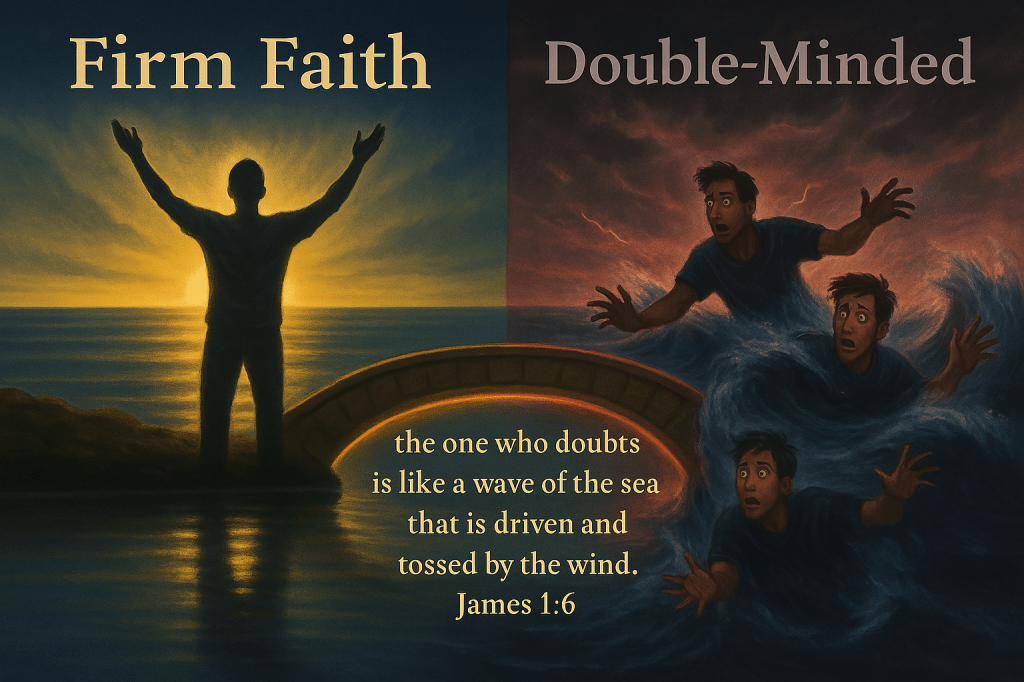
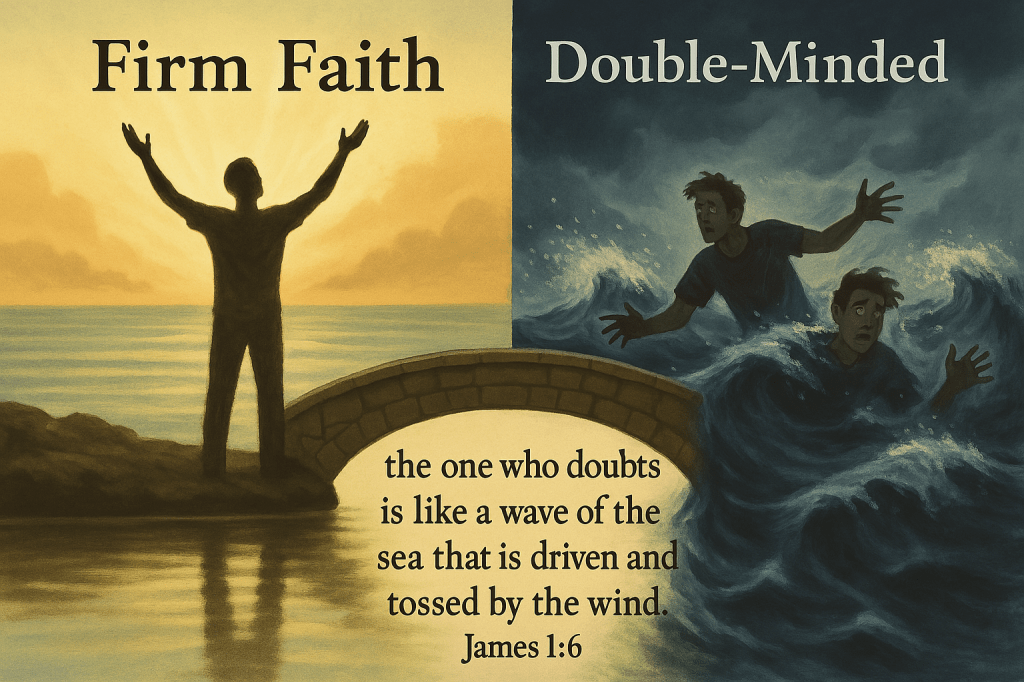
The apostle doesn’t mince words. He doesn’t soften the blow with comforting platitudes or diplomatic language. Instead, he presents us with a stark reality: the doubting person is “like a wave of the sea, blown and tossed by the wind” and such a person “should not think he will receive anything from the Lord.”
The Dangerous Disease of Double-Mindedness
Understanding the Original Language
The term “double-minded” comes from the Greek word “dipsuchos,” meaning “a person with two minds or souls.” Remarkably, this word appears only in the book of James, leading Bible scholars to conclude that James might have coined this term. This linguistic innovation suggests that James encountered a spiritual condition so prevalent and dangerous that existing vocabulary was insufficient to describe it.
The Greek construction reveals layers of meaning that our English translation can barely capture. “Dipsuchos” literally means “two-souled,” implying not just mental indecision but a fundamental split in one’s very essence. It’s not merely about changing one’s mind occasionally; it’s about harboring two competing souls within one body.
The Anatomy of Spiritual Instability
A double-minded person, according to James 1, is someone who fluctuates in their loyalty to Christ. Their belief in whether or not he existed may not shift back and forth, but their commitment to following him changes, sometimes following other gods instead.
This instability manifests in several devastating ways:
The Prayer Life Crisis: The double-minded believer approaches God with requests while simultaneously harboring doubt about God’s willingness or ability to answer. They pray for healing while scheduling worry time. They ask for provision while hoarding resources out of fear. They seek God’s will while secretly hoping for their own agenda to prevail.
The Decision-Making Dilemma: Every choice becomes a battlefield between faith and fear, between God’s ways and worldly wisdom. The double-minded person seeks counsel from multiple sources – some godly, others secular – and attempts to synthesize contradictory advice into a workable solution.
The Worship Paradox: Sunday morning finds them in church, hands raised in apparent devotion, while Monday morning finds them living as practical atheists, making decisions based purely on human logic and selfish ambition.
The Historical Context: James’s Urgent Warning
James wrote his epistle to Jewish Christians scattered throughout the Roman Empire, believers facing persecution, economic hardship, and cultural pressure to compromise their faith. These early Christians lived in a world remarkably similar to ours – a world of competing ideologies, multiple religious options, and constant pressure to adapt and blend in.
The historical context reveals why James used such strong language. These believers were literally dying for their faith. For them, double-mindedness wasn’t just inconvenient – it was potentially fatal. A believer who wavered between Christ and Caesar, between the Gospel and social acceptance, between faith and fear, wouldn’t survive the coming storms.
James understood that lukewarm faith isn’t just ineffective – it’s dangerous. In times of testing, the double-minded believer lacks the spiritual fortitude to stand firm. They become casualties of their own indecision.
The Modern Epidemic: Double-Mindedness in the 21st Century
The Social Media Split Personality
Today’s believers face unique challenges that amplify the tendency toward double-mindedness. Social media creates platforms where we can present curated versions of ourselves to different audiences. We might share Scripture verses on Sunday and worldly content on Wednesday. We celebrate God’s blessings while quietly envying others’ success. We post prayers for others while struggling with our own hidden doubts.
The Consumer Christianity Trap
Modern Christianity often presents faith as another lifestyle choice rather than a complete surrender of will. We’re encouraged to take what works for us and leave the rest. This consumer mentality breeds double-mindedness by allowing us to believe we can serve God on our terms rather than His.
The Prosperity Gospel Confusion
Perhaps nowhere is double-mindedness more evident than in prosperity theology, which teaches that faith should result in material blessing. When the promised wealth doesn’t materialize, believers find themselves torn between what they were taught and what they experience. They begin to question whether God is good, whether their faith is sufficient, or whether the promises are true.
Watch This Powerful Message on Faith and Doubt
Before we explore deeper into the solution, I encourage you to watch this profound teaching that beautifully illustrates the very struggles we’re discussing:
Watch: Understanding Faith and Overcoming Doubt
This message will provide additional insight into the practical aspects of maintaining unwavering faith in a world that constantly challenges our spiritual stability.
Insights from Great Spiritual Leaders
Charles Spurgeon: The Prince of Preachers on Steadfast Faith
Charles Haddon Spurgeon, the renowned 19th-century Baptist preacher, understood the dangers of spiritual wavering better than most. Having pastored through personal trials, public controversies, and seasons of depression, Spurgeon wrote extensively about the necessity of unwavering faith.
“The man who prays with doubt in his heart is like a hunter shooting with an unloaded gun,” Spurgeon observed. “He may go through all the motions, but he should not expect to bring down any game.” Spurgeon’s own battles with doubt make his insights particularly valuable. He didn’t speak from theoretical knowledge but from the trenches of spiritual warfare.
Spurgeon emphasized that doubt isn’t the opposite of faith – it’s faith mixed with unbelief. “Pure doubt,” he noted, “would never pray at all. It’s the mixture that creates the problem. We want God to answer, but we’re not sure He will. We believe He can, but we wonder if He’ll choose to do so for us.”
His remedy was radical simplicity: “Take God at His word completely, or don’t take Him at all. Half-faith receives half-answers, which are really no answers at all.”
Mother Teresa: Embracing Faith Through Darkness
Surprisingly, Mother Teresa of Calcutta provides deep insights into overcoming spiritual double-mindedness, despite her well-documented struggles with periods of spiritual darkness. Her private letters, published posthumously, reveal decades of feeling God’s absence while continuing to serve with unwavering dedication.
What makes Mother Teresa’s example powerful is that she demonstrates how to maintain single-minded devotion even when feelings fail. “Faith,” she wrote, “is not about feeling God’s presence. Faith is about continuing to trust when feelings fail, continuing to serve when emotions deceive, continuing to love when love seems unreturned.”
Her secret was anchoring faith in decision rather than emotion. She chose to believe regardless of what she felt. This choice-based faith, rather than emotion-based faith, proved unshakeable even in her darkest spiritual winters.
“I have learned,” she reflected near the end of her life, “that God’s silence doesn’t mean God’s absence. Sometimes the greatest faith is expressed not in miraculous answers but in persistent obedience despite unanswered questions.”
A.W. Tozer: The Mystic on Pure Heart Devotion
Aiden Wilson Tozer, the Christian mystic and author of “The Pursuit of God,” provided perhaps the most penetrating analysis of double-mindedness in modern Christian literature. Tozer believed that the root of spiritual instability lay in divided affections rather than intellectual doubt.
“The reason why many are still troubled, still seeking, still making little forward progress is because they haven’t yet come to the end of themselves,” Tozer wrote. “We’re still trying to give orders, and interfering with God’s work within us.”
Tozer identified the core issue: we want God’s benefits without God’s lordship. We want His answers without His authority. We want His blessings without His boundaries. This creates an internal civil war that James identifies as double-mindedness.
His solution was radical surrender: “We must do something, and that something is to abandon ourselves to God. We must surrender absolutely to the will of God. We must stop trying to manage our own spiritual lives and allow God to be God in us.”
The Pathway to Single-Minded Faith
Step 1: Recognition and Confession
The journey from double-mindedness to spiritual stability begins with honest self-examination. We must identify the areas where we’re serving two masters, believing two contradictory truths, or maintaining two different standards.
This requires courage because recognition often reveals uncomfortable truths about our spiritual condition. We might discover that we’ve been praying for God’s will while secretly hoping for our own. We might realize that we’ve been asking for faith while feeding our doubts through negative thinking, fearful conversations, or faithless entertainment.
Step 2: Repentance and Realignment
Recognition without repentance leads nowhere. True repentance involves not just feeling sorry for our double-mindedness but actively turning away from it. This might mean:
Ending relationships that consistently undermine our faith
Changing entertainment choices that feed doubt and fear
Abandoning thought patterns that contradict God’s promises
Choosing to trust God’s character even when circumstances suggest otherwise
Step 3: Intentional Faith Building
Faith, like muscle, grows stronger with intentional exercise. Building single-minded faith requires deliberate, consistent practices:
Scripture Meditation: Instead of reading the Bible for information, meditate on God’s promises until they become more real than current circumstances. Transform Bible reading from academic exercise to faith-building encounter.
Worship-Based Prayer: Begin prayers with worship rather than requests. Spend time acknowledging God’s character, power, and faithfulness before presenting needs. This builds confidence in His ability and willingness to answer.
Testimony Rehearsal: Regularly recount God’s past faithfulness in your life and in Scripture. Keep a journal of answered prayers, divine interventions, and God’s provision. Review these regularly to strengthen faith for current challenges.
Step 4: Community Accountability
Double-mindedness thrives in isolation. Surround yourself with believers who will call out spiritual inconsistency and encourage single-minded devotion. Share your struggles with trusted spiritual mentors who can provide godly counsel and prayer support.
Practical Applications for Modern Believers
In Decision Making
Replace the question “What do I want?” with “What does God want?” When facing choices, don’t seek multiple opinions that might contradict each other. Instead, seek God’s will through Scripture, prayer, and godly counsel, then trust that God will guide your decision.
In Financial Matters
Money reveals double-mindedness faster than almost anything else. If you pray for provision while hoarding resources, you’re double-minded. If you ask God to meet your needs while spending impulsively on wants, you’re double-minded. Align your financial practices with your prayers.
In Relationships
Stop seeking romantic relationships through worldly methods while praying for a godly spouse. Stop using manipulation and game-playing while asking God for authentic love. Let your relationship approaches match your relationship prayers.
In Career and Ministry
Don’t climb corporate ladders through worldly ambition while praying for God’s promotion. Don’t build your reputation through self-promotion while asking God for favor. Let your professional conduct reflect your spiritual convictions.
A Detailed Prayer of Surrender
Heavenly Father, I come before You today acknowledging the double-mindedness that has plagued my heart and hindered my prayers. I confess that I have tried to serve two masters, sought two kingdoms, and maintained two standards. Forgive me for the instability that has marked my spiritual journey.
I recognize that my wavering has not only robbed me of Your blessings but has also dishonored Your character. When I doubt Your goodness while proclaiming Your love, I bear false witness about who You are. When I fear Your provision while claiming to trust Your care, I call You a liar.
Today, I choose single-minded devotion. I surrender my will completely to Yours. I abandon my agenda in favor of Your plan. I relinquish my understanding in submission to Your wisdom. I choose to trust Your heart even when I cannot see Your hand.
Root out every area of double-mindedness in my life. Reveal the places where I’m serving other gods while claiming to serve You. Show me the thoughts, relationships, habits, and attitudes that undermine my faith. Give me courage to cut away everything that competes with my devotion to You.
I ask not just for answers to my prayers, but for transformation of my heart. Make me the kind of person who can receive from You because I trust You completely. Develop in me unwavering faith that stands firm regardless of circumstances.
When doubt whispers, let Your Spirit speak louder. When fear threatens, let Your peace prevail. When the world offers alternative solutions, let Your Word be my final authority. Make me stable in all my ways, anchored in Your unchanging character.
I pray this not just for my own benefit, but for the glory of Your name. Let my life be a testimony to Your faithfulness. Let my unwavering trust demonstrate Your trustworthiness to a watching world.
In Jesus’ mighty name, Amen.
Meditation and Reflection Points
Week 1: The Wave Metaphor
Spend time near water – whether ocean, lake, or even your bathtub. Watch how waves are “driven and tossed by the wind.” Notice their constant motion, their lack of stability, their inability to maintain any fixed position. Reflect on how this describes your spiritual state when you’re double-minded. Journal about areas where you feel tossed by circumstances rather than anchored in faith.
Week 2: The Master Question
Each morning, ask yourself: “Who am I serving today?” Throughout the day, evaluate your choices, words, thoughts, and attitudes. Are they serving God’s kingdom or your own? Are they building His reputation or yours? Are they advancing His agenda or your agenda? End each day by confessing areas where you served the wrong master.
Week 3: The Prayer Audit
Review your recent prayers. What percentage focused on worship versus requests? How many demonstrated trust versus anxiety? Were you approaching God as a cosmic vending machine or as a loving Father? Restructure your prayer life to begin with worship, proceed with thanksgiving, and only then present requests – always with submission to God’s will.
Week 4: The Stability Test
Identify one area where you’ve been double-minded. Make a single-minded decision to trust God completely in that area. Stop seeking alternative solutions. Stop entertaining backup plans that exclude God. Stop worrying about outcomes. Trust and act on that trust consistently for an entire week. Journal about the results.
Faithful Inquiries (Frequently Asked Questions)
Q: Isn’t it natural to have some doubts? Doesn’t everyone struggle with faith sometimes?
A: There’s an important distinction between honest questions and double-mindedness. Doubts that drive us to seek God more earnestly are different from doubts that cause us to hedge our bets. Even great biblical figures like John the Baptist had moments of questioning, but they brought their questions to God rather than using them as excuses for unfaithfulness.
The issue isn’t occasional doubts – it’s maintaining a lifestyle of divided loyalty. It’s continuing to serve two masters while expecting God to bless the arrangement.
Q: How can I know if I’m double-minded or just being wise and cautious?
A: Wisdom seeks God’s will and acts accordingly. Double-mindedness seeks God’s will but maintains alternative plans in case God doesn’t come through. Wisdom trusts God’s timing and methods. Double-mindedness trusts God’s ends but not His means.
Ask yourself: Am I seeking God’s direction and then following it completely, or am I seeking God’s blessing on my own plans? Am I trusting God’s provision while being responsible, or am I trusting God while secretly relying on my own backup systems?
Q: What about situations where I genuinely don’t know God’s will? Should I just wait and do nothing?
A: God rarely reveals His entire plan at once. He gives us enough light to take the next faithful step. Double-mindedness often disguises itself as waiting for more clarity when God has already provided sufficient direction.
If you know the right thing to do but you’re afraid of the consequences, that’s not a clarity issue – it’s a trust issue. If God has spoken through His Word about a situation, you don’t need additional revelation. If godly counselors agree on a direction and it aligns with Scripture, you probably have enough guidance to act.
Q: Can God use double-minded people at all, or are they completely useless to His kingdom?
A: God can use anyone, but double-minded people limit their own usefulness and rob themselves of God’s best. Think of it like trying to fill a bucket with holes in the bottom. God can pour in blessing, anointing, and opportunity, but the instability causes most of it to leak out.
The question isn’t whether God can use double-minded people, but whether they can receive and retain what God wants to give them. The vessel matters as much as the content.
Q: How long does it take to overcome double-mindedness?
A: The decision to become single-minded can happen in a moment. The transformation of character takes time. Some see immediate changes in their prayer life and spiritual stability. Others find it’s a process of gradually aligning their actions with their decisions.
The key is consistency. Every time you choose God’s way over the world’s way, every time you trust instead of worry, every time you obey instead of compromise, you’re building single-minded character. The compound effect of these choices eventually creates unshakeable stability.
Q: What if I’ve been double-minded for years? Is it too late to change?
A: It’s never too late to choose single-minded devotion. God’s grace is sufficient for any spiritual condition, and His power can transform any heart. Some of the most powerful testimonies come from people who lived double-minded lives for decades before discovering the joy of wholehearted faith.
The past doesn’t determine the future when God is involved. Today can be the beginning of a completely different spiritual trajectory.
The Ripple Effect: How Single-Minded Faith Transforms Communities
When believers move from double-mindedness to single-minded devotion, the impact extends far beyond individual spiritual growth. Families are strengthened when parents model consistent faith rather than situational spirituality. Churches grow healthier when members approach worship, service, and relationships with undivided hearts.
The workplace becomes a mission field when believers demonstrate integrity consistently rather than selectively. Communities are transformed when Christians stop compartmentalizing their faith and begin living as integrated followers of Christ in every sphere of life.
Single-minded faith is contagious. When others see believers who trust God completely, act on their convictions consistently, and maintain peace despite circumstances, they’re drawn to investigate the source of such stability.
The Ultimate Promise: What God Gives to the Single-Minded
James doesn’t just warn about what double-minded people won’t receive – he implies what single-minded believers will receive. The promise isn’t just answered prayer, though that’s included. The promise is access to divine wisdom, supernatural peace, unshakeable joy, and the kind of spiritual authority that moves mountains.
Single-minded believers become conduits of God’s power rather than obstacles to it. They become answers to their own prayers and solutions to their own problems because God can work through surrendered vessels without resistance.
Perhaps most importantly, single-minded believers discover that what they thought they were sacrificing by abandoning their backup plans and alternative loyalties was nothing compared to what they gain in intimate relationship with God.
A Call to Decisive Action
The time for spiritual fence-sitting is over. The luxury of keeping your options open is a luxury you can’t afford. The cost of double-mindedness is too high, and the benefits of single-minded faith are too great to postpone this decision any longer.
Today, God is calling you to choose. Not partially, not conditionally, not temporarily – but completely, unconditionally, and permanently. He’s calling you to burn the bridges that lead back to divided loyalty and to step fully into the adventure of wholehearted faith.
The question isn’t whether God is trustworthy – thousands of years of human history and billions of personal testimonies confirm His faithfulness. The question is whether you’re ready to stake your life on that trustworthiness.
Your Rise & Inspire Challenge
As you finish reading this reflection, you face a choice that will determine the trajectory of your spiritual journey. Will you remain tossed by the waves of uncertainty, receiving nothing from the Lord because of your divided heart? Or will you plant your feet firmly on the solid ground of single-minded faith and begin experiencing the fullness of God’s blessings?
Here’s your specific action step: Identify one area of your life where you’ve been double-minded. Write it down. Then write a prayer of surrender for that specific area. Post it somewhere you’ll see it daily. For the next 30 days, every time you’re tempted to hedge your bets or maintain backup plans in that area, read your prayer of surrender and choose to trust God completely.
Reflective Questions for Your Journey:
1. What backup plans am I maintaining because I don’t fully trust God’s provision?
2. In what areas of my life do my actions contradict my prayers?
3. What would change if I truly believed that God wants to give me “every good and perfect gift”?
4. How has my double-mindedness affected my ability to encourage others in their faith?
5. What legacy of faith do I want to leave for the next generation?
Remember, Rise & Inspire family: You were created for more than spiritual mediocrity. You were designed for the kind of faith that moves mountains, transforms communities, and leaves a legacy of wholehearted devotion to God.
The choice is yours. The time is now. Choose wisely, choose boldly, choose completely.
May this reflection stir your heart toward the life-changing power of single-minded faith. Share your insights and commitments in the comments below, and let’s encourage one another in this journey toward spiritual stability and divine blessing.
Explore additional inspiration from the blog’s archive. | Wake-Up Calls
Categories: Astrology & Numerology | Daily Prompts | Law | Motivational Blogs | Motivational Quotes | Others | Personal Development | Tech Insights | Wake-Up Calls
🌐 Home | Blog | About Us | Contact| Resources
📱 Follow us: @RiseNinspireHub
© 2025 Rise&Inspire. All Rights Reserved.
Word Count:3895