
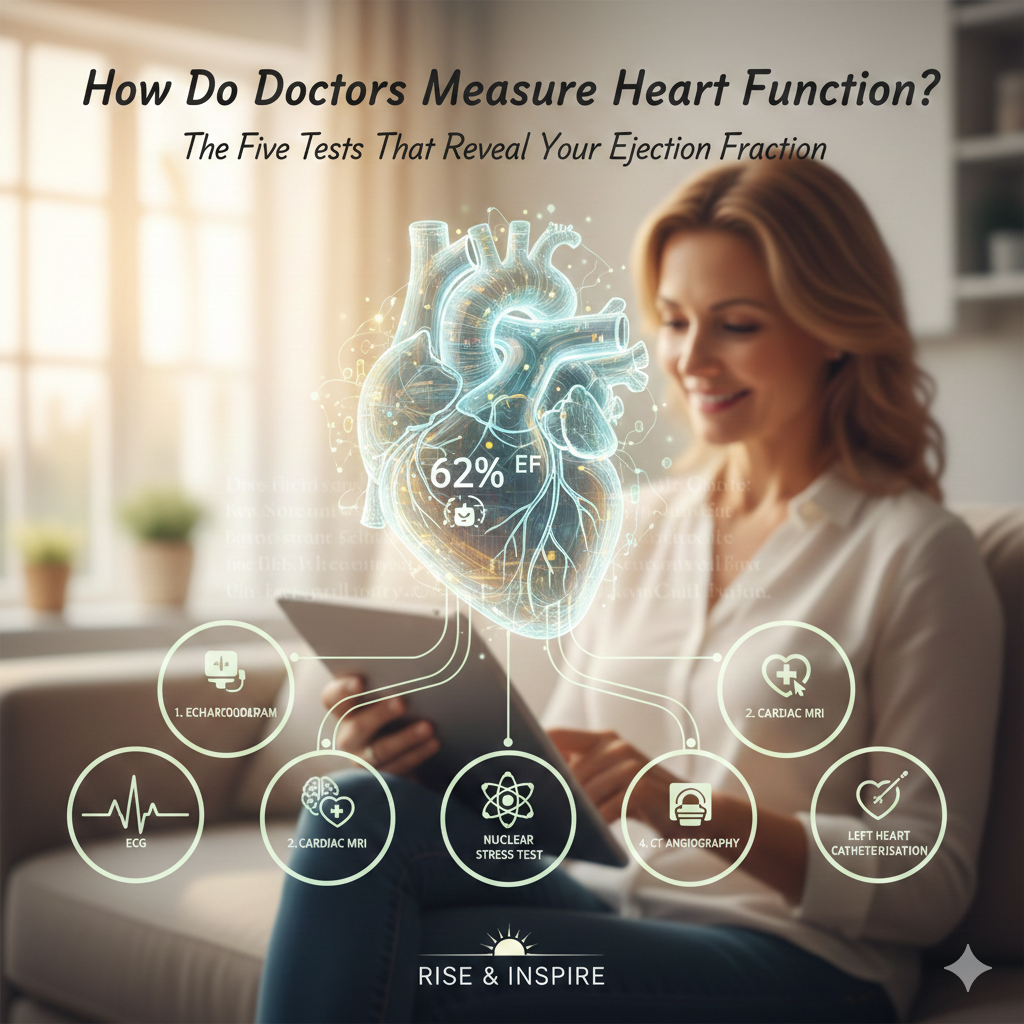
Every day, your heart contracts roughly 100,000 times, and every single one of those beats has a measurable efficiency rating. That rating is called ejection fraction — and for millions of people, it is quietly sitting below the danger threshold without a single obvious symptom to show for it. Heart disease does not always arrive with a warning. Sometimes it whispers through a little fatigue, a slightly swollen ankle, a breathlessness you blamed on the stairs. This guide will show you what your heart is actually trying to tell you, how doctors measure it, and what you can do with that knowledge starting today.
Know Your Heart: Understanding Ejection Fraction & Why It Matters
Your heart beats around 100,000 times a day. Are you listening to what it’s telling you?
At Rise & Inspire, we believe that true empowerment begins with knowledge — especially when it comes to your health.
Today, we’re taking a closer look at one of the most important yet often overlooked metrics in heart health: the Ejection Fraction (EF). Understanding this number could literally save your life.
💓 What Is Ejection Fraction?
Ejection Fraction is a measurement — expressed as a percentage — of how much blood your left ventricle pumps out with each heartbeat. Think of your heart as a powerful pump. EF tells you how efficiently that pump is working.
A normal EF ranges between 50% and 70%. This means a healthy heart pumps out more than half its blood volume with every beat — consistently, reliably, powerfully.
Understanding the EF Ranges:
• 50–70% — Normal. Your heart is pumping efficiently.
• 40–49% — Mildly Reduced (HFmrEF). A borderline zone that warrants close monitoring.
• Below 40% — Reduced EF (HFrEF). Often associated with heart failure or cardiomyopathy — a condition where the heart muscle is weakened.
Important Note: Heart failure isn’t limited to low EF. Heart Failure with Preserved Ejection Fraction (HFpEF) can occur even when EF appears normal, if the heart muscle is too stiff to fill properly. This is why regular check-ups are so critical — numbers alone don’t always tell the full story.
🔬 How Is EF Measured? Your Testing Options Explained
The good news? Measuring your EF is more accessible than ever. There are multiple safe, effective tests your doctor can recommend based on your personal health needs. Most cardiac evaluations begin with one simple, painless test — the ECG — before moving into the specific tools that measure EF directly.
The Starting Point: ECG (Electrocardiogram)
Before measuring ejection fraction, doctors often begin with an ECG — a quick, non-invasive test that records the electrical activity of your heart. It detects rhythm irregularities, signs of a previous heart attack, or an enlarged heart. While an ECG does not measure EF directly, it is frequently the first diagnostic step that signals a doctor to look deeper.
Think of the ECG as checking the wiring of the heart. The tests below measure how much blood the pump actually delivers. Both matter — and one often leads to the other.
1. Echocardiogram (Echo) — The Go-To Test
The most widely used test for EF measurement. It uses ultrasound to create real-time images of your heart in motion — non-invasive, radiation-free, and highly accessible. If you’ve never had one, ask your doctor about it today.
2. Cardiac MRI — The Gold Standard of Accuracy
When pinpoint accuracy is needed, Cardiac MRI delivers the most detailed images of heart structure and function. It’s more expensive and less common, but offers unparalleled clarity.
3. Nuclear Stress Test (MUGA Scan)
Using a small amount of radioactive tracer to track blood flow, this test is highly accurate and especially useful when the echo results are unclear or inconclusive.
4. CT Angiography (Cardiac CT)
This test uses X-rays and contrast dye to image the heart, measure EF, and check for arterial blockages simultaneously — a powerful diagnostic tool.
5. Left Heart Catheterisation — The Invasive Expert
Reserved for specific cases, this procedure involves threading a catheter into the heart. It’s the most direct method and also evaluates coronary artery blockages at the same time.
🌟 Rise Up: Why This Knowledge Is Your Superpower
Here’s the truth that Rise & Inspire stands by: you cannot change what you don’t measure. Too many people wait until something feels wrong before they seek answers. But heart disease is often silent — developing quietly over years before making itself known in a crisis.
Knowing your Ejection Fraction is an act of self-love and self-advocacy. It puts the power back in your hands. Whether your results come back normal or reveal something that needs attention, either way you win — because now you know, and knowledge is where healing begins.
If your EF comes back low, remember: it’s not a death sentence — it’s a starting point. With the right medical support, lifestyle changes, and a determined spirit, people improve their heart function every single day.
✅ Your Next Steps
✔️ Schedule a check-up with your cardiologist or primary care physician.
✔️ Ask specifically about having an Echocardiogram if you haven’t had one.
✔️ Share this article with someone you love — heart health is a family conversation.
✔️ Don’t wait for symptoms. Be proactive. Be empowered.
“Take care of your heart — it’s the only engine you’ve got.”
RISE & INSPIRE
Health & Wellness | Heart Health Edition
This article is for informational purposes only. Always consult a qualified cardiologist or medical professional for personal health advice.
Explore more at the Rise & Inspire archive | Motivational Blogs
© 2025 Rise & Inspire. Follow our journey of reflection, renewal, and relevance.
Website: Home | Blog | About Us | Contact| Resources
Word Count:923