Quick Reference Summary & Index
Blog Title: Who Really Rules? Why the Fear of the Lord Outranks Every Earthly Authority
Anchor Verse: Ecclesiasticus 10:24
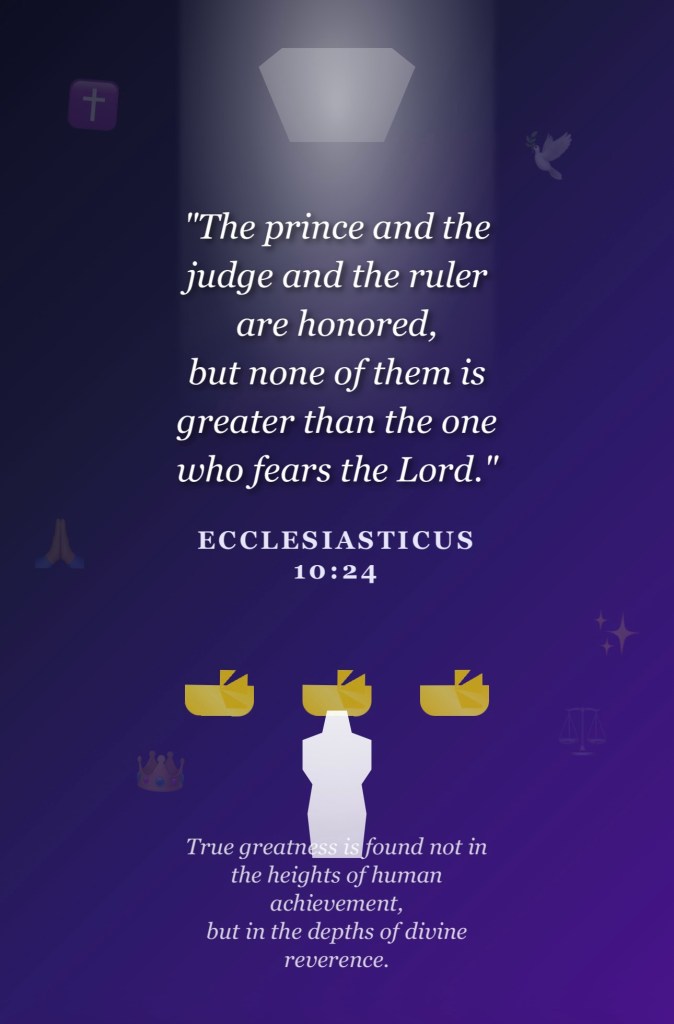
“The prince and the judge and the ruler are honored, but none of them is greater than the one who fears the Lord.”
Overview:
This blog post is a Spirit-led journey into the sacred authority of God over all human power structures. Through poetic insight, theological depth, prophetic challenge, and practical application, it invites readers into holy reverence and Kingdom-aligned living in a world obsessed with influence and status.
Blog Flow & Spiritual Index
- A Divine Wake-Up Call
A prophetic exhortation from the Rt. Rev. Dr. Selvister Ponnumuthan, calling the Church to honor God above all rulers and powers. - The Sacred Text Unveiled
A layered exploration of Ecclesiasticus 10:24—its historical, theological, and spiritual meaning. - Historical Heartbeat
Understanding the verse in its original Hellenistic-Jewish context and its subversive power under foreign rule. - Theological Depths
Exploring the imago Dei and the Kingdom reversal embedded in the fear of the Lord. - Linguistic Treasures
A word study on “fear” (yirah) and “honor” (nikbadim), revealing heavenly insight through Hebrew roots. - Voices from the Cloud of Witnesses
Reflections from Augustine, Gregory the Great, Bonhoeffer, Nouwen, and N.T. Wright on reverence, power, and the Kingdom. - Sacred Stillness: A Meditation
A poetic and guided visualization to help readers internalize the verse and reframe their view of greatness. - Spirit-Breathed Prayer
A heartfelt and reverent prayer surrendering human recognition in exchange for holy awe. - Testimony: The Word Made Flesh
The moving story of Maria, whose hidden life of service and prayer eclipsed worldly power. - Today’s Holy Habit: The Sovereignty Pause
A practical spiritual discipline to keep God’s authority central in daily life. - Confronting Cultural Distraction
How this Scripture critiques celebrity culture, social media fame, and worldly validation. - From the Word to the World
Connecting the verse to global issues: injustice, ecological grief, and digital alienation. - Liturgical Resonance
Rooted in Ordinary Time—an invitation to live the extraordinary call of reverence in everyday moments. - Video Reflection: Sacred Screen
A contemplative video titled “When Kings Bow”—a visual pause to realign with divine authority.
Watch Here - The Candlelight Challenge
A bold, haunting call to rise, revere, and live by the fear of the Lord in a world of temporary crowns.
Use this guide as a roadmap—read straight through or return to sections throughout your day or week for spiritual nourishment and re-alignment.
The Crown That Trembles: When Authority Bows Before the Almighty
A Biblical Encounter: Rise & Inspire Reflections with Johnbritto Kurusumuthu
1. A Divine Wake-Up Call from His Excellency
From the episcopal chambers of His Excellency, the Rt. Rev. Dr. Selvister Ponnumuthan
“Beloved shepherds and sheep of Christ’s flock, the hour is upon us when the kingdoms of this world must acknowledge the Kingdom of our God. In these fractured times, when earthly powers posture and preen, when the mighty mistake their positions for their worth, the Spirit calls us to a deeper recognition: true greatness is found not in the heights of human achievement, but in the depths of divine reverence.
Listen! The principalities and powers that seem so permanent, so unshakeable, are but shadows dancing before the eternal throne. The One who holds the breath of every ruler in His hands whispers still: ‘Be still, and know that I am God.’ Wake up, dear ones! The urgency of this hour demands that we see with heaven’s eyes, that we measure greatness by heaven’s standard, that we bow only to the One who is worthy of all praise.”
2. The Sacred Text Unveiled
“The prince and the judge and the ruler are honoured, but none of them is greater than the one who fears the Lord.” (Ecclesiasticus 10:24)
Here, in the crystalline clarity of Ben Sira’s wisdom, we encounter a revolutionary truth that turns the world’s hierarchy upside down. The Hebrew concept behind “fears the Lord” (yirat Adonai) is not cowering terror, but that breathtaking awe when finite meets infinite, when the created encounters the Creator. It is the trembling that accompanies true worship, the holy reverence that recognises the vastness of God’s majesty and our complete dependence upon His grace.
3. Historical Heartbeat
Written in the crucible of Hellenistic pressure upon Jewish faith (circa 200-175 BCE), Ben Sira’s words carry the weight of a people struggling to maintain their identity under foreign rule. The “prince, judge, and ruler” were not abstract concepts but lived realities—the Ptolemaic and later Seleucid authorities who demanded not just political submission but cultural assimilation.
In this context, the sage’s declaration becomes revolutionary: your earthly authorities may command your external compliance, but they cannot command your ultimate allegiance. That belongs to the Lord alone. The one who fears God—the Jewish faithful who maintain a covenant relationship—stands taller in the divine economy than any earthly potentate.
4. Theological Depths
This verse pulses with profound theological currents. It speaks to the imago Dei—that every human being, regardless of social position, carries the image of the Almighty. The street sweeper who walks in the fear of the Lord possesses a dignity that transcends any earthly title.
Here we glimpse the theology of the upside-down kingdom that Jesus would later proclaim: the last shall be first, the meek shall inherit the earth, the humble shall be exalted. The fear of the Lord is not just personal piety but cosmic reordering—a recognition that God’s ways are not our ways, that His thoughts are higher than our thoughts.
5. Linguistic Treasures
The Hebrew yirah (fear/reverence) shares its root with ra’ah (to see). To fear the Lord is to see clearly—to perceive reality as it truly is, with God at the centre. The “honoured” ones (nikbadim) derive their weight from human recognition, but the God-fearers’ worth comes from divine recognition.
The progression “prince, judge, ruler” moves from inherited authority to appointed authority to seized authority—yet none of these human sources of power can elevate a person above the one who has received their authority directly from heaven through a reverent relationship.
6. Voices from the Cloud of Witnesses
Augustine of Hippo reminds us: “It is only when we stand in the fear of the Lord that we begin to have wisdom. For the fear of the Lord is the beginning of wisdom.” The great bishop understood that true greatness flows from recognising our place in the cosmic order.
Gregory the Great declared: “Holy fear is the guardian of all virtues.” The pope who sent missionaries to England knew that kingdoms rise and fall, but those who walk in holy fear participate in the Kingdom that cannot be shaken.
Dietrich Bonhoeffer, writing from his Nazi prison cell, testified: “The church has only one altar, the altar of the Almighty… before which all other altars are abolished.” Even facing earthly powers bent on destruction, he understood that ultimate authority belongs to God alone.
Henri Nouwen offered this insight: “The movement from fear to love is the movement of the spiritual life.” The fear of the Lord that begins in awe blossoms into the love that casts out all other fears.
N.T. Wright observes: “The fear of the Lord is not about being afraid of God, but about being so awed by God that everything else shrinks into proper perspective.”
7. Sacred Stillness: A Meditation
Close your eyes. Breathe deeply.
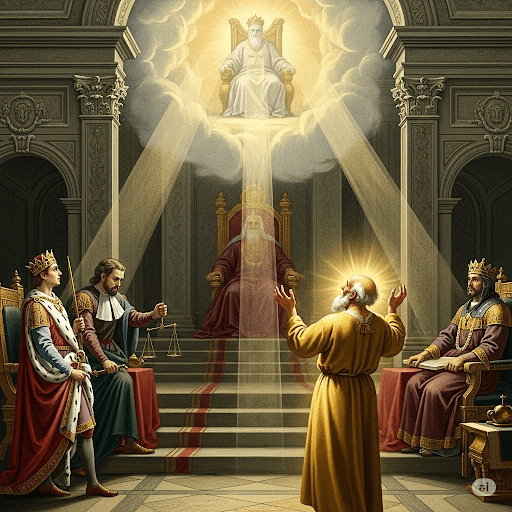
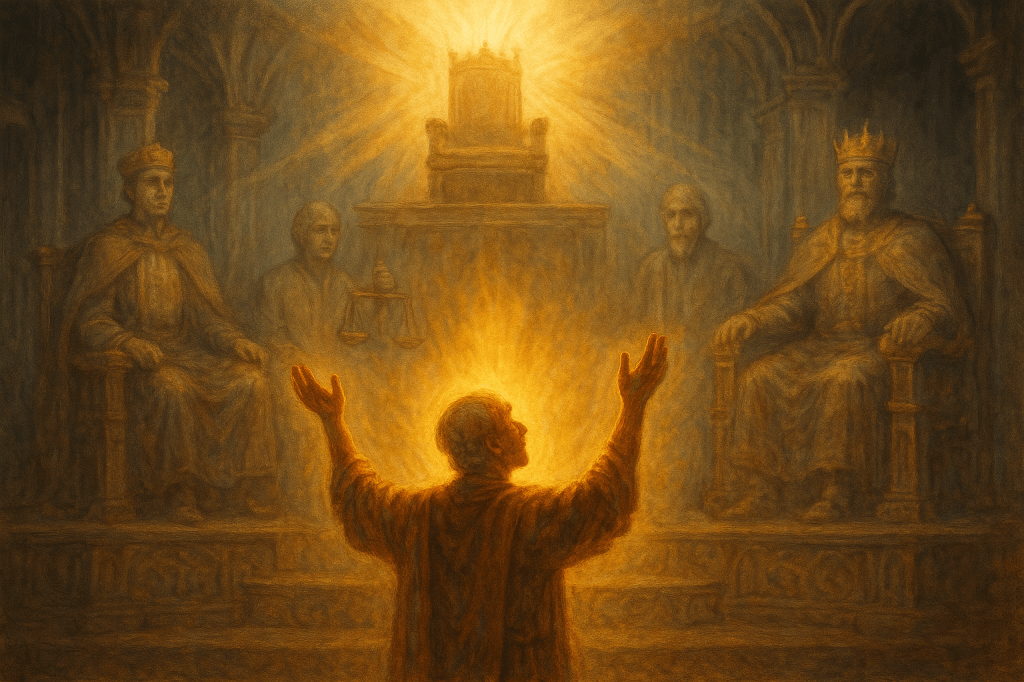
Imagine yourself standing in a vast cathedral where earthly authorities have gathered—presidents and prime ministers, judges and generals, celebrities and titans of industry. See them in their regalia, hear the murmur of deference, feel the weight of their accumulated power and influence.
Now… imagine the cathedral doors opening. A simple figure enters—perhaps a cleaning woman who prays the rosary as she works, or an elderly man who has spent decades in quiet service to God and neighbour. They carry no titles, command no armies, and sign no legislation. Yet as they walk down the aisle, something shifts in the spiritual atmosphere.
The One who sees hearts sees theirs—ablaze with love for Him, transparent with humility, radiant with the fear of the Lord. And in heaven’s economy, this humble soul outranks every earthly potentate.
What does this do to your understanding of greatness? How does it reorder your own ambitions and fears?
8. A Spirit-Breathed Prayer
Holy Spirit, breathe through these words…
“Almighty God,
You who humble the proud and exalt the lowly,
teach us the wisdom of Your upside-down kingdom.
When we are tempted to bow before earthly powers,
remind us that You alone are sovereign.
When we chase after human honours and recognition,
redirect our hearts toward the honour that comes from You alone.
Grant us the fear of the Lord—
not the terror that paralyses,
but the awe that liberates,
not the dread that diminishes,
but the reverence that elevates our souls.
Help us to see with heaven’s eyes:
the janitor who prays is royalty,
the CEO who ignores You is impoverished,
the child who trusts You is wise beyond measure,
the scholar who denies You is a fool.
Transform our understanding of success, of power, of worth.
May we find our identity not in what the world offers
but in what You have declared:
we are Your beloved children,
and that is honour enough for eternity.
Through Christ, who emptied Himself of heavenly glory
yet became the Name above every name,
Amen.”
9. Testimony: The Word Made Flesh
Maria worked the night shift at the hospital, emptying bedpans and mopping floors while doctors made life-and-death decisions and administrators counted profits. By the world’s measure, she was invisible, insignificant. But Maria had a secret: she prayed for every patient she served, whispered blessings over every room she cleaned, and lived each moment conscious of God’s presence.
One night, a prominent businessman lay dying in room 314. His family had flown in from around the world, his lawyers were updating his will, and the media waited for news of his condition. But it was Maria who sat with him in his final hours, Maria who held his hand as he took his last breath, Maria who helped him find peace with God.
Years later, that businessman’s son would say: “The most powerful person I ever met wasn’t my father, with all his wealth and influence. It was the cleaning lady who showed him—and me—what it meant to fear the Lord.”
10. Today’s Holy Habit: The Daily Acknowledge
Practice: The Sovereignty Pause
Throughout your day, whenever you encounter authority figures or feel intimidated by someone’s position or power, take a “sovereignty pause.” Silently acknowledge: “God alone is ultimately sovereign. This person has been given their role by divine permission, but You, Lord, are the final authority.”
Then ask: “How can I honour both their position and Your supremacy? How can I show respect without surrendering my ultimate allegiance to You?”
This practice will gradually rewire your spiritual reflexes, helping you navigate earthly hierarchies while maintaining heavenly perspective.
11. Confronting Cultural Distraction
In our age of social media influencers and viral fame, we’ve created new categories of the “honoured”—those with millions of followers, blue checkmarks, and algorithmic amplification. Our culture worships at the altar of celebrity, bowing before anyone with a platform and a brand.
But Ecclesiasticus 10:24 cuts through our digital delusions: the teenager who fears the Lord is greater than the influencer with ten million followers. The grandmother who prays faithfully outranks the celebrity pastor whose books top bestseller lists. The unknown missionary serving in forgotten places carries more authority than the politician making headlines.
The fear of the Lord immunises us against the infection of artificial importance, helping us recognise that true influence comes not from human platforms but from divine calling.
12. Global Echoes: Justice, Ecology, and Digital Souls
Injustice: When judges pervert justice and rulers serve only themselves, this verse reminds us that there is a higher court, a throne of perfect justice where every wrong will be made right. Those who fear the Lord are called to be instruments of His justice, speaking truth to power regardless of earthly consequences.
Ecological Grief: As corporate executives prioritise profit over creation and world leaders fail to address climate change, we remember that the earth belongs to the Lord. Those who fear Him will be faithful stewards, honouring the Creator through care for His creation.
Digital Alienation: In our hyperconnected yet profoundly lonely age, the fear of the Lord offers an authentic relationship—connection with the One who knows us completely and loves us unconditionally. No amount of digital validation can substitute for the deep knowing that comes from walking with God.
13. Liturgical Resonance
[During the current liturgical season—late July falls in Ordinary Time]
In the green season of Ordinary Time, when the Church focuses on growth in discipleship and the practical living of faith, this verse from Ecclesiasticus provides perfect spiritual nourishment. It challenges us to examine our daily priorities, our understanding of success, and our response to authority.
The ordinary moments—when we choose whom to honour, whom to fear, whom to follow—become the extraordinary opportunities to live out the fear of the Lord. In the ordinary encounters with ordinary people, we practice seeing with God’s eyes, measuring greatness by heaven’s standard.
14. Video Reflection
“When Kings Bow: Understanding True Authority”
A contemplative visual journey exploring earthly power versus divine sovereignty
15. The Haunting, Holy Challenge
The challenge of Ecclesiasticus 10:24 is not comfortable. It demands that we examine our own relationship with power, authority, and recognition. It asks uncomfortable questions:
• Do you fear human disapproval more than divine displeasure?
• Are you more concerned with your reputation before people than your standing before God?
• When you encounter the powerful, do you forget the ultimate authority of the Almighty?
• In your own sphere of influence, do you wield authority with the humility of one who fears the Lord?
The verse doesn’t call us to disrespect earthly authority, but to put it in proper perspective. It doesn’t advocate for anarchy, but for theocracy of the heart—the recognition that God alone deserves our ultimate allegiance.
In a world obsessed with going viral, this ancient wisdom calls us to go vertical—to look up, to bow down, to remember that there is only One whose opinion ultimately matters, only One whose approval brings true significance, only One whose Kingdom will never end.
The prince, the judge, the ruler—they will all stand before the same throne, give account to the same God, face the same judgment. But blessed is the one who has lived in the fear of the Lord, for they will hear the words every soul longs to hear: “Well done, good and faithful servant.”
Rise up, beloved. Fear the Lord. And discover what it truly means to be great in the Kingdom of Heaven.
Explore more at the Rise & Inspire archive | Wake-Up Calls
Categories: Astrology & Numerology | Daily Prompts | Law | Motivational Blogs | Motivational Quotes | Others | Personal Development | Tech Insights | Wake-Up Calls
© 2025 Rise & Inspire. All Rights Reserved.
Follow our journey of reflection, renewal, and relevance at @RiseNinspireHub
Website: Home | Blog | About Us | Contact| Resources
Word Count:2547