

When God Fights Your Battles: Finding Courage in Divine Protection
In a world that seems increasingly chaotic and threatening, where do we find the courage to face tomorrow? Today’s reflection on Deuteronomy 3:2 reveals a profound truth that has sustained believers for millennia: when God fights for you, fear becomes obsolete. Discover how this ancient promise can transform your perspective on every challenge you face.
Opening Prayer
Heavenly Father, as we gather in Your presence this morning, we come with hearts that sometimes tremble with uncertainty and minds that wrestle with worry. Before we dive into Your Word, we ask that You quiet the storms within us. Help us to set aside the anxieties of yesterday and the fears of tomorrow, that we might fully receive what You have to speak into our lives today.
Lord, we confess that we often try to fight our battles with our own strength, forgetting that You are the God who goes before us. As we reflect on Your promise in Deuteronomy, open our hearts to understand not just with our minds, but with the depth of our being, that You are indeed our divine warrior. May Your Holy Spirit illuminate these words and write them upon our hearts. In Jesus’ name, we pray. Amen.
Meditation Steps
Take a moment now to center yourself in God’s presence. Find a comfortable position and close your eyes gently. Begin by taking three deep breaths—inhale slowly through your nose, hold for a moment, and exhale through your mouth, releasing any tension you’re carrying.
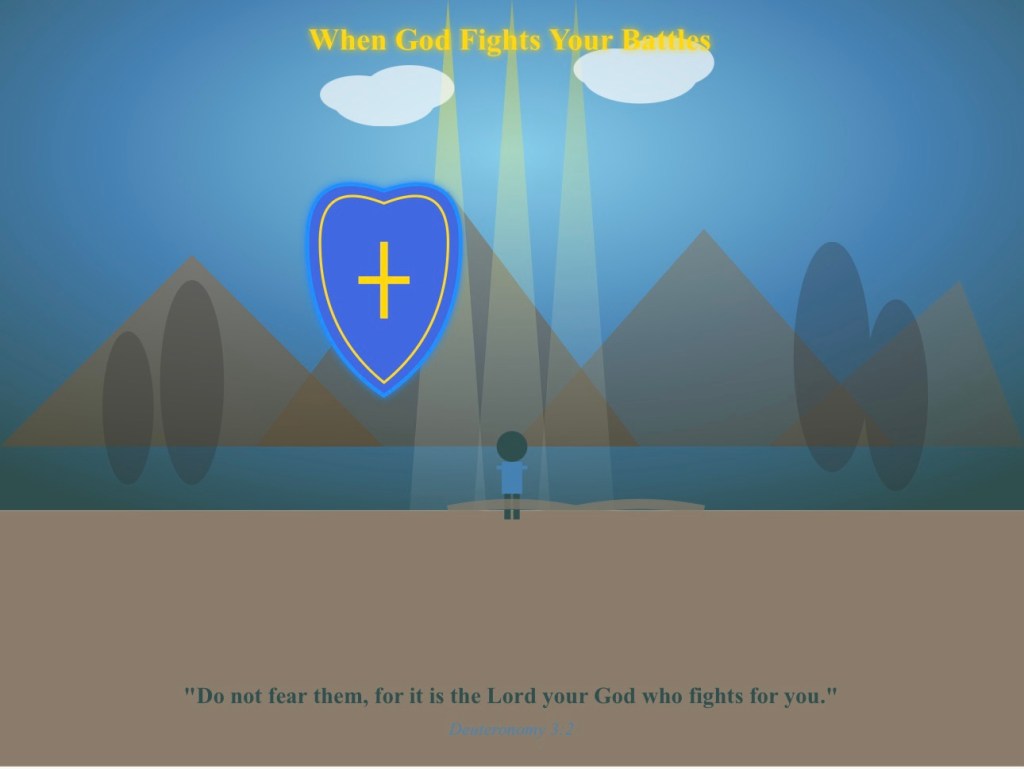
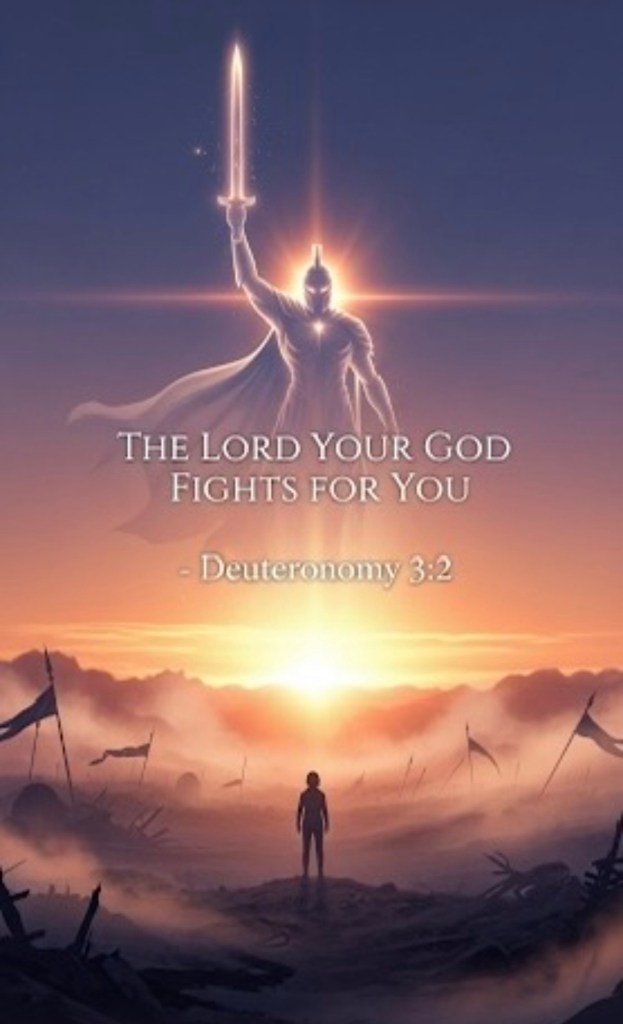
As you breathe, imagine yourself standing at the edge of a battlefield. You can see the challenges ahead—those relationships that need healing, the decisions that weigh heavy on your heart, the uncertainties about your future. Now, visualize the Lord stepping beside you, not as a distant observer, but as a mighty warrior ready to fight on your behalf.
Spend the next two minutes in silence, simply resting in this image. If worries intrude, gently return your focus to the presence of God beside you. After this time of silence, consider writing in your journal: “What battles am I trying to fight alone that I need to surrender to God today?”
The Verse and Its Context
“Do not fear them, for it is the Lord your God who fights for you.” (Deuteronomy 3:2, ESV)
To truly grasp the weight of these words, we must step into the sandals of the Israelites hearing them for the first time. Moses is addressing a people on the threshold of the Promised Land, having just witnessed God’s victory over Sihon, king of Heshbon. Now they face Og, king of Bashan—a giant of a man ruling over a land of giants.
The immediate context reveals Moses recounting God’s specific instruction before this second battle. The Israelites had every human reason to be afraid. Og was described as the last of the Rephaim, the ancient race of giants, and his iron bed was thirteen feet long and six feet wide. Yet God’s command was simple: “Do not fear.”
This verse sits beautifully within the broader narrative of God’s salvation history. From the moment God promised Abraham that his descendants would inherit the land, through the exodus from Egypt, the crossing of the Red Sea, and the wilderness wanderings, we see a consistent pattern: God fights for His people. This isn’t merely about military victory; it’s about God’s faithfulness to His covenant promises, ultimately pointing toward the victory Christ would win over sin and death on the cross.
Key Themes and Main Message
The central message of Deuteronomy 3:2 is profoundly simple yet life-transforming: when God fights for you, fear becomes unnecessary. But let’s dig deeper into the Hebrew to fully appreciate what Moses is communicating.
The word translated “fear” here is “yare,” which encompasses not just being afraid, but being overwhelmed, intimidated, or paralyzed by the perceived threat. It’s the kind of fear that stops us in our tracks and makes us forget who God is and what He has already done.
The phrase “fights for you” uses the Hebrew “lacham,” which means to engage in battle, to wage war, to contend on behalf of another. This isn’t God offering advice from the sidelines; this is God entering the fray as our champion, our substitute, our representative in battle.
The key themes that emerge from this verse include divine protection, covenant faithfulness, and the call to courage rooted in God’s character rather than our circumstances. Moses isn’t asking the Israelites to be brave because they’re strong; he’s calling them to be fearless because their God is invincible.
Historical and Cultural Background
In the ancient Near East, warfare was not just about military strategy—it was about which god was stronger. When nations went to battle, they understood it as their deities fighting through them. The Israelites’ enemies would have seen Og’s impressive physical stature and military might as evidence that his gods were powerful.
For the Israelites to hear that their God would fight for them meant something profound in this context. They weren’t just receiving military assurance; they were being reminded that the Creator of the universe had chosen them as His covenant people and would demonstrate His supremacy over all false gods.
The original audience would have understood this promise against the backdrop of their recent deliverance from Egypt, where God had already proven His superiority over Pharaoh and all the gods of Egypt through the plagues and the exodus. They had seen the Red Sea part and their enemies destroyed. This wasn’t wishful thinking; this was a God with a proven track record.
Liturgical and Seasonal Connection
We find ourselves in the twenty-second week of Ordinary Time, a season when the Church invites us to grow steadily in our understanding and practice of Christian discipleship. The liturgical color green symbolizes hope, growth, and life—perfectly complementing today’s message about finding courage in God’s protection.
During Ordinary Time, we’re called to integrate the great mysteries of faith we’ve celebrated throughout the liturgical year into the everyday rhythms of life. Today’s verse speaks directly to this integration, showing us how to live with supernatural courage in ordinary circumstances.
This season reminds us that while we may not face literal giants like Og of Bashan, we do encounter “giants” in our daily lives—overwhelming responsibilities, broken relationships, health concerns, financial pressures, or spiritual doubts. The green of this season encourages us to see these challenges as opportunities for growth rather than reasons for despair.
Faith and Daily Life Application
The promise that God fights for us transforms how we approach every aspect of daily life. When you’re facing a difficult conversation with a family member, you don’t enter that room alone. When you’re making a crucial career decision, you’re not relying solely on your own wisdom. When you’re battling temptation or struggling with doubt, you have a divine ally who has already secured the ultimate victory.
Practically, this verse calls us to several actionable responses. First, develop the habit of morning surrender. Before your feet hit the floor each day, remind yourself that God goes before you into every situation you’ll encounter. Second, practice the discipline of casting your anxieties on Him through prayer, specifically naming the “giants” you’re facing and asking God to fight those battles for you.
Third, memorize this verse and use it as a breath prayer throughout your day: “Lord, You fight for me” on the inhale, “I will not fear” on the exhale. Fourth, keep a victory journal where you record the ways you see God working on your behalf, building your faith for future challenges.
Finally, when faced with decisions, ask yourself: “Am I trying to fight this battle in my own strength, or am I trusting God to fight for me?” This simple question can transform your approach from anxiety-driven striving to faith-filled surrender.
Storytelling and Testimony
The power of Deuteronomy 3:2 comes alive when we see it lived out in real life. Consider the testimony of Corrie ten Boom, who along with her family, hid Jews from the Nazis during World War II. When they were eventually caught and sent to concentration camps, Corrie faced literal giants of evil and hatred.
In the horrific conditions of Ravensbrück concentration camp, Corrie discovered that even there, God was fighting for her. She later wrote, “There is no pit so deep that God’s love is not deeper still.” Despite losing her father and beloved sister Betsie to the Nazi regime, Corrie experienced God’s protection in miraculous ways—from finding her release papers had been processed just days before all women her age were sent to the gas chambers to discovering that the Bible she’d smuggled into the camp remained undetected because the guards refused to search the area where she hid it due to a flea infestation.
Corrie’s testimony demonstrates that God fighting for us doesn’t always mean He removes us from difficult circumstances, but that He gives us supernatural grace to endure them and uses even our sufferings for His greater purposes. After the war, she traveled the world sharing the gospel, even returning to Germany to speak forgiveness to her former captors. The God who fought for her in the concentration camp continued to fight for her in the spiritual battle for souls.
Interfaith Resonance
The concept of divine protection and God fighting on behalf of His people resonates throughout Scripture. In Exodus 14:14, Moses declares, “The Lord will fight for you; you need only to be still.” Second Chronicles 20:15 echoes this theme: “The battle is not yours, but God’s.” The New Testament affirms this truth in Romans 8:31: “If God is for us, who can be against us?”
Interestingly, this theme of divine protection finds parallels in other faith traditions as well. The Bhagavad Gita speaks of Krishna’s protection of devotees, particularly in Chapter 18, verse 66, where Krishna promises, “Abandon all varieties of religion and just surrender unto Me. I shall deliver you from all sinful reactions. Do not fear.” The Qur’an similarly speaks of Allah as protector in Surah 2:286: “Allah does not burden a soul beyond that it can bear.”
Buddhist teachings, while approaching the concept differently, emphasize refuge in the Three Jewels—Buddha, Dharma, and Sangha—as sources of protection from suffering. While the theological frameworks differ significantly, these parallels reveal a universal human longing for divine protection and the recognition that true security comes from a power greater than ourselves.
However, the biblical promise is unique in its personal nature and covenant foundation. This isn’t a general principle about divine benevolence; it’s a specific promise from the Creator to His chosen people, ultimately fulfilled in Christ’s victory over sin and death.
Community and Social Dimension
God’s promise to fight for His people has profound implications for how we engage with social justice, community building, and environmental stewardship. When we truly believe that God fights against injustice, we’re emboldened to stand with the oppressed, knowing we’re not fighting alone.
This verse challenges us to see social issues through the lens of spiritual warfare. Poverty, racism, human trafficking, and environmental destruction aren’t merely sociological problems—they’re battles in which God calls us to participate, with the assurance that He goes before us.
In family life, this truth transforms how we approach conflicts and challenges. Instead of seeing family problems as burdens we must bear alone, we recognize them as opportunities to invite God’s intervention. Parents can teach their children to pray about bullies at school, knowing that God fights for them. Spouses can approach marital difficulties with the confidence that God is working to strengthen their union.
Communities of faith become training grounds for spiritual warfare, where believers encourage one another to trust in God’s protection rather than relying solely on human wisdom or strength. Churches that embrace this truth become bold in their mission work, social justice initiatives, and evangelistic efforts.
Commentaries and Theological Insights
John Calvin, reflecting on this passage, wrote, “When God promises to fight for us, He does not exempt us from the battle, but assures us of victory.” This insight reminds us that God’s protection doesn’t necessarily mean passive waiting, but active participation in His purposes with the confidence of ultimate victory.
Saint Augustine emphasized the connection between God’s fighting for us and His sovereignty: “God does not promise to spare us every difficulty, but to be present in every difficulty, turning even our defeats into stepping stones toward His greater purposes.”
Modern theologian N.T. Wright adds contemporary clarity: “The God who fights for His people is not a tribal deity concerned only with military victories, but the Creator and Redeemer who is working to restore all creation. When we understand that God fights for us, we’re not claiming divine endorsement for our agendas, but surrendering our agendas to His greater purpose.”
Dietrich Bonhoeffer, writing from a Nazi prison, reflected on this verse: “The God who fights for us calls us into costly grace—the grace that costs us everything because it demands our complete trust, yet gives us everything because it assures us of His complete victory.”
Psychological and Emotional Insight
From a psychological perspective, Deuteronomy 3:2 addresses one of humanity’s most fundamental needs: security. Modern neuroscience tells us that our brains are constantly scanning for threats, and chronic anxiety can literally reshape our neural pathways, making us more susceptible to fear-based thinking.
This verse offers what psychologists call “cognitive reframing”—a shift from threat-focused thinking to resource-focused thinking. Instead of asking, “What if this situation overwhelms me?” we learn to ask, “How might God use this situation for His purposes and my growth?”
The promise that God fights for us provides what attachment theorists call a “secure base”—a safe haven from which we can explore life’s challenges with confidence rather than retreat in fear. Just as children with secure attachment to their parents explore the world more boldly, believers who truly grasp God’s protection for them approach life’s challenges with greater resilience.
This truth also addresses trauma and PTSD. Many people carry deep wounds from past battles they fought alone, feeling abandoned and vulnerable. The promise that God fights for us doesn’t minimize past pain but offers hope for future healing. It suggests that even in our darkest moments, we were not as alone as we felt, and that God can bring redemption even from our worst experiences.
Art, Music, and Literature
The theme of God as divine warrior has inspired countless expressions of faith through the centuries. The hymn “A Mighty Fortress Is Our God” by Martin Luther directly echoes this truth: “Did we in our own strength confide, our striving would be losing; were not the right man on our side, the man of God’s own choosing.”
Visual artists have long been drawn to this theme. Caravaggio’s “David and Goliath” captures the moment when human weakness, empowered by divine strength, triumphs over seemingly insurmountable opposition. The painting reminds us that God often uses the weak things of the world to shame the strong.
In literature, C.S. Lewis’s “The Lion, the Witch and the Wardrobe” provides a powerful allegory of God fighting for His people through Aslan’s sacrifice and resurrection. The scene where Aslan appears at the Stone Table after his death echoes the victory God promises to those who trust in Him.
Consider incorporating these creative expressions into your reflection time. Play “A Mighty Fortress” during your morning prayer, or spend time meditating on artistic depictions of divine protection. Let these works of art deepen your understanding of God’s promise to fight for you.
Divine Wake-up Call
In the prophetic-pastoral style that characterizes the ministry of His Excellency, Rt. Rev. Dr. Selvister Ponnumuthan, let me offer this word of exhortation:
Church, we live in an hour when the giants in the land seem more formidable than ever. The giant of materialism tells us that our security lies in our bank accounts. The giant of nationalism whispers that our identity comes from our political affiliations. The giant of individualism convinces us that we must fight every battle alone. The giant of despair shouts that the problems of our world are too big for any solution.
But hear the word of the Lord today: “Do not fear them, for it is the Lord your God who fights for you.” This is not merely an ancient promise to a wandering people; this is God’s present-tense reality for His Church. We serve the same God who parted the Red Sea, who brought down the walls of Jericho, who raised Jesus from the dead.
The giants in your land—that addiction you can’t break, that relationship you can’t heal, that calling you feel too inadequate to fulfill—these giants may look massive from your perspective, but they are mere grasshoppers in the sight of Almighty God.
This is your wake-up call, beloved: Stop fighting battles that God never asked you to fight alone. Stop carrying burdens that belong on His shoulders. Stop living in fear of enemies that He has already defeated. Your God is a warrior, and His battle record is perfect. Trust Him, follow Him, and watch Him turn your greatest weaknesses into displays of His magnificent strength.
Common Questions and Pastoral Answers
Question 1: “What does it mean that God fights for me when I still experience defeat and suffering?”
God fighting for us doesn’t mean we never face difficulties or apparent setbacks. Rather, it means that in every circumstance—even those that feel like defeats—God is working to accomplish His greater purposes in our lives. Sometimes His victory looks like deliverance from our problems; other times, it looks like transformation through our problems. The cross itself appeared to be the ultimate defeat, yet it was God’s greatest victory over sin and death. Trust that God’s timeline and definition of victory may be different from yours, but His love and faithfulness remain constant.
Question 2: “How do I practically trust God to fight for me when I’m used to trying to control everything?”
Learning to let God fight for you is a process that requires daily practice. Start small—identify one worry or problem you’ve been trying to solve entirely through your own effort, and commit to praying about it each morning, asking God to take control. Practice the discipline of surrendering your anxieties in prayer before taking action. Remember that trusting God doesn’t mean being passive; it means taking wise action while acknowledging that ultimate outcomes rest in His hands.
Question 3: “Why does it feel like God isn’t fighting for me when my prayers seem unanswered?”
Unanswered prayers can feel like evidence that God isn’t fighting for us, but consider that God’s ways of fighting may be different from what we expect. Sometimes God protects us by saying “no” to our requests because He sees dangers we don’t perceive. Other times, His timeline is longer than ours because He’s working on multiple fronts simultaneously. Keep a record of answered prayers and unexpected provisions—you may discover that God has been fighting for you in ways you didn’t initially recognize.
Question 4: “How can I help my children understand that God fights for them?”
Children grasp this truth through concrete experiences and stories. Share age-appropriate biblical accounts of God’s protection, create family traditions of praying together about concerns, and help them identify times when things worked out better than they expected. Teach them simple prayers like “God, You are bigger than this problem” and model trusting God rather than panicking when family challenges arise. Your calm confidence in God’s protection will teach them more powerfully than words alone.
Question 5: “Does God fighting for me mean I should be aggressive or confrontational with people who oppose me?”
Absolutely not. God fighting for you means you can respond to opposition with grace, patience, and love because you’re not responsible for defending yourself or winning every argument. When God fights for you, you’re free to “turn the other cheek,” to bless those who curse you, and to respond to hatred with love. Your security comes from God’s protection, not from your ability to overpower others. This truth should make you more gentle, not more aggressive.
Engagement with Media
I invite you to watch the video reflection provided by His Excellency, Rt. Rev. Dr. Selvister Ponnumuthan at this link:
As you watch, consider these reflection questions: How does this visual presentation deepen your understanding of God’s protection? What specific insights speak to your current circumstances? How might you share these truths with others who need encouragement?
Take notes during the video and spend time afterward in prayer, asking God to help you internalize the truths presented. Consider sharing the video with someone who might benefit from this message of divine protection.
Practical Exercises and Spiritual Practices
Morning Surrender Exercise: Each morning for the next week, before getting out of bed, place your hands on your heart and pray: “Lord, I surrender this day to You. I give You my plans, my worries, and my expectations. Fight for me today in every situation I encounter. Help me to walk in Your peace rather than my anxiety.”
Ignatian Prayer Exercise: Using your imagination, place yourself in the scene from Deuteronomy 3. Visualize standing with the Israelites, seeing the giants in the land, feeling your own fear and inadequacy. Now hear Moses’ words: “Do not fear them, for it is the Lord your God who fights for you.” What do you see, hear, and feel as you receive this promise? How does God appear to you in this scene? What is He saying to your specific situation?
Breath Prayer: Throughout the day, use this breath prayer: Inhale—“Lord, You fight for me”; Exhale—“I will not fear.” Practice this especially when you feel anxiety rising or when facing challenging situations.
Family Activity: Create a “God’s Victories” poster with your family. Each week, add drawings, photos, or written descriptions of ways you’ve seen God working in your family’s life. This visual reminder will strengthen everyone’s faith in God’s protection.
Journaling Prompts:
✔️What “giants” in my life do I need to surrender to God’s fighting?
✔️How has God fought for me in the past that I may have overlooked?
✔️What would change in my daily life if I truly believed God fights for me?
✔️Where am I trying to fight battles that belong to God?
Virtues and Eschatological Hope
This verse calls us to develop the cardinal virtue of fortitude—not the kind that relies on human strength, but the supernatural courage that comes from trusting in God’s protection. True fortitude isn’t the absence of fear; it’s acting faithfully despite fear because we know God fights for us.
The theological virtue of hope also grows from this promise. Our hope isn’t wishful thinking but confident expectation based on God’s character and track record. When we believe God fights for us, we can face uncertain futures with supernatural hope because we know the outcome of history is secure in God’s hands.
This verse points us toward eschatological hope—the ultimate victory God will achieve when Christ returns to establish His kingdom fully. Every battle God fights for us now is a foretaste of that final victory when every tear will be wiped away, every enemy defeated, and every wrong made right.
The promise that God fights for us connects to our eternal destiny because it assures us that nothing can separate us from God’s love or thwart His purposes for our lives. Even death itself—the ultimate enemy—has been defeated through Christ’s resurrection. We fight life’s battles with the confidence that win or lose in temporal terms, our eternal victory is secure.
Blessing and Sending Forth
As you go from this time of reflection into the rhythms of your day, receive this blessing:
May the God who fought for the Israelites against impossible odds fight for you in every challenge you face. May you walk with the confidence that comes not from your own strength, but from His mighty power working on your behalf. May His peace guard your heart and mind, His wisdom guide your decisions, and His protection surround you like a shield.
When giants appear in your path—whether they come in the form of difficult people, overwhelming circumstances, or internal battles with doubt and fear—remember that you do not face them alone. The same God who parted the Red Sea, who brought down the walls of Jericho, who raised Jesus from the dead, goes before you as your champion.
May you live this week not as one who must win every battle through personal effort, but as one who trusts in the God who has already secured ultimate victory. And may others see in your peace and confidence a testimony to the reality of God’s protection and love.
Go in peace, knowing that the Lord your God fights for you. Amen.
Clear Takeaway Statement
What you’ve learned today: God’s promise in Deuteronomy 3:2 transforms how we approach every challenge in life. When we truly understand that the Creator of the universe fights on our behalf, fear loses its power over us. This doesn’t mean we never face difficulties, but it means we face them with supernatural confidence because our security rests in God’s character, not our circumstances.
How to carry this into your week:
1. Practice daily surrender each morning, giving God your anxieties before your day begins
2. Use the breath prayer “Lord, You fight for me / I will not fear” when facing stressful situations
3. Keep a record of God’s faithfulness to build your confidence for future challenges
4. Share this truth with someone who needs encouragement this week
The bottom line: You are not fighting life’s battles alone. The God who has never lost a battle in all of history and eternity has chosen to fight for you. This changes everything about how you can live—with courage instead of fear, with peace instead of anxiety, with hope instead of despair. Trust Him, follow Him, and watch Him demonstrate His faithfulness in your life.
Explore more at the Rise & Inspire archive | Wake-Up Calls
Ever felt like life’s battles are too big for you? ⚔️ What if the God of the universe has already stepped onto the battlefield for you? 🌟 Curious? Read today’s reflection again 👀
Biblical Reflection by Johnbritto Kurusumuthu
In response to the daily verse forwarded by His Excellency, Rt. Rev. Dr. Selvister Ponnumuthan
© 2025 Rise & Inspire. Follow our journey of reflection, renewal, and relevance.
Website: Home | Blog | About Us | Contact| Resources
Word Count:4454