There are several image-focused generative models apart from DALL-E that have gained prominence:
BigGAN: This model is designed to generate high-resolution images. It uses a variant of GAN architecture and is capable of producing detailed and realistic images.
StyleGAN and StyleGAN2: These models focus on generating images with specific styles and qualities. They allow for control over various aspects of the generated images, such as their level of detail and style.
CycleGAN: Unlike traditional GANs, CycleGAN is used for image-to-image translation tasks, like converting images from one style to another (e.g., turning photos into paintings or changing day scenes to night scenes).
Pix2Pix: Similar to CycleGAN, Pix2Pix is designed for image-to-image translation tasks. It learns to map input images to output images in a supervised manner.
Progressive GAN: This model progressively generates images, starting from low resolution and gradually increasing the resolution. This approach produces high-quality images and reduces training difficulties.
VQ-VAE-2: This model focuses on learning compact and disentangled representations of images. It is used for tasks like image compression and generating images from text descriptions.
SPADE (Semantic Image Synthesis with Spatially-Adaptive Normalization): This model is used for generating images based on semantic layouts. It generates images from textual descriptions of scenes.
BézierGAN: It uses Bézier curves to generate images, allowing for control over shapes and structures in the generated content.
Depending on the task and the desired output, different models might be more suitable.
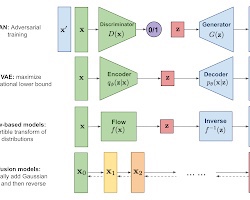
Image-focused generative models like GANs and VAEs have shown great potential, but they do come with a few issues. Some challenges include mode collapse (GANs generating limited variations), training instability, generating high-resolution images, and difficulty in controlling specific image attributes. Researchers are actively working on addressing these problems to improve the performance and versatility of these models.
Explore more insights from Rise&Inspire