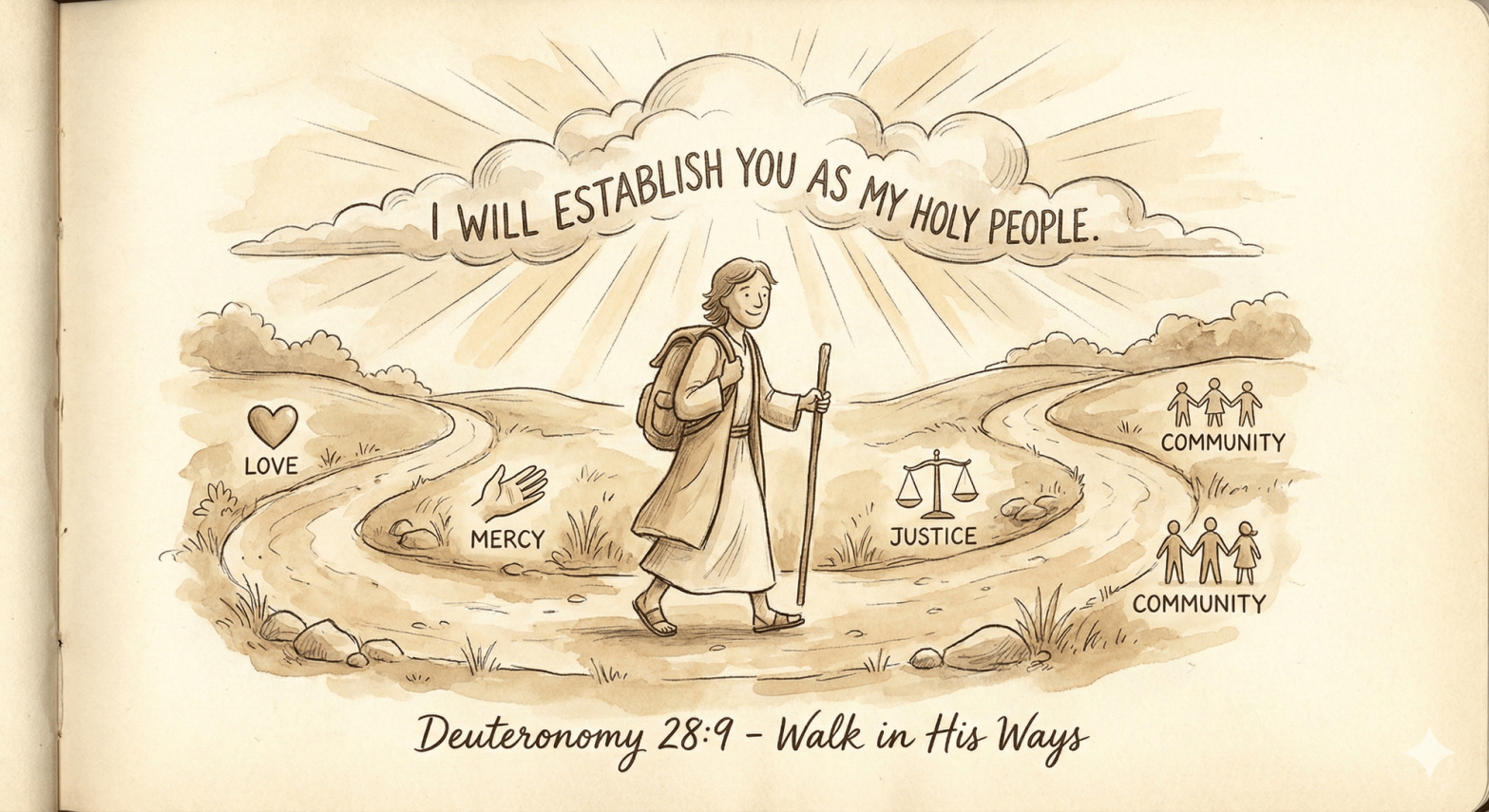
Holiness sounds intimidating until you realise it’s not something you achieve but something you receive. Deuteronomy 28:9 flips the script on how we think about obedience and identity. God doesn’t wait for you to get it all right before He calls you His own. He establishes you as His holy people as you walk with Him. The journey is the transformation.
Most people think holiness is reserved for the spiritually elite. The saints. The martyrs. The flawless. But Deuteronomy 28:9 tells a different story. It reveals that holiness is not about religious perfection but about covenantal direction. God promises to establish you as His holy people if you walk in His ways. Not run. Not sprint. Walk. One faithful step at a time.
Daily Biblical Reflection – Verse for Today (23rd January 2026)
“The Lord will establish you as his holy people, as he has sworn to you, if you keep the commandments of the Lord your God and walk in his ways.”
Deuteronomy 28:9
Today, the 23rd day of 2026. This is the 23rd reflection on Rise&Inspire in the wake-up call category.
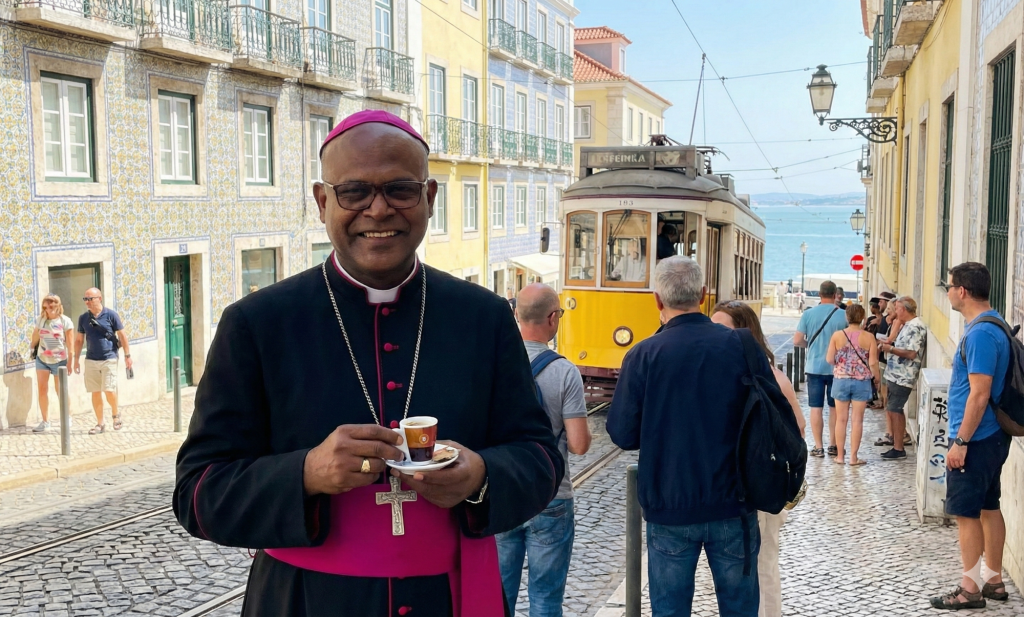
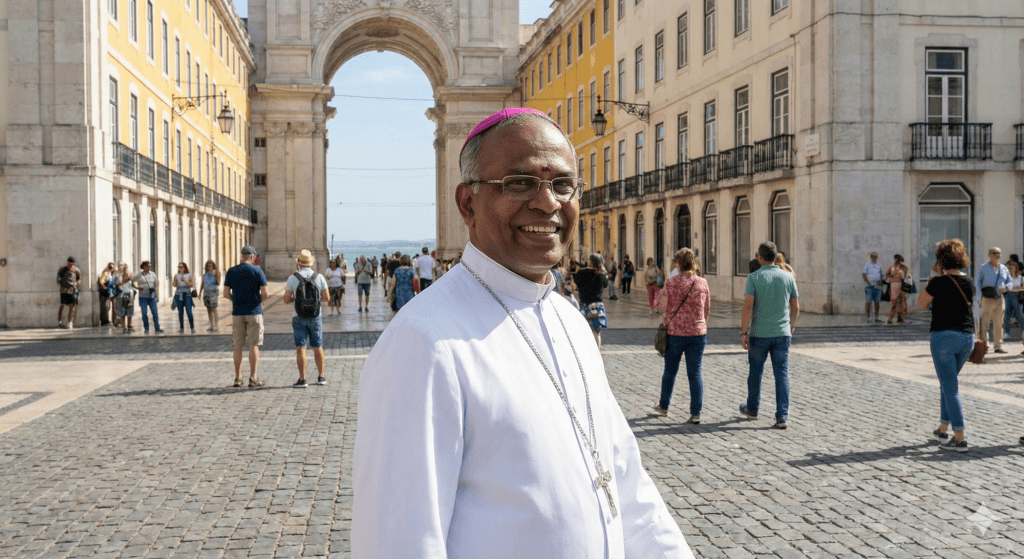
Today’s Scripture, prayerfully shared with blessings from His Excellency, Rt. Rev. Dr. Selvister Ponnumuthan, and enriched with reflective insights by Johnbritto Kurusumuthu.
A Covenant of Becoming
There is something deeply tender in the promise God makes through Moses to the people of Israel in this verse. It is not merely a command or a threat, but an invitation into identity. The Lord says, “I will establish you as my holy people.” Notice the language here: God does not say, “Make yourselves holy,” but rather, “I will establish you.” This is the work of God. Our holiness is not self-manufactured; it is God-given, God-shaped, and God-sustained.
Yet this divine promise comes with a human response: “if you keep the commandments of the Lord your God and walk in his ways.” This is not a legalistic transaction but a relational covenant. It is as if God is saying, “If you will walk with me, I will make you into who you were always meant to be.” The commandments are not burdens meant to weigh us down, but pathways meant to lead us home, into the fullness of who we are in God.
Walking in His Ways
To walk in God’s ways is to live in alignment with His heart. It means choosing mercy over judgment, love over indifference, truth over deceit, and faithfulness over fleeting pleasures. It is a daily decision to let God’s Word shape our thoughts, our actions, and our relationships. Walking in His ways is not about perfection; it is about direction. It is not about never stumbling, but about always returning to the path when we do.
The beauty of this verse is that it speaks to both the present and the future. God has already sworn to make us His holy people. The promise is secure. But the unfolding of that promise in our lives requires our cooperation, our obedience, our willingness to walk with Him day by day. Holiness is not a distant, unattainable state reserved for saints of old. It is the ongoing transformation that happens when we choose, again and again, to follow Jesus.
A Holy People in a Broken World
What does it mean to be established as God’s holy people today, in a world so fractured and hurting? It means being set apart, not in isolation, but in mission. It means living lives that reflect the character of God, lives marked by integrity, compassion, and courage. It means being salt and light, preserving goodness and illuminating truth in the midst of darkness.
God’s call to holiness is also a call to community. We are not established as isolated individuals, but as a people, together. We encourage one another, bear one another’s burdens, and remind each other of whose we are. In our shared journey of obedience, we become witnesses to the transforming power of God’s love.
A Personal Response
As you reflect on this verse today, ask yourself: Am I walking in God’s ways? Are there areas of my life where I have wandered off the path? Are there commandments I have neglected, relationships I have harmed, or truths I have ignored? Take heart. God’s promise still stands. He is faithful to establish you as His holy people, not because of your perfection, but because of His unfailing love.
Return to Him today. Confess where you have strayed. Renew your commitment to walk in His ways. And trust that the God who has begun a good work in you will be faithful to complete it.
May the Lord establish you as His holy people. May you walk confidently in His ways, knowing that you are held, loved, and transformed by His grace.
Amen.
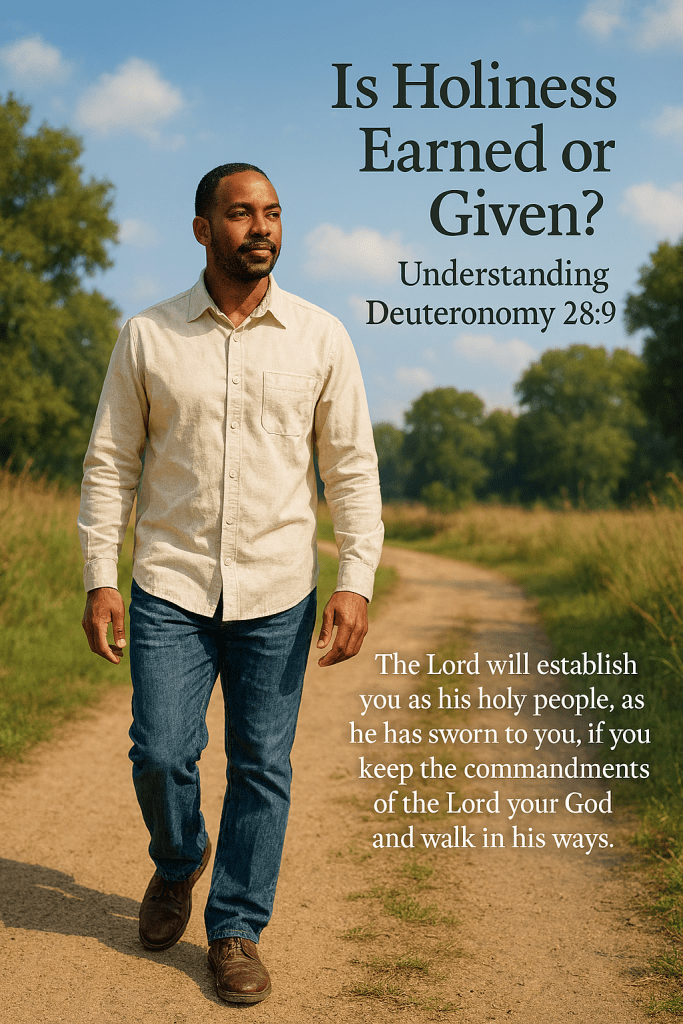
Holiness Lived, Not Achieved
From Leviticus to Deuteronomy, and from Moses to Peter, holiness remains God’s gift—slowly learned through faithful walking.
(Learning from the Holiness Code)
When Moses speaks of God “establishing” His people as holy in Deuteronomy 28:9, he is not introducing a new idea. He is echoing a vision of holiness already woven deeply into Israel’s life—most clearly expressed in what scholars call the Holiness Code (Leviticus 17–26).
At the heart of this section lies a simple yet profound command:
“Be holy, because I, the LORD your God, am holy” (Leviticus 19:2).
What is striking is how ordinary this holiness looks. It is not confined to priests, altars, or sacred spaces. It reaches farmers leaving grain for the poor, employers paying fair wages, neighbours refusing to gossip, judges acting without partiality, families honouring parents, and communities protecting the weak, the elderly, and the foreigner.
In Leviticus 19 especially, holiness steps out of the sanctuary and into the street. God’s people are called to reflect His character in how they speak, trade, work, worship, forgive, and love. The famous command “Love your neighbour as yourself” (Leviticus 19:18) stands at the centre of this vision—not as sentimental advice, but as the very shape of holy living.
This helps us understand Deuteronomy 28:9 more clearly. Holiness is not earned by flawless obedience. Israel did not become holy by ticking religious boxes. They were made holy because God chose them, redeemed them, and walked with them. Obedience was the response, not the price.
Even the most demanding parts of the Holiness Code—sexual integrity, economic justice, Sabbath rhythms, Jubilee restoration—are not about moral superiority. They are about forming a people whose daily lives make God’s goodness visible in the world.
In this sense, holiness is not about distance from others but about depth of faithfulness. It is not separation for pride, but consecration for love.
The New Testament recognises this continuity. When Peter urges believers to be holy (1 Peter 1:15–16), he directly quotes Leviticus—not to place us back under the law, but to show that the same holy God is still at work, now shaping lives through grace and the Spirit.
So when Deuteronomy 28:9 promises that the Lord will establish His people as holy as they walk in His ways, it is inviting us into a lifelong becoming. God gives the identity; we learn to live into it.
Holiness, then, is not the reward at the end of obedience.
It is the gift at the beginning of the journey.
Closing Prayer
Holy and faithful God,
You are holy, not distant—pure, just, merciful, and full of steadfast love.
You have called us to be Your people, not because we are flawless,
but because You are faithful.
Establish us, O Lord, as Your holy people.
Teach us to walk in Your ways—not in fear or pride,
but in trust, humility, and love.
Shape our holiness in the ordinary moments of life:
in our homes, our work, our words, and our relationships.
Give us honest hearts in our dealings,
gentle tongues in our speech,
clean hands in our work,
and compassionate eyes for the poor, the elderly, the stranger, and the weak.
Help us to honour one another,
to forgive without holding grudges,
to act justly without partiality,
and to love our neighbour as ourselves.
When we stumble, draw us back.
When we grow weary, renew us.
When we forget who we are, remind us that we belong to You.
May our lives reflect Your holiness—not as a burden to bear,
but as a grace to live out, step by step, day by day.
We ask this in faith, trusting the God
who establishes, sustains, and completes the work He begins.
Amen.

© 2026 Rise&Inspire
Reflections that grow with time.
Website: Home | Blog | About Us | Contact| Resources
Category: Wake-Up Calls
Scripture Focus: Deuteronomy 28:9
Word Count:1473