Numbers catch the eye, but meaning holds the heart. When a blog quietly reaches thousands through organic search, it raises a deeper question: what are people truly looking for—and why do certain words find them at just the right moment?
🌱 A Gratitude Note: 2,200 Clicks, One Shared Journey
Every journey has moments that invite us to reflect—not to boast, but to give thanks.
Today, I’m sharing one such moment with you.
Over the past 28 days, Rise&Inspire has received 2,200+ clicks from Google Search. Behind this simple number is something far more meaningful: people—real lives, real questions, real searches for hope, wisdom, and encouragement—finding their way here.
Google Search Impact screenshot
What does this milestone really mean?
It means that when someone searched for clarity, faith, leadership, motivation, or a gentle nudge to keep going, Rise&Inspire appeared on their path.
It means this space is quietly doing what it was always meant to do:
help us rise above challenges and inspire one another to live more thoughtfully and purposefully.
Whether you have been reading from the beginning or arrived here recently through a search result, your presence matters. Every click represents trust—and I do not take that lightly.
Why this matters to me
Rise&Inspire was never about chasing numbers.
It was about sharing reflections that awaken the mind, strengthen the spirit, and encourage meaningful living.
This milestone reassures me that:
• Thoughtful writing still has a place
• Faith-rooted reflections still resonate
• Words, when written with sincerity, still travel far
And above all, it tells me that we are not walking this journey alone.
Looking ahead 🌿
This moment renews my commitment to:
Write with greater depth – staying faithful to truth, wisdom, and lived experience
Serve the community better – listening to what truly matters to you
Remain consistent – showing up, even on quiet days, because someone out there may need these words
Numbers may measure reach, but impact is measured in hearts touched and minds stirred.
A note of thanks
Thank you for reading.
Thank you for sharing posts.
Thank you for returning—again and again.
If Rise&Inspire has encouraged you in even a small way, then this journey is already worthwhile.
💬 I’d love to hear from you:
What topics would you like to see more of in the coming weeks? Faith reflections? Leadership insights? Life lessons? Leave a comment or reach out—I’m listening.
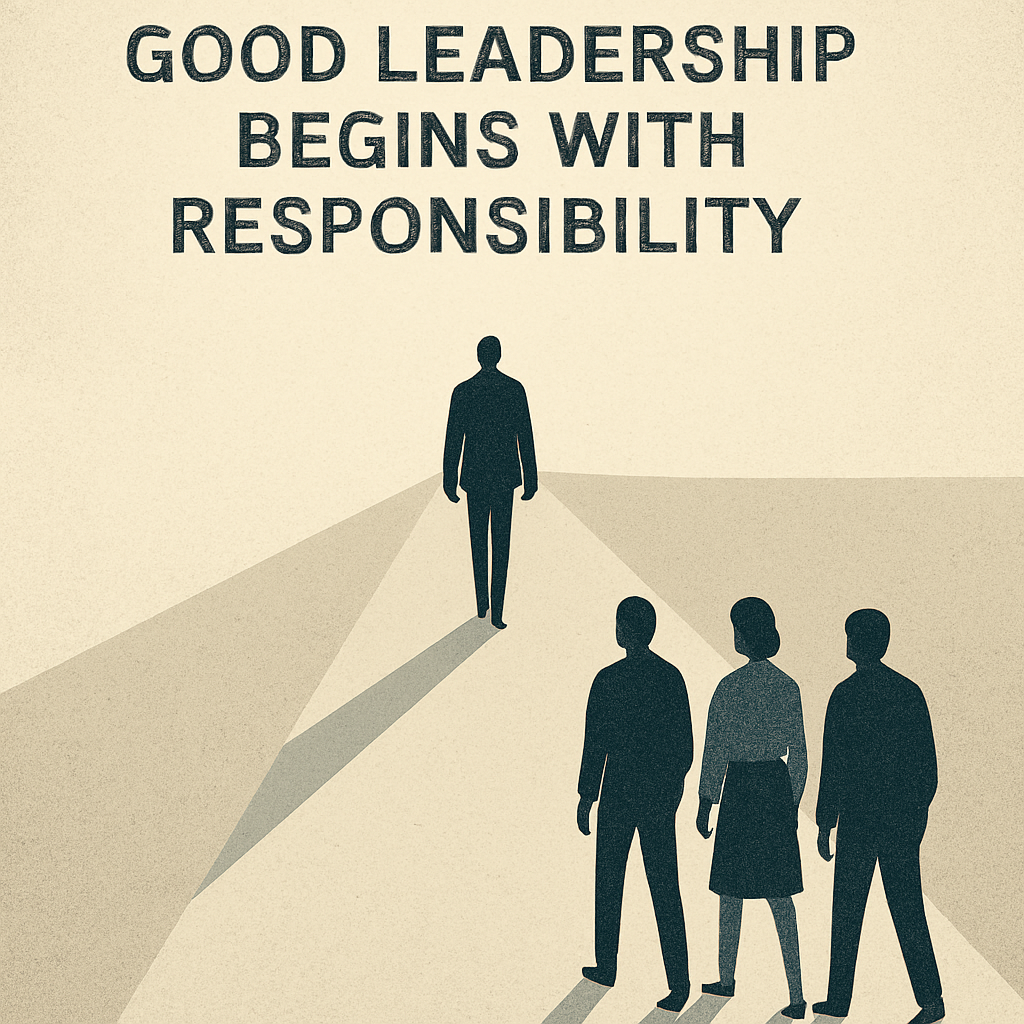
A good leader leads with integrity and responsibility, not authority alone—earning trust, putting people first, and creating lasting positive impact beyond their position.
Leadership is often mistaken for authority, visibility, or control. But history—and lived experience—tell a different story. The leaders who truly endure are not those who command the loudest, but those who carry responsibility with integrity, clarity, and care. This reflection explores what makes leadership meaningful, credible, and human in a world craving trust.
What Makes a Good Leader?
Leadership as Responsibility, Not Privilege
A good leader is not defined by position, popularity, or power. Leadership begins much earlier—in conscience, character, and commitment. Titles may grant authority, but only integrity earns trust.
In an age where leadership is often confused with visibility and dominance, the most needed leaders are those who serve quietly, decide courageously, and stand firmly for what is right, even when it is inconvenient.
1. A Good Leader Leads from Within
Before leading others, a good leader learns to lead the self. This means emotional maturity, moral clarity, and the humility to acknowledge limitations. Self-aware leaders do not react impulsively; they respond thoughtfully. They are not driven by ego but guided by values.
Leadership without inner discipline quickly turns into control. Leadership rooted in self-mastery becomes influence.
2. Integrity Is the Non-Negotiable Core
Skills can be taught. Strategies can be learned. Integrity cannot be improvised.
A good leader keeps promises, speaks truthfully, and remains consistent whether watched or unseen. People may tolerate incompetence for a while, but they never forgive hypocrisy. Trust, once broken, rarely returns in full.
Integrity is what allows followers to feel safe—even during uncertainty.
3. Vision with Compassion, Not Blind Ambition
A leader must see ahead—but never at the cost of people along the way.
Good leaders articulate a clear vision while remaining sensitive to human limits and struggles. They do not push people as expendable resources; they carry people forward as partners. Vision without empathy becomes tyranny. Empathy without direction becomes stagnation. Leadership requires both.
4. Courage to Decide, Humility to Listen
Leadership demands decisions—often difficult, sometimes unpopular. A good leader does not postpone responsibility out of fear, nor act unilaterally out of pride.
They listen widely, discern carefully, and then decide firmly—owning both success and failure. When mistakes occur, they do not look for scapegoats. They accept accountability.
This balance of courage and humility is rare—and deeply respected.
5. A Good Leader Makes Others Better
The true test of leadership is not personal success but collective growth.
Good leaders mentor, encourage, and create space for others to rise. They are not threatened by talent; they cultivate it. They measure success not by how indispensable they become, but by how confidently others can lead in their absence.
Leadership that hoards power eventually collapses. Leadership that shares it multiplies.
6. Leadership as Service, Not Status
At its best, leadership is an act of service. It asks, “What is needed?” rather than “What do I gain?”
History remembers leaders not for how high they sat, but for how deeply they cared—especially for the weakest, the unheard, and the overlooked. Authority earns obedience; service earns loyalty.
Closing Reflection
A good leader does not seek applause. They seek purpose.
They do not chase control. They cultivate trust.
And long after their role ends, their impact continues through the lives they shaped.
In the end, leadership is not about being above others—but about walking ahead with responsibility, wisdom, and compassion.
Executive Leadership Q&A
1. What makes a good leader?
A good leader demonstrates integrity, takes responsibility, communicates clearly, and puts people before position while guiding others toward shared goals.
2. What are the most important leadership qualities?
Integrity, empathy, vision, accountability, and the ability to inspire trust are the most essential leadership qualities across all contexts.
3. Is leadership about authority or responsibility?
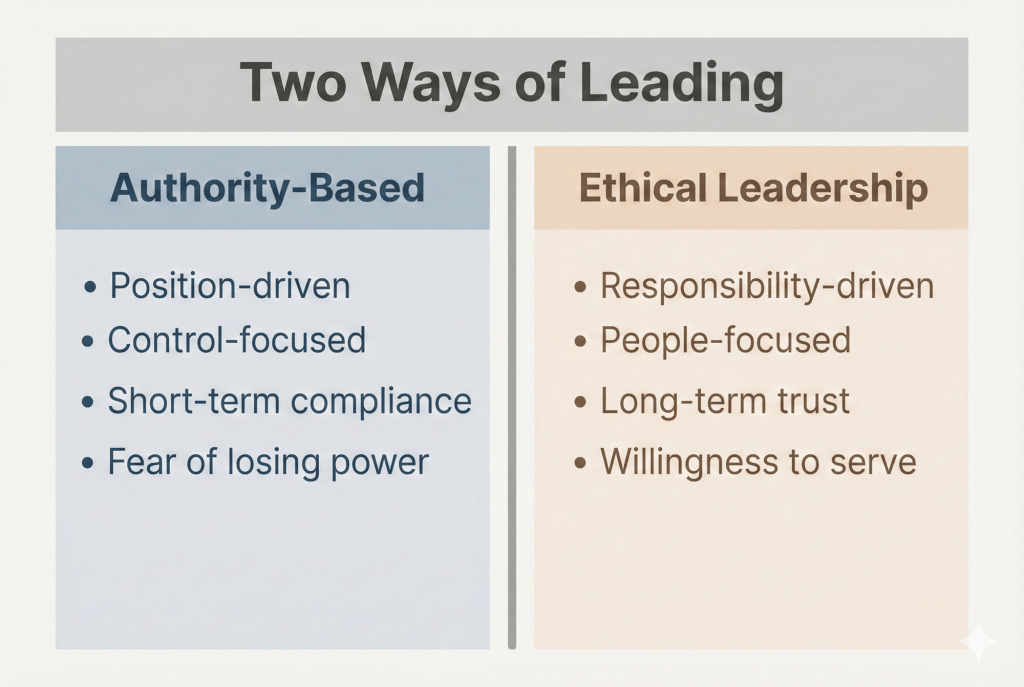
Leadership is fundamentally about responsibility. Authority may grant power, but responsibility builds trust and long-term influence.
4. Can leadership exist without integrity?
Leadership without integrity may function temporarily, but it cannot sustain trust, credibility, or meaningful influence over time.
5. Why is empathy important in leadership?
Empathy helps leaders understand people’s needs, build strong relationships, and make decisions that balance results with human well-being.
6. How does ethical leadership differ from traditional leadership?
Ethical leadership prioritises values, accountability, and service, while traditional leadership often emphasises hierarchy and control.
7. What is people-centred leadership?
People-centred leadership focuses on developing individuals, encouraging participation, and valuing human dignity alongside performance.
8. Can leadership be learned or is it innate?
While some traits may be natural, leadership skills such as communication, decision-making, and emotional intelligence can be learned and refined.
9. Why do good leaders focus on service rather than status?
Service-oriented leaders earn loyalty and trust by prioritising collective growth over personal recognition or power.
10. How is leadership measured in the long run?
Leadership is ultimately measured by the positive impact left behind—on people, institutions, and values—long after the leader steps away.
Previous reflections on the same prompt (for deeper reading)
Trouble does not wait for permission. It arrives suddenly—often when we feel least prepared. It may come as illness, broken relationships, financial strain, unanswered questions, or the quiet ache of loneliness. Scripture never promises a trouble-free life. What it offers is something far deeper: the assurance that in the day of trouble, we are not alone.
Psalm 86:7 does not deny distress; it dignifies it. The psalmist does not pretend strength. He simply calls—and he does so with confidence.
The Heart of the Verse
The movement of the verse is strikingly simple:
Trouble → Calling → Confident Expectation
There are no rituals, no conditions, no spiritual performance. Just a relationship.
“In the day of my trouble” — a real, personal season of distress
“I call on you” — an active cry rooted in trust
“For you will answer me” — certainty grounded in God’s character
This is not spiritual optimism. It is tested faith.
Psalm 86 in Context
Psalm 86 is titled “A Prayer of David” and stands as a deeply personal plea woven from Israel’s sacred memory. David describes himself as “poor and needy,” yet he prays with boldness—not because of who he is, but because of who God is.
The psalm unfolds in four movements:
1. A plea for help (vv. 1–7)
2. Praise for God’s uniqueness (vv. 8–10)
3. A desire for wholehearted obedience (vv. 11–13)
4. A renewed cry amid opposition (vv. 14–17)
Verse 7 stands as a hinge—bridging distress and praise. Reflection on God’s mercy fuels confidence that He will respond.
What Does It Mean That God “Answers”?
God’s answers are rarely one-dimensional.
✔️ Sometimes He delivers swiftly.
✔️ Sometimes He strengthens us to endure.
✔️ Sometimes He grants peace that makes no logical sense.
✔️ Sometimes He gives His presence before He gives explanations.
An answered prayer is not always a changed situation—but it is always a changed relationship with fear.
A Pattern of Grace
This verse reveals a rhythm that runs throughout Scripture and life:
Cry → Answer → Gratitude → Deeper Trust
Many of us can look back and see days we thought we would not survive—yet here we stand. Not because we were strong enough, but because we called, and God answered.
A Countercultural Invitation
We live in a world that celebrates self-sufficiency. Faith teaches something radically different: we were never meant to carry our troubles alone.
To call on God is not weakness.
It is wisdom.
It is humility.
It is trust.
A Word for Today
Nearly three years after first reflecting on this verse, it speaks with undiminished power. Some promises must be revisited—not because they change, but because we do.
Perhaps today is your day of trouble. If so, this verse is not a slogan. It is an invitation.
Not to shout into emptiness.
Not to beg a distant deity.
But to call upon the God who listens, who loves, and who has already proven His faithfulness.
He will answer you.
Closing Prayer
Lord, teach us to call on You without fear, to trust Your answers without conditions, and to wait with faith when the path is unclear. Be our strength in trouble and our peace in waiting. Amen.
Related Reflection
Those who wish to read the earlier reflection written on 04 October 2023 may visit:
Rise&Inspire consistently presents a daily “wake-up call” series inspired by the Scripture shared by Bishop Selvister Ponnumuthan, Bishop of Punalur, Kerala, India. Through these reflections, the author, Johnbritto, offers thoughtful, faith-nourishing content aimed at spiritual growth and inspiration.
The blog adopts an interpretative and contextual approach, translating theological insights into accessible reflections aimed at fostering spiritual awareness, ethical reflection, and faith formation.
If I could un-invent something, it would be single-use plastic — not because it can be erased entirely, but because its culture of convenience causes lasting harm far beyond its momentary usefulness.
Single-use plastic was invented to make life easier — and it succeeded brilliantly. But what if the very invention that simplified our lives quietly complicated our future? If you could un-invent one thing, would convenience still be worth the cost?
If I Could Un-Invent Something, It Would Be Single-Use Plastic
If I could un-invent something, it would be single-use plastic.
Not because I believe it can be completely erased from history — it cannot — but because no other invention better exposes the tension between human convenience and long-term consequence.
Single-use plastic was created with good intentions. It made packaging lighter, products safer, and transport more efficient. In medicine and emergency care, it continues to save lives. Yet the very quality that made it successful — disposability — is what turned it into a global burden.
A plastic item may serve us for minutes, but it remains on the planet for centuries.
That imbalance is why this invention deserves to be questioned.
Why Un-Inventing It Is Not Fully Possible
Honesty demands an important admission: single-use plastic cannot be completely un-invented.
It is deeply embedded in modern systems — especially healthcare. Syringes, IV lines, blood bags, sterile packaging, and emergency equipment depend on plastic for safety and hygiene. Removing it entirely, without equally safe alternatives, would risk lives.
Moreover, plastic already exists in staggering quantities. Even if production stopped today, billions of tonnes would remain in landfills, oceans, soil, and water. Microplastics have crossed into ecosystems and human bodies. What already exists cannot simply be undone.
The world is creating more single-use plastic waste than ever
Acknowledging these limits does not weaken the argument.
It strengthens it.
What Can Be Un-Invented
What can — and must — be un-invented is unnecessary single-use plastic.
Much of today’s plastic waste exists not for survival, but for convenience: shopping bags, cutlery, straws, excessive packaging, and layers of plastic added for marketing rather than need. These are not unavoidable technologies; they are design choices shaped by habit.
Un-inventing single-use plastic, then, is less about erasing a material and more about rejecting a mindset — the belief that convenience should always come before consequence.
The World This Choice Points Toward
A world that questions single-use plastic would:
✔️ design products to be reused or returned,
✔️ value durability over disposability,
✔️ accept small inconveniences to prevent lasting harm,
✔️ and treat waste as a shared responsibility, not an invisible problem.
Life might become slightly slower.
But it would be far more thoughtful.
Single-use medical devices
Why This Still Answers the Prompt
The prompt asks what we would choose to un-invent — not whether it can be perfectly undone.
Choosing single-use plastic reveals a belief that inventions should be judged not only by what they make easier, but by what they leave behind.
We may never fully un-invent single-use plastic.
But we can refuse to keep inventing its excess.
And sometimes, that is the most realistic form of change.
How does plastic waste affect marine life?
Earlier Reflections on the Same Prompt
(Different moments, different lenses, the same underlying question)
The dead cannot thank you. They cannot reciprocate your kindness or acknowledge your generosity. So why does the Bible insist that we extend grace even to them? Sirach 7:33 reveals a profound truth about the nature of love and the continuity of our spiritual obligations. This reflection examines how honouring the departed shapes the way we treat the living and deepens our understanding of what it means to give graciously.
Daily Biblical Reflection – Verse for Today (18th January 2026)
“Give graciously to all the living, do not withhold kindness even from the dead.”
Sirach 7:33
Today, the 18th day of 2026
This is the 18th reflection on Rise&Inspire in 2026 under the category/series: Wake-up calls
There is something wonderful about a verse that calls us to extend kindness without boundaries, without conditions, and without end. Sirach 7:33 invites us into a way of living that is marked by generous grace, a grace that flows not only to those who stand before us but even to those who have departed from this earthly life.
To give graciously to all the living is to recognise the divine image in every person we encounter. It is to see beyond surface judgments, past hurts, and personal preferences, and to offer kindness as a reflection of the kindness we ourselves have received from God. This is not a selective generosity that picks and chooses its recipients based on merit or reciprocity. Rather, it is a spacious and expansive love that mirrors the heart of God, who makes the sun rise on the evil and the good, and sends rain on the righteous and the unrighteous.
In our daily lives, this call to graciousness challenges us in concrete ways. It asks us to be patient with the difficult colleague, compassionate toward the stranger in need, forgiving toward the one who has wronged us, and generous with our time, our resources, and our attention. It reminds us that kindness is not a commodity to be rationed but a wellspring that deepens the more we draw from it.
But the verse does not stop there. It extends an extraordinary invitation: do not withhold kindness even from the dead. At first glance, this may seem puzzling. How do we show kindness to those who have passed beyond the veil of mortality? Yet this instruction carries profound spiritual and pastoral wisdom.
To honour the dead with kindness is to remember them with love, to speak of them with respect, to pray for the repose of their souls, and to cherish the legacy they have left behind. It is to resist the temptation to judge their lives harshly or to reduce their memory to their failings. It is to continue the bonds of love that death cannot fully sever, acknowledging that in God’s economy, the communion of saints transcends the boundaries of life and death.
This teaching also calls us to fulfil any duties we may have toward those who have gone before us. It may mean honouring their memory through acts of charity done in their name, caring for their loved ones who remain, or simply ensuring that they are remembered with dignity and gratitude. In cultures that practice prayers for the dead, it means offering our intercessions on their behalf, trusting in God’s mercy and the power of our spiritual solidarity.
There is a beautiful continuity in this verse. The kindness we show to the living prepares our hearts to honour the dead with the same grace. And in remembering the dead with kindness, we learn to treat the living with greater reverence, knowing that each person we encounter is an eternal soul on a journey that extends far beyond this present moment.
In a world that often measures worth by productivity, status, or usefulness, Sirach’s words are a counter-cultural proclamation. They declare that every person, living or dead, is worthy of kindness simply because they exist, because they are beloved by God, because they share in the mystery of human dignity that neither time nor death can erase.
As I reflect on this verse this morning, I am reminded of the people I will encounter today and the opportunities I will have to give graciously. I am also reminded of those who have shaped my life and have now passed into eternity. I think of family members, teachers, friends, and even people I never met but whose lives have inspired me through their witness.
This reflection takes on a special significance today, as I write it using a verse from three years ago, one that His Excellency, Rt. Rev. Dr. Selvister Ponnumuthan, shared with me on October 7, 2023. Life has a way of bringing us full circle, allowing us to revisit the same truths with new eyes and a deeper understanding. What may have spoken to me one way in 2023 speaks to me differently now, enriched by the experiences, joys, and sorrows of the intervening years.
Perhaps this is itself a lesson in the verse. Just as we do not withhold kindness from the dead, we need not discard the wisdom of the past. We can return to it, honour it, and allow it to speak afresh into our present circumstances. The words of Scripture are living words, and they carry within them an inexhaustible depth that reveals itself anew each time we approach them with open hearts.
Let us then take this verse as our wake-up call for today. Let us commit to giving graciously to all we meet, without holding back, without calculating the cost, without waiting for the perfect moment. Let us also remember with kindness those who have gone before us, honouring their memory and praying for their peace.
In doing so, we participate in the divine generosity that knows no limits, a generosity that flows from the heart of God and returns to God, gathering all of us, living and dead, into the embrace of eternal love.
May this day be marked by gracious giving, by kindness without boundaries, and by a heart that reflects the boundless mercy of our Creator.
Amen.
Kindness That Reaches Beyond the Grave:
Prayer for the Dead in the Catholic Faith
The call to extend kindness even to the dead finds a profound and concrete expression in the Catholic tradition of praying for the repose of souls. This practice is not rooted merely in sentiment or cultural custom; it is grounded in Scripture and in the enduring conviction that love does not end with death.
Here, Sirach 7:33 opens a door that another Old Testament passage walks us through more fully. In 2 Maccabees 12:38–46, we encounter a striking example of this very kindness in action. After a battle, Judas Maccabeus and his companions pray for their fallen comrades and offer sacrifices on their behalf, trusting that God’s mercy can cleanse what remains imperfect. The sacred author commends this act as “holy and pious,” rooted firmly in hope for the resurrection.
This moment is deeply illuminating. If prayer for the dead were meaningless, the passage tells us, it would be foolish to offer it. But because God’s justice is always accompanied by mercy, such prayer becomes an act of faith, charity, and hope. It is kindness extended to those who can no longer help themselves, entrusted entirely to the compassion of God.
Read in this light, Sirach’s instruction—“do not withhold kindness even from the dead”—takes on sacramental depth. Our kindness becomes prayer. Our memory becomes intercession. Our love becomes a quiet offering placed in God’s hands. In praying for the dead, we affirm that death does not dissolve the bonds of communion, and that the living and the departed remain united in Christ.
Catholic tradition understands this within the mystery of purification after death, a final healing for those who die in God’s friendship yet still bear the traces of human frailty. To pray for the dead, then, is not to doubt God’s mercy, but to cooperate with it. It is believed that love continues its work until every soul rests fully in God.
This practice also shapes the way we live. When we pray for the dead, we become more patient with the living. When we entrust departed souls to God’s mercy, we learn to judge less harshly, forgive more readily, and love more generously. Kindness offered beyond death transforms the heart of the one who offers it.
In this sense, prayer for the dead is not a backwards-looking devotion but a forward-moving grace. It reminds us that every act of kindness echoes into eternity, and that no gesture of love is ever wasted in God’s economy.
Eternal rest grant unto them, O Lord; forgive what was frail, perfect what was begun in love, and let Your mercy lead them into everlasting peace. Amen.
I felt loved when someone noticed my silence and chose to stay without asking anything of me. Their quiet presence, without advice or demands, made me feel accepted and valued exactly as I was.
Love doesn’t always arrive with words or grand gestures. Sometimes, it reveals itself in silence—when someone stays, notices, and asks nothing of you. This reflection explores that quiet kind of love we often overlook, but never forget.
Can You Share a Positive Example of Where You’ve Felt Loved?
Love doesn’t always announce itself.
Sometimes, it arrives softly.
I once felt deeply loved in a moment when nothing was asked of me—no explanations, no strength, no words. Someone simply stayed. They noticed my silence and respected it.
There was no attempt to fix or fill the space. Just presence.
In that quiet, I felt accepted exactly as I was—not for what I do, but for who I am.
There are moments when your own wisdom simply runs out. The problem remains unsolved. The question stays unanswered. The future refuses to clarify itself. You’ve exhausted every human resource, consulted every available expert, and still you stand empty-handed.
This is exactly where Daniel stood when he spoke words that would echo through millennia:
“But there is a God in heaven who reveals mysteries.” (Daniel 2:28)
What he discovered in that desperate moment may be precisely what you need to hear today.
Some mysteries aren’t meant to be solved by clever thinking or harder trying. They are meant to be revealed by the One who sees what we cannot. Daniel learned this truth not in a classroom but in a crisis, not through study but through surrender. Standing before impossible demands with his life on the line, he pointed away from human capability and toward heavenly revelation.
His ancient confidence speaks directly to modern confusion: the God who knew a king’s forgotten dream also knows the questions keeping you awake at night.
Daily Biblical Reflection
The God Who Reveals Mysteries
Daniel 2:28 – “But there is a God in heaven who reveals mysteries.”
Book of Daniel
📺 Wake-up Call Reflection Video
A Quiet Confidence Before Power
As I sit with these words from the Book of Daniel, I am struck by the quiet confidence they carry. Daniel speaks them not in a throne room of his own making, but in the presence of Nebuchadnezzar, one of the most powerful rulers of the ancient world.
The king has demanded the impossible: that his wise men not only interpret his dream, but tell him what he dreamed in the first place. Failure means death. Success seems beyond human reach.
And yet, Daniel does not panic. He does not scramble for clever explanations or human solutions. Instead, he lifts the conversation heavenward with a simple, profound declaration:
“But there is a God in heaven who reveals mysteries.”
The Limitations of Human Wisdom
How often do we find ourselves in similar situations—facing questions we cannot answer, problems we cannot solve, futures we cannot predict? Like the king’s counselors, we exhaust our own resources and still come up empty.
Human wisdom has great value, but it also has clear boundaries. There are mysteries in life that intellect alone cannot penetrate and doors that effort alone cannot open.
The astrologers and enchanters told Nebuchadnezzar that “there is not a man on earth” who could do what he asked. They were right—as far as human ability goes. But they were wrong to stop there. They forgot that beyond human limitation stands divine revelation.
A God Who Reveals
Notice the beautiful paradox in Daniel’s words. God is “in heaven”—exalted, transcendent, beyond our reach. Yet this same God “reveals mysteries”—He draws near to make known what is hidden.
The God who dwells in unapproachable light chooses to illuminate our darkness.
The God who knows all things chooses to share knowledge with those who seek Him.
This is not a God who delights in confusion or hoards secrets. This is a God who speaks, unveils, and makes Himself known. Throughout Scripture, we see this pattern—God revealing Himself through the prophets and ultimately through His Son.
“The Word became flesh and dwelt among us, and we have seen his glory.” (John 1:14)
The Posture of Humility
What allowed Daniel to receive this revelation?
He did not approach God with arrogance or entitlement. Earlier in the chapter, Daniel goes to his friends and asks them to “seek mercy from the God of heaven concerning this mystery.” He prayed. He waited. He trusted.
This is deeply instructive for us today. We live in an age of instant answers and quick solutions. But the mysteries of God are not unlocked by impatience or self-sufficiency. They are revealed to those who come with humility, acknowledge their need, and wait in faithful expectation.
Daniel understood something the king’s counselors did not:
Revelation is a gift, not an achievement.
Living with Mystery
Not every mystery in our lives will be solved immediately. Some questions will remain unanswered longer than we would like. Faith does not remove mystery; it teaches us how to live within it.
We learn to trust that God sees what we cannot, knows what we do not, and works all things together for good—even when the pattern is hidden from view.
And here is the promise that sustains us:
There is a God in heaven.
Not a distant force, but a personal God who reveals, speaks, and enters into our story.
A God who came near in Jesus Christ and promised never to leave us or forsake us.
An Invitation to Trust
This seventeenth day of 2026 may find you facing your own mysteries.
You may be wrestling with a decision.
Carrying a burden.
Searching for clarity in a complicated world.
To you, Daniel’s ancient words speak with fresh relevance:
“But there is a God in heaven who reveals mysteries.”
Not a God who might reveal.
Not a God who sometimes reveals.
But a God who does reveal—because it is His nature.
You may not have all your answers by evening, but you are not alone in your questioning. The God who knew the king’s dream before it was remembered also knows the deepest concerns of your heart.
A Prayer for Today
God in heaven,
Revealer of mysteries,
I bring before You the questions I carry and the confusion I feel.
I confess that my wisdom reaches its limits quickly.
Yet I trust that You see clearly what I see only dimly.
Grant me patience to wait,
Humility to receive,
And faith to believe
That You are working even in the mysteries I do not yet understand.
In the name of Jesus, the Light of the World.
Amen.
Reflection Questions
✔️ What mysteries are you facing right now that only God can reveal?
✔️ How does it change your perspective to remember that God desires to reveal rather than conceal?
✔️ In which areas might God be inviting you to move from self-reliance to humble dependence?
May this day be marked by the peace that comes from knowing that the God who reveals mysteries is the same God who holds you in His love.
Today’s Scripture comes with the blessings of His Excellency, Rt. Rev. Dr. Selvister Ponnumuthan, and thoughtful reflections by Johnbritto Kurusumuthu.
Seventy no longer means standing at life’s edge — it often marks a doorway. As human longevity stretches, a deeper question emerges: if we are likely to live longer, how should we live better? This reflection explores what the numbers reveal — and what they never can.
When Seventy Feels Young:
A Philosophical Reflection on Longevity, Chance, and Choice
There’s a beautiful paradox in the way we think about age. Once, a century ago, saying “I am seventy” might have implied you had already walked most of life’s road. Today, seventy often feels less like a finish line and more like the doorway to a richly lived second half. This shift is not merely sentimental — it is measured in numbers, witnessed in hospitals and homes, and written into the archives of public health. But numbers alone cannot carry the whole story. They invite a deeper question: if modern life makes long life likelier, what does that change mean for how we live now?
From averages to individuals: the statistical ladder
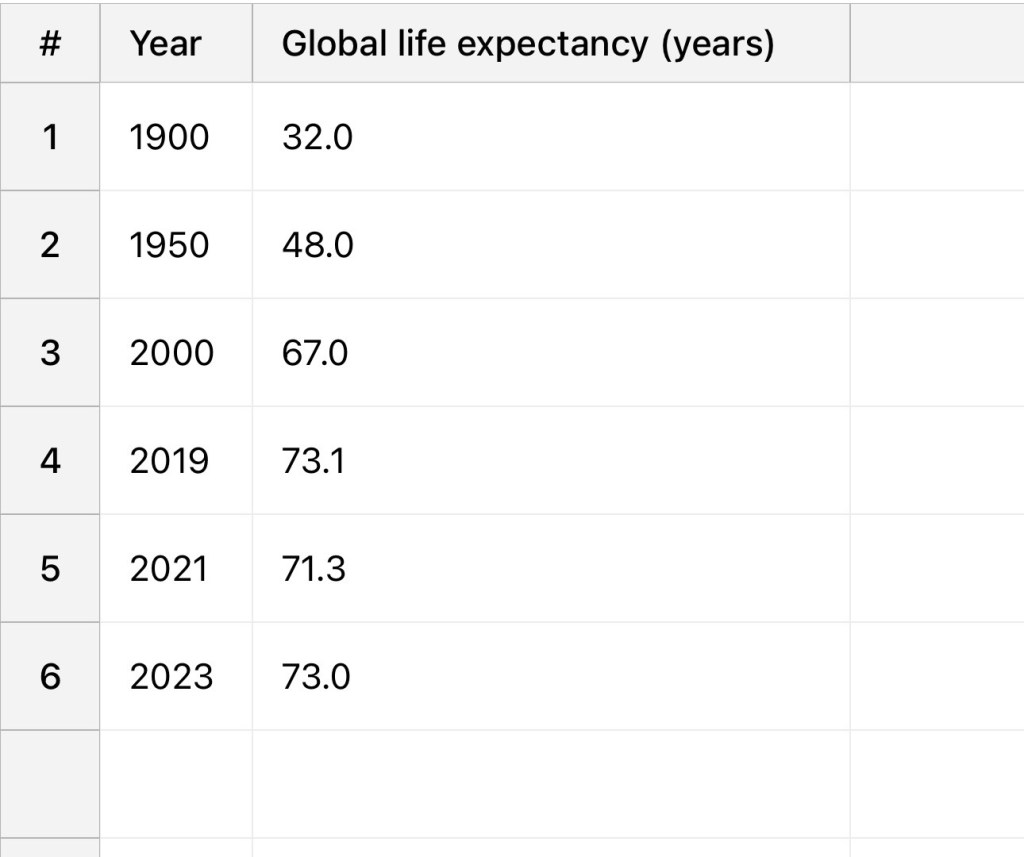
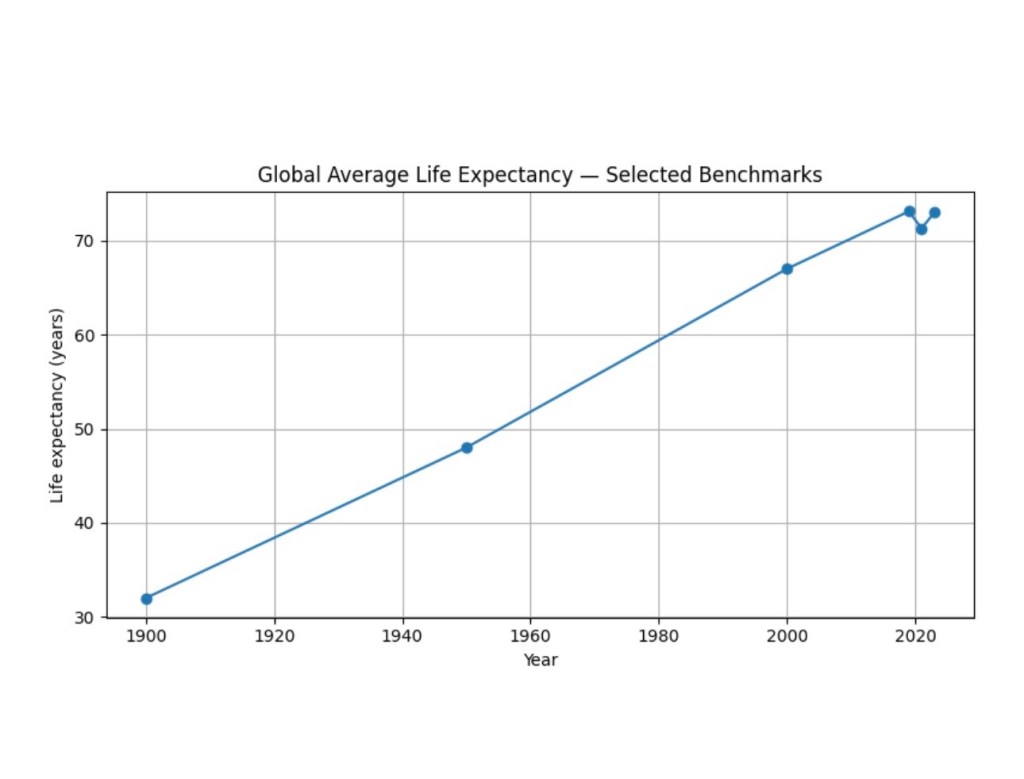
Public-health progress has been dramatic. Global average life expectancy has climbed from roughly 32 years in 1900 to the low-70s in the early 2020s — a more-than-doubling made possible by sanitation, vaccines, antibiotics, better nutrition, and broader access to healthcare.
Yet averages are blunt tools. Saying the average life expectance rose from 32 to 73 does not mean everyone suddenly gained 40 years. Averages compress many histories into a single number. A hundred years ago, high infant and child mortality pushed the average down; those who survived childhood often lived into their 60s or 70s. Today’s gains come from improvements at every age: fewer early deaths, better chronic-disease treatment, and safer later-life care. The result is a changed probability landscape rather than an ironclad guarantee for individuals.
What the odds tell us — and what they don’t
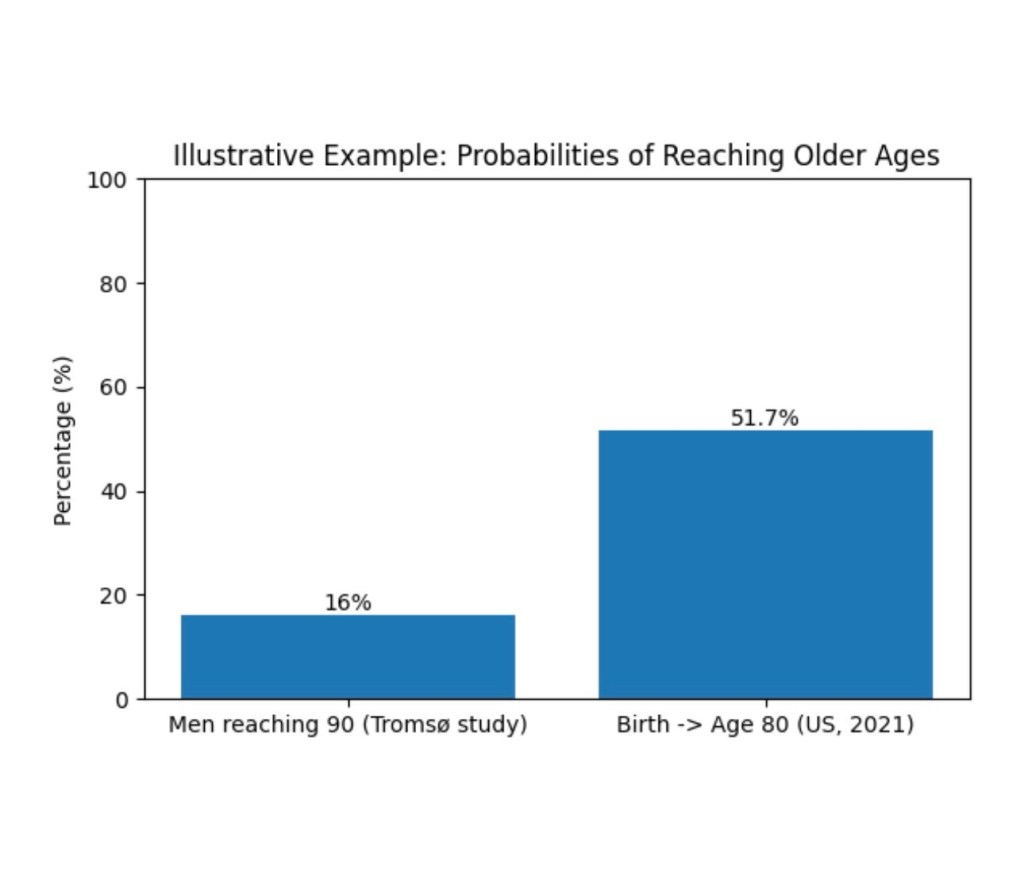
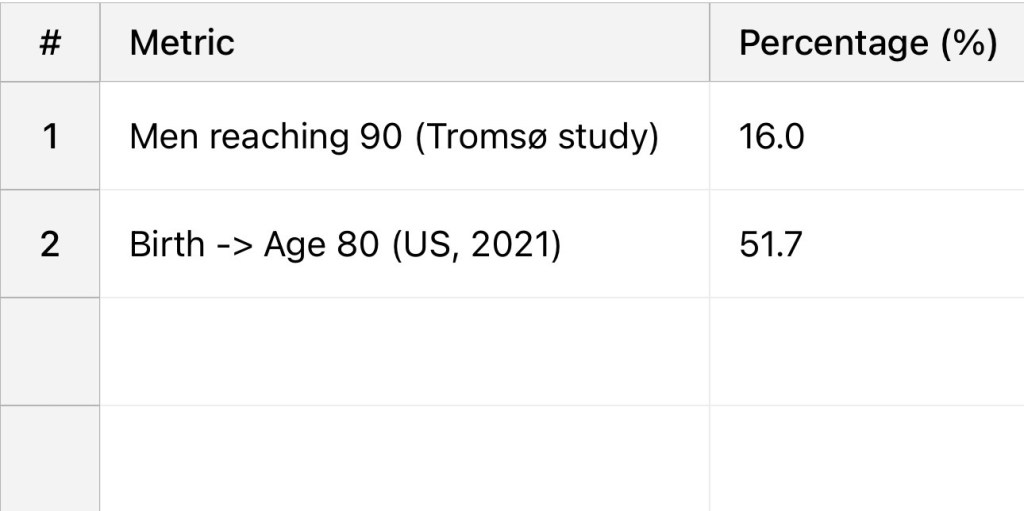
A practical way to think about this is through survival probabilities. Studies and life tables show that the chance of reaching milestone ages has risen, but it still varies greatly by sex, country, lifestyle, and socioeconomic factors. For example, a long-running Norwegian cohort study found that in a particular male cohort about 16% reached age 90; risk factors such as smoking, inactivity, and high blood pressure strongly affected those odds.
Similarly, national life tables and vital-statistics reports (for example, U.S. life tables) show that survival probabilities increase and shift over time: many people today have better-than-ever chances of reaching ages that were once rare. But the probabilities remain conditional — they depend on which chronological and biological path you’ve followed up to your current age. A 70-year-old has cleared many of the mortality hazards that shorten average life, and so statistically their remaining life expectancy is higher than someone younger — but conditional chance is not a promise.
Why the philosophical shift matters
This probabilistic change invites philosophical reflection. If reaching seventy now more often correlates with reaching eighty or ninety than it did a century ago, how should that alter our values, priorities, and relationships?
1. Time is both more and less precious. On one hand, longer life offers more seasons to savor — relationship repair, creativity, new careers, travel, mentorship. On the other, a sense of abundance can tempt postponement: I’ll write the book later, I’ll reconcile later, I’ll take the leap later. The ethical insight here is old: abundance can become an excuse for procrastination. The remedy is intentionality. If longevity becomes probable, make it meaningful by choosing how to spend the extra years.
2. Responsibility widens. Medical and social progress are communal achievements. Longer lives create intergenerational responsibilities: for caregivers, public policy, and how societies structure work and retirement. Economists and global institutions now note both the challenges and the opportunities of “silver economies” — older adults remaining active, productive, and socially engaged. But that participation must be enabled by policies, design, and imagination.
3. Meaning is not automatic. More time does not guarantee more meaning. What matters is how that time is framed: service, relationships, curiosity, and small daily practices. Philosophers from Aristotle to modern existentialists remind us: the good life is an activity aligned with purpose and virtue, not merely longevity.
Practical lessons for the seventy-year-old (and for everyone)
If you find yourself at seventy today or advising someone who is, here are practical lessons grounded in evidence and human wisdom.
Invest in health as agency, not just insurance. Lifestyle choices — not smoking, staying physically active, managing blood pressure — measurably affect odds of long, functional life. Cohort studies repeatedly highlight these modifiable risks.
Cultivate purpose. Studies from longevity hot spots (and large demographic reports) show that social bonds, community, and a sense of purpose are associated with healthier, longer lives. Japan’s long-lived communities, for instance, combine diet, movement, social cohesion, and meaning into everyday life (cultural context matters, but the principle of purposeful connection is universal).
Plan economically and socially. Longer lives mean rethinking retirement, work, and savings. Policy discussions emphasize lifelong learning and flexibility to keep older adults engaged and secure.
Practice gratitude and acceptance. Philosophically, longer life invites both gratitude for the gift of more time and acceptance of mortality’s certainty. These twin attitudes help convert more years into deeper living.
Two charts to hold in your hands
1. Global life expectancy — benchmarks: a simple visual of how the global average has climbed from about 32 years in 1900 to the low 70s in the 2020s, showing how extraordinary the change has been.
2. Illustrative survival probabilities: two example numbers to remind us that probability is conditional — a Norwegian cohort observed ~16% of men reaching 90, while national life tables show improving probabilities of survival to older ages. These figures are illustrative and country- and cohort-specific.
A closing reflection
Numbers can correct our illusions — they remind us that seventy is, in our time, often a threshold of possibility. But they cannot tell us what to do with possibility. That task belongs to moral imagination: to decide how to spend the years we are given, to care for one another, and to make time not merely longer but fuller.
So if you are seventy, or you love someone who is, hear both messages: statistically, your odds for more years are better than they used to be; philosophically, each year asks to be lived with intention. The best use of longer life is not to chase immortality, but to enlarge the meaning of the life you have — with curiosity, courage, and care.
Appendix:
Data & Methods
Understanding Longevity, Life Expectancy, and Survival Probabilities
Purpose of This Appendix
This appendix explains the statistical foundations behind the reflections in this article. While the main essay explores longevity philosophically and motivationally, the data below clarifies what the numbers actually mean—and what they do not mean.
1. Key Definitions (Essential for Correct Interpretation)
Life Expectancy at Birth
Life expectancy at birth is the average number of years a newborn is expected to live, assuming current age-specific mortality rates remain constant throughout their life.
⚠️ Important clarification:
This is not a prediction for individuals. It is a population-level average heavily influenced by early-life mortality.
Conditional Life Expectancy
Conditional life expectancy refers to the expected remaining years of life once a person has already reached a certain age (e.g., 60 or 70).
Example:
If life expectancy at birth is 70 years, a person who has already reached 70 does not have zero years left; their remaining life expectancy may still be 12–16 years, depending on sex and health.
Survival Probability
Survival probability answers questions such as:
• “What percentage of people who reach age 60 will reach age 80?”
• “What fraction of those aged 70 today will live to 90?”
These probabilities vary by country, cohort, sex, and lifestyle.
2. Primary Data Sources Used
The statistical interpretations in this article rely on consolidated findings from the following authoritative sources:
• World Health Organization (WHO)
– Global Health Estimates, Healthy Life Expectancy (HALE), and longevity trends.
• Registrar General of India (RGI)
– Sample Registration System (SRS) Life Tables for India.
• United Nations (UN DESA)
– World Population Prospects and cohort survival analysis.
• Our World in Data
– Long-term historical life expectancy datasets.
These datasets are widely cited in demographic, economic, and public-health research.
3. Life Expectancy in India: A Historical Perspective
India – Life Expectancy at Birth (Approximate)
YearLife Expectancy (Years)
1950 ~36
1970 ~49
1990 ~58
2000 ~63
2010 ~67
2019 ~69.7
2021 (pandemic dip) ~67
2023 (recovery estimate) ~70
Interpretation:
India has gained over 30 years of average life expectancy in roughly seven decades. This gain is driven primarily by:
• Reduced infant and maternal mortality
• Expanded vaccination coverage
• Control of infectious diseases
• Improved food security and sanitation
4. Conditional Life Expectancy in India (Crucial Insight)
Life tables published by the Registrar General of India show that remaining life expectancy increases once early-life risks are passed.
Approximate Remaining Life Expectancy (India)
Age ReachedRemaining Years (Men)Remaining Years (Women)
60 17–18 19–21
70 12–13 14–16
80 7–8 8–9
📌 Key takeaway:
A person who reaches 70 years in India today can statistically expect another 12–16 years of life, depending on sex and health conditions.
This directly supports—but also limits—the idea that “living to 70 means living to 90.”
The probability improves, but certainty does not exist.
5. Probability of Reaching Advanced Ages (India)
Using cohort survival patterns derived from SRS life tables:
Estimated Survival Probabilities (Illustrative)
Starting AgeProbability of Reaching 80Probability of Reaching 90
Birth ~30–35% ~8–10%
Age 60 ~55–60% ~15–18%
Age 70 ~35–40% ~10–14%
These probabilities:
Are higher for women
Improve with non-smoking status, physical activity, and chronic disease management
Decline sharply with untreated hypertension, diabetes, or cardiovascular disease
6. Comparison with High-Income Countries (Context Only)
For perspective (not equivalence):
CountryLife Expectancy at BirthProbability of Reaching 90 (Men)
India ~70 ~10–14%
Japan ~85 ~25–30%
France ~83 ~22–26%
Norway ~83 ~20–25%
This comparison highlights:
✔️ The role of health systems and lifestyle
✔️ The growing but uneven global convergence in longevity
7. Healthy Life Expectancy (HALE): The Quality Dimension
Longevity without health can be misleading.
India’s Healthy Life Expectancy (HALE) is approximately 60–62 years
This implies 8–10 years of later life may involve reduced functional health
👉 Motivational implication:
Longevity gains must be paired with health-span investments, not merely lifespan optimism.
• Life tables assume current mortality rates, not future medical breakthroughs
• National averages mask state, rural–urban, and socioeconomic disparities
• Individual outcomes vary widely due to genetics, behavior, and environment
This article therefore treats statistics as guides, not guarantees.
9. Why This Data Supports the Article’s Core Message
Statistically:
Living to 70 today is a strong survival milestone
The odds of reaching 80 or even 90 are far higher than a century ago
Philosophically:
Probability is not destiny
Extended years invite intentional living, not complacency
References (selected)
Our World in Data — Life Expectancy (global trends, benchmark data).
World Health Organization — Global Health Estimates: Life expectancy and Healthy Life Expectancy (HALE).
Social Security Administration — Period Life Table (2022).
National Center for Health Statistics (CDC) — National Vital Statistics Reports (life table examples and survival probability calculations).
Brenn, T. et al., Tromsø Study (survival to age 90 in men — cohort study).
International Monetary Fund analysis on aging and the “silver economy.”
Reports on longevity practices and cultural examples (e.g., Japanese longevity reporting).
Summary:
When Seventy Feels Young: A Philosophical Reflection on Longevity, Chance, and Choice
There’s a beautiful paradox in how we view age. A century ago, “I am seventy” often meant life’s road was mostly traveled. Today, seventy frequently marks the start of a richly lived second half. This shift is rooted in data, not just sentiment.
From Averages to Individuals: The Statistical Landscape
Global life expectancy at birth has more than doubled since 1900—from ~32 years to over 70 in recent decades—thanks to sanitation, vaccines, antibiotics, nutrition, and healthcare advances.
Averages, however, mask nuances. Early gains came from reducing infant/child mortality; later gains from better chronic-disease management and safer aging. Today’s higher probabilities of reaching 70+ are conditional on surviving earlier risks.
What the Odds Reveal
Survival probabilities have improved dramatically, varying by sex, country, lifestyle, and socioeconomic factors. A Norwegian cohort study (Tromsø Study) found ~16% of men reached age 90. National life tables show rising chances of advanced ages, though these remain probabilistic, not guaranteed.
Why the Philosophical Shift Matters
Longer probable lifespans reshape values and priorities:
Time becomes more precious yet abundant — inviting intentional use rather than procrastination.
Responsibility expands — to caregivers, policy, and “silver economies” where older adults stay engaged.
Meaning requires effort — more years don’t guarantee purpose; virtue, service, and relationships do.
Practical Lessons
For those at seventy (or approaching it):
Invest in modifiable health factors (e.g., no smoking, activity, blood pressure control) to boost functional longevity.
Cultivate purpose through social bonds and daily practices.
Plan financially and socially for extended life.
Balance gratitude for extra time with acceptance of mortality.
Two Key Visuals
Global life expectancy trend — from ~32 in 1900 to low-70s today.
Illustrative survival probabilities — conditional odds improve sharply after age 70, with ~10–14% reaching 90 in India (higher in high-income countries like Japan ~25–30%).
Closing Reflection
Statistics show seventy is now often a threshold of possibility, not an endpoint. Yet numbers alone don’t dictate meaning. Moral imagination does: live each added year with curiosity, courage, and care.
Appendix: Data & Methods (Concise Summary)
Key Definitions
Life expectancy at birth: Hypothetical average years for a newborn under current mortality rates.
Conditional life expectancy: Remaining years after reaching a certain age (e.g., 70).
Survival probability: Chance of reaching a milestone age (conditional).
India-Specific Trends (SRS, UN, WHO data)
At birth: Rose from ~36 (1950) to ~70–72 (recent years).
Remaining at age 70: ~12–16 years (men 12–13; women 14–16).
Survival from age 70: ~35–40% to 80; ~10–14% to 90 (higher for women, improved by healthy behaviors).
Healthy Life Expectancy (HALE): ~60–62 years at birth — emphasizing quality over mere quantity.
High-Income Comparison (e.g., Japan ~85 at birth, ~25–30% men to 90; Norway ~20–25%).
Limitations: Estimates assume current rates; vary by region, lifestyle, and future advances. Data sources include WHO, UN, SRS (India), and cohort studies like Tromsø.
I can reduce clutter by letting go of unnecessary noise—unhelpful thoughts, excess commitments, digital overload, and anything that no longer serves my peace or purpose.
Clutter doesn’t always shout. Sometimes it settles quietly into our thoughts, routines, and digital lives—until everything feels heavier than it should. This reflection explores where letting go creates unexpected clarity.
Where Can I Reduce Clutter in My Life?
Clutter isn’t always visible.
Sometimes it lives in my thoughts, my calendar, my phone, and the emotions I keep carrying long after they’ve expired.
I can reduce clutter in the noise I consume every day—too many opinions, updates, and distractions competing for attention. Silence, even briefly, feels like clearing a mental desk.
I can reduce clutter in commitments. Not every invitation needs a yes. Not every responsibility needs to stay forever.
I can reduce clutter digitally—emails unread, files untouched, apps unused—things that pretend to be important but quietly drain energy.
Most of all, I can reduce clutter by letting go of what no longer serves my peace, growth, or purpose.
What if the most hopeful words in Scripture were written in the darkest moment? Lamentations is a book of grief, yet right in the center of it all, we find this breathtaking declaration: His mercies are new every morning. Not someday. Not when life gets easier. Every single dawn. If you have ever needed permission to start over, to lay down yesterday’s failures, or to believe that today can be different, this is it.
Wake-Up Call #16 – 16 January 2026
Rise&Inspire | Wake-Up Calls (2026)
Featured Reflection Title
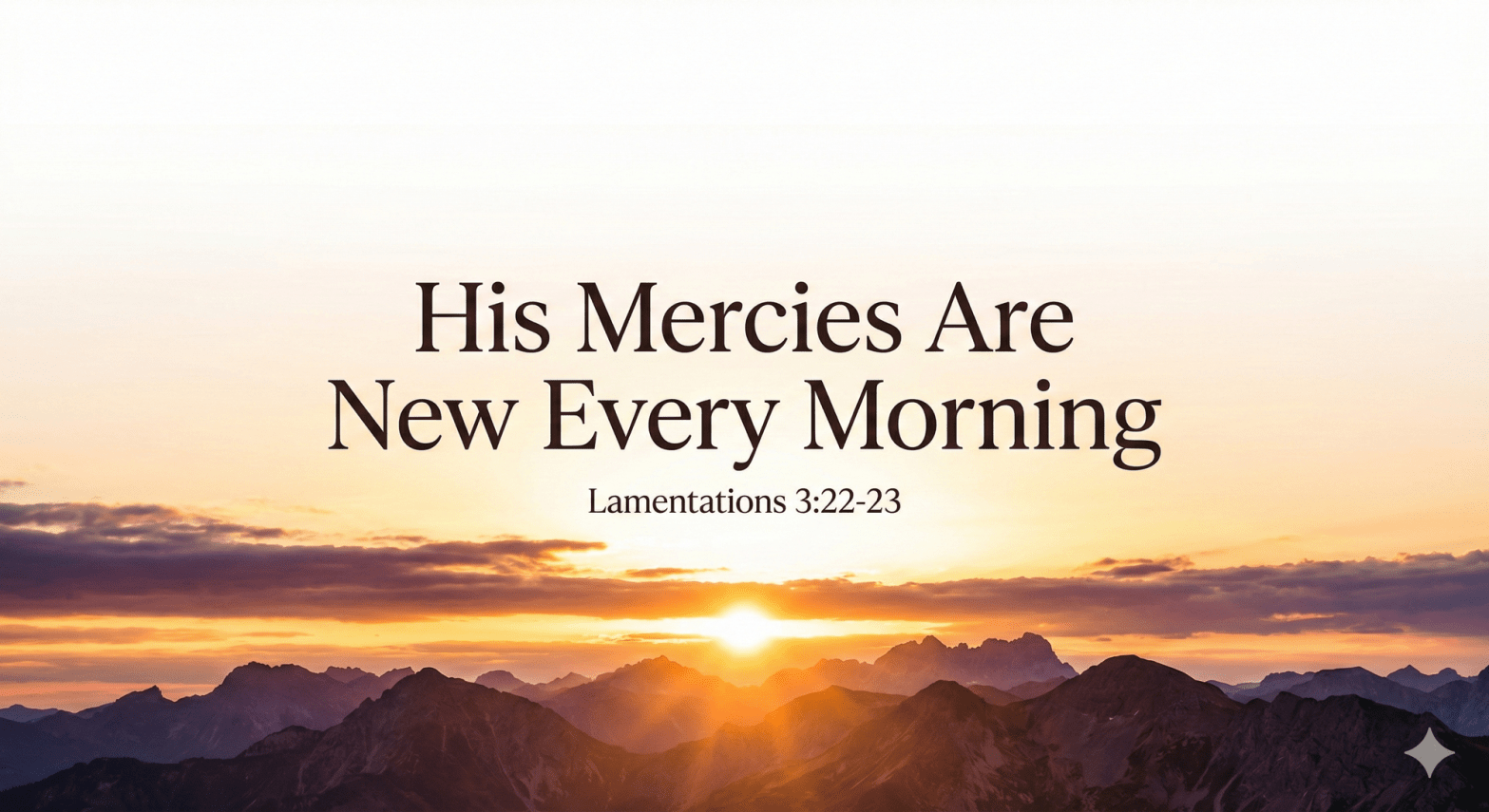
“His Mercies Are New Every Morning”
(Lamentations 3:22–23)
A Note to Begin the Morning
The Wake-Up Calls on Rise&Inspire are a daily rhythm of faith—listening, reflecting, and responding to God’s Word each morning. Today, the customary Verse for the Day has not yet reached us. Rather than allowing this day to pass without reflection, I have prayerfully returned to the Wake-Up Call archives.
God’s Word does not belong only to the day it was first written or shared. What once awakened our hearts continues to speak with living power. Today’s Wake-Up Call is therefore a graceful weaving of earlier reflections, offered anew for this morning—so that the chain of prayer, hope, and trust remains unbroken.
Featured Reflection
“His Mercies Are New Every Morning”
“Because of the LORD’s great love we are not consumed, for his compassions never fail. They are new every morning; great is your faithfulness.”
(Lamentations 3:22–23, NIV)
This morning, as the sixteenth day of 2026 unfolds before us, we take a moment to consider one of the most tender and hopeful declarations in all of Scripture. These words from Lamentations were written not in a palace or temple, but amid the ruins of Jerusalem—a city destroyed, a people scattered, a prophet overwhelmed by grief. Yet from the depths of sorrow, Jeremiah lifts his eyes and remembers something unshakable: the steadfast love of the Lord.
It is remarkable that such words of hope arise from such a place of pain. Lamentations is a book of mourning, and yet here, in the very heart of it, we find this radiant confession of faith. It reminds us that God’s mercies are not contingent upon our circumstances. They do not arrive only when life is smooth or when we feel deserving. They come to us in the rubble, in the waiting, in the weariness of another ordinary Thursday morning. They come because of who God is, not because of who we are.
“Because of the LORD’s great love we are not consumed.” What a staggering truth. We are held, not by our own strength or goodness, but by the great love of God. This love is not passive or distant. It is active, protective, sustaining. It stands between us and the forces that would undo us—our guilt, our failures, our fears, the weight of a world that often feels too heavy to bear. We are not consumed because God’s love refuses to let us go.
And then comes that beautiful promise: “His compassions never fail. They are new every morning.” Every morning. Not once a year, not on special occasions, but with the rising of the sun. Each dawn is an invitation to begin again, to receive afresh what we could never earn or manufacture on our own. God’s compassions are not rationed or recycled. They do not grow stale or run thin. They are new—fresh, living, sufficient for this day.
Perhaps you woke this morning carrying yesterday’s regrets. Perhaps you are anxious about what lies ahead, or weary from battles that seem endless. The grace of this verse is that it meets you exactly where you are. You do not have to clean yourself up first. You do not have to pretend that everything is fine. God’s mercies are new this morning for you, just as you are.
This is the sixteenth reflection in our 2026 series of Wake-Up Calls, and already we have learned that faithfulness is not about perfection—it is about returning. Sixteen mornings, sixteen opportunities to receive what God freely gives. Some mornings we come with joy, others with doubt. Some with clarity, others with confusion. But every morning, His mercies are waiting.
“Great is your faithfulness.” This is not merely a statement about God’s character; it is an anchor for the soul. When we are faithless, He remains faithful. When we forget, He remembers. When we falter, He holds firm. His faithfulness is not dependent on ours. It is the bedrock beneath our unsteady feet, the constant in a world of change.
So what does it mean to live in light of this truth? It means we can face this day without the crushing weight of having to be enough on our own. It means we can confess our need without shame, knowing that God’s response is not condemnation but compassion. It means we can extend grace to others because we have received it so generously ourselves. And it means that no matter how many times we stumble, we can rise again, because His mercies are new every morning.
As you step into this sixteenth day of the year, take a moment to receive what God is offering. His love. His compassion. His faithfulness. They are yours, not because you have earned them, but because He is good. Let this truth settle into the deepest parts of your heart. Let it shape the way you see yourself, the way you see this day, the way you see the road ahead.
The steadfast love of the Lord never ceases. His mercies never come to an end. They are new every morning. And today, they are new for you.
Prayer for the Morning
Faithful God, we thank You that Your love does not depend on our performance or our feelings. Thank You that every morning brings a fresh supply of mercy, grace enough for whatever this day holds. Help us to receive what You freely give. Help us to walk in the confidence that we are held, not by our own strength, but by Your great love. May we extend to others the same compassion we have received from You. In the name of Jesus, who is Your mercy made flesh, we pray. Amen.
This is the 16th reflection on Rise&Inspire in 2026 under the category/series: Wake-Up Calls
I don’t have one favorite animal anymore — I have seasons.
This is what I’ve learned: the most revealing questions are the ones that come back. They don’t test our memory—they trace our growth.
A Three-Year Reflection Arc
Horse → Jellyfish → Now
Looking back, I realise I didn’t just answer the same WordPress prompt three times.
I unknowingly documented three inner seasons of life.
2024 — The Horse
That year, the horse spoke to me.
Strength. Freedom. Forward motion.
It reflected a season of momentum—of pushing ahead, carrying responsibility, believing that progress came through discipline and endurance. Life felt like something to ride forward, even when it was demanding.
2025 — The Jellyfish
A year later, the answer changed completely.
The jellyfish emerged—not powerful, not forceful, but astonishingly resilient.
It survived by yielding, not resisting. That reflection came from a quieter season, one that taught me that not all strength looks strong, and not all movement needs direction.
2026 — Now
Today, I don’t feel drawn to a single animal.
Because life has taught me this:
growth is not about replacing one truth with another, but holding both.
There are moments that call for the horse—steadiness, courage, resolve.
And moments that require the jellyfish—softness, surrender, trust in the current.
Now is the season of integration.
I no longer ask, “What is my favourite animal?”
I ask, “What part of me is being invited forward today?”
One-Line Takeaway
The question may return each year, but the person answering it never does.
My Earlier Reflections on This Prompt
If you’d like to see how this question spoke to me in earlier seasons, here are the previous reflections — best read as chapters, not duplicates:
How one repeated question captured three seasons of life
The author reflects on three years of answering the same question and realises that growth is revealed not by new answers, but by deeper self-understanding. Each response marks a different life season—strength and drive, quiet resilience, and finally integration—showing that growth weaves past truths together rather than replacing them.
What if the most important thing about your prayer is not whether it gets answered the way you want, but whether you believe you are heard? In the rubble of a destroyed city, a prophet discovered something that would sustain him through unimaginable suffering. It was not a quick fix or an easy answer. It was the unshakable assurance that God’s ear remains open, even when everything else has fallen silent. This changes everything about how we pray, how we wait, and how we endure.
Before you try to pray better, pray more eloquently, or find the right words to move heaven, you need to know this: God is already listening. Right now. To the cry you cannot articulate. To the pain you have not named. To the desperate plea forming in the depths of your soul. The prophet Jeremiah learned this truth in his darkest hour, and it became the anchor that held him when everything else gave way.
There is a moment between crying out and receiving an answer that most of us dread. We call it waiting. We call it silence. We call it unanswered prayer. But what if that space holds something more sacred than we realise? What if being heard by God matters more than we ever imagined, even before the relief comes? One ancient prayer from the ruins of Jerusalem reveals why this changes everything.
Your worst prayers might be your most powerful ones. Not the polished, Sunday-morning kind. Not the ones you rehearse or refine. The raw ones. The desperate ones. The prayers that are more groan than grammar. Jeremiah prayed one of those prayers from the wreckage of his world, and what he discovered about God’s listening ear has sustained believers through centuries of suffering.
What does it take for God to close His ear to your prayers? The wrong words? Too much repetition? Not enough faith? Sins you have not confessed? Jeremiah asked God not to close His ear, as if it were even possible. What he discovered in that vulnerable moment of pleading transforms how we understand prayer, suffering, and the character of God Himself.
I’ve written a pastoral biblical reflection on Lamentations 3:56 for you.
The reflection explores themes of crying out to God, divine attentiveness, honest prayer, and the faith that sustains us between petition and answer. It speaks with pastoral warmth to both those who suffer and those who minister to the suffering.
Daily Biblical Reflection
Verse for Today (15th January 2026) is
Forwarded this morning by His Excellency, Rt. Rev. Dr. Selvister Ponnumuthan, upon whom Johnbritto Kurusumuthu wrote reflections.
You heard my plea, “Do not close your ear to my cry for help, but give me relief!”
Lamentations 3:56
Today the 15th day of 2026
This is the 15th reflection on Rise&Inspire in 2026 under the category/series: Wake-up calls
When We Cry Out:
The Divine Ear That Never Closes
There is something deeply human about crying out in distress. In our moments of deepest anguish, when words fail and reasoning crumbles, we discover within ourselves a primal need to be heard. The prophet Jeremiah, writing from the ruins of Jerusalem, gives voice to this universal experience. His words in Lamentations 3:56 are not merely poetic; they are the raw testimony of a soul that has touched the depths of suffering and found God present even there.
“You heard my plea.” These opening words carry the weight of answered prayer, not necessarily in the way we might expect, but in the most fundamental way possible: God listened. Before solutions come, before circumstances change, before relief arrives, there is this sacred moment of being heard. In a world where so many voices go unnoticed, where pain is often dismissed or minimised, the assurance that the Creator of the universe inclines His ear toward us transforms everything.
Notice the intimacy of Jeremiah’s appeal: “Do not close your ear to my cry for help.” This is not formal, religious language. This is the desperate plea of someone who needs God to stay present, to remain engaged, not to turn away. It reminds us that authentic prayer is not about eloquence or proper theology; it is about an honest relationship. God does not require us to clean ourselves up, to have our doctrine perfectly aligned, or to present our case with calm composure before He will listen. He welcomes our cries, our confusion, our desperation.
The phrase “cry for help” in Hebrew carries connotations of breathing heavily, of sighing, of the kind of deep groaning that comes from the very core of our being. Sometimes our prayers are not carefully crafted sentences but wordless groans, tears that fall in the quiet, sighs too deep for articulation. The beautiful truth is that God hears these too. In fact, Scripture elsewhere tells us that the Spirit intercedes for us with groanings too deep for words. We are never beyond the reach of God’s attentive ear, even when we cannot find the words to express what we feel.
Then comes the request: “but give me relief!” Jeremiah is not asking for mere emotional comfort or spiritual platitudes. He is asking for tangible relief from real suffering. This teaches us that it is not only acceptable but right to bring our practical needs before God. We do not have to spiritualize our pain or pretend that our struggles are less real than they are. God cares about our actual circumstances, our physical well-being, our emotional health, and our relational struggles. He invites us to ask for relief.
Yet embedded in this verse is a profound act of faith. Jeremiah speaks these words in the past tense: “You heard my plea.” Even before the relief has fully come, he declares that God has heard. This is the faith that sustains us in the waiting, in the space between crying out and seeing change. We may not yet have the answer we seek, but we have something even more foundational: we have been heard by the One who holds all things in His hands.
For those of us walking through valleys of difficulty today, this verse offers a wake-up call of a different kind. It awakens us not to productivity or achievement, but to the reality of God’s attentive presence. In a culture that often measures worth by output and success, we are reminded that simply being heard, simply being known, simply being loved by God is enough. Our cries matter. Our pain is valid. Our pleas reach the throne of heaven.
This is also a word for those who minister to others in their pain. We are called to have ears like God’s ears, ears that do not close, ears that remain open even when the cries are repetitive, even when solutions are not immediately apparent, even when the suffering is uncomfortable to witness. To truly hear another person’s pain without rushing to fix it, without offering cheap comfort, without turning away is to participate in the very character of God.
As we begin this 15th day of 2026, let us take comfort in knowing that we serve a God who hears. Whatever your cry might be today, whether it is whispered in secret or shouted in frustration, whether it is articulate or wordless, whether it is your first plea or your thousandth, God’s ear is not closed to you. He hears. He remains present. And in His perfect time and His perfect way, He brings the relief we need, which is often deeper and more complete than the relief we first imagined.
May we have the courage to cry out honestly, the faith to believe we are heard, and the patience to trust in God’s timing for our relief.
When the Cry Has No Answer:
Learning to Pray with the Psalms of Lament
Jeremiah’s cry in Lamentations 3:56 does not stand alone in Scripture. It belongs to a much larger chorus of voices—voices that dared to speak honestly to God when life hurt deeply. These voices are gathered for us in what Scripture calls the Psalms of Lament.
Lament psalms form the largest single category in the Psalms, making up nearly one-third of the entire book. Their sheer number tells us something important: God expected His people to suffer, and He provided them with words for those moments when praise felt impossible.
These psalms are not polished prayers. They are raw, unfiltered cries—born out of illness, injustice, betrayal, guilt, national disaster, and the terrifying feeling that God has gone silent. And yet, they are prayers of faith. To lament is not to abandon God; it is to cling to Him when nothing else makes sense.
How Lament Teaches Us to Pray When Heaven Feels Silent
Most laments follow a gentle but honest movement:
• A direct cry to God: “O Lord… How long?”
• A description of the pain, without minimising it
• A plea for help or deliverance
• A remembering of who God is and what He has done
• Often, a quiet shift toward trust—even before circumstances change
Not every lament resolves neatly. Psalm 88, for example, ends in darkness without a clear word of hope. Scripture leaves it there on purpose. This teaches us that faith does not always mean feeling better; sometimes it means staying in conversation with God when nothing improves yet.
Jeremiah’s prayer echoes this same faith. When he says, “You heard my plea,” he is not celebrating an immediate rescue. He is resting in something more basic and more sustaining: God listened.
The Courage of Honest Prayer
The Psalms of Lament permit us to bring to God what we are often tempted to hide:
• anger without pretending
• doubt without shame
• grief without rushing to resolve it
• questions without quick answers
In Psalms 13, the psalmist asks, “How long, O Lord? Will you forget me forever?”
In Psalms 22, the cry is even more severe: “My God, my God, why have you forsaken me?”—words later taken on the lips of Jesus Himself.
This tells us something profound: God does not close His ear because our prayers are messy. He listens precisely because they are real.
Why Lament Matters for Today
In a culture that prizes positivity, productivity, and quick solutions, lament feels uncomfortable. We would rather move quickly to encouragement or explanations. But Scripture invites us to stay a little longer in the sacred space between crying out and receiving relief.
Jeremiah teaches us this. The psalmists teach us this. And together they remind us that:
✔️ Being heard by God is not a consolation prize—it is a gift in itself
✔️ Silence is not absence
✔️ Waiting is not wasted when it is held before God
Lament trains us to believe that God’s ear remains open, even when His hand seems still.
A Gentle Invitation
If you find yourself unable to pray today, consider borrowing the prayers God has already given you. Read a lament psalm slowly. Let its words become your own. Do not rush to the ending. Sit with the cry. Sit with the ache. Trust that the same God who heard Jeremiah in the ruins of Jerusalem hears you now.
Because before relief comes, before clarity dawns, before circumstances change, this truth remains:
You are heard.
And sometimes, that is what sustains us until morning comes.
I communicate online the same way I communicate anywhere—with intention. The platforms are familiar: email, messaging apps, social media, video calls. But I’ve stopped treating them as separate from real communication. I focus less on which tool I’m using and more on whether I’m showing up authentically. Every message is a choice about connection. Every reply matters. The medium has become secondary to the meaning behind it.
When a prompt shows up three years in a row, you have two choices: dismiss it as redundant or treat it as a mirror. I chose the mirror. What I saw surprised me. My digital communication has evolved in ways that have nothing to do with technology and everything to do with intention.
The Evolution of How I Communicate Online:
A Third Look at a Familiar Prompt
When WordPress serves up the same prompt for the third year in a row, it’s either a glitch in the matrix or an invitation to measure growth. Today’s question—“In what ways do you communicate online?”—has become an unexpected annual tradition, and I’m choosing to embrace it.
Looking back at my previous responses to this prompt, I can see how my digital communication patterns have shifted, not necessarily in the tools I use, but in the intention behind them.
Then: The Tools I Used
In 2024, I catalogued my digital toolkit: emails for formality, WhatsApp for immediacy, social media for broadcasting, and video calls for presence. I approached the question literally, creating an inventory of platforms and their purposes in my life.
Last Year: The Impression I Made
By 2025, I’d matured in my thinking. I began questioning what my communication style revealed about me—whether my emoji usage made me seem less professional, whether my response times signalled availability or anxiety, whether my carefully curated posts reflected authenticity or performance.
Now: The Connection I Seek
Today, I realise that the ways I communicate online have become less about the medium and more about the meaning. I’ve stopped treating digital communication as a separate category of interaction and started seeing it as simply communication—with all its complexities, vulnerabilities, and possibilities for genuine connection.
I’ve learned that a thoughtful voice note can carry more warmth than a perfectly punctuated email. That showing up consistently in someone’s comments section can build friendship just as effectively as coffee shop conversations. That turning off read receipts isn’t about being evasive—it’s about creating breathing room in a world that demands constant availability.
The real evolution isn’t in switching from Slack to Discord or from Facebook to Instagram. It’s in recognising that every message, every reply, every reaction is a choice about the kind of presence I want to have in other people’s lives.
What Hasn’t Changed
Despite three years of reflection, one truth remains constant: online communication is still communication. It still requires empathy, clarity, respect, and sometimes, the courage to misunderstand and be misunderstood. The screen between us doesn’t diminish our responsibility to show up as whole, thoughtful human beings.
The Question I’m Asking Now
So as I encounter this prompt for the third time, I’m asking myself something new: Am I communicating online in ways that honour both my needs and the humanity of the people on the other side of the screen?
Because ultimately, that’s what matters—not which platform I’m using, but whether I’m using any of them to build bridges instead of walls.
For those curious about my journey with this question, here’s where I’ve been before:
Perhaps next January 14th, WordPress will surprise me with something new. Or perhaps I’ll be ready to explore this question from yet another angle, discovering something about myself I hadn’t noticed before.
After all, the best prompts aren’t the ones we answer once and move on from—they’re the ones we return to, again and again, finding different truths each time.
Job spoke some of the most counterintuitive words in human history on the worst day of his life. While his world collapsed around him, children gone, wealth vanished, health destroyed, he made a declaration that still challenges our deepest assumptions about faith, possession, and the nature of blessing. Job 1:21 is not a verse for the faint of heart. It dismantles our illusions of control and invites us into a radically different way of living. This is faith stripped bare, worship without pretense, trust without conditions.
I’ve written a pastoral reflection on Job 1:21 that explores themes of stewardship, faith in suffering, and the radical trust Job demonstrated.
The reflection emphasises Job’s counter-cultural wisdom about possessions and security, the context of his faith amid devastating loss, and practical applications for contemporary readers who measure life by accumulation. It maintains a warm, pastoral tone while offering deep spiritual insights suitable for daily devotional reading.
Daily Biblical Reflection
Verse for Today (14th January 2026)
Today’s Scripture comes with the blessings of His Excellency, Rt. Rev. Dr. Selvister Ponnumuthan, and thoughtful reflections by Johnbritto Kurusumuthu.
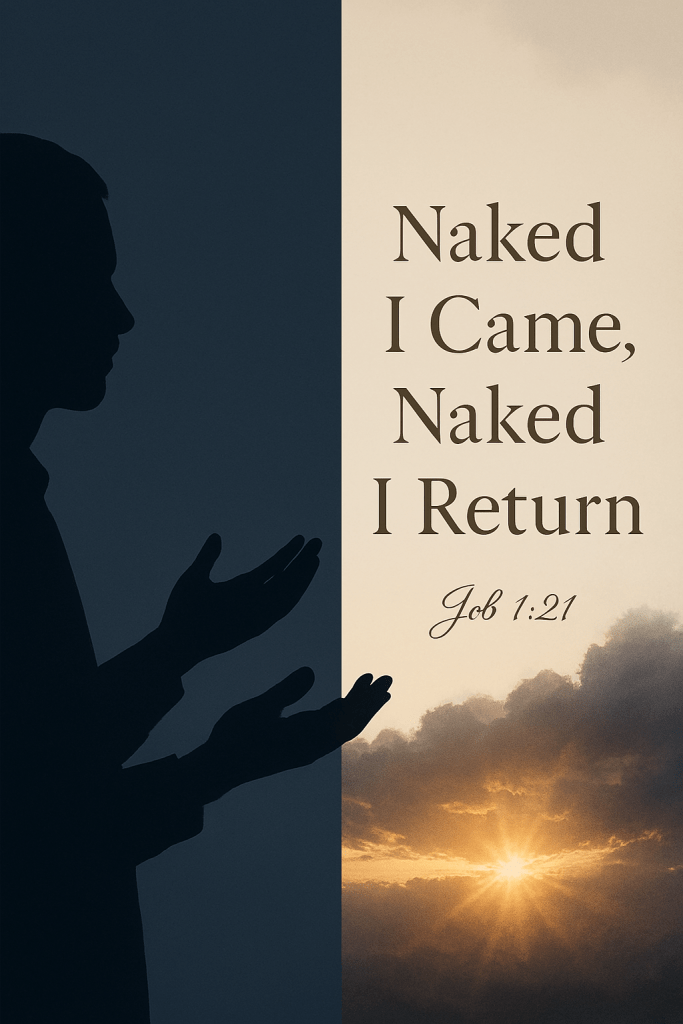
“Naked I came from my mother’s womb, and naked shall I return there; the Lord gave, and the Lord has taken away; blessed be the name of the Lord.”
Job 1:21
Today the 14th day of 2026
This is the 14th reflection on Rise&Inspire in 2026 under the category/series: Wake-up calls
Reflection
Dear friends in Christ,
Job’s words echo across the centuries with a wisdom that pierces through our modern illusions of control and permanence. In a single breath of faith, this ancient patriarch captures a profound truth that our consumer-driven culture desperately needs to hear: we are not owners, but stewards. We are not possessors, but pilgrims.
When Job speaks of coming naked from his mother’s womb and returning naked, he reminds us of the great equaliser that transcends wealth, status, and achievement. The hospital delivery room and the funeral home tell the same story, whether we arrive in luxury or simplicity. Between these two moments of nakedness lies the gift of life itself, not as our possession to hoard, but as God’s trust to steward.
What makes Job’s declaration extraordinary is not merely his theological insight, but the context in which he speaks it. These words emerge not from a comfortable study or a peaceful garden, but from the ruins of unimaginable loss. In a single devastating day, Job lost his children, his livelihood, his health, and his social standing. Yet in the midst of this catastrophic grief, he chose worship over bitterness, trust over accusation.
“The Lord gave, and the Lord has taken away; blessed be the name of the Lord.” This is not resignation or passive fatalism.This is radical faith, the kind that recognises God’s sovereignty even when life makes no sense, the kind that blesses God’s name not only in seasons of abundance but also in valleys of loss.
We live in an age that teaches us to measure life by accumulation. Success is defined by what we acquire, display, and protect. Security is found in bank accounts and insurance policies. Identity is constructed from achievements and possessions. Job’s words confront this entire worldview with liberating force. If we came with nothing and will leave with nothing, then perhaps our true wealth lies elsewhere, in relationships nurtured, in love shared, in faith deepened, in character formed.
This reflection is a wake-up call for our times. How tightly are we grasping what was only ever meant to be held loosely? What would it look like to live each day with open hands, recognising that everything is a gift, everything is grace? Job’s faith invites us to examine whether we serve God for his blessings or for himself. Do we worship the Giver or merely the gifts?
The beauty of Job’s testimony is that it doesn’t ask us to pretend loss doesn’t hurt or that grief isn’t real. Job wept, Job mourned, Job questioned. But underneath the pain, there remained a bedrock conviction that God is good, that God is sovereign, and that God’s name deserves blessing even when life delivers blows we cannot understand.
As we begin this day, let us carry Job’s wisdom with us. Let us hold our blessings with gratitude and humility, knowing they are entrusted to us for a season. Let us love people more than possessions, eternal values more than temporary comforts. And let us cultivate a faith so deep that even in life’s darkest chapters, we can still say with Job, “Blessed be the name of the Lord.”
May this wake-up call resound in our hearts today. We are pilgrims, not settlers. We are stewards, not owners. We are blessed not by what we accumulate, but by whom we worship. Naked we came, and naked we shall return, but in between, we have the privilege of knowing and serving the God who gives, who takes away, and who remains forever worthy of our praise.
In Christ’s love,
Johnbritto Kurusumuthu
Deepening the Reflection on Job
Faith That Cries: Job’s Journey from Trust to Lament and Back
One of the most comforting truths in Scripture is this: God allows His people to speak honestly to Him—even when faith is hurting. Few biblical books demonstrate this reality more powerfully than the Book of Job.
Job’s story begins with words that generations of believers have repeated in moments of loss:
“The Lord gave, and the Lord has taken away; blessed be the name of the Lord.” (Job 1:21)
This declaration stands as a remarkable expression of trust and submission. Yet the book does not freeze Job at this moment. As suffering continues—unexplained, prolonged, and intensified by misunderstanding friends—Job’s voice changes. Scripture allows us to hear not only his praise, but also his pain.
From Submission to Sorrow
After the initial shock of disaster, Job enters a long season of lament. In chapters 6–7, he describes his anguish as heavier than the sands of the sea. His words grow sharp, emotional, and unfiltered:
“Therefore I will not keep silent; I will speak out in the anguish of my spirit.” (Job 7:11)
Job refuses to pretend that faith makes pain disappear. Instead, he brings his bitterness directly to God. This honesty is not condemned in Scripture—it is preserved.
Crushed by God’s Greatness
In chapters 9–10, Job acknowledges God’s unmatched power and sovereignty. Yet this very greatness terrifies him. How can a fragile human argue his case before such a Judge?
“He would not let me catch my breath but would overwhelm me with misery.” (Job 9:18)
Job does not deny God’s authority. He despairs of being heard. His struggle reflects a tension many believers feel: trusting God’s power while fearing His silence.
Faith Under Fire
As the dialogues progress (chapters 16–17), Job’s suffering deepens. His friends—convinced that suffering must equal guilt—become a source of pain rather than comfort. Job calls them “miserable comforters” and dares to describe God as an enemy who has torn him apart.
“My spirit is broken, my days are cut short, the grave awaits me.” (Job 17:1)
These are not tidy prayers. They are desperate cries from the edge of death.
Hope That Refuses to Die
Then, in chapter 19, something astonishing breaks through the darkness. Abandoned by family and friends, Job makes one of Scripture’s most famous declarations:
“I know that my redeemer lives, and that in the end he will stand on the earth.” (Job 19:25)
This is not cheerful optimism. It is defiant hope—faith clinging to God even while accusing Him. Job believes that somehow, beyond death itself, he will be vindicated.
A Demand for God—and a Divine Answer
In his final speeches (chapters 29–31), Job looks back on former blessing, contrasts it with present humiliation, and formally swears an oath of innocence. He does not ask for escape; he demands an answer.
God responds—but not with explanations.
From the whirlwind (chapters 38–41), God reveals His wisdom, power, and governance of creation. Job encounters not reasons, but revelation. The result is humility and awe:
“Surely I spoke of things I did not understand, things too wonderful for me to know.” (Job 42:3)
Job repents—not for lamenting, but for assuming understanding beyond human limits.
Why Job Still Matters
At the end of the book, God delivers a surprising verdict:
“You have not spoken the truth about me, as my servant Job has.” (Job 42:7)
God rebukes Job’s friends—not Job. This alone teaches us something vital:
Faith does not require stoic silence in suffering.
Scripture validates honest lament, painful questions, and tears poured out before God.
Job’s journey reminds us that faith is not the absence of struggle, but persistence through it—a refusal to let go of God, even when God feels distant.
In suffering, we are not called to pretend.
We are invited to speak—and to trust that God is still listening.
🔑 Key Takeaway
God is not offended by honest lament. He is offended by false explanations that misrepresent His heart.
When Job’s Cry Becomes Our Prayer: The Psalms of Lament
Job’s anguished words are not an isolated witness in Scripture. His cries echo a much larger, sacred tradition: the Psalms of Lament—the largest category in the Book of Psalms.
Scholars estimate that roughly one-third to nearly half of the 150 psalms (about 50–65, depending on classification) are laments. These are not theological treatises but raw prayers—born from grief, confusion, injustice, fear, guilt, and waiting. Like Job, the psalmists refuse to suppress pain. Instead, they bring it boldly into God’s presence.
Job and the Psalms: Different Forms, the Same Faith
Job’s laments unfold as extended dialogues amid personal catastrophe—spoken from the ashes, contested by friends, and pressed toward a courtroom encounter with God. The Psalms of Lament, by contrast, are poetic prayers shaped for personal devotion and communal worship.
Yet the heart is the same:
• Pain addressed to God, not away from Him
• Questions asked in faith, not unbelief
• Hope pursued without denying sorrow
Together, Job and the Psalms teach us that lament is not faith’s failure—it is faith’s language in suffering.
Two Main Types of Lament Psalms
Individual Laments
Personal cries from one person facing illness, enemies, abandonment, guilt, or God’s perceived absence. These are the most common and mirror Job’s solitary anguish.
Communal (Corporate) Laments
Prayers offered on behalf of a people—during national crisis, exile, oppression, or collective sin—showing that suffering can be shared and voiced together before God.
The Shape of Biblical Lament
Though emotionally unrestrained, lament psalms often follow a recognizable movement (not always neatly or completely):
1. Address – A direct appeal (“O Lord,” “My God”)
2. Complaint – Honest naming of pain and injustice
3. Petition – A bold plea for God to act
4. Affirmation of Trust – A turn toward God’s character (“But…”)
5. Vow of Praise – Anticipated or promised worship
This movement keeps lament from collapsing into despair. Pain is spoken—but hope is not abandoned.
Voices of Lament: Representative Psalms
Individual Laments
Psalm 13 – The Cry of Waiting
“How long, Lord? Will you forget me forever?” (v. 1)
Yet it ends with:
“But I trust in your unfailing love… I will sing the Lord’s praise.” (vv. 5–6)
Psalm 22 – The Cry from the Cross
“My God, my God, why have you forsaken me?” (v. 1)
The psalm moves from abandonment to worldwide praise (vv. 22–31).
Jesus Himself prayed this psalm in His darkest hour.
Psalms 42–43 – The Cry of the Downcast Soul
“My tears have been my food day and night…” (42:3)
“Why, my soul, are you downcast?” (42:5)
Yet the refrain insists:
“Put your hope in God.”
Psalm 6 – The Cry of Bodily and Emotional Pain
“My soul is in deep anguish. How long, Lord, how long?” (v. 3)
Psalm 130 – The Cry from the Depths
“Out of the depths I cry to you, Lord…” (v. 1)
“But with you there is forgiveness.” (v. 4)
Some laments—like Psalm 88—end without resolution, reminding us that Scripture does not force emotional closure where life has not yet provided it.
Communal Laments
Psalm 44 – Suffering Despite Faithfulness
“For your sake we face death all day long…” (v. 22)
Psalm 74 – Lament over Sacred Ruin
“Why have you rejected us forever, O God?” (v. 1)
These prayers gave voice to national trauma, teaching Israel—and us—how to suffer together before God.
Why Lament Still Matters
Just as Job’s journey moved from trust → protest → awe, the Psalms of Lament show that God welcomes honest prayer. They remind us:
• Suffering is real—and speakable to God
• Lament is an act of faith, not rebellion
• God hears, even when He seems silent
• Faith often says, “Why?” before it says, “I will praise”
When words fail, these psalms lend us their voice.
A Simple Practice
If you are walking through grief or confusion, try praying Psalm 13 or Psalm 42 aloud.
Make the complaint your own.
Then linger—without rushing—where the psalm turns toward trust.
Like Job, you may not receive explanations.
But you will encounter the God who listens.
🔑 Companion Takeaway
Faith that cries out is still faith.
From Job’s ashes to Israel’s hymns, Scripture assures us that God meets His people not only in praise—but in lament.
A Closing Prayer: Faith That Cries and Trusts
O Lord, our God,
You are the One who gives, and the One who takes away—
yet You remain worthy of blessing, even when our hearts are breaking.
Like Job, we come before You with questions we cannot silence,
with pain we cannot explain,
with suffering that feels heavier than the sands of the sea.
We confess that there are days when we do not understand Your ways,
when Your presence feels distant,
and when our words are shaped more by tears than by certainty.
Hear our lament, O God.
You have taught us through the psalms that crying out is not faithlessness,
that complaint can still be prayer,
and that honest sorrow is not rejected in Your courts.
How long, O Lord?
Why do You seem hidden when we need You most?
Out of the depths we cry to You—
from confusion, grief, fear, and weariness of soul.
Yet even here, we choose to trust.
We remember Your faithfulness in the past.
We cling to Your steadfast love in the present.
We hold fast to hope for the future.
Like Job, we place our case before You—
not demanding answers,
but longing for You.
Teach us to rest in Your wisdom when explanations fail.
My most memorable road trip was the trek to Agasthyarkoodam. What makes it unforgettable isn’t just reaching the summit—it’s that the journey never ended. A decade later, it still teaches me new lessons each year about resilience, growth, and what I’m capable of. The best journeys keep traveling with you long after you come home.
When WordPress served up the same writing prompt for the third consecutive year, I almost rolled my eyes. Another essay about my most memorable road trip? Haven’t I exhausted this topic already? But then something shifted. I realised I wasn’t looking at a repeat assignment. I was looking at proof that the best journeys never really end. They just keep teaching us new things.
The Road Trip That Keeps Teaching Me:
A Third Look at Agasthyarkoodam
It’s January 13th again, and WordPress has served up the same prompt for the third time: “Think back on your most memorable road trip.”
I could feel a flicker of frustration—haven’t I already said everything there is to say about my trek to Agasthyarkoodam? I wrote about it in 2024, reflecting on the raw adventure itself. Then in 2025, I explored what lessons that decade-old journey could teach us today. And now here we are in 2026, staring at the same question once more.
But maybe that’s the point.
Some experiences don’t just happen once. They echo. They ripen. They mean different things as we ourselves change.
When I first wrote about that trek through the dense forests of the Western Ghats, I focused on the physical challenge: the steep climbs, the leeches, the moments of doubt when my legs screamed to turn back. It was a story of endurance, of pushing through discomfort to reach the summit of one of South India’s most sacred peaks.
A year later, I revisited it through a different lens. What could a journey from a decade ago teach us in 2025? I found answers in resilience, in the value of preparation, in the quiet wisdom that comes from nature when we’re willing to listen. The trek became a metaphor for navigating life’s uncertainties.
And now, in 2026, I realise something else: the most memorable journeys aren’t the ones we finish and file away. They’re the ones that keep traveling with us.
That road trip—or mountain trek, more accurately—hasn’t ended. It lives in the way I approach challenges now. It surfaces when I need to remind myself that discomfort is temporary but growth is lasting. It whispers to me on days when I’m tempted to take the easier path: remember what you’re capable of.
Perhaps what makes it so memorable isn’t just what happened on those trails. It’s what keeps happening because of them.
So yes, this is my third time writing about the same prompt, the same adventure. But it’s not the same essay. It can’t be. Because I’m not the same person who climbed that peak, nor am I the same writer who first put those memories into words.
And maybe that’s the real lesson of any memorable road trip: the journey doesn’t end when you come home. The best ones keep unfolding, revealing new meaning with each year that passes, each January 13th that rolls around.
If you’d like to see how my perspective has evolved, here are my previous reflections on this same unforgettable adventure:
What about you? Is there a journey that keeps teaching you new things years after you took it? I’d love to hear about it in the comments.
For the Trekking Guidelines Section
The Kerala Forest Department has issued the official guidelines for the Agasthyarkoodam trekking season for 2026.
The trekking season will be held from January 14 to February 11, 2026. The total trekking fee has been fixed at ₹3,000 per person, comprising a trekking charge of ₹2,420 and an eco-tourism and management fee of ₹580.
As part of the eligibility criteria, trekkers must produce a valid medical fitness certificate issued by a registered medical practitioner. The certificate must be obtained within seven days prior to the date of the trek; without it, participation will not be permitted.
The guidelines also specify a phased online booking system to regulate registrations efficiently. Online bookings will be opened on the Forest Department’s official website in two stages, aligned with the trekking schedule:
👣 Bookings for treks scheduled between January 14 and January 31 will open during the first week of the month.
👣 Bookings for treks scheduled between February 1 and February 11 will open towards the end of the third week of January.
These measures are intended to ensure trekker safety, effective crowd management, and sustainable eco-tourism practices during the trekking season.
For official updates, guidelines, and online registration, visit the Kerala Forest Department website:
The Kerala Forest Department is the state government agency responsible for managing and conserving forests, wildlife, and biodiversity in Kerala. Operating under the Government of Kerala, it oversees forest protection, sustainable resource use, and eco-development across one of India’s most biologically diverse regions.
The department’s origins trace back to the late 19th century under the princely states of Travancore and Cochin, later unified after Kerala’s formation in 1956. It is headed by the Principal Chief Conservator of Forests (Head of Forest Force) and organised into territorial, wildlife, and social forestry wings to address distinct management needs.
Functions and responsibilities
Kerala Forest Department manages around 29% of the state’s land area, including protected areas such as Periyar Tiger Reserve, Silent Valley National Park, and Wayanad Wildlife Sanctuary. Its core activities include forest protection, biodiversity conservation, wildlife management, eco-tourism, afforestation, and community-based forest governance through participatory schemes like Vana Samrakshana Samithis.
Conservation initiatives
The department plays a pivotal role in Kerala’s climate resilience efforts and habitat restoration projects. It implements national programs such as Project Tiger and Project Elephant and collaborates with local communities for human-wildlife conflict mitigation, eco-restoration, and livelihood support through eco-tourism and non-timber forest produce initiatives.
Research and education
It operates institutions like the Kerala Forest Research Institute and the Kerala Forest School, supporting scientific research, training, and forest officer capacity building. Educational outreach focuses on conservation awareness and sustainable resource management across Kerala’s diverse ecosystems.